
IEE/ITE Mallorca Obligation: What Buyers and Owners Need to Know
Anyone buying or already owning an older property on Mallorca cannot avoid the subject of IEE/ITE Mallorca obligation. The Informe de Evaluación de Edificios (IEE) is the direct successor to the former Inspección Técnica de Edificios (ITE) and has been mandatory island-wide since the Balearic urban planning law (LUIB, Ley 12/2017) came into force. Unlike its predecessor, the IEE is not limited to structural integrity and building fabric, but additionally covers accessibility and energy efficiency. In this guide you will learn which buildings must be inspected and when, what four sections the surveyor's report comprises, what happens when deficiencies are found, what the whole thing costs — and why the IEE is a deal-defining due-diligence item when purchasing an older finca, flat or town villa.

Are you currently buying a property that is more than 30 years old — and you don't know whether a valid IEE exists?
- 📩 Submit a personal enquiry — We will check the document status and recommend an approved surveyor
- Everything about the property purchase process on Mallorca
ITE and IEE: What do the abbreviations actually mean?
The term ITE is still widely used in Germany and on Mallorca alike — in listings, in conversations with owners, in older purchase contracts. Legally, however, it is no longer valid in the Balearic Islands. The Inspección Técnica de Edificios has been replaced in current legislation by the more comprehensive Informe de Evaluación de Edificios (IEE).
The essential difference: the old ITE assessed only the structural condition — load-bearing elements, facades, roof, pipework. The IEE is broader in scope. It assesses the same structural condition but supplements it with a statement on accessibility and incorporates the energy certificate that is in any case mandatory for sales and lettings.
Please note: In conversations with Spanish owners and agents you will encounter both terms. Always ask for the IEE — only this document satisfies the currently applicable legal requirement pursuant to Art. 125 LUIB.
| Term | Meaning | Status |
|---|---|---|
| ITE | Inspección Técnica de Edificios | Superseded, legally obsolete |
| IEE | Informe de Evaluación de Edificios | Currently valid (LUIB 2017) |
| LUIB | Ley 12/2017 de Urbanismo de las Islas Baleares | Legal basis on Mallorca |
| ITV | Inspección Técnica de Vehículos | Vehicle roadworthiness test — no connection, but frequently confused |
Legal basis: Article 125 LUIB
The obligation to obtain an IEE is set out in Article 125 of Law 12/2017 (Ley de Urbanismo de las Islas Baleares, LUIB). This Balearic regional law applies in all municipalities of Mallorca without exception. In addition, individual municipalities may issue their own by-laws (ordenanzas municipales) that stipulate more extensive requirements or different submission procedures — which is why it is always worth checking with the relevant Ayuntamiento.
At national level, Law 8/2013 (Ley de Rehabilitación, Regeneración y Renovación Urbanas) introduced the IEE as an instrument; the LUIB has given it concrete form and made it binding for the Balearic Islands.
Who is affected? An overview of the mandatory thresholds
The inspection obligation depends on the age of the building, not on its use. This means that detached houses, apartment buildings, town villas, fincas and apartments are all subject to it — provided they exceed the age thresholds.
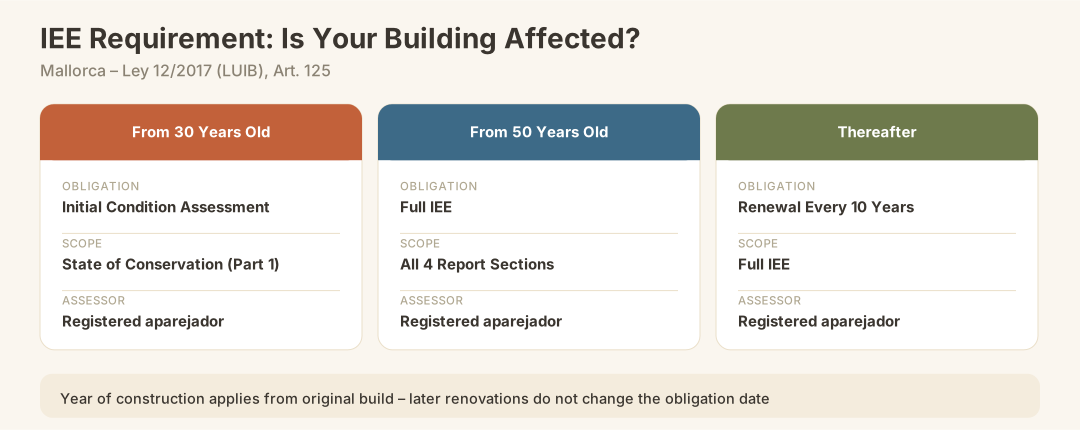
| Building age | Obligation | Scope |
|---|---|---|
| From 30 years | First condition assessment | State of preservation (Part 1) |
| From 50 years | Complete IEE | All 4 report sections (Condition + Accessibility + Energy + Site Plan) |
| Thereafter | Renewal every 10 years | Complete IEE |
Important: The age threshold refers to the year the building was constructed, not to any subsequent renovations. A villa built in 1970 that was extensively refurbished in 1995 is still classified technically as a building with a construction year of 1970.
The report must be prepared by a registered technical architect (arquitecto técnico or aparejador) who is authorised to practise in Mallorca. A self-declaration by the owner or a general contractor's survey does not meet the requirement.
The four report sections of the IEE in detail
The complete IEE consists of four clearly defined sections. Only when all four are present is the document considered finalised and ready for submission.
Section 1 — Structural Condition (the decisive section)
This section is the most practically significant. The surveyor assesses:
- Foundations and load-bearing structure
- Exterior walls and boundary walls
- All other structural elements that could pose a safety risk to persons
- Communal installations: water supply, drainage, electrics
Where deficiencies are identified here, this immediately triggers obligations to act (see the section 'Deficiencies and Deadlines').
Section 2 — Accessibility
The surveyor objectively records whether and to what extent the building is accessible to persons with limited mobility. This assessment describes the current state — under the present rules it creates no immediate obligation to carry out remedial works for the owner, provided there are no specific deficiencies within the meaning of that structural element.
Section 3 — Energy Certificate
The third section incorporates the energy certificate that is in any case required by law for sales and lettings Certificado de Eficiencia Energética. It rates the energy efficiency of the building on a scale from A (very efficient) to G (very inefficient) — without deriving any direct obligation to carry out renovation work within the framework of the IEE. The certificate must be issued separately by a certified technician and lodged with the competent Balearic energy register.
You can find out more in our guide to the energy certificate Spain.
Part 4 — Site Plan and Photographic Documentation
The fourth part contains a site plan at a scale of 1:1,000 in DIN A4 format, showing the plot boundary and the inspected structures. This is supplemented by colour photographs of the building. If defects have been identified, these must also be documented photographically.
| Report section | Content | Obligation to renovate? |
|---|---|---|
| 1 — Structural condition | Load-bearing structure, façades, pipework | Yes, where defects are identified (6-month deadline) |
| 2 — Accessibility | Access for people with reduced mobility | Generally no (condition assessment only) |
| 3 — Energy certificate | Efficiency class A–G | No (mandatory document, no renovation obligation) |
| 4 — Site plan & photos | Cadastral plan 1:1,000, photographic documentation | No |
Defects and Deadlines: What Happens When the Findings Are Negative?
If the surveyor identifies defects in the first report section — whether in the load-bearing structure, the façade, or the pipework — clear response deadlines apply:
- Within 6 months of identification, the defects must be remedied and, where required, planning permissions applied for.
- Once the works are complete, the surveyor must produce a completion report (final report) confirming explicitly that the building now meets the statutory requirements.
- Without this final report the IEE process is considered incomplete — with potential consequences for sales, planning permissions, and insurance.
Please note: The 6-month deadline for remedying defects begins on the date of the survey report, not the date of the official notification. Anyone purchasing a property with a negative IEE takes on this ongoing deadline.
The IEE when buying a property: what buyers need to check
When buying a property on Mallorca, the IEE is not a nice-to-have — it is due diligence. Anyone purchasing a property that is more than 30 years old and does not review a valid IEE risks:
- Taking on ongoing renovation obligations with a tight timeframe
- Unknown defects to the structure or installations
- Problems when applying for planning permissions for alterations or renovation
- Complications when reselling at a later date
Checklist before the notary appointment:
- Verify the year the building was constructed (from the land registry or cadastre)
- Request the IEE from the seller — in full, with all four sections
- Check the date and surveyor of the IEE (valid for 10 years from the date of issue)
- Check Section 1 for recorded defects and proof that they have been remedied
- Request the final report where defects have been identified
- Check the energy certificate (Section 3) for validity (typically 10 years)
- If the IEE is missing: obtain it before exchange of contracts or negotiate a reduction in the purchase price
Please note: the land registry will tell you about registered encumbrances, but not about the structural condition of the building. Find out in advance about the Spanish land registry check and arrange for a property inspection & surveyor to be carried out.
The IEE in a residents' association
In apartment buildings, the obligation to commission and fund the IEE falls to the residents' association (comunidad de propietarios) and not to the individual owner. This means:
- The community resolves to commission a certified surveyor at the owners' meeting
- Costs are divided according to ownership shares (cuotas de participación)
- If defects are identified and remedial works become necessary, the community bears the costs collectively
- Individual owners cannot unilaterally refuse the obligation
You can find out more about the structure and rights of an owners' community in Spain in our guide to the owners' community in Spain.
What does an IEE cost in Mallorca?
The costs for an IEE are not uniformly regulated by the authorities. From practical experience: costs depend on the size of the building, the year of construction, the complexity, and the firm commissioned. As a rule, individual buildings and smaller apartment blocks are assessed more affordably than large residential complexes. Always request a written quote before commissioning, which explicitly includes all four sections of the report — including the energy certificate.
Note: Some providers charge for the energy certificate (Part 3) separately. Make sure a complete package is offered in order to avoid paying for two separate assessments.
If defects are found, the costs of remediation are added on top — these can vary considerably depending on the extent of the damage (façade cracks, pipework issues, structural defects). These costs are a legitimate argument in purchase and price negotiations.
IEE and planning permission: the connection
If you are planning a conversion, extension or extensive renovation after purchase, the IEE becomes relevant: local authorities can make the granting of planning permission conditional on a valid IEE being in place that shows no defects. Anyone who buys without a valid IEE and wishes to renovate immediately risks delays in the planning permission process.
You can find more information on this topic in our guides on planning permission in Mallorca as well as on legalising unauthorised construction and identifying illegal extensions.
Most common mistakes with the IEE
1. Accepting an out-of-date IEE The IEE is valid for 10 years. A report from 2013 will have expired by the time of a purchase in 2025 — even if it is formally presented. Always check the date.
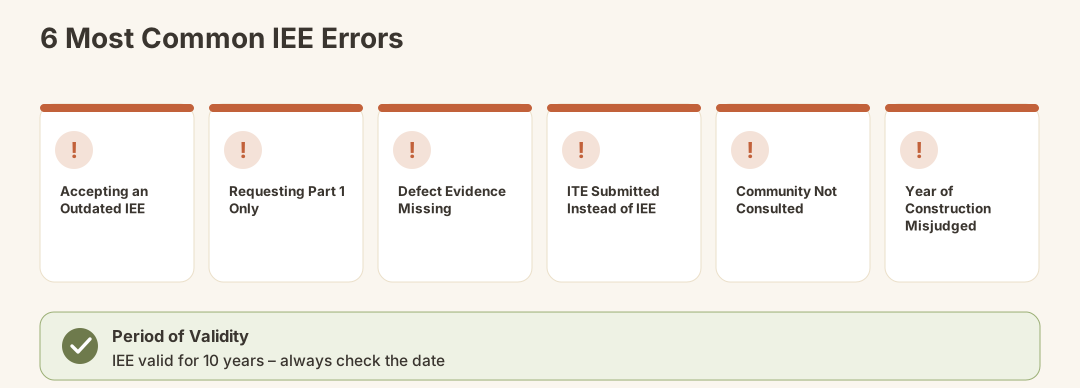
2. Requesting only Part 1 Some surveyors will initially provide only the condition report, whether at the client's request or for cost reasons. A complete IEE must contain all four parts.
3. Proof of defect rectification is missing An IEE that records defects but lacks a subsequent completion report is legally incomplete. The buyer then takes on an outstanding obligation.
4. No Distinction Between ITE/IEE Sellers occasionally present old ITE reports. These do not meet the current legal requirement.
5. For Flats, Only Asking the Community Even if the community commissions the IEE for the entire building — as a buyer you must actively enquire whether it exists and review it yourself.
6. Misjudging the Year of Construction Later extensions or renovations do not change the relevant year of construction of the main building. Always check the original year of construction from the Kataster (Catastro).
What Comes Next?
If the IEE is available and free of defects — or if defects have been demonstrably remedied — you as the owner are obliged to maintain the building in this condition and toevery 10 years commission a new inspection. The next IEE can therefore already be planned into your calendar at the time of purchase.
Recommended next steps following a successful IEE:
- Check renovation grants: Sanierungsförderung Mallorca
- Photovoltaics on the roof? Photovoltaik Mallorca anmelden
- Retrofit air conditioning: Klimaanlage Mallorca installieren
- Have your energy certificate upgraded: Energiezertifikat Spanien
IEE/ITE Mallorca Checklist
| # | Task | Who | When |
|---|---|---|---|
| 1 | Check year of construction from the Kataster (Catastro) | Buyer / Owner | Before exchange of contracts |
| 2 | Request a valid IEE (all 4 parts) from the seller | Buyer | Before notary appointment |
| 3 | Check the date of the IEE (max. 10 years old) | Buyer | Before notary appointment |
| 4 | Check Part 1 for recorded defects | Buyer / Solicitor | Before notary appointment |
| 5 | Request the completion report where defects have been remedied | Buyer | Before notary appointment |
| 6 | If IEE is missing: commission a surveyor or renegotiate the purchase price | Buyer | Before notary appointment |
| 7 | In an owners' community: arrange for the IEE to be approved at a general meeting | Community | When due |
| 8 | Note the next IEE due date in the calendar | Owner | After purchase |
| 9 | Ensure defects are remedied within 6 months | Owner | Where a negative finding is issued |
| 10 | Submit the completion report following remediation | Owner | After defects have been remedied |
Conclusion
The IEE is by no means a bureaucratic footnote in Mallorca — it is a central document when purchasing older properties and a regularly recurring obligation for owners. The four sections of the report give you, as a buyer, a structured picture of a property's condition: structure and services, accessibility, energy efficiency, and a site plan. Part 1 is the critical section: if defects are identified there, a 6-month deadline begins to run — and as a buyer, you inherit that deadline if you are not careful. The ground rules are straightforward: failing to review a valid IEE before the notary appointment represents a calculable yet entirely avoidable risk. Have the document checked by a solicitor or experienced adviser — before you sign.
Official sources
- Ley 12/2017, de 29 de diciembre, de urbanismo de las Islas Baleares (LUIB), in particular Art. 125: https://www.caib.es/sites/normativa/es/llei_12_2017_de_29_de_desembre_durbanisme_de_les_illes_balears/
- Ley 8/2013, de 26 de junio, de rehabilitación, regeneración y renovación urbanas (national basis of the IEE): https://www.boe.es/buscar/act.php?id=BOE-A-2013-6938
- Govern de les Illes Balears — Urbanisme: https://www.caib.es/govern/organigrama/area.do?coduo=1887&lang=es
- Ajuntament de Palma — Sede Electrónica (ITE/IEE): https://seuelectronica.palma.es
- Consell de Mallorca — Departament de Territori: https://www.conselldemallorca.net