
Eco-friendly living in Mallorca: energy-efficient building, water & solar
Mallorca is an island with limited resources – and anyone who lives here permanently feels it. Water is scarce, energy is expensive, and a large proportion of the electricity is still generated on the island itself using fossil fuels. At the same time, demand for ecological living Mallorca is rising sharply: buyers from German-speaking countries are specifically asking about sustainable properties, photovoltaic systems, rainwater storage tanks and passive house standards. This guide explains what ecological building and living on the island actually means in practice – from choosing the right building materials and registering your solar installation through to the energy certificate, without which you are permitted neither to buy nor to let. You will learn which funding programmes are available, where the legal boundaries lie, and how to avoid common mistakes.
Are you planning to buy or convert a sustainable property on Mallorca?
- 📩 Submit a personal enquiry — Our experts can advise you on sustainable building, grants and local planning permissions
- Everything about building & renovation on Mallorca
Why sustainability on Mallorca is not a lifestyle question
On the mainland, energy efficiency can be regarded as a bonus. On Mallorca, it is a necessity. The island is connected to the Spanish electricity grid only via a submarine cable, and a large proportion of local power generation is based on oil and gas. Electricity prices are correspondingly higher than the Spanish mainland average. At the same time, fresh water in the Balearen is a structurally scarce resource: there are no large rivers, the groundwater reservoirs are under pressure from overuse and salinisation, and dry spells in summer can push the public water supply to its limits.
There is also a societal shift under way: demand for green, ecological housing solutions on Mallorca has grown noticeably in recent years. Anyone building or renovating today is building for a market in which energy efficiency and sustainability are increasingly seen as a value proposition – not merely a matter of conscience.
Note: Ecological building on Mallorca is no contradiction of island tradition. Many of the old fincas were built from local sandstone (Marès) and, thanks to their solid-mass construction, have excellent natural thermal insulation values.
The energy certificate: a mandatory document when buying and letting
Before we discuss individual technologies, there is a legal requirement you need to be aware of: in Spain, the Certificado de Eficiencia Energética (energy efficiency certificate) is required by law whenever you sell or let a property – regardless of whether it is a long-term or short-term let. Without this document, the notary cannot complete the purchase contract, and breaches in the context of letting can be subject to fines.
| Energy class | Index value (kWh/m² · year) | Rating |
|---|---|---|
| A | below 15 | Very efficient (passive house level) |
| B | 15–30 | Good |
| C | 30–60 | Satisfactory |
| D | 60–100 | Average |
| E | 100–150 | Poor |
| F | 150–200 | Bad |
| G | above 200 | Very bad |
Please note: Many older fincas and townhouses on Mallorca fall into classes E, F or G. This is not a barrier to purchase, but it does mean: those who renovate have room for improvement – and can increase the sale or rental value by achieving a higher energy class.
The certificate must be issued by a certified technician (architect or ingeniero) and registered with the Institut Balear de l'Habitatge (IBAVI). It is generally valid for ten years. Find out more in our guide to the energy certificate Spain.
Building materials: think traditional, build modern
The most ecological approach to building on Mallorca is often the most traditional. The local sandstone Marès (pronounced: ma-rès) has been the island's most important building material for centuries. It is quarried locally, involves short transport distances, is vapour-permeable, retains heat in winter and stays cool in summer – a natural passive house effect that is hard to surpass with modern insulation materials.
| Material | Ecological strength | Typical application |
|---|---|---|
| Marès (sandstone) | Local, breathable, high thermal mass | Exterior walls, floors |
| Lime render (Calç) | Vapour-permeable, antibacterial, locally sourced | Interior plasters, façades |
| Timber (local / certified) | Renewable, CO₂-binding | Roof structures, window frames |
| Recycled brick | Resource-efficient | Partition walls, arches |
| Geopolymer concrete | Significantly reduced CO₂ emissions | Foundations |
| Conventional concrete | High CO₂ emissions | Minimise where possible |
For new builds, a combination is recommended: Marès exterior walls for thermal mass, lime plaster inside for vapour diffusion, and well-insulated flat roofs or green roofs that provide additional cooling effects. Green roofs are explicitly encouraged in Palma for certain new-build projects under new sustainability guidelines.
Note: Anyone building on land classified as Suelo Rústico is subject to special restrictions regarding building volume and façade design. Read our guide on Finca Suelo Rústico.
Photovoltaics on Mallorca: solar power with mandatory registration
The Balearic Islands enjoy more than 300 sunny days per year. A photovoltaic system on Mallorca typically pays for itself more quickly than in more northerly parts of Europe – making the island an attractive location for self-consumption solar power. That said, the bureaucratic hurdles are real, and ignoring them risks fines and complications when selling the property later.
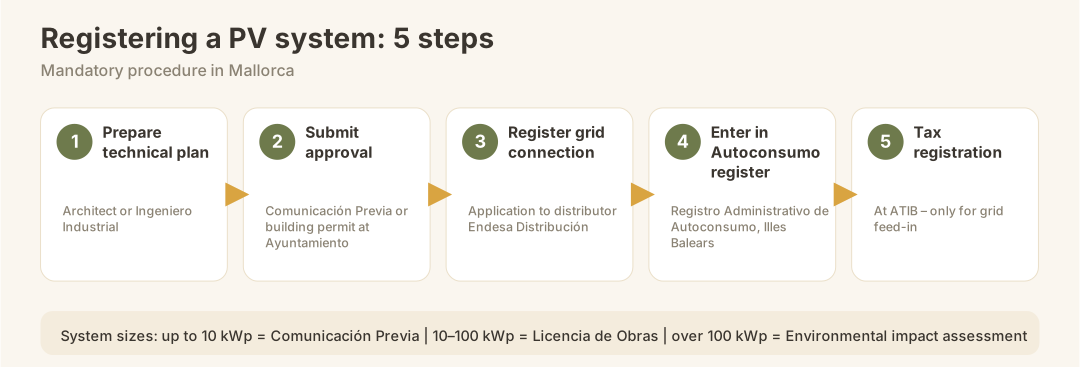
How the registration of a PV system works:
- Technical plan to be drawn up (architect or Ingeniero Industrial)
- Building permit or Comunicación Previa submit to the relevant Ayuntamiento (depending on system size and location)
- Registration with the distributor (Endesa Distribución on Mallorca) for grid connection
- Registration in the Registro Administrativo de Autoconsumo of the Comunitat Autònoma de les Illes Balears
- Tax registration with the ATIB (Agència Tributària de les Illes Balears), if feed-in to the grid is planned
| System size | Approval route | Typical authority |
|---|---|---|
| Up to 10 kWp (self-consumption) | Comunicación Previa | Ayuntamiento |
| 10–100 kWp | Building permit (Licencia de Obras) | Ayuntamiento |
| Over 100 kWp | Environmental impact assessment additionally required | Conselleria de Medi Ambient |
| In protected zones (ANEI, BIC) | Extended approval required | Consell Insular de Mallorca |
For systems with grid feed-in (known as vertido a red), registration with the relevant grid authority is also required. The entire process takes between several weeks and several months, depending on the municipality and system size.
You can find full details on the approval process in our dedicated guide Registering photovoltaics in Mallorca.
Water on Mallorca: saving, harvesting, recycling
Water is the island's scarcest resource. The public water supplier EMAYA (Palma) and the respective municipal supply networks have reached their capacity limits, and during dry summers the island has historically had to import drinking water from the mainland. For homeowners, particularly in rural areas, there are three key areas to address:
1. Cistern (Aljibe)
The cistern is the traditional Mallorcan answer to water scarcity. Rainwater from the roof is collected in underground concrete tanks and used for toilets, irrigation and — after filtering — as utility water too. New cisterns are generally permitted under building regulations and on fincas in Suelo Rústico they are often the only realistic water source alongside a well.
2. Wells (Pozo)
Anyone who owns a well or wishes to have one drilled needs a water-rights permit. Groundwater on Mallorca is legally regulated; unauthorised drilling is not legal and can prove costly if discovered. More on this in our guide to legalising wells on Mallorca and to water supply on the finca.
3. Grey-water recycling
In modern new builds and extensively renovated properties, grey water from showers and washbasins can be treated and reused for toilet flushing or irrigation. Such systems require planning permission and must be designed by a qualified engineer.
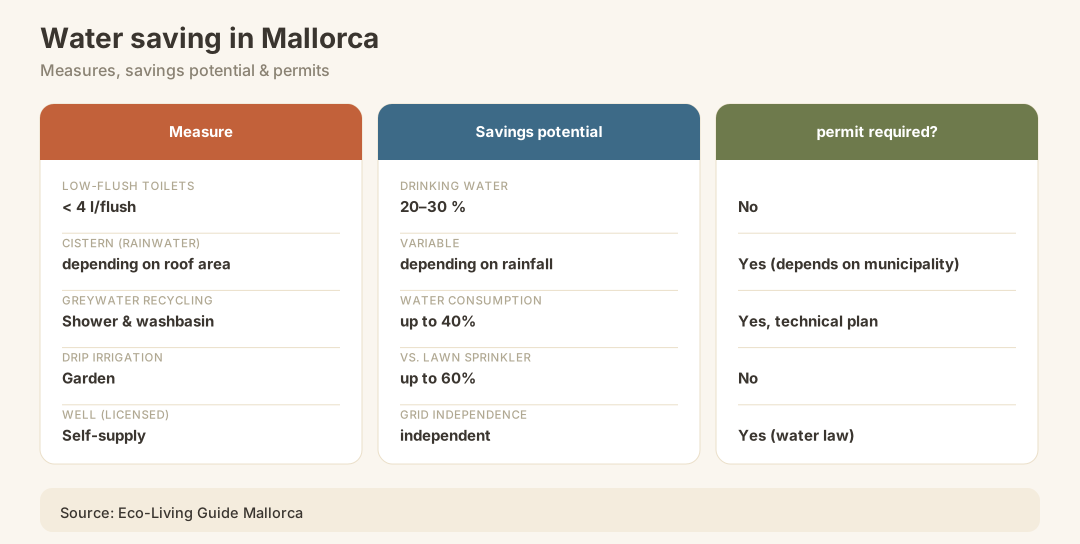
| Measure | Savings potential (estimate) | Permit required? |
|---|---|---|
| Low-flush toilets (< 4 l/flush) | 20–30 % drinking water | No |
| Rainwater cistern | depending on roof area and rainfall | Yes, depending on municipality |
| Grey-water recycling system | up to 40 % of water consumption | Yes, technical plan required |
| Drip irrigation in the garden | up to 60 % compared with lawn sprinklers | No |
| Well water (legally permitted) | independent of the mains supply | Yes (water-rights permit) |
Thermal solar system vs. heat pump: what suits Mallorca?
The question of whether a solar thermal system (for hot water) or a Heat pump (for heating and hot water) makes more sense depends on usage patterns and the building's structure.
- Solar thermal is particularly efficient on Mallorca because solar irradiation is high. A typical flat-collector system covers a large proportion of hot water demand in summer, and significantly less in winter. The system is straightforward, low-maintenance, and often cheaper to purchase than a heat pump.
- Heat pumps (air-to-water) are especially worthwhile if you also want to heat your home – which is quite relevant on Mallorca during the winter months, particularly at higher altitudes in the Tramuntana mountains. Combined with photovoltaics, the heat pump runs on self-generated electricity with significantly reduced operating costs.
- Important: On Mallorca, heat pumps with an outdoor unit are subject to the same aesthetic and planning requirements as air-conditioning systems. In town centres and listed conservation zones, outdoor units are often only permitted with restrictions or not at all. Find out more in the guide Installing air conditioning on Mallorca.
Energy-efficient building: standards and what they mean on Mallorca
Spain has transposed the European energy efficiency directives into national law. The relevant framework for new builds is the Código Técnico de la Edificación (CTE) – the Spanish regulatory framework for technical building requirements. The CTE stipulates, among other things, minimum insulation standards, window quality requirements, and maximum energy demand values.
| Standard / Norm | Content | Relevance for Mallorca |
|---|---|---|
| CTE DB-HE (Ahorro de Energía) | Minimum energy efficiency for new builds | Mandatory for all new builds |
| CTE DB-HS (Salubridad) | Ventilation, moisture protection, water | Mandatory |
| BREEAM / LEED | International certification | Voluntary, relevant for luxury projects |
| Passivhaus standard | Heating energy demand < 15 kWh/m²·a | Still rare, but achievable |
| Clase Energética A/B | Target value for new builds | Targeted by EU directives |
Note: The CTE has been tightened several times in recent years. Anyone building today must engage a current architect who is familiar with the version in force. A building permit on Mallorca always requires an approved technical plan.
Grants: What the national government, the EU and the Balearic Islands pay
In Spain there are various funding pots for energy-efficient renovations and new builds, which can also be accessed on Mallorca. The most important pillars:
| Funding programme | Provider | Who it's for | Typical measures |
|---|---|---|---|
| Plan de Rehabilitación y Regeneración Urbana | Ministerio de Vivienda / Comunitat | Owner-occupiers & landlords | Insulation, windows, building services |
| Programa de Fomento de Energías Renovables | Govern Balear (IDAE coordination) | Private individuals & businesses | PV, solar thermal, heat pump |
| Next Generation EU (Fondos PRTR) | EU via Spanish administration | Everyone, via application | Comprehensive renovation packages |
| Bonificación IBI | Individual Ayuntamientos | Owner-occupiers with a solar installation | Reduction of property tax IBI |
Please note: Funding is subject to quotas and deadlines. Anyone wishing to use funds from the Next Generation EU programmes must have the work carried out by a certified specialist contractor and must not begin before funding approval has been granted. Details of current programmes can be found in the guide Sanierungsförderung Mallorca.
Some Ayuntamientos also offer a Bonificación on the IBI (property tax) for buildings with a photovoltaic system or energy rating A. Whether your municipality offers this can be found out directly from the relevant Ayuntamiento. More on the IBI in the guide IBI Tax Spain.
Nature conservation and building zones: Where ecological building faces tight restrictions
Mallorca has a high proportion of protected land. A considerable part of the island's surface area is classified as Suelo Rústico (open countryside), much of it designated as ANEI (Àrees Naturals d'Especial Interès) or lying within the UNESCO World Natural Heritage area of the Serra de Tramuntana. In these zones, construction measures are severely restricted – including ecological ones.
| Protected zone | Restrictions | Contact authority |
|---|---|---|
| ANEI (nature conservation area) | New construction practically prohibited, renovation heavily regulated | Conselleria de Medi Ambient |
| Serra de Tramuntana (UNESCO) | Enhanced requirements regarding building materials and volume | Consell de Mallorca + Govern Balear |
| Zona de Servidumbre (Ley de Costas) | Coastal setback with strict conditions of use | Demarcación de Costas Illes Balears |
| Suelo Rústico (without special protected classification) | Strict volume restrictions, minimum plot size | Ayuntamiento |
| Listed building protection (BIC) | Façade and fabric worthy of preservation | Consell de Mallorca |
There is a dedicated guide covering the particularities of the Tramuntana area: Tramuntana Building Regulations Mallorca. And anyone building or buying on the coast should absolutely be familiar with the Ley de Costas.
Most Common Mistakes in Ecological Building and Renovation
The theory is clear, but in practice Mallorca holds a number of pitfalls. These are the mistakes we encounter most often in our consultations:
- Installing a solar system without planning permission. The system will be classified as an unauthorised installation upon sale, causing problems with the notary and the bank.
- Mounting a heat pump outdoor unit without a building permit. In historic town centres, this can result in a demolition order.
- Drilling a well without a water rights permit. Groundwater belongs to the state, not the landowner.
- Submitting a grant application after construction has begun. Most programmes require an application before the start of construction.
- Forgetting the energy certificate. Without a valid certificate, the property cannot legally be let or sold.
- Using building materials from a DIY store instead of verified architect-approved plans. The CTE sets requirements for material documentation and workmanship — particularly regarding damp protection and insulation.
- Not checking the ANEI status of the plot. Anyone who buys in a nature conservation zone and then wants to build will be in for a nasty surprise. Check the Grundbuch and the ANEI-Kataster beforehand.
- Taking on illegal structures as part of the purchase. Anyone buying a property with unauthorised extensions also takes on the liability. Legalising illegal construction is possible, but time-consuming and complex.
What comes next? Operation, maintenance and increasing property value
A sustainably equipped property costs less to run – provided the systems are serviced regularly. Specific recommendations:
- Photovoltaic system: Clean at least once a year (dust, pollen, and bird droppings can significantly reduce output). Inverters should be replaced according to the manufacturer's specifications, typically after a number of years.
- Solar thermal: Check the antifreeze level of the heat-transfer fluid regularly (even on Mallorca there are nights below zero degrees, particularly in the areas surrounding the Tramuntana).
- Cistern: Clean annually; replace filter cartridges regularly depending on the system.
- Energy certificate: Renew at least every 10 years, or following any significant change to the building.
- Value effect: Properties with a high energy rating tend to achieve better prices and shorter marketing periods on the Spanish market than those with a poor energy performance. This also has an impact on rental yield.
Checklist: Eco-friendly living on Mallorca – before buying and building
Use this list as a working document for discussions with architects, lawyers, and authorities:
Legal foundations
- Energy certificate present and registered (IBAVI)?
- Protected zone of the plot checked (ANEI, Tramuntana, Costas)?
- Existing building: illegal extensions identified?
- Planning permits for existing technical installations in place?
Water
- Water supply source clarified (mains, cistern, well)?
- Well: water-rights permit in place?
- Grey-water concept planned?
Energy
- Photovoltaic: system approved and registered?
- Energy certificate: class and improvement potential checked?
- Heat pump or solar thermal: external unit approved?
Funding
- Govern Balear funding programmes researched?
- Next-Generation-EU funds: application before Applied for building commencement?
- IBI-Bonificación enquired about at the Ayuntamiento?
Building Materials & Construction Standards
- Architect's plan drawn up in accordance with the current CTE?
- Local materials (Marès, lime) taken into account in the planning?
- Green roof or passive house standard examined?
Conclusion: Eco-friendly living on Mallorca is worthwhile – if you go about it the right way
Mallorca is no straightforward terrain for developers and renovators. Nature conservation requirements, building zones, planning permission processes, and tax obligations all overlap. Anyone who ignores this pays twice: once during construction and once at the point of sale. Those who approach it correctly, however – with local expertise, an experienced architect, and a Spanish-speaking lawyer – end up with a property that is not only good for the island but also financially astute: low running costs, a better energy rating, and greater resaleability.
The crucial first step is transparency: check the land registry, clarify the protected zone status, and obtain the energy certificate. Everything else builds on that.
Do you have concrete plans for an eco-friendly building project or a renovation on Mallorca? Put your questions to us now – our experts have first-hand knowledge of the local authorities, specialist contractors, and funding opportunities.
Official Sources
- Código Técnico de la Edificación (CTE): https://www.codigotecnico.org — Spanish building standard with energy efficiency requirements (DB-HE, DB-HS)
- IBAVI – Institut Balear de l'Habitatge (registration of energy certificates, funding programmes): https://www.ibavi.caib.es
- Conselleria de Transició Energètica, Sectors Productius i Memòria Democràtica (photovoltaic permits, energy funding Balearen): https://www.caib.es/govern/organigrama/area.do?lang=de&coduo=2950072
- ATIB – Agència Tributària de les Illes Balears (tax registration for photovoltaics): https://www.atib.es
- IDAE – Instituto para la Diversificación y Ahorro de la Energía (national funding coordination): https://www.idae.es
- Consell de Mallorca – Departament de Territori (building permits Suelo Rústico, Tramuntana): https://www.conselldemallorca.net
- Demarcación Hidrográfica de las Illes Balears (water rights permits): https://www.caib.es/govern/sac/fitxa.do?codi=3203963&coduo=6&lang=de
- Demarcación de Costas de las Illes Balears (Ley de Costas, coastal protection): https://www.mitma.gob.es/areas-de-actividad/costas-y-medio-marino/demarcaciones-de-costas/baleares