
ANEI zones in Mallorca: building rules for land buyers
Anyone looking to buy a plot of land on Mallorca will sooner or later come across three abbreviations that can determine whether an investment succeeds or ends in total loss: ANEI, Posidonia and Red Natura 2000. These protection categories are no mere bureaucratic footnote – they determine whether you are ever permitted to lay a single stone on a piece of land, what minimum size a plot must be for a building permit to even be conceivable, and whether a coastal property might one day face problems with boat anchoring. This guide explains the legal position on the basis of the applicable Balearic regulations – specific, with tables, and without sugarcoating. You will learn what the various protection zones mean, what the Decreto Ley 9/2020 changed, why Posidonia is relevant when buying coastal property, and how to properly check a plot before your notary appointment.

Land classification on Mallorca: Why it determines everything
Before you sign any purchase contract, you need to understand which land category a plot falls into. The Balearic spatial planning act (LUIB, Ley de Urbanismo de las Illes Balears) divides, pursuant to Article 18, the entire municipal territory into urban land (suelo urbano), developable land (suelo urbanizable) and rural land (suelo rústico).
For most land purchases outside built-up areas, the rural land category is the decisive one. Within this category there are in turn several sub-classifications – and that is precisely where the crucial differences lie:
| Category | Abbreviation | Minimum size | New build possible? | Main restriction |
|---|---|---|---|---|
| General Rural Land | SRG | 14.000 m² | Yes, subject to conditions | Max. 1 % buildable area |
| Rural Woodland | SRF | 20,000 m² | Severely restricted | Forest protection takes priority |
| Agriculturally Significant Areas | AIA | 21,000 m² | Very restricted | Agricultural use takes priority |
| Territorially Protected Zones | ARIP | 50,000 m² | Almost entirely prohibited | Protected area, max. 0.5 % |
| Areas of Special Natural Interest | ANEI | — | Fundamentally prohibited | Absolute landscape protection |
| ANEI with highest protection status | AANP | — | Prohibited | Strictest protection |
Please note: The categories are not always clear-cut. A plot of land may fall partly within several different zones — and as a rule, the least favourable area is the determining factor.
What is the ANEI — and why does a building prohibition apply here?
ANEI stands for Área Natural de Especial Interés — Area of Special Natural Interest. This category covers, on a large scale, the most valuable natural landscapes on the island: the Tramuntana, large stretches of the east coast, the Formentor peninsula, the Alcúdia peninsula, and further ecologically sensitive areas of countryside.
The building prohibition in ANEI zones is not new, but was reinforced by the Decreto Ley 9/2020 de medidas urgentes de protección del territorio de las Illes Balears (which came into force on 25 May 2020) further tightened and extended to additional risk areas. Specifically, the following applies:
- In AANP (Áreas Naturales de Especial Interés con Alta Nivel de Protección) and ANEI zones, any new construction of residential buildings is fundamentally prohibited.
- In ARIP-B (areas of special forestry and landscape interest) the same applies.
- In APT (areas under territorial protection) and AT-C (transitional growth areas) likewise.
The Decreto Ley 9/2020 additionally incorporated SRP-APR (risk-prevention areas with flooding, fire, erosion, or landslide risk) into the complete new-build prohibition. Previously, construction was still permitted there with a maximum of 3 % sealed surface area and a maximum of 2 % residential floor area – this exemption has been removed.
What does this mean in practice? A plot of land in an ANEI can still be bought and sold – but as a rule you cannot erect a new residential building on it. Existing buildings that were legally constructed may, under certain conditions, be renovated or maintained; new builds cannot be granted planning permission.
Note: You can find the classification of a plot as ANEI in the Plan Territorial de Mallorca (PTM) as well as in the local land-use plans (PGOU) of the respective municipality. The official mapping application of the Govern Balear is available at ideib.caib.es.
Decreto Ley 9/2020: What specifically changed
The decree of May 2020 was a turning point for anyone wishing to build on rustic land in Mallorca. The key changes compared with the previous regulations:
| Aspect | Before Decreto Ley 9/2020 | After Decreto Ley 9/2020 |
|---|---|---|
| Maximum residential floor area for new builds (SRG) | More generous limits, depending on the municipality | Significantly reduced; finca properties may generally not exceed 1.5% of the total plot area |
| Pool size | Barely restricted | New maximum limits (resource protection) |
| SRP-APR zones (risk avoidance) | Conditional construction permitted (max. 3% sealed surface area / max. 2% residential floor area) | Ban on new-build detached houses |
| ANEI/AANP | Ban on new construction | Ban on new construction (confirmed) |
| Purpose | Landscape protection | Additionally: water resources, proportionality |
In areas classified as SRG (general rustic land), the following has applied since then: development by finca properties may generally not exceed 1.5% of the total plot area, with absolute upper limits in place. Under the building footprint rule applicable to SRG (according to research, up to 1% building coverage), a plot of 14,000 m² yields a calculable building footprint of approximately 140 m² — a figure that must be known before purchase.
Minimum plot sizes: the critical thresholds
One of the most important — and frequently underestimated — questions when purchasing land is: is the plot actually large enough to apply for planning permission? Different minimum sizes apply depending on the category:
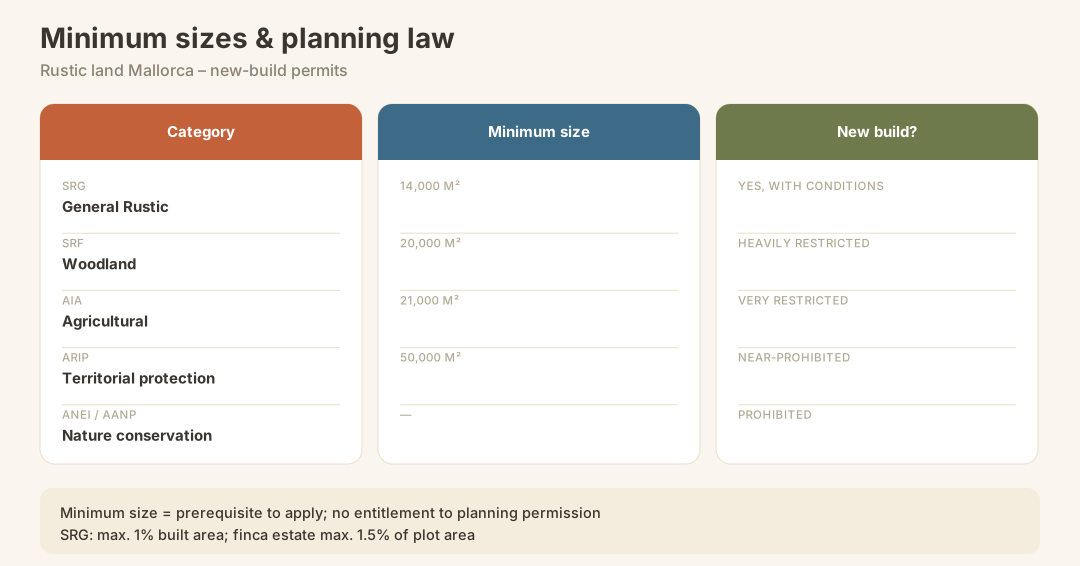
| Category | Minimum size for new-build planning permission |
|---|---|
| SRG (general rustic land) | 14,000 m² |
| SRF (woodland) | 20,000 m² |
| AIA (agriculturally significant) | 21,000 m² |
| ARIP (territorial protection) | 50,000 m² |
| ANEI / AANP | No new builds, size irrelevant |
Important: These thresholds represent the minimum requirement — they confer no entitlement to planning permission, but merely allow an application to be submitted at all. Actual planning approval depends on additional factors (location within the sub-zone, municipal plan, environmental impact assessment).
Before purchasing plots below these thresholds, it must be clearly understood: a new build is legally excluded. Smaller parcels sometimes lie within scattered settlements that were historically developed — however, this does not change the rule for new construction projects.
Posidonia oceanica: The invisible protective factor along the coast
Anyone buying a property directly on the sea or a plot near the coast must also be familiar with the protective framework for Posidonia oceanica — the endemic seagrass meadows that cover the seabeds around the Balearic Islands and rank among the most ecologically valuable habitats in the Mediterranean.
The Balearic Government adopted, on 27 July 2018 , the Decreto 25/2018 , which establishes a comprehensive protective framework for Posidonia. The decree prohibits, among other things:
- Trawl fishing over Posidonia meadows
- Extraction of aggregates and dredging with discharge into Posidonia areas
- Uncontrolled anchoring over Posidonia meadows
- New aquaculture installations, new underwater discharges, and new construction projects where the environmental impact assessment identifies adverse effects on Posidonia
The Decreto 25/2018 has also established a Posidonia monitoring service : 19 patrol boats around the Balearic Islands, reachable via VHF channel 68. Vessels of 15 metres or more in length may contact this service to receive anchoring assistance.
What does this mean when purchasing a plot? Anyone acquiring a seafront property or a coastal plot and planning to build a marina, a private jetty, or undertake any coastal construction work must undergo an environmental impact assessment. If the proposed project falls within the sphere of influence of Posidonia meadows, it may simply be impermissible. The use of the adjacent sea zone for a private boat is likewise subject to the anchoring rules.
Please note: The mapping of the Posidonia meadows around the Balearic Islands has been completed through the Atlas Posidonia project. The Balearic Government's "Posidonia GOIB" app enables access to the precise distribution maps. A check prior to purchase is mandatory for coastal properties.
Red Natura 2000 on Mallorca: European protection meets Balearic law
In addition to purely national and Balearic protection categories, Mallorca has numerous areas that form part of the European Natura-2000 network are – either as SPA (Special Protection Area for birds) or as SAC/ZEC (Special Area of Conservation / Zona Especial de Conservación for habitats and species).
On Mallorca, these include among others:
- The Serra de Tramuntana (also a UNESCO World Heritage Site)
- The Badia d'Alcúdia and adjacent wetlands
- The peninsula of Cap Salines
- Parts of the Serres de Llevant
| Protection type | EU basis | Consequence for construction projects |
|---|---|---|
| SPA (bird protection area) | EU Birds Directive | Environmental impact assessment mandatory |
| SAC/ZEC (habitat protection) | EU Habitats Directive | Significance assessment (compatibility assessment) required |
| Overlap with ANEI | Balearic + EU law | Cumulative protection, practically no new construction |
Important: Natura 2000 status does not mean an automatic total building ban on every square metre – it does mean, however, that any project that could have significant effects is subject to a compatibility assessment (impact assessment) must be carried out. In practice, most new-build projects in these areas already fail at this hurdle.
How to carry out the protection-status check before purchase
The legal due diligence for a land purchase on Mallorca must necessarily include the soil classification and protection status. This is done in several steps:
Obtain a Nota Simple: Request the current Nota Simple from the relevant land registry (Registro de la Propiedad) – it shows the owner, area, encumbrances and easements. More on this in the guide Checking the Spanish land registry.
Check the cadastral extract: Retrieve the official cadastral extract via the Sede Electrónica del Catastro (sedecatastro.gob.es) – it contains the area, land-use classification and reference number.
Consult the PTM map: Access the Plan Territorial de Mallorca online via ideib.caib.es and locate the plot on the zoning map. Here you can see ANEI, ARIP and APT designations.
Consult the PGOU of the municipality: The local land-use plan (Plan General de Ordenación Urbana) of the respective municipality may contain stricter regulations than the PTM. Submit an enquiry directly to the urban planning department (Departament d'Urbanisme) of the municipality.
Check the Posidonia Atlas: For coastal plots, use the app "Posidonia GOIB" or ideib.caib.es.
Natura 2000 Viewer: Check on the European Natura 2000 Viewer (natura2000.eea.europa.eu) whether the plot lies within an SPA or SAC.
Instruct a lawyer: Only after these preliminary checks – and always before signing a reservation contract – engage an Abogado specialising in property law. More on this in the guide Lawyer for property purchase.
What can still be built? Existing buildings and renovation
The absence of new-build rights does not necessarily mean an absence of value. Within ANEI zones there are many historic fincas and rural properties that were legally constructed before the protective regulations came into force. For these buildings the following applies:
- Maintenance and repair are generally permitted, provided the gross floor area is not extended.
- Modernisation works (energy efficiency, building services, interior fit-out) are frequently possible, but require a building permit or at least a comunicación previa – more on this in the guide Building Permit Mallorca.
- Extensions and enlargements are categorically excluded within ANEI.
- Pools have been subject to new size restrictions since Decreto Ley 9/2020, including on rural land outside ANEI.
A legally existing building within ANEI can therefore represent an attractive purchase – provided you are aware of the restrictions and they are compatible with your intended use. The risk lies in what is hidden: many rural properties have extensions or outbuildings that were constructed without planning permission. Legalising such unauthorised structures within ANEI is generally ruled out – more on this in the guide Legalising Unauthorised Building Works Mallorca.
Decree Law 3/2024: New legalisation options on rural land
On 24 May 2024 the Balearic government passed Decreto Ley 3/2024, which, under certain conditions, allows the legalisation of structures on rural land that were previously non-compliant. The key points:
- Legalisation through payment of a fee and implementation of ecological compensatory measures
- Sustainability requirements, e.g. a mandatory obligation to use renewable energy sources
- Deadlines vary depending on the location and year of construction of the building
Please note: Decreto Ley 3/2024 does not apply to buildings within ANEI, AANP, or other absolute protection zones. The legalisation option is restricted to structures on general rural land (SRG) and comparable categories. An individual legal assessment is absolutely essential.
Purchase ancillary costs: what additional costs arise when buying a plot
Even a pure plot of land without any buildings is subject to Balearic taxes and ancillary costs upon purchase. As a rule of thumb, allow 10 bis 14 % des Kaufpreises for ancillary costs. The Balearic property transfer tax (ITP) on resale is applied on a progressive sliding scale:
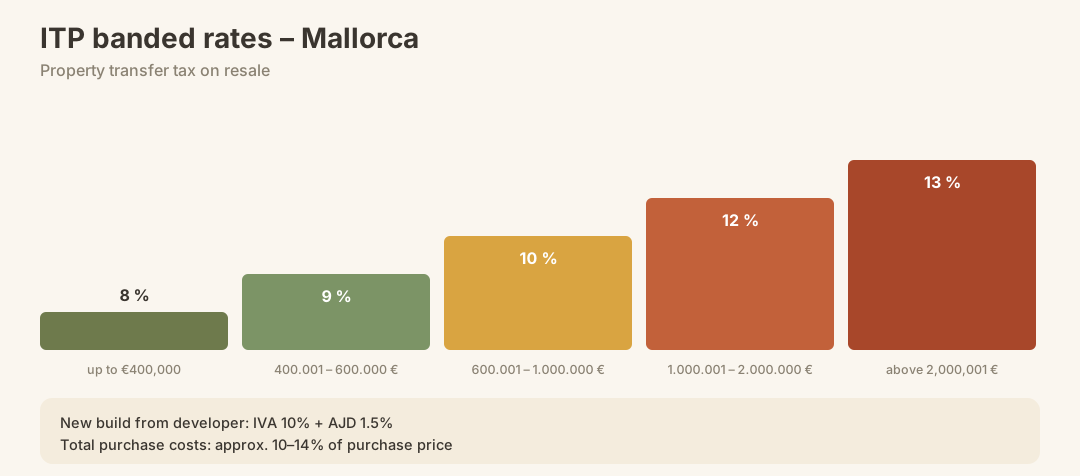
| Purchase price band | ITP Rate |
|---|---|
| Up to €400,000 | 8 % |
| €400,001 to €600,000 | 9 % |
| €600,001 to €1,000,000 | 10 % |
| €1,000,001 to €2,000,000 | 12 % |
| Over €2,000,001 | 13 % |
Notary and land registry fees also apply, as well as legal costs in most cases. For new-build properties (purchased from a developer), VAT (IVA) of 10% plus 1.5% stamp duty (AJD) applies instead of ITP. For a detailed overview, see the guide on Purchasing Costs in Mallorca.
Most Common Mistakes When Buying Land in Protected Zones
- Relying solely on the estate agent: Agents are not obliged to verify the legal buildability of a plot. That is the solicitor's responsibility.
- A Nota Simple is not enough: The Nota Simple shows private-law encumbrances, but not public-law protection categories.
- Trusting verbal assurances: "You can build something there, everyone does it" – statements like these have no legal standing and can prove very costly.
- Buying existing buildings without checking permits: Not all structures on a plot have necessarily been built with the required authorisation. Outbuildings, pools, and terraces may have been constructed without planning permission – and cannot be legalised within the ANEI.
- Overlooking the Posidonia check: Particularly for coastal plots, marine protection requirements are routinely overlooked.
- Underestimating size requirements: A plot of 12,000 m² may seem attractive – but it falls below the minimum size of 14,000 m² required for the most basic rustic category (SRG).
- Failing to consult the local PGOU: The Plan Territorial de Mallorca and the local land-use plan may differ – the more restrictive one takes precedence.
What Comes Next? Planning Permission and First Steps
If the plot falls within a category that permits new construction (SRG, subject to conditions), the next step is obtaining planning permission. In Mallorca, there are essentially two procedures:
- Licencia de obras mayor: For all significant new builds and major renovations – a full planning permission procedure through the local authority, taking anything from several months to over a year depending on the municipality.
- Comunicación previa / Declaración responsable: For minor works that do not alter the building envelope – a simplified procedure based on a self-declaration.
On rustic land, a Licencia de obras mayor is generally required, often in combination with a Environmental impact assessment (evaluación de impacto ambiental), carried out by the competent authority of the Govern Balear. More details in the guide Planning permission or comunicación previa in Mallorca.
Checklist: ANEI and nature conservation when buying land
Use this list as preparation for any land purchase on Mallorca:
- Cadastral reference and Nota Simple obtained
- Plot located in the Plan Territorial de Mallorca (ideib.caib.es)
- Protection category identified (ANEI, AANP, ARIP, SRG, etc.)
- Local PGOU of the municipality consulted
- Minimum plot size for the relevant category verified
- Existing buildings on the plot: planning permissions and legalisation status checked
- Posidonia Atlas consulted (for coastal locations)
- Natura 2000 membership checked (natura2000.eea.europa.eu)
- Specialist Abogado engaged for due diligence
- Reservation contract signed only after due diligence is complete
- Purchase ancillary costs (10–14 %) factored into the budget
Conclusion: nature conservation is not an obstacle – it is a planning foundation
The protected areas on Mallorca – ANEI, Posidonia, Natura 2000 – are not arbitrary acts of bureaucracy. They protect what makes the island valuable: landscape, coastline, and biodiversity. Anyone who accepts them as a given and carries out thorough checks before purchasing can make excellent decisions. A legally constructed existing building in an ANEI zone can be an extraordinarily attractive purchase – precisely because the building ban ensures that no new development will alter the neighbourhood. A freshly surveyed plot with no existing structure in the ANEI, on the other hand, is a trap for most buyers.
Due diligence takes time and money – but far less than a purchase price for a plot on which you will never be able to build. Engage a specialist lawyer, check the public registers yourself, and sign nothing before you know the protection category in black and white.
Official sources
- Decreto Ley 9/2020, de 25 de mayo, de medidas urgentes de protección del territorio de las Illes Balears – BOIB
- Decreto 25/2018, de 27 de julio, de protección y conservación de la Posidonia oceanica – BOIB
- Ley 12/2017, de 29 de diciembre, de urbanismo de las Illes Balears (LUIB) – BOE
- Plan Territorial de Mallorca (PTM) – Consell de Mallorca: conselldemallorca.net
- IDEIB – Infraestructura de Dades Espacials de les Illes Balears (map service for protected zones): ideib.caib.es
- Atlas Posidonia – Govern Balear: atlasposidonia.com
- Natura 2000 Viewer of the European Environment Agency: natura2000.eea.europa.eu
- Sede Electrónica del Catastro (cadastral extracts): sedecatastro.gob.es