
Buy, build or renovate a house in Mallorca: compare the costs
Buying or building a house on Mallorca cannot be decided by comparing two prices per square metre. When you buy, you pay for a completed property, including the plot and building; when you build, the cost of the plot is added to the construction cost. And an inexpensive existing property can become costly if it needs work. This guide shows you what to include in each of the three calculations: buying, building a new home, and buying with renovation. You’ll find indicative construction and renovation costs, a sample budget and the questions to settle before arranging finance. The order matters: first check what is permitted on a plot or at an existing house, then compare quotes and financing options. The figures offer an initial guide; they are no substitute for assessing a specific property or obtaining a firm construction quote.

Is it cheaper to buy or build on Mallorca?
There is no option that is cheaper in every case. A construction cost per square metre is not the price of a move-in-ready house with a plot. Equally, the purchase price of an older house tells you nothing about its condition or future costs.
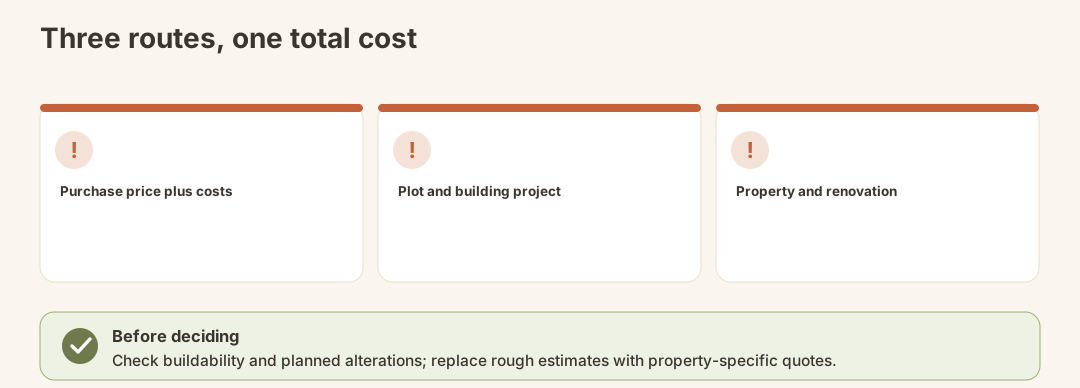
| Route to owning a house | Starting point for the calculation | Often underestimated cost |
|---|---|---|
| Buy a move-in-ready house | Purchase price plus buying costs | Technical condition and later alterations |
| Buy a plot and build | Plot plus construction work | Planning, permits, utility connections and outdoor areas |
| Buy and renovate an existing property | Purchase price plus buying costs and renovation work | Hidden damage or more extensive work than planned |
So compare houses with a similar location, usable floor area and features. Property prices on Mallorca provide a guide to the market; what matters for your decision is the total cost of the specific property.
How much does it cost to buy a house on Mallorca?
For houses on Mallorca, an average price per square metre of €4,704.26 is quoted for 2026. This is a market indicator, not an asking price for every house: location and condition can make a substantial difference. Buying costs are added to the agreed purchase price. As a rough budgeting guide, allow 10–14% on top of the purchase price. The actual taxes and costs depend in particular on whether you buy an existing house or a new build.
Before making a binding decision, you should also check the land register and the building’s condition. Do not assume an extension is approved simply because you saw it during a viewing or it was described in the sales discussion. For more detail, see the guides to buying costs, to checking the land register and to Illegal extensions when buying a house.
What does a new build cost – and what does the price per square metre leave out?
For building a house on Mallorca, 1,800–2,800 € per m², as of 2026 is a useful guide. Estimates for high-end villas are higher. These figures can help you shortlist projects, but they are not a fixed price for your home.
| Cost item | Guide price | What matters for your budget |
|---|---|---|
| House construction | 1,800–2,800 € per m², as of 2026 | Depends on factors including construction method, materials and building type |
| Luxury villa | 3,000–4,500 € per m² | Construction costs excluding the plot |
| Plot in much of the island | 800–1,500 € per m² | Check the location and building potential separately |
| Plot in a prime location | Often over 2,000 € per m² | The cost of the land can dominate the budget |
| Permit fees for a detached house | 1,500–4,000 € | Depends on the municipality and project |
The asking price is just the start, especially for a plot. Its building potential and access to water and electricity must suit the house you plan to build. Rural plots do not always have utility connections; installing them can cost over 10,000 €. Check the building potential of rural plots before you count a low plot price as a saving.
Buying and renovating: When do the numbers add up?
Renovating can be an attractive option if the location and the existing house suit what you have in mind. The key question, though, is whether you are refreshing the finishes, altering parts of the house or undertaking a comprehensive renovation. The following guide prices apply to the first two types of work:
| Scope | Guide price | Typical work |
|---|---|---|
| Cosmetic renovation | 400–800 € per m² | Painting, flooring, fittings |
| Partial renovation | 800–1,500 € per m² | Kitchen, bathrooms, some structural work |
These figures are not a firm quote for a house that has not been inspected. If work on the building’s structure is needed, a quote tailored to the property should replace a general per-square-metre estimate. For extensive work, see our guide to the cost of a full renovation; to assess the property’s condition before buying, a home inspection is a more appropriate step.
Planning rules and permits: What should you check first?
A cheap building plot is of little use if your plans are not permitted there. Likewise, you should not buy a house in need of renovation on the unverified assumption that every alteration you want will be approved. Rural plots in particular are subject to restrictions on land area and development.
Follow these steps in order:
- Describe your plans: List new construction, extensions and renovation work separately.
- Check the plot or existing property: Compare the plot’s classification, existing buildings and intended use against the relevant documents.
- Establish the permit requirements: Ask the relevant local council which documents and procedures are required for the specific work.
- Only then finalise your budget: Bring design, fees, utility connections and building work together in one budget.
Important: A renovation budget does not automatically make an unauthorised part of a building legal to use. Check the status of the existing building and your planned alterations before buying. You can find out more from Building permits in Mallorca and buildings outside planning regulations.
How does financing a purchase differ from financing a build?
When buying, an existing property can be valued. With a self-build, the starting point is the plot, the plans and a project whose final value and actual costs only become clear as work progresses. If you are considering a Hipoteca autopromotor, check explicitly whether your particular project can take an existing plot into account or include financing for the plot purchase. Do not assume either.
For buyers who are not resident in Spain, financing of up to 60–70 % of the appraised property value is cited as a market benchmark. That is neither a guarantee for a particular house nor automatically applicable to a self-build. Nor is there one universally ‘best’ way to finance a self-build: compare which costs are covered, how much of your own money you need and how expenses will be funded during construction. For an overview without specific loan offers, see the guide to property financing in Mallorca; for non-residents buying a property, the purchase budget is particularly important.
Example budget: why the construction cost alone is misleading
An illustrative calculation for a villa in south-west Mallorca shows how much the plot and additional costs matter. It describes an example project, not an island-wide average or a binding cost estimate.
| Items in the example project | Amount |
|---|---|
| Plot of 1,000 m² | 1,200,000 € |
| Construction of a 300 m² villa | 960,000 € |
| Architect and specialist planners | 96,000 € |
| Taxes, fees and permits | 120,000 € |
| Utility connections, outdoor areas and extras | 25,000 € |
| Estimated total cost | 2,401,000 € |
In this example, the construction cost is 3,200 € per m². If you compare this figure alone with the price of a house, you leave out the largest single cost: the plot. For your own budget, you should also ask for the “taxes, fees and permits” item to be broken down according to the procedures and documents your project actually requires.
Where can you have a house or chalet renovated?
The right approach depends on the type of work. Surface improvements need a different specification from changes to the layout or a comprehensive renovation. Start by describing the property's current condition and the result you want, then obtain comparable quotes with the work itemised. If the work requires a permit or technical plans, this must be clarified before construction begins.
A starting point for your search is the guide to tradespeople in Mallorca. It does not replace checking the exact scope of work and the permits required.
The most common mistakes when comparing costs
- Compare construction costs directly with the purchase price. This leaves out the plot and other project costs when building.
- Assume a cheap plot is a bargain without checking it. Whether you can build on it and connect it to utilities may change your decision.
- Underestimate renovation costs. A cost per square metre for new finishes does not cover a comprehensive renovation.
- Forget the additional costs of buying. These come on top of the agreed purchase price.
- Base your financing plans on the asking price. Factors may include the valuation, your own funds and the type of project.
- Make plans before checking the existing property. Visible extensions and proposed changes must be checked for compliance with planning and building rules.
What comes next?
Once you've narrowed down your options, you need specific documents rather than more average figures: a house listing or plot you can assess, a check of the property's condition or planning status, and a cost breakdown for the work you actually intend to carry out. Only then can you make a meaningful comparison of financing options.
If you're looking for a finished house, you can compare listings. A note about our own interests: mallorca.com, the publisher of this guide, lists properties. An independent assessment of the property and your own calculation of the total cost remain essential to your purchase decision.
Checklist for your decision
- Set comparable criteria for location, usable floor area and your desired standard of finish across all options.
- When buying, factor in purchase costs on top of the asking price.
- For a new build, itemise the plot, construction, design, permits and utility connections separately.
- For a renovation, break down the work by scope and inspect the existing building.
- Check whether the plot can be built on or the planned alterations are permitted before making a binding commitment.
- Assess how much financing you need, including your own funds and any costs not covered.
- Replace broad estimates with quotes for the specific property.
Conclusion
Buying on Mallorca is not necessarily cheaper than building – and renovating is not automatically the middle ground. With a purchase, you can see the existing property, but it still needs to be inspected. A new build lets you plan a home around your needs, but requires a suitable plot and a complete project budget. With a renovation, the key factor is what actually needs doing to the house. So compare total costs for a completed home, not square-metre prices in isolation.
This is not legal, tax or financial advice. Permits, taxes and financing for your project must be assessed in light of the specific plot or property.
Official sources
The following authorities are particularly relevant when assessing a specific project:
- Balearic Islands Government – information on responsibilities and regulations.
- Palma City Council – the local authority to contact about projects in Palma; elsewhere, the relevant local council is responsible.
- Spanish Land Registries – information on checking the register.