
Mallorca pool law: size limits and rules for existing pools
Anyone wanting to build, buy or inherit a pool in Mallorca will quickly run into Pool Law Mallorca: a web of Balearic law, ocupación limits and municipal ordenanzas that has become considerably stricter since 2020. The core rule for new pools in rural land (suelo rústico) today is Article 68 bis of the Balearic Spatial Planning Law LUIB: a maximum of one pool per finca, a maximum water surface area of 35 m², and a maximum volume of 60 m³. Existing pools built before this rule came into force generally enjoy grandfathered status – but expansion, legalisation or sale quickly become complex. This guide explains which sizes apply, where pools in protected zones cannot be authorised at all, how municipalities such as Andratx regulate appearance, and what the 2026 drought situation means for your pool water.

Pool costs Mallorca
Explanation
Enter the day your works start: ICIO accrues then under art. 102.4 of Spain’s Local Finances Act (TRLRHL), even without a permit. The records are read for that date.
- Pool quote with tax and permission
- €62,622.00
- Permission: municipal charges
- €2,122.00
- IVA (VAT): 21 %
- €10,500.00
- Construction start
- Construction start: 1 Jul 2026
Examples and preset pump and pool dimensions are illustrative. Replace them with your figures; they are not price or consumption recommendations.
Legal status: 31 October 2025
This calculation is provided for guidance only and is not a substitute for tax or legal advice in specific cases.
The basic rule: size limits under LUIB Article 68 bis
The central norm for new pool builds on suelo rústico is Art. 68 bis of the Ley 12/2017, de urbanismo de las Illes Balears (LUIB). The article states literally that use as a single-family home on rural land may not result in more than one pool per finca, and that the water surface area of new pools may not exceed 35 m², nor the volume 60 m³. The rule was introduced with the Decreto-ley 9/2020, de medidas urgentes de protección del territorio de las Illes Balears, generalised and confirmed by the Decreto-ley 10/2022 – today consolidated within the LUIB itself.
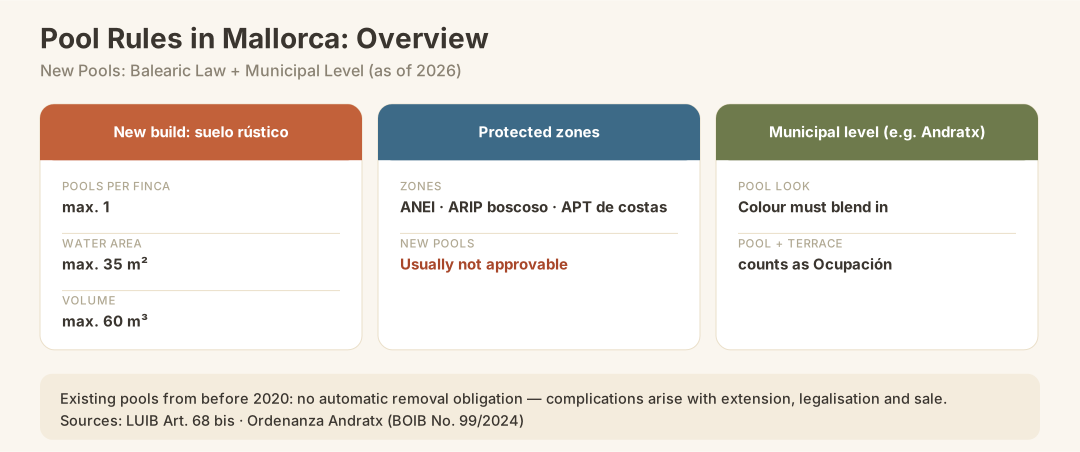
Important: the rule applies to new pools. Anyone who already built a larger pool before 2020 does not have to reduce it under this norm. But anyone building new, extending, or wanting to enlarge an existing small pool must comply with the 35 m²/60 m³ limit – regardless of how large the plot is.
| Parameter | Limit (new build, suelo rústico) | Legal basis |
|---|---|---|
| Number of pools per finca | max. 1 | LUIB Art. 68 bis |
| Water surface area (lámina de agua) | max. 35 m² | LUIB Art. 68 bis |
| Volume | max. 60 m³ | LUIB Art. 68 bis |
| Rainwater requirement for new builds | Collection from roof areas for reuse | LUIB Art. 68 bis |
Note: This rule applies to rural land (suelo rústico). For pools on urbanised building land (suelo urbano), the requirements are primarily governed by the respective municipal development plan – check with the Ayuntamiento beforehand.
Development parameters: Ocupación, volume and the 2 per cent limit
Alongside pure pool size, a second, often underestimated restriction applies: the total ocupación of the parcel. The Decreto-ley 9/2020 (Art. 5) tightened the development parameters for suelo rústico overall – and the pool together with its surrounding terrace counts towards this calculation.
| Parameter | Standard rustic land (suelo rústico) | Protected zones (Red Natura 2000 / ARIP) |
|---|---|---|
| Max. buildable area (Edificación) | 1.5% of the plot | 1.0% of the plot |
| Max. Ocupación (incl. pool + terrace) | 2.0% of the plot | 1.5% of the plot |
| Max. total volume | 900 m³ | 900 m³ |
In practice, this means: even if your plot is large enough for a 35 m² pool, the combination of house, terrace, outbuildings and pool may already exhaust the permitted total Ocupación. A preliminary check by an architect or Aparejador before planning is therefore mandatory, not optional.
Note: The Ocupación limit is calculated per plot, not per building. Anyone who already has a large built-up area often has no remaining margin for an additional pool—even if it would stay within the 35 m² limit.
Protected suelo rústico: where no new pool is approved at all
In particularly protected categories of rural land—ANEI (Àrea Natural d'Especial Interès), ARIP boscoso (forested areas of special interest) and APT de costas (coastal protection zones)—new pools are generally not approvable. This applies even if the main house is fully legal: a pool, as an addition, always requires its own planning permit, and in these protected categories this permit is regularly refused. Even freestanding or removable pools are affected once they are permanently installed—the permit requirement is linked to the "implantation", not the construction method.
A second barrier concerns plots with existing planning irregularities—even if these are already time-barred. As long as an irregularity has not been removed or resolved through a legalisation procedure, the "fuera de ordenación" regime applies: new elements, including pools, are generally not approved on such a plot until the existing situation has been legally cleared up. Anyone buying a finca with a barn, extension or terrace without proper paperwork should clarify this before any pool planning.
| Zone/category | New pools approvable? | Practical consequence |
|---|---|---|
| Suelo rústico común | Yes, within LUIB limits | Standard procedure via Ayuntamiento |
| ANEI / ARIP boscoso | Generally no | Even an addition to a legal house is usually excluded |
| APT de costas | Generally no | Coastal protection takes priority |
| Plot with unresolved illegalities | No, until legalisation/removal | Review before purchase mandatory |
Further reading on nature conservation areas: ANEI & nature conservation in Mallorca.
Existing pools: What applies to pools built before 2020?
Anyone buying or inheriting a finca with an older, larger pool doesn't automatically need to take action. The LUIB size limits are not a retroactive obligation to demolish – they explicitly regulate new pools and new building projects. An existing 70-m² pool from the 1990s generally remains protected under grandfathering rules (Bestandsschutz), as long as it was originally built with a valid permit or the deadline for an official restoration order (Restablecimiento) has long since expired.
It becomes critical in two cases:
- Extension or renovation involving structural intervention: As soon as you enlarge the pool, reseal it with a structural change, or build a new surround, the current limits apply – even to the already existing part, if a new urbanistic title becomes necessary.
- Missing original permit: If the pool was never legalised and no statute of limitations has taken effect (for example for structures in specially protected zones, where no statute of limitations applies), the structure remains formally illegal – with the risk of an official restoration order.
Note: Whether an old pool enjoys grandfathering protection or not depends on the year of construction, the zone, and the state of the documentation. There is no blanket legal rule that "old = safe" – have the cadastral history of your plot checked before you buy or carry out any structural work.
Legalisation of old pools without paperwork
For pools and other structures on suelo rústico without a valid permit, where the official restoration order can no longer be enforced due to the statute of limitations, the Consell de Mallorca has created an extraordinary legalisation procedure, based on Ley 7/2024 and its seventh additional provision (DA 7ª). The deadline runs from the publication of the plenary resolution in the BOIB: for Mallorca this took place on 15 February 2025, so the three-year deadline ends on 15 February 2028.
| Feature | Regulation |
|---|---|
| Legal basis | Ley 7/2024, DA 7ª / Decreto ley 3/2024 (Consell de Mallorca) |
| Start of deadline | Publication in BOIB: 15.02.2025 |
| Deadline in Mallorca | 15.02.2028 |
| Fee basis | Coste de Ejecución Material (CEM), rising annually |
| Requirement | Grandfathering protection (statute of limitations has taken effect), no ongoing sanction proceedings, technical documentation |
| Exclusions | Among others, specially protected categories, ongoing proceedings |
The procedure is not a blank cheque: it requires technical documentation on environmental impact, safety and energy efficiency, as well as payment of a financial charge that increases with each additional year. Furthermore, on 17 June 2025 a constitutional appeal was filed with the Tribunal Constitucional against the underlying Ley 7/2024 – so the legal framework may still change. You can find details on the complete procedure in the guide Legalising an illegal build in Mallorca.
Attention: The longer you wait, the more expensive legalisation becomes – the fee based on the Coste de Ejecución Material rises every year. Anyone with an old pool without paperwork should get the assessment underway now, not wait until 2027.
Colour and appearance: what municipalities like Andratx actually require
A persistent rumour claims that turquoise-blue pools are banned island-wide in Mallorca. That's not quite true: the currently valid Plan Territorial Insular de Mallorca (PTIM), in its consolidated legal text, doesn't contain a single article that even mentions the word "pool" (piscina). So there is no blanket colour rule at island level.
What does exist are two real levels:
- Approval practice and landscape integration: According to press reports, the Consell de Mallorca, in the course of Decreto-ley 9/2020, prohibited the use of blue for new pools in rural areas and instead required landscape-integrating colours such as green or grey. This requirement mainly takes effect through approval practice in sensitive locations (such as the Tramuntana), rather than through a single citable legal article.
- Municipal ordinances (Ordenanzas): It gets more concrete at the municipal level. Andratx, for example, explicitly requires in its urban planning ordinance (published in BOIB Núm. 99, 2024) that the pool basin must be designed in a colour or material that blends into the surroundings.
| Requirement (Andratx Ordenanza, BOIB Núm. 99/2024) | Content |
|---|---|
| Colour/material of the basin | Must blend into the surroundings |
| Counting towards Ocupación | Pool + terrace count towards the maximum total area |
| Max. water surface area on protected suelo rústico | 50 m² (the LUIB rule of 35 m² takes precedence as the higher-ranking law) |
| Max. water surface area on common suelo rústico | 75 m² (the LUIB rule takes precedence) |
| Minimum distance from overhead power lines | 3 m from the vertical projection |
Note: Where a municipal ordinance is more generous than the LUIB (e.g. 50 m² instead of 35 m²), the stricter regional law applies. Municipal rules can tighten requirements, but they cannot soften the Balearic legal limit. It's best to clarify the exact colour palette directly with the Ayuntamiento before submitting your application – "Caribbean turquoise" is frequently rejected in rural locations.
Water shortage 2026: why your pool has suddenly become a political issue
The Balearic Islands are facing a tense water situation in 2026. According to the official Portal de l'Aigua, reserves stand at around 45 to 50 percent, several supply units are in Prealerta, and the Es Pla unit is even in Alerta. Individual municipalities are responding with their own Bandos (administrative decrees): in July 2026, for instance, Esporles issued a Bando completely banning the filling of private pools.
For pool owners, this means the following in practical terms: even a fully legal, properly approved pool can be temporarily affected by a filling ban through a municipal Bando – regardless of building law. Anyone building new or planning to should therefore check both the planning situation and the water-law situation in their municipality. Topics such as rainwater use and private wells are becoming increasingly relevant here – more on this in the guide Legalising a pool on Mallorca.
Approval procedure: step by step to a legal pool
- Land registry check of the plot: clarify building category (suelo urbano/rústico común/protected), existing illegalities, Ocupación reserve.
- Preliminary consultation with the Ayuntamiento: discuss colour palette, setback distances, and if applicable overhead power line distances (min. 3 m following the Andratx model).
- Project by architect/Aparejador: provide calculations demonstrating compliance with the 35 m²/60 m³ limit and the maximum Ocupación (2 % or 1.5 % in protected zones).
- Licencia de Obras application to be submitted to the relevant Ayuntamiento.
- Construction may only start after the permit is granted – not before.
- Final inspection and Cédula-relevant documentation to be secured for future sales.
More on the general process in the guide Building permit Mallorca.
Most common mistakes
- "The pool is mobile, so it doesn't need a permit." Wrong: every permanent installation of a pool basin requires an urban planning permit, even in protected zones.
- Ocupación of the entire plot not taken into account. A 35 m² pool that would otherwise be permissible can fail due to the overall Ocupación limit if the house and terrace already occupy a large area.
- Existing illegal older construction ignored. A new pool will not be approved as long as other structures on the plot remain unlegalised.
- Colour choice without prior consultation. A garish turquoise design in a rural location regularly leads to rejection or subsequent conditions.
- Construction started before permit approval. Substantial fines and the obligation to demolish are real risks with illegally built pools.
- Municipal water situation overlooked. Even a legal pool can be temporarily banned from being filled due to a municipal Bando.
Checklist: check pool law on Mallorca before building or buying
| Checkpoint | Done? |
|---|---|
| Building category of the plot (urbano/rústico/protected) clarified | ☐ |
| Ocupación reserve of the plot calculated (2% or 1.5%) | ☐ |
| Existing illegalities on the plot ruled out | ☐ |
| Pool size planned within 35 m² / 60 m³ (for new builds) | ☐ |
| Colour scheme agreed with the Ayuntamiento in advance | ☐ |
| Distance to overhead power lines (≥ 3 m) maintained | ☐ |
| Licencia de Obras obtained before construction begins | ☐ |
| Water situation/Bando of the municipality checked | ☐ |
What comes next? Comunidad, IBI, and sale
An approved pool often affects other legal aspects of your property: it can influence the cadastral value and thus the IBI tax, forms part of the shared cost distribution in owners' communities if it is a communal pool, and is part of the Cédula-relevant documentation for a later sale. Anyone renting out the property should also keep an eye on the safety and hygiene requirements for holiday pools. Further reading: IBI tax Spain, Community of owners Spain and Cédula de Habitabilidad.
Conclusion
Pool law Mallorca 2026 is stricter but not opaque: for new builds on suelo rústico, Art. 68 bis LUIB sets clear limits – one pool per finca, 35 m² water surface, 60 m³ volume, embedded within the plot's overall Ocupación. Existing pools generally enjoy grandfathered status, as long as there are no unresolved illegalities; anyone owning an old pool without paperwork should keep the legalisation deadline of February 2028 in mind, as costs rise each year. Colour requirements do not stem from an island-wide standard but from municipal ordenanzas and approval practice – and the 2026 drought situation additionally turns the water question into a political one. Those who carry out a thorough check before building or buying will save themselves fines, demolition hassles, and costly surprises.
Official sources
- LUIB (Ley 12/2017, de urbanismo de las Illes Balears), consolidated text, Art. 68 bis: https://www.boe.es/buscar/act.php?id=BOE-A-2018-806
- Decreto-ley 9/2020, de medidas urgentes de protección del territorio de las Illes Balears: https://www.boe.es/buscar/doc.php?id=BOE-A-2020-8012
- Portal de l'Aigua – Drought situation Balearics: https://www.caib.es/sites/aigua/es/index_de_sequera
- Andratx Town Council – Urban Development Ordinance, BOIB No. 99 (2024): https://andratx.es/sites/cilma_andratx/files/2024-07/7408-2.pdf
How much is the fine for a pool built without permission on suelo rústico?
There is no fixed amount in euros for this in Mallorca. Anyone who builds a pool on non-protected suelo rústico without the required planning permission faces a fine of 100 to 250% of the value of the work carried out under the Balearic Urban Planning Act. The specific penalty depends on the individual case; different rules apply to protected land.
Paying the fine does not amount to obtaining retrospective permission. If the pool cannot be legalised, the authorities may also require its removal and the restoration of the land. Note: This is not legal advice.