
Mallorca water restrictions in 2026: pools, irrigation and wells
Anyone who owns a house with a pool, garden or private well in Mallorca can't avoid one topic: water restrictions Mallorca have, since 2024/2025, no longer been the exception but a fixed part of summer. Contrary to what is often claimed, however, there is no island-wide ban – the rules apply on a municipality-by-municipality basis, based on an official drought-level system from the Balearic Government. In this guide you'll learn how the system works, where to check the current status of your municipality, what bandos such as the one in Esporles specifically prohibit, how pool filling, garden irrigation and well use are regulated – and which structural requirements apply regardless of the respective drought situation.

Pool costs Mallorca
Explanation
Enter the day your works start: ICIO accrues then under art. 102.4 of Spain’s Local Finances Act (TRLRHL), even without a permit. The records are read for that date.
- Pool quote with tax and permission
- €62,622.00
- Permission: municipal charges
- €2,122.00
- IVA (VAT): 21 %
- €10,500.00
- Construction start
- Construction start: 1 Jul 2026
Examples and preset pump and pool dimensions are illustrative. Replace them with your figures; they are not price or consumption recommendations.
Legal status: 31 October 2025
This calculation is provided for guidance only and is not a substitute for tax or legal advice in specific cases.
The starting situation: water reserves in Mallorca in summer 2026
The Balearic Government publishes the water reserve levels per island and per supply zone on a monthly basis. In June 2026 the overall figure for the Balearic Islands stood at around 45 percent, Mallorca at about 46 percent, and Menorca at around 34 percent — the lowest level of recent years. The figures fluctuate monthly – anyone currently planning (pool construction, irrigation system, well drilling) should check the local status rather than treating the figures in this article as fixed.
| Zone | Reserve summer 2026 (approx.) | Status |
|---|---|---|
| Balearic Islands total | ~45% | several zones in Alerta/Prealerta |
| Mallorca | ~46% | inconsistent depending on Unidad de Demanda |
| Menorca | ~34% | lowest level in recent years |
| Ibiza | ~47% | partly Prealerta |
Note: These figures are a snapshot (as of summer 2026). The Índice de Sequía is updated monthly – you can find the current map directly on the Portal de l'Aigua of the Balearic Government (source below).
The official level system: Índice de Sequía explained
The basis for all restrictions is the Plan Especial de Sequía, monitored via the Portal del Agua de las Islas Baleares. Important: the system doesn't work with municipal boundaries, but with Demand Units (UD) – hydrological units. On Mallorca these are: Palma-Alcúdia, Tramuntana Nord, Tramuntana Sud, Artà, Manacor-Felanitx, Migjorn and es Pla.
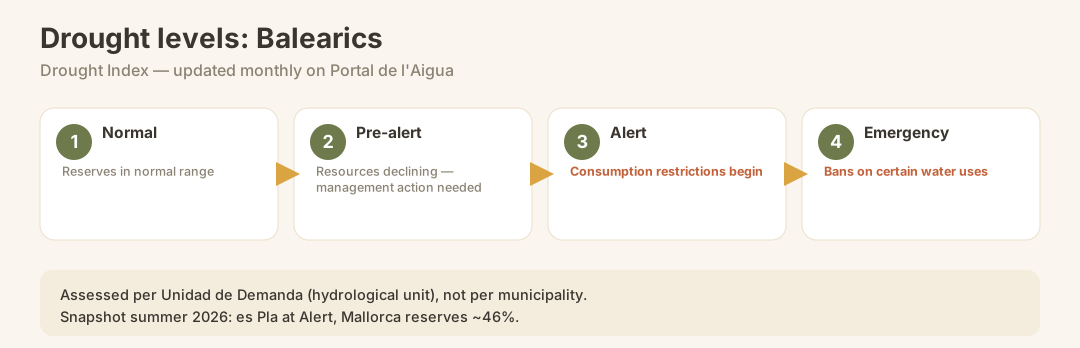
| Level | Meaning | Trigger according to the portal |
|---|---|---|
| Normalidad (green) | Reserves within the normal range | – |
| Prealerta (yellow) | Resources starting to dwindle, management measures required | Index at least 3 consecutive months below threshold |
| Alerta (orange) | Resources scarce, additional measures + consumption restrictions | 2 months above the specified values |
| Emergencia (red) | Serious situation, restrictions plus bans on certain uses | persistently critical values |
The downgrading is deliberately designed to be slow: from Alerta it only reverts after at least 60 days of better data, from Prealerta only after three months within the normal range. For you as an owner, this means that restrictions once imposed often remain in place longer than the weather situation in any single month would suggest.
Where to check the current status
Since the levels apply per Demand Unit and the specific bans apply per municipality (Bando), you need two sources:
- Portal de l'Aigua (CAIB) – for the official Índice de Sequía (drought index) of your supply zone, updated monthly.
- Website, official notice board or social media channel of your Ayuntamiento – for the actual Bando with the specific bans (pool, irrigation, cleaning).
Note: The index only tells you the hydrological situation. Whether and which bans follow for your property is decided by the municipality via Bando. Two neighbouring municipalities at the same UD level can have Bandos of very different strictness.
Example Esporles: what a municipal Bando specifically bans
In July 2026, the municipality of Esporles issued a Bando that illustrates just how far municipal bans can go. Initially it only applied to the Ses Rotgetes and Jardín de Flores urbanisations, but was extended to the entire municipal area at the end of June 2026.
| Measure | Rule according to the Esporles Bando (July 2026) |
|---|---|
| Filling/refilling a pool | Prohibited using mains drinking water (any ornamental/recreational use) |
| Garden irrigation | Prohibited using mains drinking water (gardens, fruit/vegetable plots, trees, green areas) |
| Irrigation exception | Treated water (aguas depuradas) permitted |
| Cleaning paths/terraces/courtyards | Prohibited using mains drinking water, exception for aguas depuradas |
| Escalation clause | Temporary supply cuts possible |
Comparable patterns can also be found in other Tramuntana municipalities: in Sóller, a municipal ordinance was temporarily in force banning the filling of pools from the public network, as well as washing cars, boats and terraces, and garden irrigation. In Deià, the water supply in certain parts of the village was at times shut off completely on three days a week – affected households made do with tanker deliveries or their own cisterns.
Note: restrictions don't come "from the island" as such, but are issued as a Bando (public notice) by the respective mayor, based on the Alerta/Emergencia level of the drought plan. Violations can be sanctioned under the local Ordenanzas.
Filling pools during water shortages: what's allowed
Whether you're allowed to fill your pool almost always depends on where the water comes from:
| Water source | Typical rule |
|---|---|
| Public drinking water network | Prohibited in many municipalities at Alerta/Emergencia level (check the Bando) |
| Tanker truck (camión cisterna) | Generally not covered by the network Bando – still worth checking the municipal Bando in detail |
| Own registered well | Depends on the concession and any additional extraction limits during drought stages |
| Treated water (aguas depuradas) | Explicitly permitted as an exception in many Bandos |
| Rainwater from your own cistern | Generally unproblematic, provided the cistern is legal |
If you have an existing pool and are worried about the water supply, a pool cover is also worthwhile: it significantly reduces evaporation and thus the amount of water needed to top it up over the summer. You can find out more about the basic legal questions around pools in the guide Pool law Mallorca and on building permits/size in the guide Building a pool in Mallorca.
Garden irrigation: rules, times, exceptions
Alongside the classic ban on mains-water irrigation, many Bandos provide for exceptions for treated water (aguas regeneradas/depuradas). Where no such exception exists, often the only options are:
- Irrigation from your own rainwater cistern
- Drip irrigation instead of sprinklers (lower consumption, explicitly favoured in some Bandos)
- Irrigation during the cool night/morning hours to reduce evaporation
- Switching to drought-resistant, native planting
Please note: Even if a Bando only mentions "irrigation" in general terms, this usually also covers vegetable and ornamental gardens, trees, and private green and sports areas – not just lawns.
If you're planning to convert your property to be water-saving anyway, our guide Ecological Living Mallorca offers further approaches to rainwater use and grey-water systems.
Wells (pozos): concession, registration, limits
Having your own well makes you more independent of the municipal network, but it's not a legal grey area. Any water extraction from a private well generally requires a concession or registration with the relevant water authority, the Direcció General de Recursos Hídrics.
| Point | Regulation |
|---|---|
| New well | Concession/registration with the water authority required |
| Existing, unregistered well | Considered illegal, can be penalised |
| Extraction limits | Can be further tightened during drought stages (Alerta/Emergencia) |
| Breaches of limits | Can be sanctioned by the water authority |
If your property has an old, informally unregistered well, this is something you should clarify before buying, or at the latest now. You can find details on how to proceed in the guide Legalising a Well in Mallorca.
Structural requirements independent of the drought situation
In addition to the seasonal Bandos, there are permanent, structural requirements that apply regardless of the current Índice de Sequía – set out in the Balearic Housing and Land Law (LUIB, Art. 68 bis):
| Requirement | Content |
|---|---|
| Sanitary systems | New builds and complete renovations must install water-saving sanitary fittings |
| Suelo rústico – Rainwater | New-build projects must collect and reuse rainwater from roofs |
| Suelo rústico – Pool size | New pools maximum 35 m² surface area / 60 m³ water volume, one pool per finca |
These rules apply regardless of whether your municipality is currently in Normalidad, Prealerta or Alerta – they are part of the standard building permit process. You can read more about how a building permit works in the guide Building permit Mallorca.
Rainwater and cisterns as an alternative
Given recurring restrictions, more and more owners are investing in their own cisterns – underground or as tank solutions. Advantages: independence from network bandos for irrigation and (depending on the bando exemption) sometimes also for the pool, noticeably lower water bills during the summer months, and reduced strain on local resources. It's important that a newly built cistern is correctly registered under building law – on suelo rústico this is mandatory anyway (see LUIB Art. 68 above).
Most common mistakes owners make
- Relying on island-wide announcements instead of checking your own municipality's bando – restrictions apply locally, not uniformly across all of Mallorca.
- Using well water without a concession, just because "it's always been done this way" – even old, informal wells need to be registered.
- Assuming pool filling by tanker truck is "always allowed" without checking – some bandos regulate this in detail too.
- Expecting downgrades too soon: according to the system logic, after Alerta it takes at least 60 days of good readings before restrictions are eased.
- Overlooking irrigation exemptions: those using treated water (aguas depuradas) are explicitly exempt from bans in many bandos.
What comes next? How to stay up to date
Since the Índice de Sequía is updated monthly and municipal bandos can be tightened or relaxed at short notice, a simple annual rhythm is worthwhile:
- At the start of spring (March/April), check the current status of your Unidad de Demanda.
- Before the high season (May/June), check your municipality's bando – many tightenings take effect exactly during this phase.
- Over the summer, keep an eye on your municipality's noticeboard/website channel, as bandos can also be adjusted mid-month.
- For new builds or pool construction, factor in the structural LUIB requirements from the outset, rather than having to retrofit them later.
Checklist for owners
- Identified my municipality's Unidad de Demanda (Palma-Alcúdia, Tramuntana Nord/Sud, Artà, Manacor-Felanitx, Migjorn, es Pla)
- Checked the current Índice de Sequía on the Portal de l'Aigua
- Read the current Bando of my municipality (website/notice board)
- Pool filling: checked source (mains/tanker truck/well/cistern) against the Bando
- Checked irrigation system for drip irrigation/night-time watering
- Checked own well for concession/registration
- For new builds/pool construction, factored in LUIB requirements (rainwater use, pool size on rústico land)
Conclusion
Water restrictions in Mallorca are not alarmism in 2026, but an established system, readjusted monthly, based on a drought index and municipal Bandos. As an owner, if you know the two decisive sources – the Portal de l'Aigua for the hydrological situation and your municipality's Bando for the specific restrictions – you stay in control instead of being caught out by surprises in the height of summer. Structural requirements such as pool size limits on suelo rústico or mandatory rainwater use should be factored into any building or renovation plan from the outset anyway.
Official sources
- Portal del Agua de las Islas Baleares – Índice de Sequía (CAIB): https://www.caib.es/sites/aigua/es/index_de_sequera
- LUIB – Ley 12/2017 de Urbanismo de las Illes Balears (Art. 68 bis, BOE consolidation): https://www.boe.es/buscar/act.php?id=BOE-A-2018-806