
Identifying and protecting yourself against illegal extensions when buying a house in Mallorca
Anyone buying a finca on Mallorca quickly falls in love with the old stone building, its attached conservatory, the hillside pool, and the rustic outbuilding tucked behind the almond tree. What tends to get overlooked: according to a study by the Col·legi Oficial d'Enginyers Tècnics en Topografia (CQNE), around a third of rural buildings on Mallorca are illegal or only partially legalised — and the responsible authority, the Agència de Defensa del Territori (ADT), is now issuing genuine demolition orders rather than mere warnings. In this guide you will learn how to systematically identify illegal extensions when buying a property on Mallorca, what legal risks you face as a buyer, how the legalisation process works under current legislation, and which checklist will protect you before you sign the reservation contract.

Have you already got your eye on a property and are unsure whether the land registry and the planning permission actually match up?
- 📩 Submit a personal enquiry — We connect you with vetted lawyers and surveyors on Mallorca
- Step by step: the legal process for buying property on Mallorca
Why the problem is so widespread on Mallorca
Unauthorised buildings on Mallorca are far from a fringe phenomenon. The years between the 1990s and the early 2010s in particular were characterised by lax enforcement and a building culture in which extensions were carried out "quietly" — often without any ill intent, but with lasting legal consequences.
The most common causes according to the CQNE study and industry experts:
| Cause | Typical examples |
|---|---|
| Missing or incomplete planning permission | Entire building constructed without a Licencia de Obras |
| Illegal extensions added after a legal original build | Conservatories, terraces, pergolas, garages |
| Change of use without authorisation | Stable → living space, shed → guest house |
| Structures in protected zones | Suelo rústico protegido, Tramuntana protected zone |
| Discrepancy between reality, cadastre and land registry | Greater floor area than registered, additional buildings not recorded |
The complex Spanish planning law — which can also vary from one municipality to the next — has misled many foreign buyers and even local developers. The result: houses that present themselves in immaculate condition carry planning encumbrances that the new owner inherits without being aware of them.
Please note: The ADT does not only inspect new buildings. Extensions that are decades old can also become subject to an active enforcement procedure if the authority takes action or a neighbour files a complaint.
The authority with teeth: ADT and the Island Council
The Agència de Defensa del Territori de Mallorca (ADT) operates under the Consell de Mallorca and is tasked with verifying the legality of buildings on the island and penalising any breaches. Its toolkit ranges from fines and penalty payments through to demolition orders.
In 2019 alone, the ADT issued dozens of demolition orders, with several hundred further proceedings also under way. Its enforcement capacity has continued to grow since then. Professional estate agents now generally refuse to list illegal properties until a fundamental legal clarification has taken place.
| ADT measure | Description |
|---|---|
| Fine (sanción) | Financial penalty, amount depending on severity and municipality |
| Restoration order | Return to approved condition |
| Demolition order (orden de derribo) | Full or partial demolition |
| Prohibition of use | Ban on occupation or letting |
Anyone who purchases a property with an ongoing ADT procedure in progress assumes that procedure as legal successor — the notice remains attached to the property, not to the seller.
Land Registry, Catastro and Licence: Three Different Realities
A fundamental misconception among many buyers: what appears in the Spanish Land Registry (Registro de la Propiedad) need not correspond either with the Catastro (Catastro) or with the planning permission actually granted (Licencia de Obras).
| Document | Responsible authority | What it states | What it does NOT state |
|---|---|---|---|
| Land Registry entry | Registro de la Propiedad | Owner, encumbrances, mortgages, registered area | Planning and building legality |
| Catastro entry | Catastro (government) | Tax-relevant floor areas and values | Planning permission status |
| Licencia de Obras | Municipal authority | Approved building volume and use | Subsequent alterations |
| Cédula de Habitabilidad | Municipality / Balearic government | Habitation certificate | Whether an extension has been approved |
A typical scenario on Mallorca: a property is registered in the Land Registry at 120 m², yet actually has 180 m² of living space thanks to added rooms, a glazed winter garden, and a converted outbuilding — all without planning permission and none of it updated in the Catastro.
Please note: The Land Registry protects you as a buyer against hidden debts and mortgages — but not against planning irregularities. For the latter, you need an independent architect and a solicitor who can review the municipal planning files.
See also our guide Checking the Land Registry in Spain.
The most common illegal extensions when buying a property on Mallorca
Not every extension is equally problematic — but all of them are relevant. The following elements crop up most frequently in practice:
Winter gardens and covered terraces
Particularly popular and particularly often illegal. Anyone wishing to glaze or roof an existing terrace requires planning permission. Many older extensions were simply never applied for.
Guest houses and converted outbuildings
In rural areas (suelo rústico), strict rules apply to the creation of residential accommodation. A former barn that has been converted into a holiday apartment is in many cases neither approved nor capable of receiving approval.
Pools and swimming pools
Pools also require planning permission. In protected areas they are regularly prohibited. Quite a number were installed in the 1990s without any involvement from the authorities.
Basements and converted cellars
Converting basement rooms into living space requires planning permission in many municipalities and is simply forbidden in certain zones.
Garages, carports, and storage buildings
Outbuildings in open land also require a separate planning permit on Suelo Rústico.
Suelo Rústico: Special Risks in Rural Areas
Anyone wishing to buy a finca on Mallorca should have a thorough understanding of the term suelo rústico. Planning and building rights on agricultural or nature-conservation land are considerably more restrictive than on designated building land (suelo urbano or urbanizable).
| Zone type | Buildability | Notes |
|---|---|---|
| Suelo rústico común | Restricted | Only a limited number of structures permitted, strict conditions apply |
| Suelo rústico protegido | Minimal to none | Protected areas, nature parks, coastal protection zones |
| Tramuntana (UNESCO) | Highly restrictive | Its own regulatory framework, special protection requirements |
| Suelo urbano | Standard | Development in accordance with the municipal plan |
On suelo rústico protegido many structures cannot be retrospectively legalised — even where the limitation period has already expired. This is a crucial distinction.
Important: Fincas in particularly desirable locations — the Tramuntana, sea views, proximity to the coast — are frequently situated within protected zones. An attractive setting and planning permissibility are often mutually exclusive.
For more on the specific building regulations in the Tramuntana, see Tramuntana Baurecht Mallorca, and for fincas on rural land, see Finca Suelo Rústico.
Bestandsschutz: What It Covers – and What It Doesn't
The term Bestandsschutz is frequently used in the Mallorca property market, but it is often misunderstood. To put it precisely: unauthorised structures for which the statutory limitation period for regulatory action has expired can, as a rule, no longer be demolished by enforcement order.
As a general rule, this limitation period for violations on Suelo Rústico is 6 Jahre from the completion of the structure. Once this period has elapsed, the ADT can no longer order reinstatement – the structure enjoys a form of de facto protected status.
What Bestandsschutz does not mean, however:
- The structure thereby becomes legal. It is merely no longer open to challenge.
- Planning permission is not granted retrospectively.
- Alterations, renovation or extension of the protected structure may trigger new planning obligations – and thus attract the attention of the authorities once again.
Please note: This is precisely the risk in the example case from Llucmajor: the parties involved applied for planning permission for roof repairs to the conservatory – and in doing so triggered a regulatory review that led to a demolition order. Remedial works on unauthorised extensions can reawaken the attention of the authorities.
Legalisation procedures: what the current legislation permits
The Balearen government has passed a law that allows the retrospective legalisation of unauthorised structures under certain conditions. This provision offers an important, but limited, opportunity.
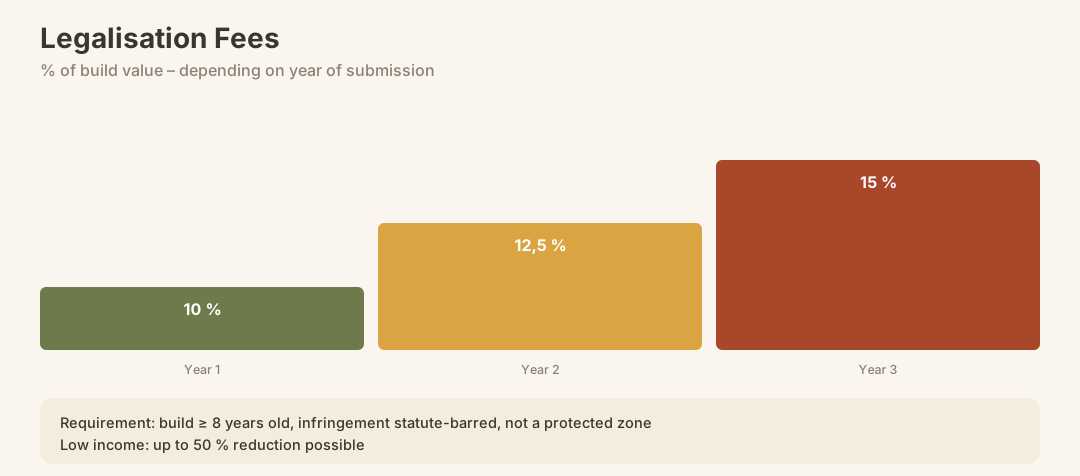
Requirements for legalisation:
- The structure must be at least 8 Jahre old
- The planning violation must be time-barred
- The building must not be situated in a protected area
- There must be no use in place that would require a tourist licence
Applicable fees (as a percentage of the construction value):
| Year of submission | Fee (% of construction value) |
|---|---|
| 1st year | 10 % |
| 2nd year | 12,5 % |
| 3rd year | 15 % |
Low-income owners may be eligible for reductions of up to 50 % on these fees. In addition, owners must comply with environmental requirements.
Not eligible for legalisation:
- Structures on protected land (suelo rústico protegido)
- Structures intended for tourist use (ETV licence)
- Structures for which the limitation period has not yet expired
For legalisation proceedings already under way or planned, the companion article is recommended: Schwarzbau Mallorca legalisieren.
Legal protection as a buyer: liability for defects and time limits
Spanish law protects buyers against hidden defects (vicios ocultos) – but only under certain conditions and within very short time limits.
| Legal remedy | Time limit | Requirement |
|---|---|---|
| Vicios ocultos (hidden defects) | 6 months from purchase | The defect existed before the purchase and was concealed |
| Action for contractual performance | 5 years | The property was unfit for habitation (serious defects) |
Please note: The 6-month period for hidden defects is not a standard limitation period but rather a Limitation period (caducidad). It cannot be extended – so swift action is essential.
Steps to take when a defect is discovered after purchase:
- Draw up a list of defects and document everything photographically
- Commission an expert report on the cause of the damage
- Seek legal advice immediately and send a formal letter of demand (this suspends the deadline)
- Prepare a statement of claim
The claim for damages may cover repair costs through to full rectification of defects, as well as compensation for loss of use.
Please note: Anyone who only engages a solicitor several months after purchase risks the 6-month period having already expired. If in doubt, act immediately.
Due diligence before purchase: step by step
A structured preliminary review is the only effective protection against planning law surprises. Ideally it begins before the reservation contract – but at the latest during the due-diligence phase between reservation and notary appointment.
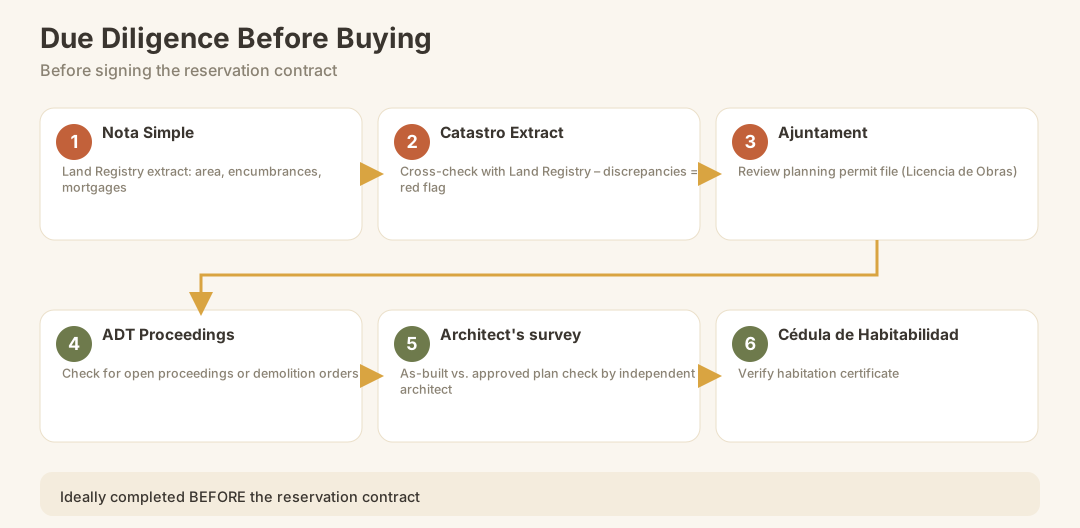
1. Request a Nota Simple Request a current land registry extract from the Registro de la Propiedad: registered area, owner, encumbrances, mortgages. Available online via the Registro portal.
2. Check the cadastral extract At catastro.meh.es retrieve the cadastral extract and compare it with the land registry entry. Discrepancies in floor areas or outbuildings are a warning sign.
3. Contact the local authority (Ajuntament) Apply to the relevant Ajuntament for access to the building-permit file (expediente de licencia de obras). This will show you which structures were approved and when.
4. Check for ongoing ADT proceedings Enquire with the Ajuntament or directly with the ADT whether any open proceedings or demolition orders exist in relation to the property.
5. Commission an architect's report An independent architect or technician (arquitecto técnico) compares the approved plans with the actual on-site condition. This is the most reliable method for uncovering illegal extensions.
6. Check the Cédula de Habitabilidad The habitation certificate shows whether the property is officially approved for residential use.
7. Check the Energy Certificate Mandatory upon sale, but also indirectly informative: a certificate that covers only part of the building's floor area may indicate unregistered sections.
For the complete property viewing checklist: Property Viewing Checklist Mallorca.
Most Common Mistakes When Buying
Mistake 1: Treating the Land Registry as a Seal of Approval The Land Registry confirms ownership and encumbrances — not planning legality. Many buyers confuse the two.
Mistake 2: Relying on What the Seller or Estate Agent Says "The pool has been there for 30 years, it's not a problem" is not a legal statement. The ADT shows no leniency towards older structures without proof that the limitation period has expired.
Mistake 3: Signing the Reservation Contract Before Completing Due Diligence The reservation contract (contrato de reserva) typically commits you with a deposit. Anyone who signs before the planning law review is complete risks losing their deposit if they later wish to withdraw due to an illegal extension that has come to light — unless the withdrawal conditions were clearly set out in the contract. More on this: Reservation Contract Spain.
Mistake 4: Beginning Renovation Before the Legal Status Has Been Clarified Anyone who renovates an illegally added section may attract the attention of the authorities — and potentially trigger a fresh review that leads to demolition proceedings.
Mistake 5: Concealing an Illegal Extension When Reselling This constitutes a breach of duty that can render the seller liable for damages. As a buyer, however, you should not rely on the previous seller having disclosed this correctly.
Mistake 6: Misunderstanding the Limitation Period as Legalisation Existing-use protection does not mean the structure is legal — and certainly does not mean it may be extended.
What Happens Next? Consequences and Options
If you discover after purchase that an extension is illegal, you have several options depending on your situation:
| Situation | Course of Action |
|---|---|
| Defect was hidden, less than 6 months since purchase | Claim for damages against the seller (vicios ocultos) |
| Property was not habitable, < 5 years | Action for specific performance |
| Building over 8 years old, not in a protected zone, statute of limitations expired | Application for legalisation with the Ajuntament |
| Building in a protected zone, statute of limitations not expired | ADT proceedings likely, consider demolition option |
| Building time-barred, existing-use protection applies | No legalisation possible, but no demolition either – document the status |
Important: Even an unlawful building with existing-use protection should be documented as clearly as possible in the notarial records and land registry, so that subsequent transactions and financing do not fall through. Bear in mind also that banks may refuse mortgages on properties with unresolved planning status. More on financing: Property Finance Mallorca.
Checklist: Identifying Illegal Extensions When Buying a House in Mallorca
Use this checklist before signing the reservation contract:
- Nota Simple (current, from the Registro de la Propiedad) is available
- Catastral extract is available and has been compared with the land registry
- Registered floor areas match the visible reality
- Building permit (licencia de obras) is available for all parts of the building
- Cédula de Habitabilidad is valid and covers all habitable areas
- No open ADT proceedings (check with the Ajuntament or ADT)
- Independent architect has carried out an actual-versus-approved comparison
- All outbuildings, pools, conservatories, and garages checked
- Zoning classification confirmed (suelo rústico común / protegido / urbano)
- Reservation contract contains a withdrawal clause in the event of planning irregularities
- Solicitor is accompanying the due diligence process and notary appointment
Conclusion
Illegal extensions when buying a house in Mallorca are no rare fringe problem – according to expert estimates, they affect around one third of rural properties. The ADT has genuine enforcement powers, and the buyer steps into the shoes of the seller as legal successor, including in respect of any open proceedings. At the same time, since the new legalisation law came into force, there is a limited but real opportunity to regularise time-barred unlawful buildings under certain conditions – with fees of between 10 and 15 percent of the construction value.
The only reliable protection remains thorough due diligence before the reservation contract: Nota Simple, catastral records, municipal file, ADT enquiry and – indispensable – a report from an independent architect. Together with an experienced solicitor who cross-checks all documents, the risk can be reduced to a manageable level.
The bad news: there is no single document that automatically proves everything is legal. The good news: with the right team, clarity can be established – and often a solution found too.
Official sources
- Agència de Defensa del Territori (ADT) – Consell de Mallorca: conselldemallorca.net
- Registro de la Propiedad (Land Registry): registradores.org
- Catastro (Cadastre): catastro.meh.es
- BOIB – Butlletí Oficial de les Illes Balears (Official Gazette of the Balearic Islands, legalisation law): boib.caib.es
- Govern de les Illes Balears (spatial planning, building law): govern.es
- Col·legi Oficial d'Enginyers Tècnics en Topografia (CQNE) – study on rural construction: cqne.cat
- Spanish Civil Code (Código Civil), Art. 1445 ff. (purchase and sale) and Art. 1484 ff. (hidden defects): boe.es