
Energy Certificate Spain: The Complete Guide for Mallorca
The energy certificate Spain – in Spanish certificado de eficiencia energética – is one of the most important documents when selling, buying, or letting a property on Mallorca. Anyone who fails to present it in time risks substantial fines and, in the worst case, a refused notarial deed. Directly linked to it is the Cédula de Habitabilidad, the certificate of habitability – without it there is no electricity connection, no water contract, and no notary appointment. In this guide you will find out which legal requirements apply, which documents you need and when, how to apply for them, what they cost, and which mistakes you should absolutely avoid.

Are you selling or buying on Mallorca and need clarity on the energy certificate and Cédula?
- 📩 Submit a personal enquiry — We will recommend vetted local technicians and solicitors
- All steps in buying a property on Mallorca
What is the energy certificate – and what does it contain?
The energy performance certificate (certificado de eficiencia energética, or EPC for short) is an official document issued by an accredited technician – typically an architect or engineer – following an inspection of the property. It assesses the building's energy consumption and rates it on a scale from A to G, where A represents the highest and G the lowest efficiency.
The certificate specifically contains:
- The estimated annual energy consumption of the building
- The CO₂ emissions of the property
- Non-binding recommendations for improving energy efficiency
During the inspection, the technician assesses, among other things: thermal insulation, ventilation, orientation and location of the building, existing solar or heating systems, air conditioning, and lighting. The underlying concept is the same as for household appliances: buyers and tenants should have objectively comparable data on energy consumption before making a decision.
Please note: The certificate does not provide any information about the structural condition, damp damage, or other defects – it assesses energy efficiency only.
Legal basis: from the EU directive to the Royal Decree
The obligation to obtain an energy certificate stems from European requirements and has been progressively tightened in Spain.
| Milestone | Instrument | Content |
|---|---|---|
| 2002 | EU Directive 2002/91/EU | Energy performance certificate requirement introduced for new builds |
| 2007 | RD 47/2007 | Transposition into Spanish law, initially for new builds only |
| June 2013 | RD 235/2013 | Extension to all existing properties |
| 2021 | RD 390/2021 | Currently applicable regulatory framework; defines procedures and obligations |
Since 1 June 2013 the obligation applies to all properties – new builds and existing stock alike – that are to be sold or let. The currently applicable legal basis is Royal Decree 390/2021, which provides binding regulation of the energy certification procedure.
Who needs an Energy Performance Certificate, and when?
The obligation falls on the owner – not the estate agent or the buyer. The critical moment is this: the certificate must be in place as soon as the property is put up for sale or let – meaning from the moment the listing goes live, not merely at the point of signing the contract.
| Situation | EPC required? |
|---|---|
| Property being sold | Yes, from the start of marketing |
| Property being let (long-term or short-term) | Yes, from the start of marketing |
| Owner-occupied property, no sale or letting | No |
| New build (first occupation) | Yes |
| Conversion/renovation involving change of use | Yes |
Please note: The certificate must be handed over to the buyer at the notarial appointment. If it is not available, the notary may refuse to proceed with the deed. For rental agreements, the tenant receives a copy. Allow sufficient lead time – ideally from the stage of the private purchase agreement (contrato privado de compraventa).
How the issue process works: step by step
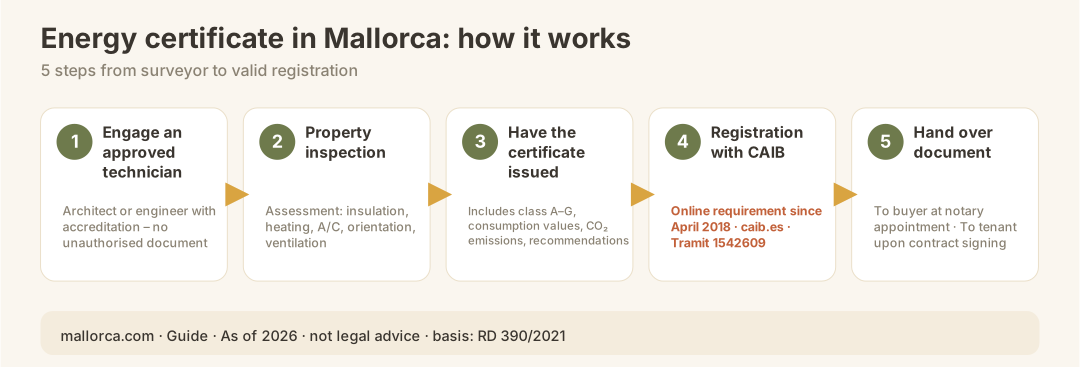
- Engage a qualified technician – an architect or engineer with the appropriate accreditation. Costs vary according to the size of the property and are generally considered to be modest.
- Site inspection – The technician assesses insulation, heating system, air conditioning, orientation, ventilation, and other energy-relevant factors.
- Have the certificate drawn up – The document sets out the energy efficiency rating (A–G), consumption figures, CO₂ emissions, and recommendations for improvement.
- Registration with the CAIB – In Mallorca, registration is exclusively online, and has been since April 2018, via the portal of the Balearic Regional Government: caib.es – Tramit 1542609. The certificate is only officially valid once it has been registered.
- Store and hand over the document – to the buyer at the notarial deed signing, and to the tenant upon signing the rental agreement.
Validity, renewal, and special cases
| Aspect | Regulation |
|---|---|
| Period of validity | 10 years |
| Renewal | New certificate via a fresh inspection |
| Property with no energy requirement (e.g. a ruin) | Special case – clarify this individually with your technician |
If the certificate expires during an ongoing tenancy agreement, it must be renewed in good time. For sales, the rule is clear: an expired certificate is invalid – you must obtain a new one before putting the property on the market.
Fines: What happens if you breach the rules?
| Breach | Fine |
|---|---|
| Missing or invalid certificate at point of sale/rental | €3,000 to €6,000 |
| Notarial deed executed without a certificate in place | Notarisation may be refused; potential claims for damages |
Please note: The fines fall on the owner, not the estate agent. A seller who does not hold a valid certificate may also face civil claims for damages on grounds of non-performance.
The Cédula de Habitabilidad: The second mandatory document
Alongside the energy certificate, there is a further document that is indispensable on Mallorca and has no equivalent in Germany, Austria or Switzerland: the Cédula de Habitabilidad (certificate of habitability).
What the Cédula certifies
The Cédula is an official certificate confirming that a property meets defined minimum habitability requirements. These include minimum size, sanitary facilities and basic technical installations. It also states how many bedrooms the property officially has. When issuing the certificate, an architect checks safety-relevant aspects: parapet heights, secured roof terraces, staircase barriers – not aesthetics, not defects in tiles or similar matters.
Why it matters so much
| Without a Cédula there is no… |
|---|
| Notary appointment – the notary is not permitted to execute the deed |
| Electricity contract with the supplier |
| Water contract |
| Gas connection |
| Telephone/internet connection |
Without a Cédula in place, utility companies cannot enter into a contract. Existing connections at very old properties may in some cases legally exist without a current Cédula – however, when re-registering utilities in the new owner's name, it is generally required.
The three types of Cédula
| Type | Spanish | When required |
|---|---|---|
| First-occupation certificate | Cédula de primera ocupación | New build, conversion, change of use |
| Renewal | Cédula de renovación | Expiry of the old Cédula |
| Missing document | Cédula de carencia | Where no previous certificate exists |
For the Cédula de primera ocupación the following documents are required: proof of ownership, architectural and construction plans, building permit, and the certificate of completion of works (certificado final de obra). It is issued by the Consell Insular de Mallorca (Island Council). This should be distinguished from the licencia de primera ocupación, which is granted by the relevant Ayuntamiento (local council) following the building inspection.
How and where to apply for the Cédula
The Cédula de Habitabilidad on Mallorca is issued by the Consell Insular de Mallorca. For the renewal or replacement of a lost or expired certificate, you can apply directly to the Island Council or engage an architect to manage the process. An experienced local estate agent can usually help obtain a copy from the Island Council's archive or coordinate the reissue.
Note: If you are buying an older property for which no Cédula is available, this is often not a deal-breaker — but you must factor in obtaining one before the notary can complete the deed. Your solicitor should check this early in the purchase process.
Energy certificate and Cédula in the purchase process: timeline
| Phase | Document | What happens |
|---|---|---|
| Property is listed | Energy certificate | Must already be in place and registered |
| Private purchase contract | Energy certificate + Cédula | Should already have been checked |
| Due diligence / legal check | Both documents | Check validity and correspondence with cadastral details |
| Notary appointment | Both documents | Handover to buyer; notary may refuse without these |
| After purchase / moving in | Cédula | Transfer utility contracts |
You can find more about the overall process in the guide Legal process for buying property in Mallorca.
What comes next? Letting and energy efficiency
Anyone wishing to let the property after purchase will need the energy certificate again – this time for the tenancy agreement. The efficiency rating is also playing an increasingly important economic role: properties with a poor rating (E, F, G) are harder to let and tend to achieve lower rents. An energy-efficiency renovation prior to letting can therefore pay off in the long run.
For long-term letting in Mallorca, the following applies: the landlord must provide the tenant with a copy of the valid energy certificate upon signing the contract. More on this in the guide Long-term letting in Mallorca.
Anyone looking for or planning a sustainably renovated property will find further information at Eco-friendly living in Mallorca.
Most common mistakes with the energy certificate and the Cédula
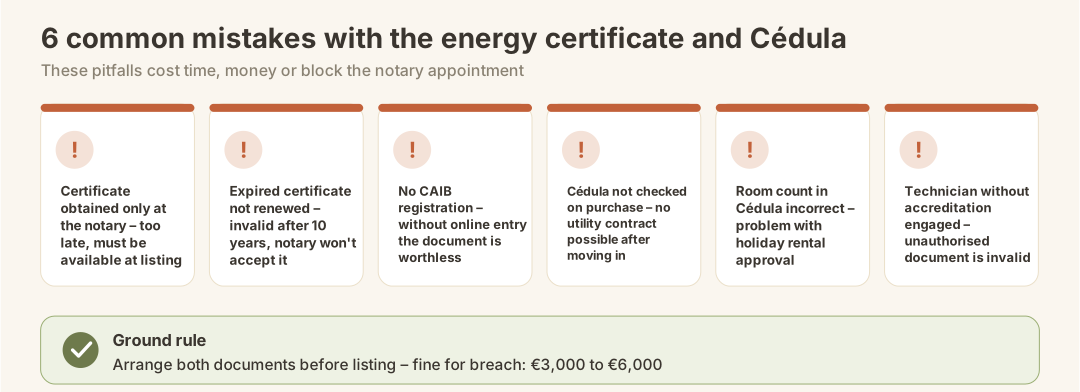
- Obtaining the certificate only at the notary appointment – Too late. It must already be in place and registered when the property is listed.
- Expired certificate not renewed – After 10 years it is invalid; a notary will not accept it.
- Missing registration with the CAIB – The document produced is worthless without registration. Online registration is mandatory.
- Cédula not checked at purchase – Buyers discover only after the purchase that no Cédula exists and that the utility contracts cannot be transferred.
- Number of rooms in Cédula does not match reality – Rooms added at a later date do not appear; in the case of holiday letting this can become a licensing issue.
- Unqualified technician commissioned – Only qualified architects or engineers are permitted to issue energy certificates. A document produced by an unauthorised person is invalid.
- Cédula de carencia overlooked – For very old properties without an original certificate, this special type exists – do not simply apply for the renovation Cédula.
Checklist: Both documents under control
- Have the energy certificate produced by a qualified technician
- Efficiency rating (A–G), consumption values and CO₂ emissions present in the document
- Certificate registered online with the CAIB (caib.es)
- Validity period checked (max. 10 years)
- Cédula de Habitabilidad present and valid
- Type of Cédula correct (primera ocupación / renovación / carencia)
- Number of rooms in Cédula matches the actual property
- Both documents already checked at the stage of the private purchase contract
- Originals and copies prepared for the notary appointment
- After the purchase: keep the Cédula ready for utility contracts
Conclusion
The Energiezertifikat España and the Cédula de Habitabilidad are not tiresome bureaucracy – they are the legal minimum standard for every property transfer on Mallorca. Anyone who organises both documents well in advance avoids fines of between 3.000 and 6.000 Euro, blocked notarisations, and nasty surprises after moving in. As a seller, you should have both documents in hand before the listing goes online. As a buyer, you check them as part of due diligence – ideally with a local solicitor. Both certificates together cost comparatively little and provide maximum legal certainty.
You can find out more about the full package when buying a property at Buying costs on Mallorca and Building & Renovating on Mallorca.
Official sources
- Royal Decree 390/2021 (currently applicable energy certification procedure): BOE – RD 390/2021
- CAIB – Online registration energy certificate Balearic: caib.es – Tramit 1542609
- Consell Insular de Mallorca (issuing the Cédula de Habitabilidad): conselldemallorca.net
- Royal Decree 235/2013 (extension to existing properties from June 2013): BOE – RD 235/2013
- Agencia Tributaria (AEAT): agenciatributaria.es