
Legalising Unauthorised Buildings in Mallorca: The Complete Guide 2026
Anyone who owns a finca on Mallorca with a pool, a guest house, or an extension that was built at some point without planning permission will recognise the uneasy feeling: the structure has been standing for decades, nobody has ever said a word – yet the moment you try to sell, renovate, or take out buildings insurance, the questions start. That is precisely what this guide addresses. You will learn what legalising an unauthorised building on Mallorca actually involves, which structures are eligible at all, what the Balearic Government's Decreto-Ley 3/2024 makes possible, how the process works, what it costs – and where the real pitfalls lie. All information is based on currently available sources; as the process is still relatively new and details may change through implementing regulations, this text is not a substitute for legal advice.

You own a property with an unresolved planning status – or you're in the process of buying one?
- 📩 Submit a personal enquiry — We connect you with experienced solicitors and architects who know the legalisation process on Mallorca
- Buying property on Mallorca: the legal process
What actually counts as an unauthorised building – and what doesn't?
On Mallorca, a distinction is made between three categories that are frequently confused in everyday use:
| Term | What it means | Practical consequence |
|---|---|---|
| Legal building | Built with a valid planning application and permit, complies with the regulations in force at the time | No restrictions, fully marketable |
| Building with established-use protection | Built without permission or in breach of regulations, but the planning violation has become statute-barred | Demolition not possible, but no right to build or renovate, no certificate of habitability, difficult to sell |
| Genuine unauthorised building (actively illegal) | Built without permission, limitation period not yet expired or proceedings pending | Demolition order and fines possible |
The crucial misconception shared by many owners is that established-use protection is not the same as legality. A building with established-use protection is merely protected from the demolition crew – it cannot obtain a new certificate of habitability (cédula de habitabilidad), it cannot receive permission for alterations or renovations, and it can only be sold at a considerable discount.
The 'Agency for the Defence of the Territory'
Subordinate to the Consell de Mallorca is an authority whose name says it all: the Agency for the Defence of the Territory (Agencia de Defensa del Territorio). It examines the legality of buildings on the island, imposes fines, and can issue demolition orders. In 2019 alone it ordered dozens of demolitions and was running several hundred active proceedings. This makes clear that unauthorised buildings are no longer a risk-free legacy from more permissive times.
The Decreto-Ley 3/2024: what the Balearic Government has made possible
In May 2024, the conservative Balearic Government passed the Decreto-Ley 3/2024 on urgent measures for administrative simplification – a legislative decree that, among other things, regulates the retrospective legalisation of certain unauthorised buildings on rural fincas. The decree resembles an earlier regulation from 2014 (the so-called Ley Company), under which approximately 1,500 buildings were retrospectively legalised by 2015. The left-wing government of the time subsequently repealed that regulation.
The new decree is time-limited – it is a transitional provision, which opens a time-limited window for owners to regularise their properties. The transitional period is three years. Prices for potentially legalisable properties on the market rose noticeably both before and shortly after the decree came into force.
Please note: The Spanish central government has raised objections to the decree. The legal situation may still change as a result of judicial or legislative intervention. Have the current status checked by a lawyer specialising in Balearic planning law before making any decisions.
Requirements: Which buildings are eligible for legalisation?
Not every unauthorised structure can be regularised. The requirements of the decree are cumulative – all of them must be met simultaneously.
The five core requirements
| Criterion | Detail |
|---|---|
| Location in a rural area | Exclusively suelo rústico – urban land (suelo urbano) is excluded |
| Expiry of the limitation period for the infringement | The planning infringement must be statute-barred; the limitation period is generally 8–12 years depending on when the building was constructed and its protected status |
| No ongoing proceedings | At the time of application, no active enforcement proceedings against the building may be pending |
| No special protected status | Structures in coastal protection zones or certain road buffer zones are explicitly excluded |
| No hotel or tourist facility | Hotel complexes are excluded from the scope of the decree |
Typical properties that may be covered
- Pools built without planning permission
- Guest houses, casitas or outbuildings on fincas
- Extensions and additions to the main building
- Garages, carports and storage buildings in rural areas
Please note: The decree makes no provision for partial legalisation. You cannot cherry-pick individual parts of a building – the entire structure to be regularised must meet all the requirements.
What is explicitly excluded?
Not everything standing on a finca in the suelo rústico can be legalised. The following grounds for exclusion are expressly set out in the decree:
| Ground for exclusion | Explanation |
|---|---|
| Coastal protection zone (zona de dominio público marítimo-terrestre) | Even statute-barred structures close to the coast remain permanently in irregular status |
| Certain road buffer zones | Structures immediately adjacent to classified roads may be excluded |
| Hotel complexes | No regularisation of accommodation establishments under this decree |
| Active ongoing administrative proceedings | As long as the authority is conducting a procedure, no application for legalisation is possible |
| Holiday rental as intended use | Legalised buildings will be permanently excluded from the holiday rental licence |
The last point is particularly significant: anyone who owns a finca with an unauthorised extension and at the same time holds or is seeking a holiday rental licence (Estancias turísticas, ETV) faces a genuine dilemma. What happens to buildings that already hold a valid ETV licence and are now to be legalised had not been conclusively clarified at the time the available research was conducted.
Existing-use protection vs. legalisation: the crucial difference
This comparison answers the most frequently asked question among property owners:
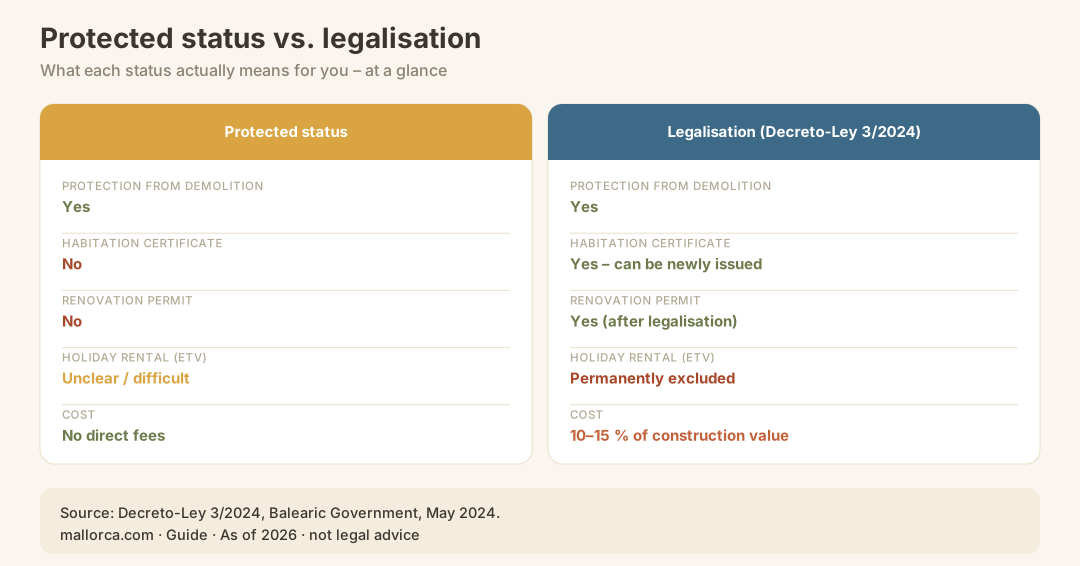
| Existing-use protection | Legalisation under Decreto-Ley 3/2024 | |
|---|---|---|
| Protection against demolition | ✅ Yes | ✅ Yes |
| New habitation certificate possible | ❌ No | ✅ Yes |
| Planning permission for renovation | ❌ No | ✅ Yes (after legalisation) |
| Entry in the land registry | Restricted | ✅ Fully possible |
| Holiday rental possible | Unclear / difficult | ❌ Permanently excluded |
| Saleability | Severely restricted | ✅ Significantly improved |
| Costs | No direct fees | 10–15 % of the construction value (see below) |
Existing-use protection is therefore no free pass — it is a state of limbo that shields the building from the worst outcome whilst simultaneously keeping it trapped in a dead end with regard to development and sale.
The cost of legalisation: what you will actually have to pay
The decree provides for tiered fees based on the construction value of the building to be legalised. The point at which the application is submitted within the three-year transitional period determines the applicable rate:
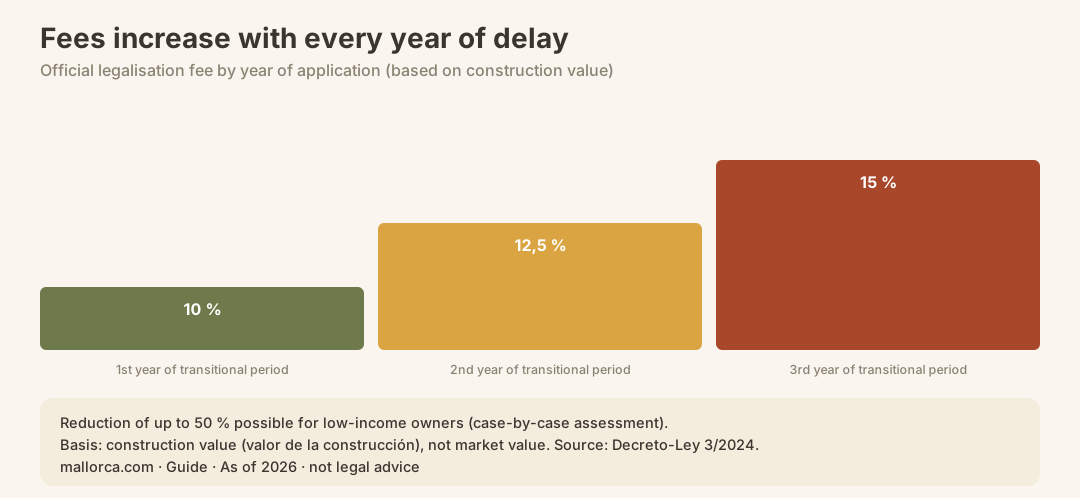
| Year of application | Fee rate (based on construction value) |
|---|---|
| 1st year of the transitional period | 10 % |
| 2nd year of the transitional period | 12,5 % |
| 3rd year of the transitional period | 15 % |
Reductions for low-income owners
Owners on a low income may receive reductions of up to 50 % on these fees. Specific income thresholds for the reduction tiers were not available in the sources reviewed — this must be clarified on a case-by-case basis with the relevant authority.
Additional cost items
In addition to the official fees, the following costs should be budgeted for:
- Architect for the technical report and survey (fee depending on the complexity and size of the property)
- Solicitor for reviewing the statute of limitations position and accompanying the process
- Registration fees at the Land Registry, if an amendment to the land register is required
- Where applicable, environmental measures prescribed as a condition of approval
Please note: The official fees are based on the construction value (valor de la construcción), not on the market value. An assessment by an architect or surveyor is required to establish the precise basis for calculation.
The legalisation process step by step
Preliminary review by a solicitor and architect: Confirm the location is within suelo rústico, clarify the statute of limitations status of the planning breach, check whether any official proceedings are pending, and verify the intended use (no holiday letting planned).
Survey and technical report: A qualified architect produces detailed documentation of the building to be legalised — floor plan, volume, structural condition, and date of construction.
Calculation of the construction value: This forms the basis for the official fee and is typically carried out by the appointed architect or a publicly appointed surveyor.
Submission of the application to the relevant local authority (Ajuntament): Submission of all documents, including the technical report, evidence relating to the statute of limitations, and proof of fee payment.
Official review: The municipality and, where applicable, the Consell de Mallorca examine the application and may request additional information.
Setting environmental conditions: Owners must carry out environmental measures and provide the relevant evidence.
Issuance of the legalisation deed and registration in the land registry by the notary.
Application for the certificate of habitability (cédula de habitabilidad) on the basis of the now legalised situation.
Implications for buying and selling: what to bear in mind when purchasing
If you wish to buy or sell a property with an unresolved planning status, that status has direct legal and financial consequences:
- Purchase price reduction: Buildings that enjoy protection through limitation periods but are not legally compliant are traded on the market at a significant discount – at the same time, properties that can be legalised have risen in price since the decree came into force.
- Mortgageability: Spanish and international banks generally only offer mortgages on protected but non-legalised buildings under significantly worse conditions, or not at all.
- Notarial and land registry transparency: The notary is required to record the planning status in the purchase contract (escritura). A qualified solicitor must have carried out a cadastral and land registry check prior to the notary appointment.
- Tax considerations: A higher market value following legalisation may affect the tax base for property transfer tax (ITP) or other taxes.
See also our guide to checking the land registry in Spain as well as purchase costs on Mallorca.
Holiday rentals and legalisation: a real dilemma
The decree permanently excludes legalised buildings from holiday rentals (Estancias Turísticas/ETV). This is the most serious drawback for many owners:
- Anyone currently planning to apply for an ETV licence will lose that option permanently upon legalisation.
- Anyone who holds an existing ETV licence and wishes to legalise an outbuilding must seek prior legal advice regarding the consequences for the overall licence – this point had not yet been conclusively resolved in the sources reviewed.
- Long-term rental remains possible following legalisation and can be a financially viable alternative.
For more on the current situation regarding rentals, see our guide to long-term rentals on Mallorca.
Most common mistakes with unauthorised buildings on Mallorca
Experienced solicitors and estate agents on Mallorca encounter these misconceptions time and again:
1. "The building is old enough – so I'm on the safe side." Limitation periods protect against demolition, but not against the consequences of lacking legal status: no renovation permits, no certificate of habitability, and restricted saleability.
2. "I'm only applying for the smaller extension." Partial legalisation is not possible under the decree. The entire property to be regularised must meet the requirements.
3. "I'll legalise the building and then apply for the holiday rental licence." This is permanently excluded under the decree. Anyone planning holiday rentals must set their priorities clearly beforehand.
4. "The seller said everything is in order." Only an independent review by a lawyer and architect — checking the land registry, the cadastre, and the municipal records — provides genuine certainty.
5. "The legalisation can happen in the background — I'll deal with it later." The window of the three-year transitional period is limited. Those who wait will pay higher fees in the third year (15 % instead of 10 % of the construction value) or miss the deadline entirely.
What comes next? Living with a legalised building
After successful legalisation, several doors open that were previously closed:
- Renovations and conversions can now be properly applied for and approved
- The habitation certificate can be reissued
- Land registry and cadastre can be brought up to date
- Energy certificate: A valid energy certificate is subsequently required for sale or long-term rental — our guide to the energy certificate Spain explains the details
- Retained value and saleability improve structurally
Checklist: legalising an unauthorised building in Mallorca
Work through these points systematically before submitting an application:
- Is the building located in suelo rústico (outside a built-up area)?
- Has the planning infringement become statute-barred (generally 8–12 years depending on the individual case)?
- Is there no pending official enforcement procedure (expediente)?
- Is the building not situated within a coastal protection zone or road buffer zone?
- Is it not a hotel complex?
- Is no holiday rental planned or in place (or have the consequences been clarified)?
- Is a complete technical report from a licensed architect available?
- Has the construction value been determined for the purposes of fee calculation?
- Have the land registry and cadastre records been checked?
- Is it possible to submit the application in the first year of the transitional period (most favourable fee rate: 10 %)?
- Is a lawyer specialising in Balearic planning law involved?
Conclusion: legalisation is not a given — but it is a genuine opportunity
The Decreto-Ley 3/2024 offers thousands of property owners in suelo rústico in Mallorca for the first time in years once again a viable option for bringing their buildings out of a legal grey area. The opportunity is real, but narrowly defined: limited in time by the three-year deadline, and in scope by the strict requirements and the permanent exclusion of holiday letting.
Anyone who owns or is looking to buy a finca with an unresolved planning status should act now — and from the outset work with experienced legal and architectural professionals. Existing-use protection alone is no comfort blanket: it protects against demolition, but not against the very real disadvantages in everyday life, when selling, or when seeking financing.
Official Sources
- Decreto-Ley 3/2024, Balearic Regional Government, May 2024 – Decree on urgent measures for administrative simplification: https://www.caib.es
- Consell de Mallorca – Agencia de Defensa del Territorio: https://www.conselldemallorca.net
- Govern de les Illes Balears – Urbanisme: https://www.caib.es/govern/organigrama/area.do?coduo=283
- Boletín Oficial de les Illes Balears (BOIB) – Official gazette of the Balearic Government: https://www.caib.es/govern/boib
- Catastro España – Cadastral information on properties: https://www.sedecatastro.gob.es
- Registro de la Propiedad – Land registry system Spain: https://www.registradores.org