Home Insurance in Spain: Choosing the Right Seguro de Hogar in Mallorca
Anyone who buys, lets, or uses a property on Mallorca as a holiday home will sooner or later come across the term Seguro de Hogar – the Spanish home insurance policy that bundles buildings, contents, liability, and often legal protection into a single policy. This sounds more straightforward than the German system, but it has its own pitfalls: holiday homes are considered a higher risk, rural houses left empty for long periods cost significantly more to insure, and anyone taking out a mortgage cannot avoid buildings cover in any case. This guide explains what components the Spanish Seguro de Hogar includes, when it is required by law, what to look out for when comparing policies, and how to avoid typical mistakes when taking out cover – with concrete tables, practical tips, and everything you need for your property on Mallorca.
Not sure which policy suits your Mallorca property?
📩 Submit a personal enquiry — our network will connect you with German-speaking insurance brokers on the ground
What is the Seguro de Hogar – and why is it different from Germany?
The Spanish Seguro de Hogar (literally: home insurance) combines what in Germany has traditionally been split across several separate policies. A single annual policy typically includes:
Contents insurance (daños al contenido): furniture, electronics, clothing, art, jewellery, personal belongings
Property owner's liability (responsabilidad civil): damage you cause to third parties as the owner
Legal protection (defensa jurídica): included automatically depending on the tariff
Note: According to insurance brokers active on Mallorca, the scope of cover in Spanish policies is generally more comprehensive than comparable German policies. Damage from power surges, glass breakage, liability, and natural hazards are often included automatically – without any separate arrangement.
One important difference from the German market: Spanish policies run for one year and renew automatically year on year unless you cancel in good time. Long-term contractual commitments of the kind common in Germany do not exist in Spain.
Feature
Spain (Seguro de Hogar)
Germany (typical)
Policy term
1 year, automatic renewal
Often multi-year
Cover components
Buildings + contents + liability in one policy
Usually separate policies
Glass breakage
Frequently included automatically
Often an additional add-on
Damage from power surges
Frequently included automatically
Often an additional add-on
Natural hazards
Included in many tariffs
Optional add-on
When is the Seguro de Hogar legally required on Mallorca?
For private homeowners, a contents or buildings insurance policy in Spain is generally not required by law – with one important exception:
Mortgage financing: Anyone financing their Mallorca property with a bank loan will be required by the bank to provide proof of buildings insurance. In practice, this is almost always the case. The lending bank often offers its own insurance products, but you have the right to take out a policy with a provider of your choice – provided the level of cover meets the bank's requirements.
Please note: You are not obliged to take out insurance with your mortgage lender. An independent comparison can be well worthwhile.
Insurance cover is also advisable in the following situations:
Situation
Recommendation
Primary residence on Mallorca
Full Seguro de Hogar incl. contents
Holiday property / second home
Buildings + contents, higher burglary cover if required
External features: fencing, garage door, pool (depending on tariff)
Typical insured risks:
Type of risk
Examples
Fire & explosion
House fire, gas explosion, lightning strike
Water damage
Burst pipe, flooding caused by a defective pipe
Storm & natural hazards
Storm, hail, snow load
Burglary & vandalism
Forced doors, damage to property
Glass breakage
Windows, terrace glazing
Power surge
Lightning strike damage to electrical installations
Contents insurance (Contenido)
Contents insurance covers everything you have brought into your home and could theoretically take with you if you moved:
Furniture and furnishings
Electrical appliances and consumer electronics
Clothing
Valuables: jewellery, art, watches (usually subject to a sub-limit)
Personal documents
Please note: Particularly valuable individual items such as paintings or high-quality jewellery are generally subject to separate upper limits (sub-limits). Check these limits carefully before signing the contract.
Liability insurance (Responsabilidad Civil)
Many Spanish policies automatically include property owner's liability cover. This applies, for example, if a falling roof tile injures a passer-by, or if water from a burst pipe enters a neighbouring flat and causes damage there.
Special considerations for holiday homes and second residences on Mallorca
Holiday homes and properties that are only occupied periodically are classified by Spanish insurers as a higher risk — and this is reflected in the premium. Specifically:
A permanently occupied home is cheaper to insure than a holiday property or a vacant property.
A house in a town centre (within a continuous built-up area) is generally cheaper to insure than a house in an urbanisation or in an open rural setting.
The longer a property remains unattended, the higher the risk profile.
This has practical implications: a burst water pipe that goes unnoticed for weeks can cause far greater damage at a holiday home than at a main residence used on a daily basis. Many insurers therefore impose requirements regarding the frequency of inspection visits, or require the water supply to be shut off during extended periods of absence.
Warning: Read the policyholder obligations in your policy carefully. Anyone who leaves their holiday home unattended for months without taking the agreed security precautions risks a partial or full reduction in the benefit paid in the event of a claim.
Premiums: what determines the cost?
The cost of a Seguro de Hogar depends heavily on location, property type, floor area, specification, intended use, and the level of cover selected, which means that reliable general averages cannot meaningfully be quoted. The following factors demonstrably influence the level of your annual premium:
Factor
Effect on premium
Intended use (main residence vs. holiday home)
Holiday home/vacant property = higher
Location (town centre vs. urbanisation vs. open countryside)
Open location = higher
Year of construction and building method
Older buildings tend to be higher
Building sum insured
Proportional
Contents sum insured
Proportional
Security technology (alarm, locks)
Discounts possible
Excess
Higher excess = lower premium
Insurer and tariff
Considerable differences
As several insurance companies are active on the market in Spain – including international providers such as Allianz as well as local companies – it is worth comparing options through an independent broker who is not tied to a single insurer.
Owners' communities (WEG): what the communal insurance covers – and what it does not
Anyone who owns a flat in a Spanish owners' community (Comunidad de Propietarios) needs to keep two levels of insurance in mind:
WEG insurance (Comunidad): Covers the communal property – the façade, communal areas, load-bearing walls, lift, and roof. This insurance is taken out by the owners' community and is binding on all owners.
Your own policy for the individual unit: The individual Seguro de Hogar protects your own flat and its contents. Both levels complement each other, but they also overlap – in the event of a claim, questions of demarcation may arise.
Note: Read through the communal insurance policy (Póliza de la Comunidad) before taking out your own policy. This helps you avoid double cover and identify any gaps.
Taking out a Seguro de Hogar: a step-by-step guide
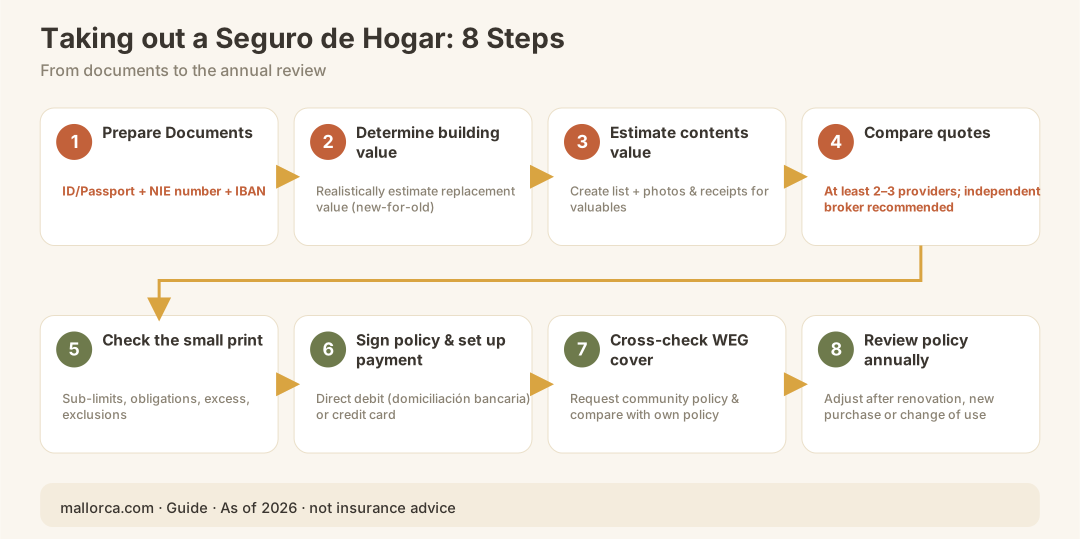
Gather your documents: When taking out a policy you will generally need a copy of your identity card or passport, your NIE number (Número de Identificación de Extranjero), and the IBAN of a Spanish bank account.
Determine the building value: Have the new-for-old value of the building (reinstatement value) estimated realistically – neither too low (underinsurance) nor too high (unnecessary costs).
Estimate the contents value: List all items worth insuring; document high-value individual pieces with photographs and receipts.
Compare quotes: Obtain quotes from at least two to three providers; use an independent broker where possible.
Check the small print: Pay attention to sub-limits on valuables, obligations in the event of the property being unoccupied, excesses, and exclusions.
Sign the policy & set up payment: Subscription by direct debit (domiciliación bancaria) or credit card.
Cross-check WEG cover: If it is a flat, request the communal policy and compare it with your own policy.
Review the policy annually: Adjust the insurance cover in the event of renovations, new purchases, or a change of use (e.g. letting).
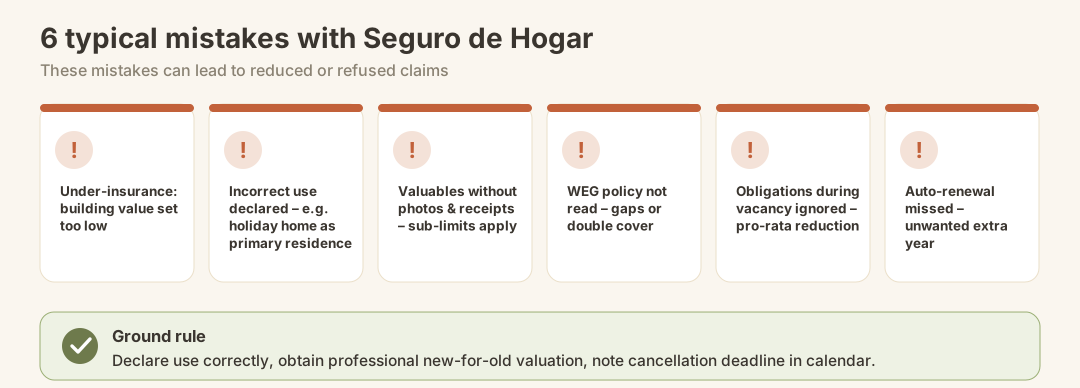
Caution:Anyone who fails to correctly declare the intended use of their property (e.g. permanent residence rather than holiday home) risks having a claim rejected on grounds of fraudulent misrepresentation.
Special considerations when letting
Anyone who lets their Mallorca property – whether short- or long-term – must adjust their insurance accordingly. Key points:
The type of use must be declared to the insurer; a property insured as a primary residence that is actually being let can cause problems in the event of a claim.
With long-term lets, the tenant is generally responsible for their own contents; building insurance remains the owner's responsibility.
With short-term lets (tourist, ETV), the risk is higher; some policies explicitly exclude commercial use.
Checklist: Taking out a Seguro de Hogar on Mallorca
NIE number and Spanish IBAN to hand
Reinstatement value of the building realistically estimated (to avoid underinsurance)
Home contents list compiled with photos and receipts for valuables
Type of use correctly defined (primary residence / holiday home / rental / vacant)
At least two to three quotes obtained
Sub-limits for jewellery, art and electronics checked
Excess consciously chosen
Community policy of the owners' association requested and cross-checked (if leasehold flat)
Obligations during vacancy read and noted
Cancellation deadline noted in the calendar
If mortgaged: bank's cover requirements met
Changes of use (e.g. rental) reported to the insurer
Conclusion: Set it up properly once, then enjoy Mallorca without a care
The Spanish Seguro de Hogar is, in its basic logic, more straightforward than the German insurance system – everything in one policy, clear terms, broad standard cover. The pitfalls lie in the details: correct declaration of use, realistic sums insured, careful cross-checking with the community policy, and observing your obligations during extended absences. Particularly for holiday home owners and landlords on Mallorca, it is worth engaging an independent German-speaking broker who can compare several insurance companies and is familiar with local particularities. Anyone who follows these fundamentals will have their insurance cover in place within a manageable amount of time – and can then focus on what really matters: enjoying the property.
Official sources
Dirección General de Seguros y Fondos de Pensiones (DGSFP): Supervisory authority for the Spanish insurance sector – https://www.dgsfp.mineco.es
Consorcio de Compensación de Seguros: State compensation fund for natural disasters and catastrophic events in Spain – https://www.consorseguros.es
Ley 5/2019, de 15 de marzo, reguladora de los contratos de crédito inmobiliario (LCCI): Governs, amongst other things, the insurance requirements associated with mortgages – https://www.boe.es/buscar/act.php?id=BOE-A-2019-3814
Is home contents insurance legally required in Mallorca?
No, it is not a legal requirement for private owners without a mortgage. However, anyone financing their property with a bank loan must provide proof of buildings insurance at the bank's request.
What is the difference between buildings insurance and contents insurance in Spain?
Buildings insurance (continente) protects the fabric of the building – walls, roof, and fixed installations. Contents insurance (contenido) covers movable valuables: furniture, electronics, jewellery, and clothing. In Spain, both are often combined into a single policy known as the Seguro de Hogar.
Why is insurance for my holiday home more expensive than for a primary residence?
Spanish insurers classify properties that are not permanently occupied as a higher risk. A holiday home that stands empty or is only used seasonally carries greater potential for damage – for example from water damage that goes unnoticed. This is reflected in a higher premium.
How long does a Spanish insurance contract run?
Spanish insurance contracts typically run for one year and renew automatically if you do not cancel in good time before they expire. Long-term contractual commitments of the kind common in Germany are not standard practice in Spain.
What do I need in order to take out a Seguro de Hogar?
You will need a copy of your identity card or passport, your Spanish NIE number, and an IBAN. Some providers also accept foreign bank accounts – if in doubt, check with the insurer.
What does the liability cover in a Seguro de Hogar include?
The property owner's liability insurance included as standard covers situations where, as the owner, you cause damage to third parties – for example through a roof tile falling off or water from your pipework leaking into a neighbouring flat.
Do I need to inform my insurer if I rent out my property?
Yes, absolutely. The type of use must be declared correctly. Anyone who rents out a property insured as a primary residence without notifying the insurer risks having a claim rejected.
Do I need my own insurance policy as a flat owner in a residents' association?
Yes. The communal insurance held by the owners' association covers the common areas and shared fabric of the building. Your individual unit and its contents are not included – you will need your own policy for those.