
Inheritance & Gift Tax on Property in the Balearics: Taxes 2026
If you inherit or transfer during your lifetime a finca, an apartment in Palma, or a villa in Son Vida on Mallorca, you face a tax that differs fundamentally from the German system: the Impuesto de Sucesiones y Donaciones (ISD), Spain's inheritance and gift tax. Crucially, it isn't the Spanish central government that sets the rate, but the respective autonomous region. And between 2023 and 2025, the Balearics pushed through a reform that effectively makes inheritances and gifts of property within the closest family tax-free. This guide explains who pays how much in 2026, why the pacto sucesorio is arguably the most important planning tool for property owners, and which deadlines you absolutely must not miss.

Mallorca inheritance tax
Explanation
Balearic law applies when the deceased spent most days of the five years before the death in the Balearics. If they were not resident in Spain, the heirs may apply the law of the region holding the most valuable part of the Spanish estate.
Explanation
The share falling to this heir, at least the valor de referencia — the cadastral reference value, below which the tax may not be assessed.
Explanation
The group decides the allowance, the tariff, the multiplier and the relief. Within group III the law distinguishes further between blood relatives and relatives by marriage.
Explanation
The larger relief for blood collaterals applies only when no descendants of the deceased inherit alongside. Disinherited descendants do not count.
- Payable (cuota a ingresar)
- €27,129.85
- Value of the inherited property
- €300,000.00
- Kinship group
- Group III — siblings, uncles, aunts, nieces, nephews
Main-home reduction: €0.00 · Value stated in the deed within the limit: Yes, value within the limit
Legal status: 25 July 2025
This calculation is provided for guidance only and is not a substitute for tax or legal advice in specific cases.
Gift or inheritance
- Difference: gift minus inheritance
- €72,219.00
- Total taxes (Gift today)
- €124,800.00
- Total taxes (Inheritance on reference date)
- €52,581.00
All preset amounts are chosen examples, not official valuations. Replace them with your figures.
Legal status: 1 January 2026
This calculation is provided for guidance only and is not a substitute for tax or legal advice in specific cases.
Impuesto de Sucesiones y Donaciones (ISD): regional, not national
Unlike in Germany, Spain has no nationwide inheritance tax rate. The ISD is indeed a national law (Ley 29/1987), but tax authority has been devolved to the Comunidades Autónomas. Each region may set its own allowances (reducciones), tax rates, and above all bonuses on the tax liability (bonificaciones). This leads to enormous differences: the same inherited property can cost a five-figure sum in Asturias and €0 in the Balearics.
Four factors determine the tax burden:
| Factor | Meaning |
|---|---|
| Kinship group | Group I+II (children, spouses, parents) pay the least; Group III/IV significantly more |
| Value of the property | Assessed via the land registry's valor de referencia or the market value |
| Connecting Factor | Residence of the deceased/donee or location of the property in the Balearic Islands |
| Reference Date (devengo) | Date of death or date of the notarial deed — determines which reform version applies |
Spanish inheritance tax recognizes four kinship groups. They are the key to the entire tax burden:
| Group | Group of Persons | Position 2026 |
|---|---|---|
| Group I | Descendants under 21 years of age | 100% bonus — effectively tax-free |
| Group II | Children 21 and older, spouses/registered partners, parents, grandparents | 100% bonus — effectively tax-free |
| Group III | Siblings, aunts/uncles, nieces/nephews, in-laws | 35% or 60% discount — depending on the type of relationship and the type of acquisition |
| Group IV | Cousins, more distant relatives, non-relatives | No general discount |
Important: An unmarried partnership only falls into Group II if it is registered as a pareja estable in the Balearic register. Without registration, the partner ends up in Group IV — and thus faces the full rate. For German couples in Mallorca, this is one of the most expensive traps.
The Balearic Reform: 100% Discount for Groups I and II
Since July 18, 2023, the Balearics have granted a 100% discount on the corrected tax liability (cuota íntegra corregida) for acquisitions upon death as well as the equivalent pactos sucesorios, provided the heir falls into Group I or II. In plain terms: a child who inherits their parents' villa pays 0 euros in ISD — regardless of value. There is no longer any upper limit.
In 2025, the reform was expanded once again with the budget law (Ley 6/2025, effective from July 25, 2025), extending it to lifetime gifts as well as raising the discount for Group III. As of 2026, the most favorable arrangement in history for family transfers in the Balearics remains unchanged.
| Scenario (as of 2026) | Discount on tax liability | Effect |
|---|---|---|
| Group I (descendants under 21) — inheritance & gift | 100 % | €0 ISD |
| Group II (children 21 and over, spouses, parents) — inheritance & gift | 100 % | €0 ISD |
| Inheritance (including pacto sucesorio) — Group III, blood relatives in the collateral line, 2nd/3rd degree (siblings, aunts/uncles, nephews/nieces) without competing descendants of the deceased | 60% (previously 50%) | strongly reduced |
| Inheritance — Group III, other cases: blood relatives in the collateral line alongside descendants of the deceased, as well as relatives by marriage | 35% (previously 25%) | reduced |
| Gift — Group III, blood relatives in the collateral line, 2nd/3rd degree, even alongside the donor's children | 60% (since July 25, 2025) | strongly reduced |
| Gift — Group III, other cases (relatives by marriage) | 35% (since July 25, 2025) | reduced |
| Group IV | no general bonus | full rate |
The most common misreading of this table: The condition without competing descendants applies only to inheritance (Art. 36 bis Decreto Legislativo 1/2014). For gifts, the law doesn't ask this question at all — Art. 54.2 grants the 60% to all blood-related collateral relatives of the 2nd and 3rd degree. A brother who receives a gift alongside the donor's children thus gets the full 60%; that same brother, inheriting alongside the same children, would receive only 35%. For relatives by marriage (in-laws), it stays at 35% in both cases. For Group III, the gift deduction has only existed since July 25, 2025 — the previous version only knew the 7% formula for Groups I and II when it came to gifts.
A technical difference that rarely matters in practice but determines the order of the calculation steps: for inheritance, the benefit is a bonificación applied to the corrected tax liability (Art. 36, 36 bis), while for a gift it's a deduction (deducción) from the cuota líquida (Art. 54). Both require, for real estate, that the value declared in the deed does not exceed the valor de referencia by more than 20%.
In addition to the bonus, there are upstream personal allowances (reducciones por parentesco) that are deducted from the tax base:
| Group | Personal Allowance |
|---|---|
| Group I | €25,000 + €6,250 per year under 21 (max. €50,000 total) |
| Group II | 25.000 € |
| Group III | 8.000 € |
| Group IV | 1.000 € |
For the deceased's primary residence, Groups I and II also benefit from a reduction of up to 100% of the value of the vivienda habitual (up to a statutory cap) — relevant especially in cases where the bonus doesn't apply.
The critical condition for real estate: For the 100% bonus to be recognized, the value of the acquired property must be stated in the notarial deed (escritura pública), and this value must not exceed the cadastral valor de referencia by more than 20%. If no valor de referencia exists, or if the Dirección General del Catastro cannot certify it, the market value serves as the limit. Anyone who sets the value too low risks an audit and the loss of the bonus.
Lifetime Gift vs. Inheritance Upon Death
Gift tax Mallorca
Explanation
What is given decides which law applies and what the deduction depends on. For a property it is always the law of the region where it lies — even when donor and recipient both live abroad.
Explanation
For a property, the value declared, at least the Valor de referencia — the official reference value of the land registry office, below which no gift may be taxed. For money, the amount given.
Explanation
The group decides the multiplier and the deduction. For gifts the law treats groups I and II alike; within group III it separates blood relatives from relatives by marriage.
Explanation
For the deduction, the Escritura pública — the notarial deed — must state a value for a property that exceeds the reference value by no more than a fifth. Where there is no reference value, the market value applies. Miss the condition and groups I and II are left with the fallback formula, everyone else with nothing.
- To pay (Cuota a ingresar)
- €0.00
- Value of the gift
- €350,000.00
- Kinship group
- Group I/II — child, grandchild, spouse, parent
Where the recipient lives: On the Balearics
Legal status: 25 July 2025
This calculation is provided for guidance only and is not a substitute for tax or legal advice in specific cases.
Until mid-2025, a crucial asymmetry applied: inheritances were 100% bonified, while ordinary lifetime gifts (donaciones) were not. They were subject to a progressive rate (7.65% to 34%), capped at an effective burden of around 7% through a regional deduction. Since July 25, 2025, this gap has been closed: ordinary gifts to Groups I and II now also benefit from a 100% deduction on the tax liability (cuota líquida) — gifting an apartment to a child via notarial deed thus costs 0 euros in ISD. As with real estate inheritances, the condition here too is that the declared value must not exceed the valor de referencia by more than 20%.
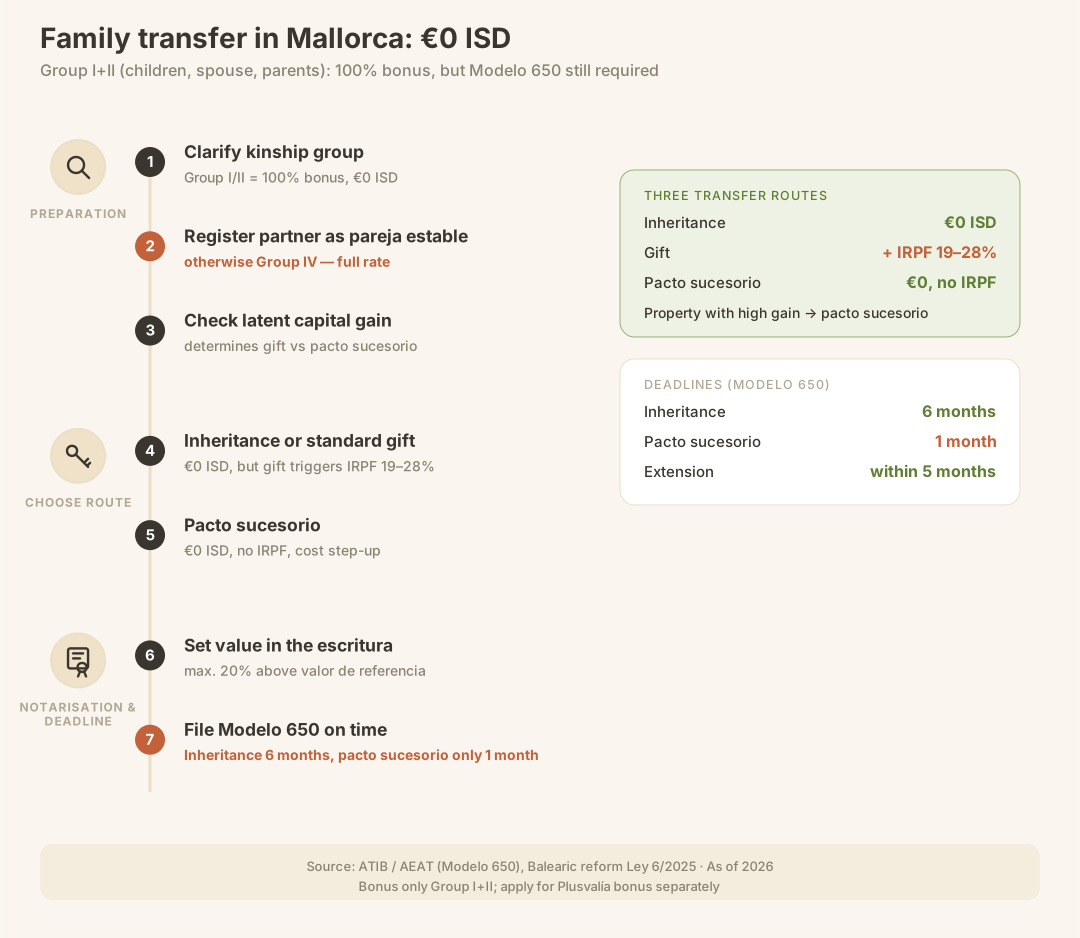
But beware: the ISD is only one of several taxes. In the case of a standard gift of a property, the donor triggers capital gains taxation under their own income tax (IRPF) — the ganancia patrimonial. If the property has increased in value over the years (which is the rule in Mallorca), this latent gain is taxed at 19% to 30% for the donor. This IRPF burden does not disappear thanks to the ISD bonus.
| Transfer method | ISD (recipient) | IRPF for the donor/deceased | When it makes sense |
|---|---|---|---|
| Inheritance (upon death) | €0 (Groups I+II) | none — the plusvalía del muerto does not apply | Standard case, no latent gain taxed |
| Standard gift | €0 (Groups I+II, since 07/2025) | yes, in case of value increase (19–30%) | Money, young assets, low appreciation |
| Pacto sucesorio | same as inheritance (1% up to €700,000) | none — treated as an acquisition on death | Real estate/holdings with high latent gains |
Rule of thumb: For cash, bank accounts, or young assets without significant appreciation, a standard gift is straightforward. For real estate with high latent gains, the pacto sucesorio is the superior route — because it sidesteps the IRPF trap.
Pacto sucesorio: the Balearic peculiarity
The pacto sucesorio is a feature unique to Balearic civil law, available only in a handful of Spanish regions with their own civil law (the Balearics, Catalonia, Aragón, Galicia, Navarre, the Basque Country). It's a contractual succession agreement that lets you transfer assets irrevocably to the next generation during your lifetime — yet for tax purposes it's treated as an acquisition on death, not as a gift.
The best-known Mallorcan variant is the definición: a transfer from parents to children in which the child, in exchange, waives their future forced-heirship share (legítima). This has been governed since Ley 8/2022, which removed the previously required Balearic vecindad civil — meaning foreigners resident in the Balearics can now enter into a pacto sucesorio under Balearic law as well.
The tax advantages are substantial:
- No IRPF for the transferor. Since the pacto sucesorio counts as an acquisition on death (Art. 33.3.b of Ley 35/2006, upheld by the Supreme Court in STS núm. 407/2016 of February 9, 2016 regarding the Galician apartación), the donor incurs no taxable ganancia patrimonial. The latent appreciation that's so feared in a standard gift goes untaxed.
- Favorable ISD rate instead of the gift-tax rate. Instead of the effective gift-tax rate, the inheritance-tax scale of 1% up to €700,000 applies for Groups I+II (where the patrimonio preexistente is under €400,000) — plus the 100% rebate on top. In practice, the ISD bill ends up at €0.
- Step-up in acquisition cost. If the child later sells the property, the (current) value declared in the pacto sucesorio counts as the acquisition cost. The gain the parents accumulated over decades effectively evaporates for tax purposes.
The 5-year lock-in (anti-fraud law 11/2021): If the child sells a property received via pacto sucesorio before the transferor's death and before 5 years have passed since the agreement, they must use the transferor's original acquisition cost and acquisition date for IRPF purposes. The step-up benefit is then lost. Anyone trying to use the pacto sucesorio as a shortcut for a quick sale comes away empty-handed.
The deadline trap: Unlike with inheritance (6 months), the deadline for the ISD self-assessment on a pacto sucesorio is only one month from the date of notarial signing. The devengo (tax trigger date) is the date of the deed, not a later date of death. Overlooking this shortened deadline risks late-filing surcharges — a common and costly trap, especially given how central this arrangement is.
The price for this: the pacto sucesorio is irrevocable. A later change via will is not possible, and under the definición the child permanently waives their forced-heirship share. This calls for careful family planning and legal guidance.
Non-residents and the EU right to choose
For a long time, non-residents faced discrimination: they had to pay ISD under the (pricier) national rate to Spain's central tax authority (AEAT), without access to the favorable regional rebates. The European Court of Justice struck this down in its ruling of September 3, 2014 (Case C-127/12) as a violation of the free movement of capital. Spain responded with Ley 26/2014: since January 1, 2015, heirs and beneficiaries resident in the EU or the EEA may apply the rules of whichever region they have a connecting link to.
Spanish courts (including STS rulings from 2018) and the tax authority (DGT ruling V0282-20) have since extended this to third countries outside the EU/EEA. Note: The statutory text of the Disposición adicional 2ª of Ley 29/1987 was not amended accordingly, meaning that third-country residents in practice sometimes have to enforce their entitlement through legal appeals. The Balearic Islands clarified with Ley 11/2023, and definitively with Ley 6/2025, that the tax benefits also apply to non-residents.
| Scenario | Competent Authority | Applicable Law |
|---|---|---|
| Deceased resident in the Balearic Islands, heir resident in Spain | ATIB | Balearic law |
| Deceased resident in the Balearic Islands, heir non-resident (EU/EEA/third country) | AEAT (Modelo 650) | Balearic law applicable |
| Non-resident deceased, property in Mallorca | AEAT (Modelo 650) | Law of the region with the highest share of assets = Balearic Islands |
| Gift of a Mallorca property to a non-resident | AEAT | Balearic law (situs) |
For German owners, this means concretely: even if you live in Germany, you can still make use of the Balearic tax benefits for a Mallorca property — but Modelo 650 is then filed with the AEAT rather than the ATIB. In parallel, German inheritance tax may apply (worldwide-income/worldwide-assets principle for German residents); there is no specific double-taxation treaty between Germany and Spain covering inheritance tax, so a credit under § 21 ErbStG needs to be examined. This is a distinct field requiring dedicated advice.
Applicable law and competent authority are two separate questions — and it's the second one that determines the deadline. Being entitled to apply Balearic law doesn't automatically mean you file with the ATIB: if the tax revenue hasn't been ceded to the Comunidad, the self-assessment under Disposición adicional 2ª Dos of the Ley 29/1987 goes to the state administration — and its deadlines then apply. For acquisitions upon death, that's likewise six months from the date of death (Art. 67.1.a Real Decreto 1629/1991). For all other cases — meaning ordinary gifts as well as a pacto sucesorio concluded during the donor's lifetime, where the six-month clock can't start for lack of a death — the period is 30 working days from the day after the legal transaction (Art. 67.1.b Real Decreto 1629/1991), not the one-month period from the Balearic Art. 90.2 of the Decreto Legislativo 1/2014. Business days here means: Saturdays, Sundays, and public holidays don't count (Art. 30.2 Ley 39/2015). Anyone living in Germany who gifts a Mallorca property or transfers it via pacto sucesorio should therefore calculate the deadline according to the AEAT's calendar — the one-month figure applies to the ATIB.
Spanish will and Plusvalía
A Spanish will is strongly recommended for every Mallorca owner: it significantly speeds up the process, avoids costly translations and apostilles of a German will, and allows you to choose your home country's law under the EU Succession Regulation (No. 650/2012). We cover this in detail in the linked article — here, just a pointer: plan the Spanish will alongside your tax planning, not after it.
For an inherited property, a second levy applies alongside the ISD: the Plusvalía municipal (IIVTNU), a tax on the increase in value of the land, levied by the respective municipality. It applies only to urban land (terrenos urbanos) and is payable by the acquirer.
In Palma, the municipal ordinance (Ordenanza fiscal) grants a rebate of up to 95% on the Plusvalía if the inherited property was the deceased's primary residence (vivienda habitual) and the heirs are the spouse, descendants, or ancestors. Key conditions in Palma:
- The full 95% rebate is tied to a cadastral value (valor catastral) of the home below €100,000. If the cadastral value exceeds this, the benefit is reduced or doesn't apply at all — for premium properties, the cadastral value frequently exceeds this threshold.
- The rebate must be actively requested within the deadline — it is not granted automatically.
- The acquired property must be held for 5 years (exception: death of the acquirer within this period).
- The rebates also apply to transfers via pacto sucesorio / definición.
- If there has been no real increase in the value of the land, no Plusvalía is owed at all (subject to proof).
Every municipality has its own ordinance — in Andratx, Calvià, or Pollença, different thresholds and percentages apply. Before any transfer, it's worth checking the municipal ordinance at the property's location.
Deadlines: 6 months for inheritance, just 1 month for pacto sucesorio
For an inheritance, the clock starts ticking from the date of death. For a pacto sucesorio, however, it starts from the notarial deed — and a considerably shorter deadline applies there. The key dates:
| Process | Deadline | Detail |
|---|---|---|
| ISD self-assessment for inheritance (Modelo 650) | 6 months from date of death | applies even if the inheritance has not yet been accepted/divided |
| Extension request (prórroga) | within the first 5 months | grants a further 6 months; from month 7 onward, late-payment interest accrues |
| Pacto sucesorio (Modelo 650, mortis causa) | only 1 month from the notarial deed | devengo = date of execution of the deed, NOT 6 months; 30 working days if the AEAT has jurisdiction |
| Ordinary gift (Modelo 651) | 1 month from the notarial deed | devengo = date of execution of the deed; 30 working days instead if the AEAT has jurisdiction |
| Plusvalía (Inheritance) | 6 months, extendable to 1 year | at the competent Ayuntamiento |
| Back-taxation upon loss of a tax benefit | 1 month from the breach | Supplementary self-assessment + late-payment interest |
The most important practical note: the 100% bonus does not exempt you from the obligation to file Modelo 650. Even with a tax liability of 0 euros, the declaration must be filed on time — missed formalities can trigger penalties. Without a filed and settled Modelo 650, the property also cannot be re-registered in the Land Registry and therefore can neither be sold nor mortgaged. And: anyone who chooses the pacto sucesorio as their central strategy must not confuse the 1-month deadline with the 6-month inheritance deadline — otherwise late-filing surcharges loom even with zero tax due.
Most Common Mistakes
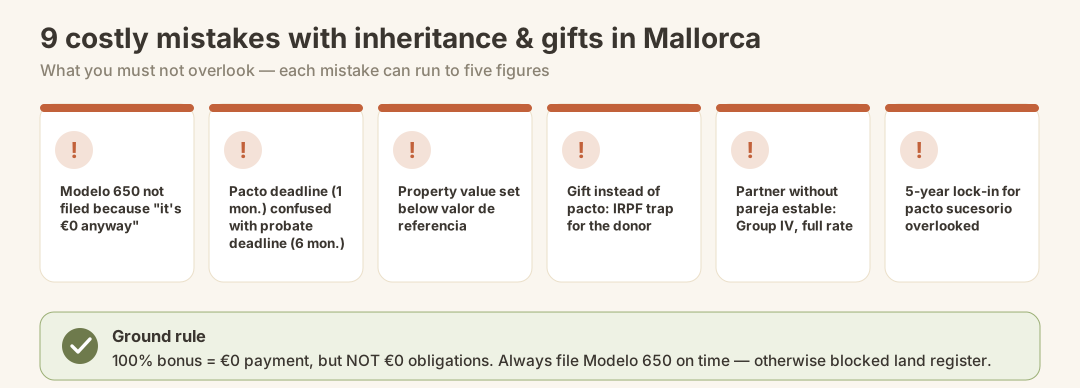
- Modelo 650 not filed because "it's 0 euros anyway." The bonus requires a timely declaration. Failure to file = formal penalty and a blocked Land Registry entry.
- Confusing the pacto sucesorio deadline with the inheritance deadline. For a pacto sucesorio, the deadline runs only 1 month from notarization, not 6 months — a common and costly trap.
- Property value declared too low. If the declared value falls below the valor de referencia, a reassessment looms; if it exceeds it by more than 20%, the bonus is jeopardized.
- Regular gift instead of pacto sucesorio for appreciated properties. The ISD may be 0 €, but the donor's IRPF capital gains tax is often overlooked — frequently a five-figure surprise.
- Unmarried partner without registry entry. Without registration as a pareja estable, the partner falls into Group IV — full tax rate instead of 0 €.
- 5-year lock-in period for the pacto sucesorio ignored. An early sale destroys the step-up benefit.
- Plusvalía bonus not applied for, or value threshold overlooked. In Palma, up to 95% — but only for a cadastral value under 100,000 € and only if applied for actively and on time.
- Forgetting German inheritance tax. With a German residence, German ErbSt can apply in parallel; without an ErbSt double-taxation treaty, crediting must be carefully reviewed.
- Extension request filed too late. The prórroga is only possible within the first 5 months — after that, the deadline expires mercilessly.
Checklist before the transfer
- Kinship group and allowance entitlement clarified (Group I/II = 100%?)
- Unmarried partner registered as pareja estable?
- Latent capital gain on the property checked → gift or pacto sucesorio?
- Cadastral valor de referencia requested, declared value determined
- Spanish will in place / choice of law made under the EU Succession Regulation?
- Jurisdiction clarified (ATIB or AEAT for non-residents)?
- German inheritance tax consequences coordinated with a German advisor
- Plusvalía reduction at the property's location researched (cadastral value threshold!) and application planned
- Deadlines in the calendar: 6 months (inheritance), 1 month (pacto sucesorio & gift), 5 months (extension request)
What comes next
Once succession is settled, further matters follow. Anyone not using an inherited property themselves should consider selling or renting it out — both have their own tax implications (IRPF, IBI, possibly Modelo 210 for non-residents). Anyone relocating their residence to the island should look early into registering with the authorities and the NIE number, which you'll need for any notarial transfer anyway. For purchasing another property, it's worth checking the additional purchase costs in Mallorca and our current market report (in German).
Conclusion
In 2026, the Balearic Islands are Spain's most tax-favorable region for passing on family wealth. Children, spouses, and parents (Group I+II) inherit and receive gifts effectively tax-free — the 100% bonus on the tax liability has applied to inheritances since 2023 and, since July 2025, to gifts as well, with no value cap. For property owners sitting on substantial latent capital gains, the decisive lever is the pacto sucesorio: it transfers ownership during the giver's lifetime, sidesteps the donor's IRPF trap, and delivers a step-up in acquisition cost. The flip side — irrevocability, a 5-year lock-in, and a tight 1-month deadline — demands careful planning. Anyone who meets the deadlines, correctly declares the property value, applies for the plusvalía bonus, and factors in the German side of things can pass on their Mallorca wealth to the next generation with minimal tax burden.
Official Sources
- Agència Tributària de les Illes Balears (ATIB) — Impuesto sobre Sucesiones, Bonificaciones y Reducciones
- ATIB — Modelo 650 (Adquisiciones Mortis Causa), Instrucciones y Plazos
- Agencia Tributaria (AEAT) — Modelo 650 No Residentes, Plazos y Prórroga
- Govern de les Illes Balears — Fiscalidad de las herencias en vida y pactos sucesorios (PDF)
- Ajuntament de Palma — Plusvalía (IIVTNU): Información, cálculo y bonificaciones
Note: This guide is for general information only and does not replace individual tax or legal advice. Tax law is YMYL-sensitive — amounts, deadlines, bonuses, and jurisdictions can change and depend on your specific circumstances (residency, degree of kinship, asset value, German tax implications). Information current as of 2026. Have your specific inheritance or gift reviewed before taking any steps by an abogado specialized in Balearic inheritance law and a tax advisor (asesor fiscal).
Calculating municipal plusvalía tax on an inherited property
To calculate municipal plusvalía tax on an inherited property, you need the deed under which the deceased acquired it, its value at the time of inheritance and the cadastral value of the land. The rules of the municipality where the property is located apply. The cadastral value of the land is not the same as the cadastral value of the entire property.
There are two ways to calculate the tax base:
- Objective method: cadastral value of the land at the time of inheritance × the coefficient for the period between the deceased’s acquisition and the inheritance. The applicable coefficient depends on the municipality’s rules.
- Actual increase in value method: difference between the value at the time of inheritance and the earlier acquisition value × the land’s share of the total cadastral value. The values used must be supported by documents.
The municipality’s tax rate is then applied to the relevant tax base. In Palma, the objective method is used unless you expressly request a calculation based on the actual increase in value and provide the required documents. The City of Palma explains the calculation and the information required. If the property is in another municipality, its rules apply. If it can be shown that the land has not increased in value, no plusvalía tax is due.
This is general information, not legal or tax advice.
This guide provides a general overview of the legal position and does not replace legal or tax advice on your individual circumstances. Laws and deadlines may change; the linked official sources are authoritative.