
Transferring an ETV licence in Mallorca: transfer, plaza freeze and value on purchase
Anyone buying a property in Mallorca with the aim of renting it out short-term to holidaymakers will quickly encounter three letters: ETV – Estancia Turística en Vivienda. Since February 2022, a moratorium has been in place across the Balearen that has largely frozen the issuing of new holiday rental licences. This makes transferring an ETV licence in Mallorca the central issue in any yield-driven property purchase. In this guide, you will learn how the transfer of an existing ETV licence works legally when ownership changes hands, what the Decreto 4/2025 and the new lottery process of March 2026 mean, which licences are actually transferable, how to protect the licence within the purchase contract, and why licensed properties now command a noticeable price premium.

Do you have a specific property with an ETV licence in mind – or are you still searching?
- 📩 Submit a personal enquiry — We will check the licence status, transferability and purchase risks on your behalf
- Everything you need to know about holiday rentals in Mallorca
What an ETV licence is – and why it has become so scarce
The ETV (Estancia Turística en Vivienda) is the official permit for the short-term tourist rental of a residential property in the Balearen. It allows rentals of fewer than 30 days and entitles the owner to list the property on platforms such as Airbnb or Booking.com. Once granted, an ETV remains permanently valid – it has no expiry date and does not need to be renewed periodically.
The licence is tied to a specific number of tourist places (plazas turísticas) approved for the property. Each place corresponds to one legally rentable guest bed. The total of all approved plazas on the island constitutes the quota managed by the Consell de Mallorca.
Since 11 February 2022, the Balearenregierung has not issued any new plazas – and, in effect, no new ETVs. The moratorium was originally intended to be time-limited, pending the introduction of new zoning requirements. That review process dragged on, with the result that the moratorium in its basic form remained in force until 2026. In March 2026, a limited quota was made available for the first time via a lottery process – more on this in a dedicated section.
The consequence: anyone wishing to enter the tourist rental market today will, as a rule, only be able to do so by purchasing a property that already holds a valid ETV.
The April 2025 decree: what has changed structurally
In April 2025, the government of Marga Prohens (PP), with support from Vox, passed the so-called decree on measures to curb tourism. It introduced several significant structural decisions:
| Provision | Detail |
|---|---|
| Ban on new places in multi-family buildings | No new ETV licences for flats in multi-occupancy buildings – in line with the model already in place in Palma and Ibiza, now extended to cover the entire archipelago |
| Stabilisation of existing stock | Holiday rental licences approved before 2017 are frozen in number and secured on a long-term basis |
| Palma: permanent ban | A permanent ban on new ETV licences applies to the capital – regardless of any future moratorium decisions |
| ETV60 category | A dedicated licence category has been introduced for primary residences with a maximum of 60 rental days per year |
Please note: The decree does not mean that existing licences expire. Anyone purchasing a flat in a multi-family building with an existing ETV takes on a licence that remains legally valid. Only new plazas in this property category are blocked.
Palma as a special case: permanent licence ban
Whilst the island-wide moratorium remains in principle open to political revision, the situation in Palma de Mallorca is clearly regulated: a permanent ban on new ETV licences applies to the capital. This holds regardless of any decisions taken at island or regional level.
For buyers, this means: a Palma property without an existing ETV will, in all likelihood, never obtain a licence for short-term tourist rentals. Existing Palma ETVs are therefore even rarer and more valuable than elsewhere on the island.
The 2026 lottery process: 1,069 new places
In March 2026, the Consell de Mallorca opened a new procedure for the allocation of holiday rental licences – the first since the 2022 moratorium. The following key details were announced:
| Feature | Details |
|---|---|
| Total allocation | 1,069 tourist places |
| Allocation procedure | Public lottery (no longer first come, first served) |
| Application deadline | Until 8 April 2026 |
| Eligible property types | Detached houses, terraced houses, semi-detached houses; primary residence with restriction (ETV60) |
| Flats | Not eligible |
| Cost – detached house | 3.500 € per plot |
| Costs for terraced/semi-detached house | 875 € per plot |
| Costs ETV60 (primary residence) | 291,67 € per plot |
| Transfer restriction | Non-transferable for 5 years from licence award |
Note: The five-year transfer restriction on newly awarded licences is legally significant from a property-purchase perspective. Anyone who receives a new licence through the 2026 lottery process will not be able to sell that property with a fully transferable ETV until 2031 at the earliest. For buyers, this is a mandatory due-diligence point.
How the transfer of an ETV licence works when buying a property
In Spain, the ETV licence is fundamentally tied to the property, not to the individual owner. This sounds straightforward at first, but the devil is in the detail: the moratorium has also temporarily restricted the transfer of existing licences.
The basic legal framework
Under normal conditions — that is, outside of moratoriums and restrictions — the transfer of an ETV proceeds as follows:
- The seller hands over the licence documentation with all plazas and the registration number from the Nuevo Registro Único de Alquiler (NRUA).
- A notary certifies the change of ownership of the property. The licence is explicitly listed in the purchase contract as part of the subject matter of the sale.
- The buyer notifies the relevant tourism authority (Conselleria de Turisme, Govern de les Illes Balears) of the change of ownership and updates the entry in the NRUA.
- A new registration number or an update to the existing one — all listings on platforms must display this number from that point onwards.
What the moratorium means for ongoing transfers
Research indicates that since 2022 the moratorium has temporarily restricted both the issuance of new licences and the transfer of existing ones. For purchases already under way or planned for the future, the following applies: have the specific licence status and current transferability checked by a specialist lawyer before you pay any deposit. The legal situation continues to evolve and varies depending on the licence type and the year in which the property was built.
Step by step: securing the ETV licence when buying
Precisely because the value of a licensed property depends substantially on a smooth transfer, a structured process is essential:
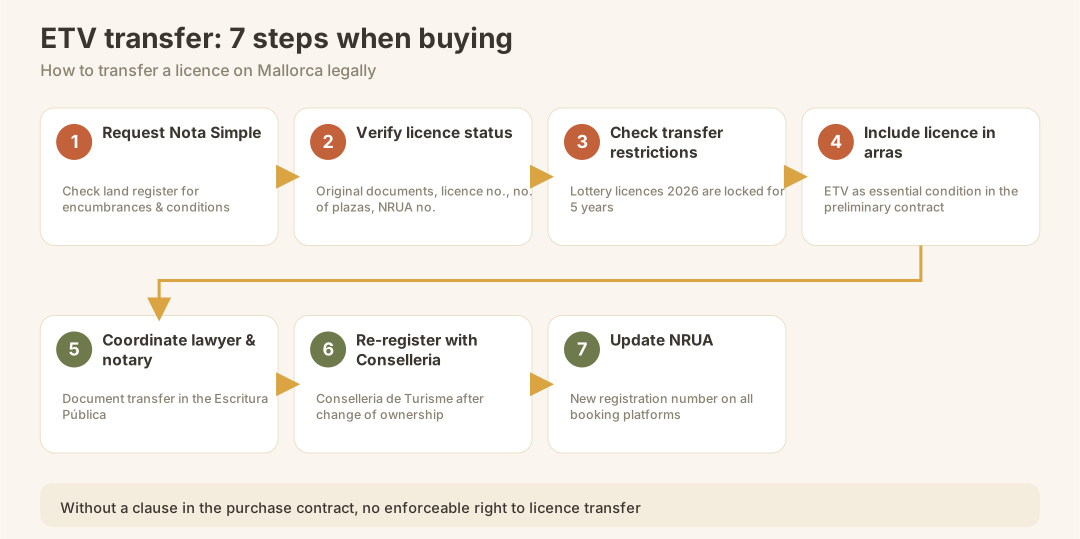
- Request a land registry extract (Nota Simple) — Check whether the property is free of encumbrances and whether any conditions are recorded. → Checking the Spanish land registry
- Verify licence status – Request the original ETV documents: licence number, date of initial grant, number of plazas, NRUA registration number.
- Check transfer restrictions – Licences from the 2026 lottery process are blocked for five years. For older licences too: has a transfer been applied for recently that may still be pending?
- Include the licence explicitly in the preliminary contract (arras) – The reservation contract or arras contract must include the ETV as an essential condition: the purchase falls through if the licence cannot be effectively transferred. → Reservation contract Spain
- Coordinate solicitor and notary – The notary must document the licence transfer in the Escritura Pública.
- Re-register with the Conselleria de Turisme following the transfer of ownership – clarify the deadline and procedure in line with current administrative practice.
- Update the NRUA entry – All booking platforms require the correct, up-to-date registration number.
Which licence types exist – and what can be transferred
| Licence type | Description | In a multi-unit building? | Transferable? |
|---|---|---|---|
| ETV (classic) | Year-round holiday letting, open-ended | Yes (existing stock), no (new) | In principle yes, observe moratorium rules |
| ETV60 | Primary residence, max. 60 days/year | No | Restricted (tied to primary residence) |
| New lottery licence (from 2026) | Detached, terraced or semi-detached house | No | Only after 5 years |
| Palma legacy licence | ETV granted before the Palma ban | Yes (existing stock) | Generally yes – highly valuable |
Note: The ETV60 licence is conceptually tied to the owner's primary residence. If ownership transfers to a person who does not use the property as their primary residence, the letting authorisation under this category lapses. Do not purchase a property with an ETV60 as a pure investment without first obtaining legal clarification.
What an ETV licence adds to a property's value
The scarcity of transferable licences has turned a licensed property into a distinct asset class in its own right. Systematic price-comparison data from the research available does not provide concrete market figures — but the market situation is clear: several estate agencies and solicitors confirm that properties with a valid ETV are in significantly higher demand than comparable unlicensed properties.
Why the premium is structurally justified:
- Anyone who buys without an existing licence can never enter the tourist-letting market in Palma, and elsewhere on the island only via a lottery process with an uncertain outcome.
- The issuance costs for new licences (up to €3,500 per place) and the lottery risk are already priced in.
- A licensed villa or finca generates legal rental income immediately from the day of key handover.
- Platforms such as Airbnb require the NRUA registration number without exception — without it, no listing is possible.
The downside: anyone who overpays for the licence must be able to justify the rental income over the years ahead. Have a return-on-investment calculation prepared before agreeing to the premium.
Taxes and reporting obligations when operating a transferred ETV
A transferred ETV does not exempt you from ongoing tax obligations. In brief:
| Tax / Obligation | Who? | Note |
|---|---|---|
| IRPF (income tax, residents) | Residents | Rental income as capital income or income from economic activity |
| IRNR (non-resident tax) | Non-residents | Quarterly return; 19 % (EU/EEA) or 24 % |
| IVA (VAT) | Where additional services are provided (cleaning, breakfast) | Verify whether taxable services are present |
| Balearic Tourist Tax (ITAT) | Landlord collects on behalf of the authorities | Tiered according to season and category |
| NRUA registration | Mandatory | Number must appear in all listings |
→ More on the tax aspects as a non-resident: Taxing rental income as a non-resident
Most common mistakes in ETV transfers
1. Licence not secured in the preliminary contract Without an explicit clause in the arras or purchase contract, there is no legally enforceable right to the transfer of the licence. Sellers can theoretically claim that the licence does not form part of the subject matter of the sale.
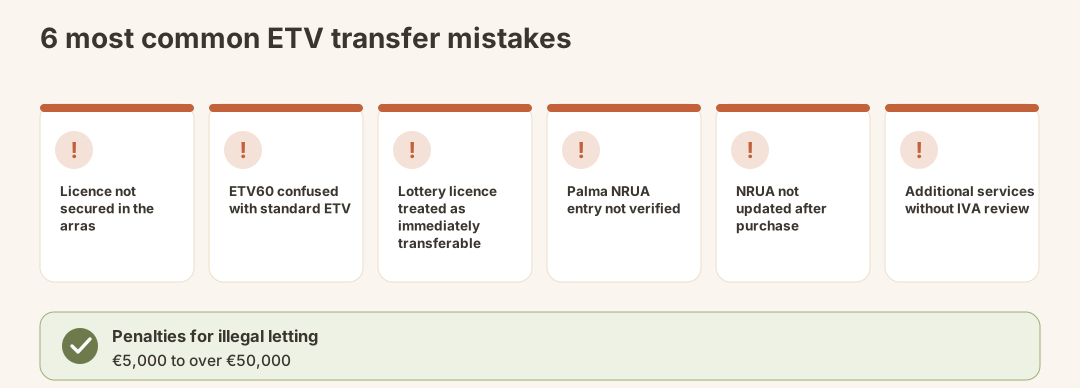
2. ETV60 confused with a standard ETV An ETV60 permits only 60 rental days per year and is tied to the primary residence. Anyone seeking a return on investment needs a standard ETV.
3. New lottery-scheme licence treated as immediately transferable Licences awarded through the 2026 lottery procedure are subject to a five-year transfer restriction. A property with a newly issued licence cannot be resold with that licence for at least five years.
4. Palma licence in a multi-unit building not verified In Palma, older ETV licences exist for flats that remain valid. However: is the licence correctly recorded in the NRUA? Is there any pending suspension by the authorities? This must be checked before purchase.
5. NRUA entry not updated after purchase Without an update in the national register, the property still shows the previous owner. In the event of a dispute or platform checks, this can lead to listings being blocked.
6. Additional services offered without checking IVA liability Landlords who offer cleaning, transfers or breakfast can inadvertently become subject to IVA obligations. This is not an ETV-specific issue, but it is a frequently overlooked problem when starting out with lettings.
What comes next? Operations and value preservation
Once you have successfully taken over the ETV, the actual operation begins. A few points you should keep in mind:
- Cédula de Habitabilidad: The habitation certificate must be valid and must correspond to the licensed occupancy figure. → Cédula de Habitabilidad Mallorca
- Energy certificate: Mandatory document for all rented properties. → Energiezertifikat Spanien
- Insurance: Different requirements apply to tourist rentals than to owner-occupation. → Contents Insurance Spain
- Owners' Community (Comunidad): In apartments within multi-family buildings, the community may pass resolutions imposing restrictions on tourist rentals. → Owners' Community Spain
- IBI and Wealth Tax: Ongoing taxes that arise independently of the ETV. → IBI Tax Spain
ETV Transfer Checklist for Property Purchase
- Obtain the licence document and original issue date from the seller
- Number of approved plazas turísticas documented
- NRUA registration number present and valid
- Moratorium status and transferability confirmed by a solicitor
- Transfer restriction (5 years for lottery-allocated licences) checked where applicable
- ETV type identified (classic / ETV60 / Palma legacy licence)
- Licence included as an essential contractual element in the arras/purchase agreement
- Notary informed of licence transfer and documented in the escritura
- Re-registration with the Conselleria de Turisme planned following change of ownership
- NRUA entry updated to reflect new owner
- Cédula de Habitabilidad checked for validity
- Energy certificate in place
- Tax obligations (IRPF/IRNR, ITAT, IVA where applicable) discussed with a tax adviser
Conclusion
The ETV licence on Mallorca has long since ceased to be a mere bureaucratic formality — it is a stand-alone asset that determines whether a property may be used for tourist rental. The moratorium in place since 2022, the permanent Palma ban, the decree of April 2025 prohibiting new residential licences, and the five-year transfer restriction on newly issued licences have frozen the stock of transferable ETVs at a scarce, structurally protected level. This makes every existing, correctly registered, and validly transferred licence a genuine unique selling point at the point of purchase.
Anyone who approaches this correctly — securing the licence contractually, documenting the transfer without gaps, and keeping on top of tax obligations from the outset — is not merely buying a property, but also the right to market it legally in one of Europe's most attractive tourism markets.
📩 Let us review your ETV case together
Official Sources
- Govern de les Illes Balears – Conselleria de Turisme: Approvals and NRUA register → https://www.caib.es
- BOIB (Butlletí Oficial de les Illes Balears): Decree April 2025 and all Balearic legal acts → https://www.caib.es/govern/boib/
- Consell de Mallorca – Departament de Turisme: Zoning, quotas, lottery procedure 2026 → https://www.conselldemallorca.net
- Habtur – Associació d'Habitatges Turístics de Balears: Industry association, advice on licensing procedures, Tel. 656 604 852 → https://www.habtur.com
- Ajuntament de Palma: Municipal regulations on the ETV ban in Palma → https://www.palma.cat
- AEAT (Agencia Tributaria): Tax obligations on rental income → https://www.aeat.es