
Leasing a garage, commercial premises or land in Spain
If you want to let a garage, commercial premises or a plot of land in Spain, you don't just need three versions of the same rental agreement. The first thing to establish is what is being let and for what purpose: A parking space may be included in a residential tenancy agreement or let separately. For a shop, business use is the main consideration. For a plot of land, the agreement must be especially clear about the area and the use it covers. These distinctions determine which clauses are appropriate and how the agreement is classified legally.
Here you'll learn how to prepare an agreement for each type of property, which points about the term, deposit, alterations and handover should not be left unresolved, and why a residential tenancy template is no shortcut in these cases. This guidance will help you clarify questions before signing; it is no substitute for a review of the specific agreement. Not legal or tax advice.

Which type of rental agreement is right for a garage, commercial premises or a plot of land?
Spain's rental law, the Ley de Arrendamientos Urbanos (LAU), distinguishes residential tenancies from lettings for other purposes. Under Article 2, the key feature of a residential tenancy is that a habitable building serves primarily as the tenant's permanent home. A garage let together with a home can form part of that tenancy. But that does not mean every separately let parking space is a residential tenancy.
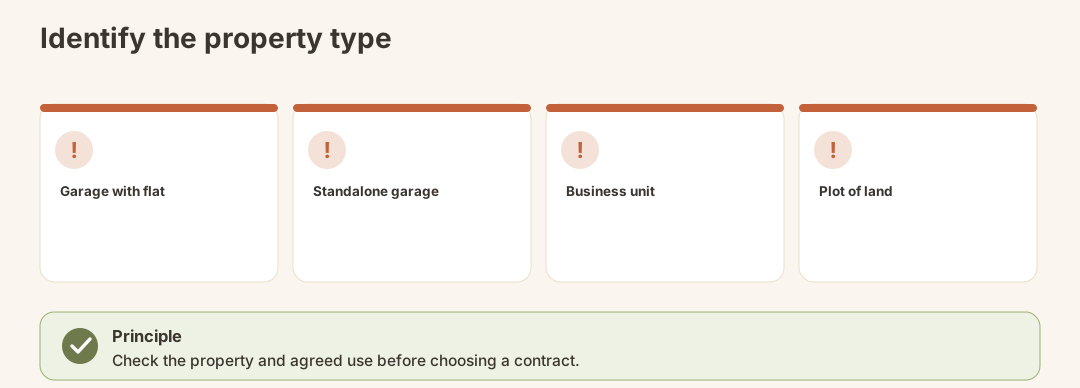

| Property being let | First question for the agreement | What to watch out for |
|---|---|---|
| Garage let together with a home | Is it part of the home being let? | Clearly identify the parking space and the right to use it in the residential tenancy agreement. |
| Separate garage or parking space | What is being let independently of any home? | Describe the property and access to it separately; do not adopt residential tenancy clauses without checking them. |
| Shop, office or workshop | Is a building or part of a building used primarily for a purpose other than living in it? | Tailor the agreement to the agreed business use. |
| Plot of land | Which area and what use are being let? | Check how the letting is classified in the individual case and set out any limits on use particularly precisely. |
Where a property has both residential and business uses, a heading such as “commercial lease” is not enough to determine how the agreement is classified. Describe which rooms are being let for which purposes and which use takes precedence. You can find more on this distinction in the guide to residential tenancy agreements in Mallorca.
How do you draw up a rental agreement for a garage?
Start with the parking space itself: identify the building, location, space number and access arrangements so there can be no confusion. State whether the tenant may use only a marked space or other areas as well. For a lockable garage, record the keys handed over and the condition of the door and access in the handover report.
Next, set out the permitted use. Is the space solely for parking a vehicle, or may other items be kept there too? The more precisely the agreement describes its use, the easier it will be to resolve any disputes later. Also state the rent, payment terms, duration, termination and return arrangements explicitly.
Important: If the parking space is rented together with a home, first check how it is covered by the residential tenancy agreement. A separate garage agreement template may misrepresent what has actually been agreed.
How do you draw up a lease for commercial premises?
For a shop or office, describing the use simply as “commercial” is often not enough. Specify the intended activity and, before signing, clarify what requirements the tenant must meet to carry it out at that particular location. A lease alone does not guarantee that every planned activity can be conducted there.
Provisions on alterations, fixtures and fittings, and succession to the business are particularly important. State who may commission work, who pays for it and what condition the premises must be returned in. If subletting or transferring the lease is to be handled differently from the relevant statutory provisions, say so explicitly in the agreement. For commercial premises in particular, these points can have significant financial consequences.
How do you draw up a lease for a plot of land?
For a plot of land, start by defining the boundaries of the area being leased. Describe its location and extent; an attached plan can help distinguish access routes from areas that are only partly leased. Then specify the intended use: leasing land for parking is contractually different from leasing land on which the tenant wants to build structures.
State explicitly what happens to any installations, connections and alterations when the agreement ends. Check the legal classification of the particular plot rather than applying the rules for a shop or a home to it. If it is a rural plot with a proposed building project, the guide to building on rural plots in Mallorca is also relevant.
Which clauses should the agreement include?
A good agreement answers the questions that might otherwise arise only when a payment is late, alterations are requested or the property is returned. Go through these points for all three types of property:
| Clause | Specify clearly |
|---|---|
| Parties and property | The parties to the agreement, the precisely defined area, and any access or equipment included |
| Use | Permitted use and restrictions |
| Rent and expenses | Rent amount, payment and allocation of agreed ongoing expenses |
| Term and termination | Start date, agreed term and options for ending the agreement |
| Alterations | Consent, payment and removal of alterations or installations |
| Transfer | Subletting and assignment of the agreement |
| Handover | Condition, vacating the premises and returning keys or access devices |
For commercial premises, you should be particularly careful about how the agreement deals with a possible transfer of the business. A Traspaso may involve a successor taking over an existing lease; the agreement should clearly distinguish this from the acquisition of business equipment and fittings.
What are the rules on deposits and lease terms?
For letting for purposes other than residential use, the LAU requires a deposit of two months’ rent. Whether and how this provision applies to a standalone garage or a specific land lease should be checked against its legal classification, rather than simply copying the amount from a template.
| Item | Details to check in the agreement | Significance |
|---|---|---|
| Commercial premises covered by the LAU | Deposit of two months’ rent | Record in the agreement what is paid as a deposit. |
| Standalone garage | Check its classification before applying the deposit rule | Do not assume that letting a garage constitutes a residential tenancy. |
| Term for commercial use | The contractual agreement is particularly important | Clearly state when it begins and ends, as well as the available options. |
Do not assume that the rules on extending and terminating residential tenancies also apply to commercial premises. Nor does a short term remove the need to check the use actually agreed. If you are considering additional security, distinguish it clearly from the deposit in the contract.
How do you prepare for signing and handover?
A contract is easier to understand when its attachments match the property described. Here is what to do:
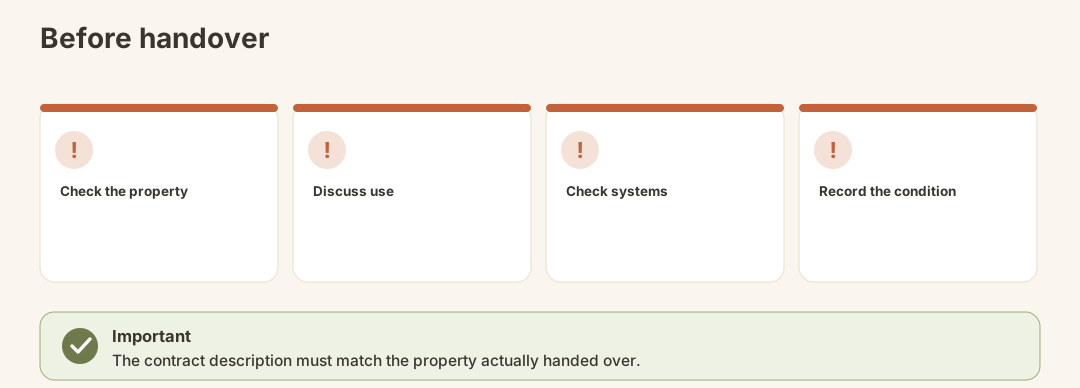
- Check the property: Compare the contract description with the actual area and any access included.
- Discuss the intended use: Ask the tenant to specify how they plan to use the property before drafting the permitted-use clause.
- Allocate costs and work: Clarify who is responsible for each ongoing expense and any agreed alterations.
- Check the contract and attachments: Make sure any plans, inventory or other attachments are included.
- Document the handover: Record the condition, existing fittings and access devices handed over together.
For premises with existing fittings, an inventory is helpful. For a plot of land, a plan may be more important than a lengthy general description.
Most common mistakes
The most common mistake is using a template contract for the wrong type of rental. A parking space let with a home, a garage let separately and a shop should not be treated alike simply because rent is paid in each case.
Unclear areas, blanket permission for “commercial use” and no agreement on alterations are equally risky. With plots of land, an imprecise description often becomes apparent only when access, installations or the return of the property are disputed. With commercial premises, subletting and the transfer of the business are easily overlooked.
Note: A contract should not state that an intended use is authorised if this has not yet been established for the specific property.
What happens next?
After signing, both parties should receive the same version of the contract, including its attachments. Keep the handover record and any later written agreements about alterations. If the use changes, additional space is to be added or someone is ready to take over the business, review the existing agreement before making the change.
If you are still looking for suitable space, do not compare properties on monthly rent alone. The exact area, permitted use and condition are at least as important when discussing the contract.
Checklist before signing a rental agreement
- Has it been clarified whether the garage belongs to the home or is let separately?
- Are the premises, parking space or plot of land clearly described?
- Is the intended use clearly specified?
- Are rent, costs, deposit and any other security arrangements set out separately?
- Are the start and end of the tenancy, and the return of the property, clearly worded?
- Are alterations, installations and any required reinstatement covered?
- For commercial use, has the assignment of the lease been considered?
- Do the annexes and handover report match the property actually being let?
Conclusion
The right contract starts not with a template, but with identifying the property and its use. For a garage, the key question is whether it belongs to a dwelling; for commercial premises, the business activity and any alterations need clear rules; for a plot of land, its area and limits on use are central. Only then can the deposit, term and return of the property be addressed appropriately.
Official sources
- Boletín Oficial del Estado (BOE) – Ley 29/1994 de Arrendamientos Urbanos (LAU), particularly the distinction between residential tenancies and the provisions on deposits for other uses.
- Boletín Oficial del Estado (BOE) – Código Civil as a further legal basis, particularly when reviewing contracts for plots of land.