
Zonas Tensionadas Mallorca: Does the rent cap apply to you?
Rents in Mallorca are soaring — yet the island does not appear on any official list of zonas tensionadas. This guide explains why, what Spain’s 2023 housing law (Ley 12/2023) still means for you as a tenant or landlord, and which rules have applied to the rent index since 2025. You’ll learn how a zona tensionada is designated, which five specific tenant rights apply in such areas, what the new IRAV index means for rent increases, and why landlords in Mallorca already have to meet certain obligations under the Ley de Vivienda — whether or not an area has been designated as under housing pressure.

What is a zona tensionada — and how is one designated?
A zona de mercado residencial tensionado is an area defined by law where the housing market is so stretched that homes are no longer affordable for a significant share of the population. The legal basis is the Ley 12/2023, de 24 de mayo, por el Derecho a la Vivienda — Spain’s most comprehensive housing law in decades.
For an autonomous community to apply to the state for a designation, the law requires at least one of two criteria to be met:
| Criterion | Threshold |
|---|---|
| Housing costs (rent/mortgage + basic costs) as a share of household income | more than 30 % of median household income in the area |
| Price increases over the past five years | more than 3 percentage points above the regional IPC rate |
Crucially, the initiative lies not with the state, but with the relevant autonomous community. Madrid cannot impose a designation from above — the Balearic Islands must apply for it themselves and submit it to the Ministerio de Vivienda for approval. The designation initially lasts three years and can be extended.
Note: A designation applies to specific geographical areas — usually individual municipalities or neighbourhoods, not entire islands or autonomous communities.
Mallorca 2026: No declared Zona Tensionada — but why?
Anyone searching the lists of officially declared rent pressure zones in Spain will find Catalonia, Navarre and the Basque Country — but not a single area in the Balearic Islands. This is no oversight.
The current regional government of the Balearic Islands (Govern Balear) has yet to submit a formal application for designation. There are political reasons for this: rent controls have found little favour with the current coalition. At the same time, housing experts acknowledge that Palma and many other municipalities on Mallorca meet both criteria of the Ley de Vivienda on paper — housing costs exceed 30 % of median household income across much of the island.
What does this mean for you in practice?
| Situation | What it means on Mallorca |
|---|---|
| Zona Tensionada declared | Rent cap applies — rent on a new tenancy limited to the previous rent or reference index |
| Zona Tensionada NOT declared (current position) | No rent cap, but all other rights under the LAU + Ley de Vivienda apply |
| Rent increase during an existing tenancy | The IRAV index applies throughout Spain, regardless of designation |
This means Mallorca is not free from regulation. Many protections under the 2023 housing law apply even without rent pressure zone status.
Five tenants’ rights in a declared Zona Tensionada
For areas that have already been declared (and as an indication of what would also apply on Mallorca if the Balearic Islands government were to apply), the Ley de Vivienda provides five specific safeguards:
1. Rent cap on new tenancies
In declared rent pressure zones, the rent for a new tenancy must not exceed the rent under the last valid tenancy agreement be. For homes that have not been rented out in the past five years, the national reference index (Sistema Estatal de Referencia de Precios de Alquiler, SERPAVI) sets the upper limit.
2. Rent capped at the previous tenant’s rate
When a new tenant moves into a property, the rent generally cannot be raised above the amount last agreed — even if some time has passed between the two contracts.
3. Ban on passing new costs on to tenants
In designated high-pressure rental areas, landlords cannot start passing on additional costs (e.g. community fees, IBI, home insurance) to tenants if those costs were not included in the previous contract.
4. Exceptional extension (Prórroga Extraordinaria)
Tenants facing financial hardship at the end of their standard tenancy (after 5 or 7 years, respectively) can request an exceptional extension of up to one year in designated high-pressure rental areas. The landlord is generally required to accept it — unless they can demonstrate that they need the property for themselves or their family.
5. Protections for vulnerable tenants
If a tenant in a designated high-pressure rental area is classified as vulnerable (vulnerable), special protections apply. Among other things, eviction proceedings may be delayed or suspended until social services have coordinated alternative arrangements.
Please note: These five rights currently do not apply in Mallorca because no area of the Balearic Islands has been officially designated. They would only take effect following such a designation.
What already applies: Ley de Vivienda & LAU in Mallorca
Even without a zona tensionada, the 2023 housing law has changed everyday life for landlords and tenants in Mallorca. These rules apply across the island with immediate effect:
| Rule | Applies from | Who it applies to |
|---|---|---|
| The landlord pays the agency fees | since Ley de Vivienda 2023 | all long-term tenancy agreements |
| Deposit: a maximum of 2 months’ rent as additional security | since the LAU reform | Long-term rental (vivienda habitual) |
| Annual rent increases only in line with the IRAV index | from 2025 | all existing residential tenancy agreements |
| Minimum term of 5 years (where the landlord is an individual) | LAU Art. 9 | vivienda habitual |
| Minimum term of 7 years (where the landlord is a legal entity) | LAU Art. 9 | vivienda habitual |
| Notice of non-renewal after the minimum term | Landlord at least 4 months, tenant at least 2 months before expiry | LAU Art. 10.1, vivienda habitual |
| Lodging the deposit (fianza) with the authorities | Regional requirement | Landlord |
For long-term rentals on Mallorca, the basic framework governing minimum terms, deposits and responsibility for agency fees is fixed — it is not negotiable.
The IRAV index: how rent increases are calculated from 2025
This is the most significant change in practice for existing tenancy agreements on Mallorca. Since 2025, the new IRAV (Índice de Referencia para la Actualización de los Arrendamientos de Vivienda) has replaced the previous IPC as the benchmark for rent increases.
Background: The IPC rose sharply during the high-inflation years of 2022/2023, leading to exceptionally large rent increases. The IRAV is intended to ensure more moderate, stable adjustments in future.
What you need to know as a landlord or tenant:
- The IRAV is published by the INE (Instituto Nacional de Estadística).
- It applies to the annual adjustment of existing tenancy agreements — not to the rent agreed at the outset.
- Without a zona tensionada designation, it is the only legally capped means of increasing the rent during an existing tenancy.
- Any increase must be announced under the contract or by separate notice at least 30 days in advance.
Note: If your tenancy agreement has no indexation clause, the landlord cannot unilaterally increase the rent during the tenancy for the time being. Does it have a clause linked to the IPC? Then the IRAV applies automatically from 2025 — provided the agreement remains in force after the new rules take effect. Seek legal advice about your specific agreement.
Seasonal tenancy agreements: An attempt to sidestep rent controls
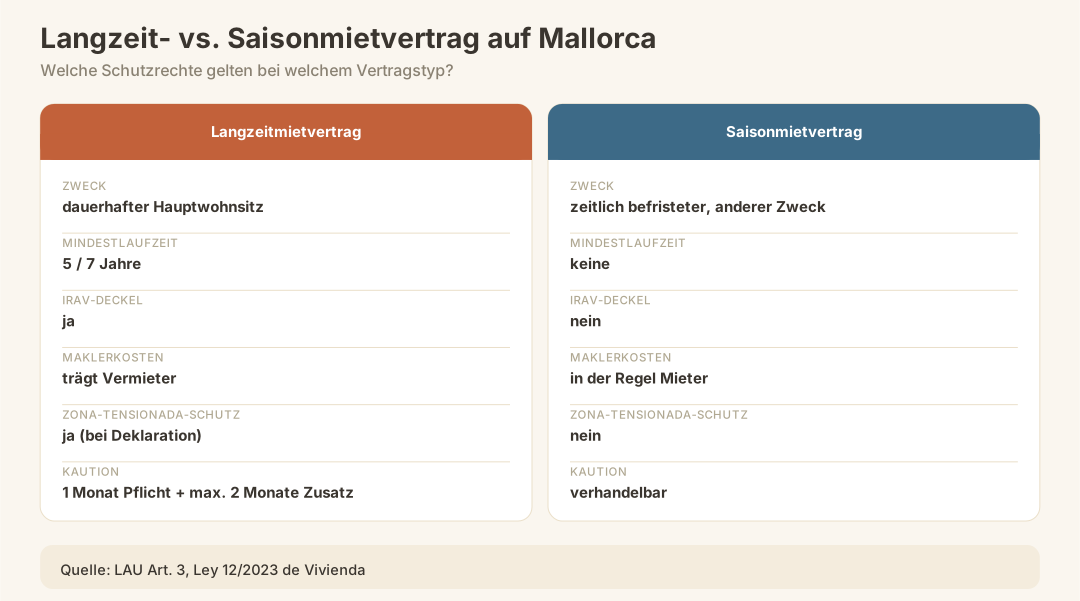
A common practice in Mallorca: landlords use the seasonal tenancy agreement (arrendamiento de temporada, LAU Art. 3) to circumvent the protections afforded to a vivienda habitual. Unlike a long-term tenancy agreement, this type of contract is not subject to the LAU’s residential tenancy protections — minimum term, IRAV limits and the landlord’s obligation to pay estate agent fees do not apply in the same way.
What you should know:
| Criterion | Long-term tenancy agreement | Seasonal tenancy agreement |
|---|---|---|
| Purpose under the LAU | permanent main residence | temporary, for another purpose |
| Minimum term | 5 / 7 years | none |
| IRAV cap | yes | no |
| Estate agent fees | paid by the landlord | usually paid by the tenant |
| Zona tensionada protection | yes (if declared) | no |
| Deposit | 1 month mandatory + max. 2 additional months | negotiable |
Important: If you will actually live in the property permanently but sign a seasonal tenancy agreement, this may legally be considered an attempt to circumvent the rules. In that case, courts can subsequently classify the agreement as a vivienda habitual tenancy — with all the consequences for the landlord. Ask a lawyer to check which type of agreement fits your specific situation.
Which municipalities in Mallorca could qualify as a Zona Tensionada?
Even without an official declaration, it is worth understanding which areas would be most likely to meet the formal criteria. The available rent and income data paint a clear picture:
| Area | Rent trend | Rent-to-income ratio | Likely to meet the criteria |
|---|---|---|---|
| Palma (city centre, Barrio Sindicato, Santa Catalina) | very high | severely strained | probably yes |
| Calvià / Magaluf surrounding area | high | strained | possible |
| Inca (inland) | medium-high | increasingly strained | partly |
| Manacor | medium | medium | unclear |
| Smaller coastal towns (Sóller, Pollença) | very high (seasonal) | severely strained | probably yes |
This assessment is based on the legal criteria and the general market picture — no official assessment is available because the Balearic Government has not submitted an application.
Landlord obligations in Mallorca: a checklist regardless of zone status
Whether your property is in a zona tensionada or not — as a landlord in Mallorca, you need to know about these obligations:
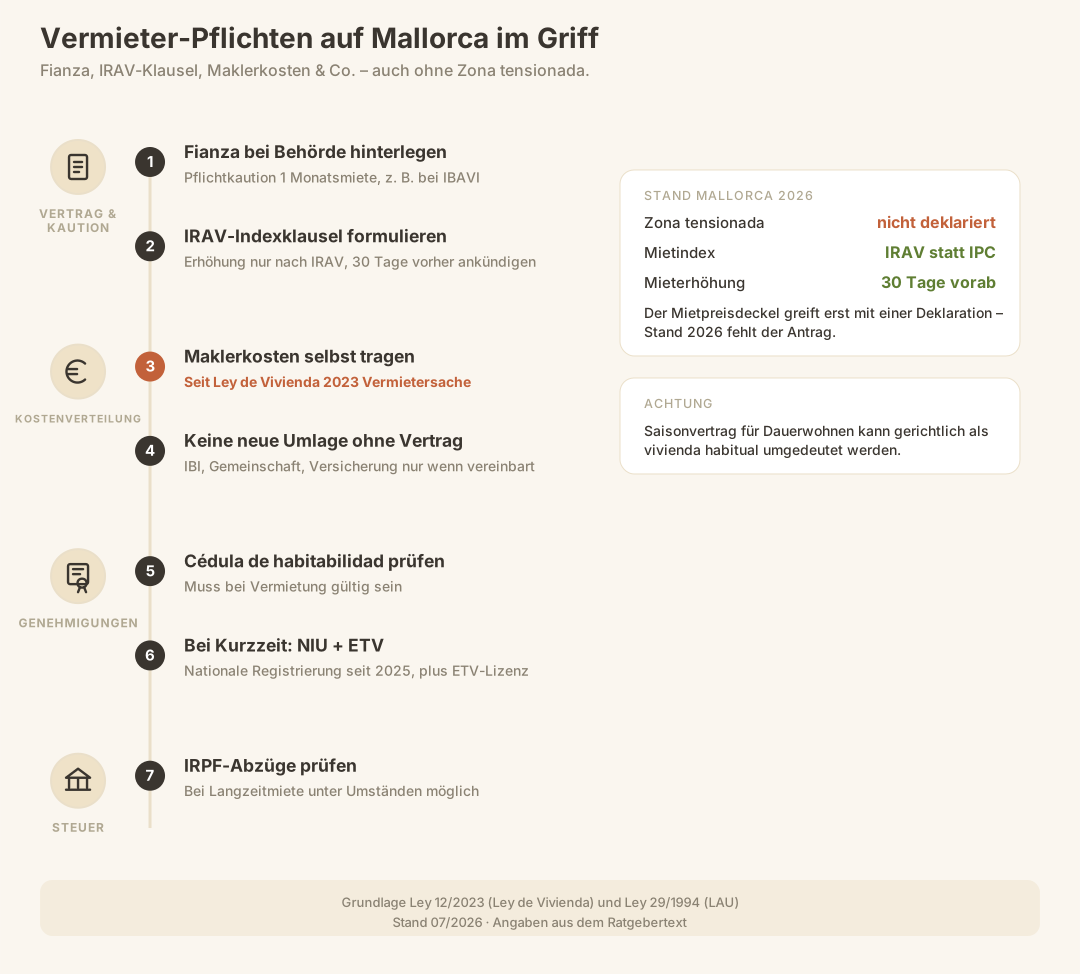
- Lodge the fianza: The mandatory deposit (1 month's rent for a residential tenancy) must be lodged with the Balearic authority (IBAVI or the relevant body).
- Word the IRAV index clause correctly: Blanket rent increase clauses that exceed the IRAV are not permitted in existing contracts.
- Do not pass estate agent fees on to tenants: For long-term rental agreements, the landlord pays the estate agent’s commission — this applies on Mallorca too.
- No new charges without agreement: Costs such as IBI, community fees or insurance can only be passed on if the contract explicitly says so.
- Cédula de habitabilidad: The property must have a valid cédula when it is let. Find out more in the Guide to the Cédula de Habitabilidad.
- Don’t forget national registration: Since 2025, short-term rentals of less than 30 days advertised through platforms have also required national registration with a Número de Identificación Único (NIU), in addition to the regional ETV licence.
- Check for tax deductions: If you let a property long-term, you may qualify for IRPF deductions. Details are in the Guide to IRPF deductions for landlords in the Balearic Islands.
Most common mistakes — by tenants and landlords
Mistakes tenants make
- Signing a seasonal rental agreement when you intend to live there permanently: This means giving up five years of housing security and IRAV protection.
- Assuming rent controls automatically apply on Mallorca: They currently do not, because no zona tensionada has been designated.
- Paying a deposit without getting a receipt: Always insist on proof that the fianza has been lodged with the relevant authority.
- Accepting a rent increase above the IRAV without checking: Just because the landlord demands it does not make it lawful.
Mistakes landlords make
- Charging estate agent fees to the tenant: Not permitted for a vivienda habitual since 2023 — including on Mallorca.
- Rent increases without an indexation clause in the contract: Without such a clause, a unilateral increase is not possible.
- Using a seasonal rental contract for a long-term tenancy: If the tenant can prove they use the property as their main residence, a court may reclassify the contract.
- Not claiming tax deductions: As a landlord, you may be entitled to IRPF deductions for long-term rentals — don’t miss out on them.
What happens next? Possible developments for Mallorca
The political situation is changing. Here’s what to watch:
- A change of government in the Balearic Islands: If another coalition takes control of the Govern Balear, a proposal to declare zonas tensionadas in Palma and other municipalities could quickly be put forward — the criteria could be met on paper.
- European pressure: Spain is under growing EU pressure to address its housing problems structurally. In the medium term, this could also influence policy in the Balearic Islands.
- IRAV developments: The new index has been in effect since 2025 — its impact on rent increases will depend on the latest INE publication. Keep track of the index figures.
- Development of the national rental register: The national rental register (Ventanilla Única Digital) has been operational since 2025. Platforms such as Airbnb and Booking.com are legally required to remove unregistered listings.
If you own or are looking to buy a property in Mallorca, you should keep a close eye on these developments. A designation can significantly affect its market value and letting strategy. It is also worth reading the guide to the Ley Vivienda Balearen.
Checklist: Are you prepared as a tenant or landlord?
For tenants in Mallorca:
- Checked the type of tenancy: vivienda habitual or temporada?
- Are the term and renewal options clearly set out in the contract?
- Has the deposit been lodged correctly, and have you received a receipt?
- Have you avoided paying the estate agent’s fees yourself?
- Checked the IRAV-based rent increase clause?
- Empadronamiento applied for using a long-term tenancy agreement?
For landlords in Mallorca:
- Has the deposit been lodged with the relevant authority?
- Is the IRAV index clause correctly included in the contract?
- Have you paid the estate agent’s fees yourself?
- Is the Cédula de habitabilidad valid?
- Checked the IRPF deductions for long-term letting?
- For short-term letting: do you have an NIU + ETV licence?
Conclusion
The stressed housing areas with their full rent caps do not apply in Mallorca as of 2026 — the Balearic government has not submitted an application. Nevertheless, Mallorca’s rental market is far from unregulated: The IRAV rent index, minimum tenancy terms, the ban on charging tenants estate agent fees and the deposit rules under Ley de Vivienda and the LAU apply across the island. Landlords who insist on the wrong type of contract risk having it reclassified retrospectively by the courts — while tenants risk losing years of security in their homes. The political situation could change: A new regional government could apply for a designation, at which point the five tenants’ rights under the housing law would come into force overnight. Being well informed — now — is the best protection.
Official sources
- Ley 12/2023 of 24 May on the Right to Housing — BOE-A-2023-12203
- Ley 29/1994 of 24 November on Urban Leases (LAU) — BOE
- State Reference System for Residential Rental Prices (SERPAVI) — serpavi.mivau.gob.es
- Instituto Nacional de Estadística (INE) — IRAV publications — ine.es
- Ministry of Housing and Urban Agenda (MIVAU) — mivau.gob.es
- IBAVI — Balearic Housing Institute — ibavi.caib.es
- Government of the Balearic Islands — Housing — caib.es
- Electronic Office of the Colegio de Registradores (Ventanilla Única Digital) — sede.registradores.org
This guide provides a general overview of the legal position and does not replace legal or tax advice on your individual circumstances. Laws and deadlines may change; the linked official sources are authoritative.