
Comunidad de Propietarios Spain: Service Charges, Resolutions & Your Rights on Mallorca
Anyone who buys a flat, apartment or unit in a residential complex on Mallorca automatically becomes a member of the Comunidad de Propietarios – the Spanish owners' community. This is not an association you can choose to join or not; it is a legally established mandatory community. It governs everything relating to the communal property: stairwells, pool, façade, lift, and garden. The legal basis is the Ley de Propiedad Horizontal (LPH), Spain's horizontal property law. This guide explains how the Comunidad works, what the service charge actually covers, how decisions are made, what rights you have – and which mistakes regularly cost German buyers on Mallorca dear.

Are you considering buying a property on Mallorca, or do you have questions about your existing Comunidad?
- 📩 Submit a personal enquiry — we connect you with experienced lawyers and property managers on Mallorca
- Everything about buying property on Mallorca
What is the Comunidad de Propietarios – and why are you automatically a member?
The Comunidad de Propietarios comes into existence by operation of law as soon as a building is divided into individual ownership units and registered in the land registry (Registro de la Propiedad). You become a member when you purchase one of those units – no signature, no application required. The Spanish horizontal property law, the Ley de Propiedad Horizontal (LPH), then governs your rights and obligations.
The Comunidad is the Spanish equivalent of the German WEG (residential owners' association), but it works differently in certain respects: voting rights are not based on the number of owners but on the cuota de participación – each unit's percentage share of the building as a whole. The owner of a large penthouse apartment therefore carries more weight than the owner of a small basement flat.
Please note: Even those who never attend a meeting remain entitled to vote and are obliged to pay. Ignoring the Comunidad will, in most cases, cost more than active participation.
The communal property (elementos comunes) comprises everything that does not form part of the private ownership of the individual units: stairwells, lifts, façades, roofs, pools, gardens, shared parking areas, and technical installations.
The key bodies: who decides what?
The Comunidad has three central bodies, each with clearly defined responsibilities.
| Body | Spanish term | Main function |
|---|---|---|
| Owners' meeting | Junta de Propietarios | Supreme decision-making body, all strategic decisions |
| President | Presidente | Legal representative, convening of meetings |
| Administrator | Administrador de Fincas | Day-to-day management, accounting, contractor assignments |
| Secretary | Secretary | Minute-taking (often the same person as the administrator) |
| Vice-President | Vicepresidente | Representation of the President (optional) |
The President is elected by the owners' assembly – in practice on Mallorca this is often done on a rotation basis or by draw, as nobody volunteers willingly. The role is theoretically honorary, but in practice carries genuine responsibility: he signs contracts, represents the community in legal proceedings, and is required to convene the annual general meeting.
The Administrador de Fincas is a licensed professional property manager. He handles the accounts, chases up late payers, coordinates tradespeople, and prepares meetings. In larger developments on Mallorca a professional manager is almost always in place; in smaller communities an owner sometimes takes on this role on a voluntary basis.
The Owners' Assembly (Junta de Propietarios): Procedure & Deadlines
The Junta is the heart of the Comunidad. This is where the budget, special levies, renovation works, and house rules are decided.
Ordinary vs. extraordinary assembly
| Type of meeting | Frequency | Typical agenda items |
|---|---|---|
| Ordinary (junta ordinaria) | At least once a year | Annual accounts, budget, election of president, maintenance |
| Extraordinary (junta extraordinaria) | As required, upon request | Urgent repairs, amendments to the bylaws, unplanned investments |
Notice period and quorum
The notice for the ordinary assembly must be delivered to owners at least three days in advance – for extraordinary assemblies this period may be shorter, provided the statutes do not stipulate otherwise. The notice must include the venue, time, and agenda.
The LPH sets no fixed quorum threshold for a valid meeting: at the first convening, a majority of owners and of the participation quotas must be represented. If this majority is not achieved, the meeting takes place at a second convening (segunda convocatoria) – at which resolutions can in principle be passed by the owners present.
Overview of voting majorities
This is the point that most frequently leads to misunderstandings. The LPH provides for different majority thresholds:
| Type of decision | Required majority |
|---|---|
| Day-to-day management (e.g. appointment of administrator, budget) | Simple majority of those present (heads + quotas) |
| Improvement measures, new services | 3/5 of all owners (headcount + quotas) |
| Changes to bylaws, changes of use | Unanimity or qualified majority depending on the case |
| New accessibility facilities | Simplified majority generally possible |
Note: The exact majority requirements depend on the specific subject matter of the resolution. For binding advice in individual cases, consultation with a Spanish lawyer is recommended.
The service charge (Cuota de Comunidad): What does it cover?
The monthly or quarterly service charge – in Spanish most commonly referred to simply as cuota de comunidad or gastos de comunidad – is the ongoing apportionment of all communal costs among the owners. There is no statutory fixed amount; this is determined by the annual budget adopted by the Junta.
Typical cost items in the service charge
| Cost item | Explanation |
|---|---|
| Cleaning & caretaker | Maintenance of stairwells, garden, pool area |
| Building insurance | Building insurance for communal parts (not contents!) |
| Lift maintenance | Regular inspection & repair |
| Water (communal) | Irrigation system, pools, cleaning |
| Electricity (communal) | Lighting for stairwells, external areas |
| Management fee | Administrador de Fincas |
| Reserve fund (fondo de reserva) | Statutory requirement |
| Extraordinary repairs | Roof, façade, lift replacement, etc. – special levy may apply |
The reserve fund (fondo de reserva) is a statutory requirement. The LPH sets a minimum level; in practice a figure of between 5% and 10% of the annual communal budget is commonly targeted. In Mallorca, actual practice varies considerably. For the binding minimum rate in individual cases, it is advisable to review the current LPH text or consult a specialist.
Please note: The service charge covers no contents insurance for your individually owned property. A separate home contents insurance in Spain must be taken out by each owner individually.
What does the Comunidad actually cost in practice on Mallorca?
The range is wide. In a small residential complex without a pool, 50–100 € per month may suffice. In upmarket urbanisations with a pool, gardener, concierge and lift, 300–600 € or more per month can arise – in luxury developments with extensive communal areas in areas such as Son Vida, Bendinat or Puerto de Andratx, costs can be considerably higher still.
Special levies (Derramas): When the budget falls short
A derrama is an extraordinary special levy that is passed when repairs or investments exceed the ongoing budget. The classic example: the roof needs renovating, a lift is being replaced, or the façade is being repainted.
The Junta must formally pass the derrama. The apportionment among owners follows – just as with the regular service charge – the cuota de participación.
Buyers inherit outstanding debts. This is one of the most important points when purchasing property on Mallorca:
Important: Upon purchase, the new owner is liable for any outstanding communal debts of the previous owner from the current and the preceding year. Before purchasing, you should ask the seller to provide a certificate confirming the current status of communal debts (certificado de deudas con la comunidad) issued by the administrator or secretary.
This certificate is generally required at the notary appointment. Find out more in the guide to the property purchase process.
Obligations & rights as an owner
Your obligations towards the Comunidad
- Pay the service charge on time – regardless of whether you use the property or not.
- Attend meetings or grant a proxy – you have both the right and an interest in participating.
- Treat communal property with care – no unauthorised alterations to the façade, terrace or communal areas without approval.
- Comply with the resolutions of the Junta – even if you voted against them, you are generally bound by them (unless you challenge the resolution through legal means).
- Inform the administrator of rental income or intentions to let – relevant for house rules and insurance obligations.
Your rights as a member
- Participation and voting rights at every meeting
- Access to all accounts, minutes and contracts of the Comunidad
- Application to convene an extraordinary general meeting (typically requiring the support of additional owners)
- Legal challenge of unlawful resolutions before the courts within the statutory time limits
- Application for the judicial removal of a president in cases of serious breach of duty
Holiday letting & the Comunidad: what the community may decide
On Mallorca in particular, the topic of holiday letting within owners' communities is extremely contentious. The LPH has been tightened in this respect in recent years:
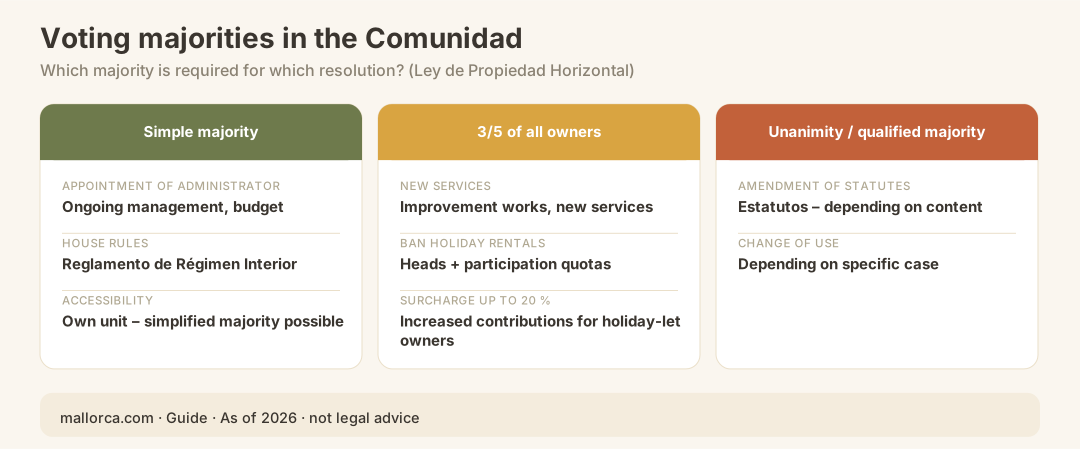
The Junta may, by a majority of 3/5 of all owners (by number of owners and participation shares) resolve to prohibit or restrict holiday letting within the development. Such a resolution is binding on all owners, including those who voted against it — provided the resolution is lawfully passed and enshrined in the community's statutes.
Please note: Whether you can apply for a tourist licence on Mallorca at all is in any case heavily restricted by Balearic tourism legislation. More on this in the guide to the ETV licence Mallorca.
In addition, the community may set higher community fees (up to a 20% surcharge) for owners who operate holiday lets — likewise by a 3/5 majority. This is a response to the increased wear and tear on communal facilities caused by a constant turnover of holiday guests.
Arrears: what happens if payments are not made?
Anyone who fails to pay their community fees is recorded in Spain as a moroso (debtor). The LPH provides the community with effective tools to deal with this:
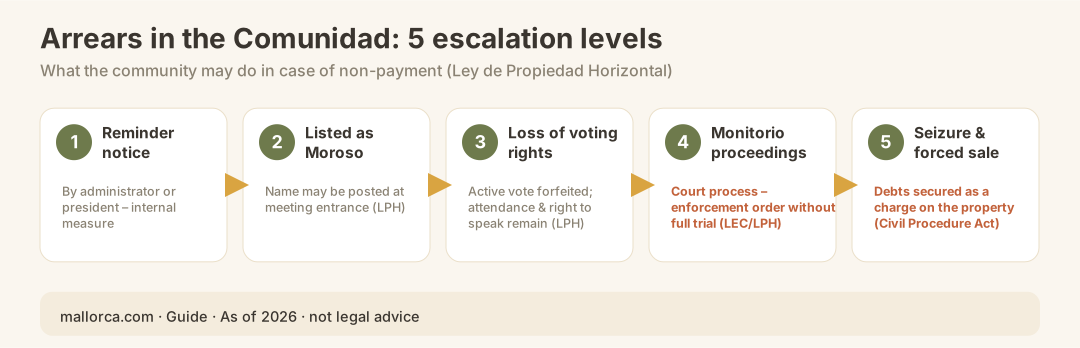
| Step | Measure | Legal basis |
|---|---|---|
| 1 | Formal reminder by the administrator / president | Internal |
| 2 | Listed as a moroso — the name may be posted at the entrance to the meeting | LPH |
| 3 | Loss of active voting rights (the right to attend and speak is retained) | LPH |
| 4 | Court order proceedings (monitorio) | LEC / LPH |
| 5 | Enforcement and, if applicable, compulsory auction | Code of Civil Procedure |
The order for payment procedure (procedimiento monitorio) is particularly efficient in Spain: the community can obtain an enforcement order without the need for lengthy main proceedings. The debts are also secured as a charge on the property — a further reason to request a certificate of freedom from debt when purchasing.
The Articles of Association (Estatutos) and the House Rules (Reglamento de Régimen Interior)
Every Comunidad may have its own Articles of Association (estatutos) registered in the land registry. These go beyond the statutory minimum requirements of the LPH and may include provisions on, for example, keeping pets, noise, letting, or the use of communal facilities.
In addition, there is often an internal House Rules document (reglamento de régimen interior), which does not necessarily have to be entered in the land registry and can be adopted by a simple majority.
| Document | Binding effect | Amendment |
|---|---|---|
| Articles of Association (estatutos) | All owners and successors in title; registered in the land registry | Unanimity or qualified majority depending on content |
| House Rules (reglamento) | All residents and tenants | Simple majority of the Junta |
| Assembly resolutions | All owners | Depending on the subject matter of the resolution |
Tip: Before purchasing a property in Mallorca, you should ask to see the current Articles of Association and the minutes of the last general meetings (at least 2–3 years). These will show you whether any major special levies are planned, whether there are any ongoing legal disputes, or whether holiday letting has been restricted. For more on preliminary checks, see the guide Checking the Spanish land registry.
Structural alterations: what can you decide on your own?
This is a frequent point of contention: you want to install an air-conditioning unit on your terrace, enlarge the balcony door, or fit a photovoltaic system. What is permitted?
General rule: Anything that affects the appearance of the building or communal areas requires approval from the Junta.
| Measure | Comunidad approval required? |
|---|---|
| Interior renovation (no external impact) | Generally no |
| Air-conditioning unit on façade / external unit visible | Yes, resolution of the Junta required |
| Photovoltaics on communal roof | Yes, and planning permission may also be required |
| Accessibility conversion (own unit) | Facilitated process available; the LPH provides for special rules |
| Alterations to load-bearing walls | No (private ownership), but planning permission may be required |
For the installation of air conditioning on Mallorca and for photovoltaic systems, additional planning regulations of the respective municipality apply.
Most common mistakes made by German-speaking property owners on Mallorca
1. Ignoring general meetings
Anyone who never attends and grants no proxy will miss resolutions on special levies that are nonetheless due.
2. Forgetting the certificate of no outstanding debts when purchasing
The new owner is liable for the previous owner's arrears from the current and preceding year – without the certificate, you are left completely in the dark.
3. Structural alterations without approval
An external blind, an awning, an outdoor unit of the air-conditioning system – the community can insist on all of these being removed.
4. Confusing the service charge with IBI or other taxes
The service charge is a private-law payment to the Comunidad. The IBI tax is a municipal property tax – both run in parallel.
5. Applying German WEG thinking to Spain
Voting weight is determined by the cuota de participación, not by a simple majority of heads. An owner with a large unit can be structurally dominant.
6. Relying on the property management without any oversight
Even a good Administrador de Fincas works on behalf of the community. Accounts and minutes should be reviewed on a regular basis.
7. Missing the deadline to challenge a resolution
The deadline for contesting an unlawful resolution is short – as a rule, three months from the date the resolution was passed (for those absent, from the date the minutes were delivered). After that, the resolution becomes final and binding.
What comes next? The Comunidad when buying and selling
When buying
- Nota Simple from the land registry – check whether any encumbrances are registered (checking the Spanish land registry)
- Certificate of no outstanding debts to be requested from the seller on behalf of the Comunidad
- Statutes and minutes from the last 2–3 years to be reviewed
- Planned special levies to be enquired about – you will be required to contribute to these after the purchase
- When Notary the Comunidad situation is recorded
When selling
You are required to provide the buyer with a current debt-free certificate. Outstanding arrears will reduce the purchase price or block completion. More on this in the guide Selling property Mallorca.
Comunidad de Propietarios checklist: Before purchase
- Nota Simple from the land registry checked for encumbrances
- Debt-free certificate (certificado de deudas) obtained from the administrator
- Annual accounts for the last 2 years reviewed
- Minutes of the last 3 general meetings read (any planned special assessments identifiable?)
- Statutes checked for letting restrictions / holiday rental prohibitions
- Monthly service charge amount and reserve fund balance known
- Any ongoing legal disputes of the community enquired about
- Administrador de Fincas identified and contact details noted
- Fondo de Reserva (reserve fund level) checked
- Energy certificate of the building reviewed (Energiezertifikat Spanien)
Conclusion
The Comunidad de Propietarios is not a bureaucratic appendage, but the central structure connecting your property on Mallorca to communal life. Those who understand the mechanisms – voting weight according to ownership share, majority requirements, liability for historic debts, challenge deadlines – can actively participate rather than being caught off guard. The most common mistakes arise not from bad faith, but from unfamiliarity with the Spanish particularities.
Read the statutes before purchasing, obtain the debt-free certificate, and take a look at the minutes of the last general meetings. It will cost you an hour – and could save you thousands of euros.
Official sources
- Ley de Propiedad Horizontal (LPH), Ley 49/1960 as amended by the relevant reform legislation: https://www.boe.es/buscar/act.php?id=BOE-A-1960-10906
- Boletín Oficial del Estado (BOE) – legislative texts and amendments to the LPH: https://www.boe.es
- Consell de Mallorca – competent administrative authority for Mallorca: https://www.conselldemallorca.net
- Govern de les Illes Balears – Balearic regional law, tourism and housing policy: https://www.caib.es
- Registro de la Propiedad (land registry, competent office depending on municipality): https://www.registradores.org
- Consejo General de Colegios de Administradores de Fincas – professional association of property managers: https://www.cgcafe.org
- ATIB – Agència Tributària de les Illes Balears (for tax queries relating to communal property): https://www.atib.es