
Okupas in Mallorca: when police can act and how eviction works
You return to your finca or flat in Mallorca after a long stay in Germany – and discover that strangers are living in it. This is no media myth: in 2024 alone, 16,426 cases of illegal squatting were recorded across Spain, up 7.4% on the previous year. For Mallorca property owners, protecting against okupas is therefore a pressing issue. This guide explains the new legal position under Ley Orgánica 1/2025, the crucial distinction between an occupied home (morada) and an empty holiday property — it is this distinction, not a supposed 48-hour deadline, that determines what the police can do — the precise eviction process, practical preventive measures and the most common mistakes, so you lose no time if it happens to you.

Who are okupas – and why is Mallorca affected?
The term ‘okupa’ comes from the Spanish verb ocupar (to occupy) and refers to people who forcibly enter someone else’s property without any legal right to do so. The roots of the problem lie in Spain’s financial crisis of 2008–2014: more than 600,000 foreclosures left hundreds of thousands of properties empty. What began as a social emergency has, in some cases, developed into an organised business model.
Well-organised groups deliberately scout out properties that appear unoccupied for extended periods – and that is precisely the problem for Mallorca property owners from German-speaking countries: many use their property only seasonally or as a second home and are away for several months of the year. Some squatter networks then demand money to leave ‘voluntarily’, or even illegally let the occupied property to others.
According to the available data, empty bank-owned properties and holiday homes in quiet locations outside the peak season are particularly affected. The Balearic Islands have at times seen disproportionately sharp increases: between January and September 2021, the number of reported occupations in the Balearic Islands rose by 73.9% to 407 cases – well above the nationwide increase of 18% over the same period.
What really matters: morada or non-morada
A ‘48-hour rule’ is often repeated in discussions of okupación: supposedly, if you act within 48 hours, the police can evict the squatters immediately; after that, a judge is needed. No such deadline exists in Spanish law – neither in the Código Penal nor in the Ley de Enjuiciamiento Criminal. It is a rule of thumb commonly used in practice to assess flagrancia, not a legal rule. Anyone relying on it is counting on a guarantee that no one has given them.
What matters instead is what kind of property has been occupied. Spanish law distinguishes between two offences:
| Property | Legal classification | What this means in practice |
|---|---|---|
| Lived-in home (morada) – primary residence or second home that is actually used | Allanamiento de morada, Art. 202 Código Penal | Violation of the sanctity of the home; the police can intervene immediately if the offence is in progress |
| Unoccupied second home or holiday property – not used as a residence | Usurpación, Art. 245 Código Penal | It applies from the very first minute, not just after 48 hours – but the police generally need a court order |
Important for owners of holiday properties: Whether your holiday property is a morada depends on the circumstances, not on whether it is called a “holiday home”. Even a furnished second home that you use regularly and that has electricity and water can qualify as a morada under case law; in that case, Art. 202 CP applies. An empty property that nobody uses as a home, by contrast, falls under usurpación under Art. 245 CP. If it is not a morada and the offence is not taking place at that moment, the police will generally not remove the occupiers without a court order, whether six or forty-eight hours have passed. The public prosecutor’s office or your lawyer can apply for this order as an interim measure right at the start of proceedings.
Why acting quickly still matters
The absence of a statutory deadline does not mean time is irrelevant – it simply matters through a different mechanism. Anyone who discovers a property occupation as it happens reports it, this allows the police to intervene on grounds of flagrancia (caught in the act). Whether the offence is still in progress is a question of fact – it depends on whether the act is still taking place or has only just happened, and whether this can be substantiated, not on whether a deadline has expired. The sooner you find out and report it, the more likely this is to apply. Neighbours, property managers or a remotely monitored alarm system are therefore your most effective safeguards – not because they help you meet a deadline, but because they make immediate intervention possible in the first place.
Important: Ley Orgánica 1/2025 has not introduced a 48-hour rule either. It added unlawful entry into a home (Art. 202 CP) and illegal occupation (Art. 245 CP) to the list of offences eligible for juicio rápido (fast-track proceedings) under Art. 795 LECrim. This speeds up cases in which the police document the offence (atestado) and bring the squatters before the duty court or summon them to appear. The public prosecutor continues to handle the non-violent occupation of a vacant property (Art. 245.2 CP) under the procedure for minor offences. Neither procedure dispenses with the need for a court order.
Ley Orgánica 1/2025: what the new law really changes
Ley Orgánica 1/2025 came into force in April 2025 – popularly known as the anti-squatting law. A key reform amended Article 795 of Spain’s Code of Criminal Procedure: certain cases of unlawful entry into a home and illegal occupation can now be dealt with through fast-track proceedings (juicio rápido).
What has changed in practice
| Feature | Before the reform | After Ley Orgánica 1/2025 (since 3 April 2025) |
|---|---|---|
| Procedure for unlawful entry into a home (Art. 202 CP) and occupation involving violence (Art. 245.1 CP) | Standard criminal proceedings, often lasting months | Juicio rápido under Art. 795 LECrim, if the police submit a report (atestado) and the accused have been brought before the duty court or summoned to appear |
| Timeframe for fast-track proceedings | – | The duty court schedules the trial within 15 days (Art. 800.3 LECrim) |
| Non-violent occupation of a property that is not a morada is (Art. 245.2 CP) | Proceedings for minor offences (minor-offence proceedings) | Unchanged: Under Circular 1/2025 of the Public Prosecutor's Office, minor-offence proceedings still apply |
| Penalties and police powers | Art. 202 CP: six months to two years' imprisonment; Art. 245.2 CP: a fine of three to six months' daily rates | Unchanged – the reform affects only the procedure |
Note: The fast-track procedure expressly does not apply to tenancy disputes – that is, tenants who remain in a property after their contract has expired or have fallen behind on rent. These cases remain a matter of civil law and proceed through summary civil proceedings or ordinary civil proceedings.
Where the reform has its limits
The reality is more nuanced: According to reports, evictions have indeed been carried out within two to three weeks in smaller judicial districts in Mallorca where the evidence was clear. In heavily burdened courts – such as those in Alicante province or Barcelona – a Madrid magistrate described the 15-day deadline as unrealistic. Chronic staff shortages in the Spanish justice system also hamper the fast-track procedure: shorter deadlines are of little help when the service of court documents is months behind schedule.
Criminal law vs civil law: Which procedure is right?
One of the most common misunderstandings among affected property owners is confusion between the two legal routes.
| Criterion | Criminal proceedings (criminal route) | Civil proceedings (civil route) |
|---|---|---|
| When it applies | Illegal break-in, no legal relationship with the occupier | Tenancy dispute, expired contract, rent arrears |
| Legal basis | Art. 202 and 245 of the Criminal Code | LAU (Tenancy Act), LEC (Civil Procedure Act) |
| Relevant offence | Unlawful entry into a home (allanamiento de morada) / Usurpación | Desahucio (eviction proceedings) |
| Typical duration after the reform | Weeks to a few months | Months to over a year |
| How to start proceedings | Criminal complaint (denuncia) filed with the police or public prosecutor | Claim filed with the competent civil court |
If someone originally moved in legally (as a tenant) and now refuses to leave, a criminal complaint is unlikely to help. In that case, desahucio is the right route – and it goes through the civil court, separately from the new fast-track procedure.
The fast-track civil procedure under Ley 5/2018
Alongside criminal proceedings, there has been a separate civil route against squatters since 2018. Ley 5/2018 amended the Civil Procedure Act for this purpose (Art. 250.1.4, 437.3 bis, 441.1 bis and 444.1 bis LEC). The procedure is available to individuals who own or have a legal right to possess the property, as well as non-profit organisations and public owners of social housing. Companies and banks cannot use it.
- The claim can be brought against the property’s “unknown occupants”; you do not need to know the squatters’ names. You must include proof of your right to possession, such as the Escritura and a current Nota Simple.
- If you request immediate possession, the court requires the occupants to produce, within five days, a document justifying their stay, such as a tenancy agreement.
- If they fail to produce sufficient proof, the court orders immediate possession by court order. There is no right of appeal against that order.
- With the occupants’ consent, the court informs social services so they can assess protective measures within seven days.
Which route gets you the quickest result in your case – a criminal complaint, a civil claim or both – depends on the property, the evidence and the court handling the case. It is best to discuss this with a local lawyer.
Step by step: What to do if it happens
If you discover, or have reasonable grounds to suspect, that your property is being occupied by squatters, the next few hours are crucial.
- Call the local police (Policía Local) or Guardia Civil immediately – telephone 112 (emergency services) or 062 (Guardia Civil). Clearly describe the situation as possible unlawful entry into a home.
- Have your Nota Simple ready – Without an up-to-date Land Registry extract (Nota Simple), the police often won't take a report seriously. Ideally, you should have a digital copy of this document saved on your smartphone. You can obtain the Nota Simple online from the Registro de la Propiedad.
- File a criminal complaint (denuncia) – With the police or directly with the court (Juzgado de Instrucción). The fast-track procedure requires a police report (atestado); if you file your complaint directly with the court, the standard procedure normally applies. You can also consider the expedited civil procedure under Ley 5/2018, either alongside this or instead.
- Hire a lawyer – A lawyer specialising in property law (abogado) in Palma will know which court has jurisdiction and can help speed up the process. Don't try to handle the case without legal assistance.
- Preserve evidence – Photos, witness statements, camera footage and records of communications. The clearer your proof of ownership and the evidence of unlawful entry, the sooner the judge can issue an order.
- Do NOT cut off utilities – Do not cut off the electricity or water. In Spain, this is a criminal offence (delito de coacciones) and could turn the case against you.
- Wait for the court hearing and eviction order – Under the fast-track procedure, an order may be issued within weeks; under the standard procedure, months is a realistic timeframe.
- Enforcement of the eviction order – A court officer carries out the eviction accompanied by the police. You are not entitled to open the door yourself.
Warning – taking the law into your own hands is a criminal offence: Changing the locks, cutting off the water or electricity, or using threats to force squatters to leave – any of these could lead to a delito de coacciones charge against you. Hiring private “eviction services” that use intimidation is also legally risky. Stick strictly to the legal process.
Prevention: How to protect your Mallorca property
Protection starts long before anyone occupies your property unlawfully. The following measures significantly reduce the risk – and speed up proceedings if it does happen.
Technical security measures
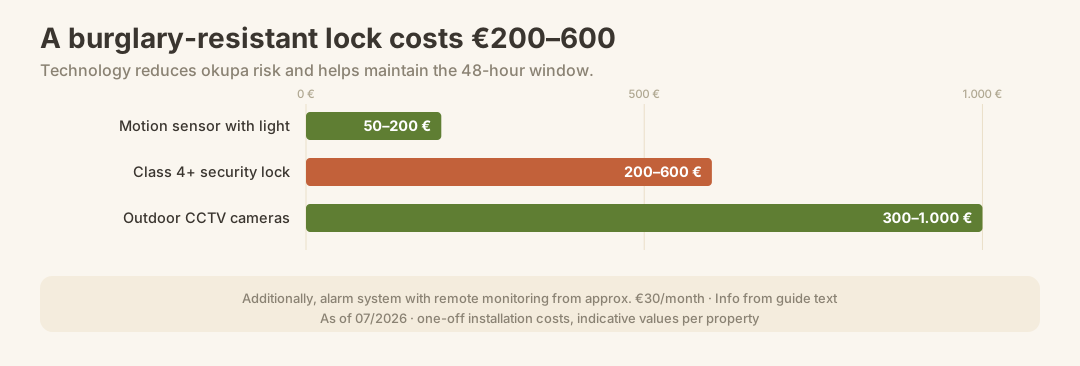
| Measure | Effect | Cost (guide price) |
|---|---|---|
| Certified security lock (class 4+) | Makes break-ins significantly harder | €200–€600 |
| Alarm system with remote monitoring | Immediate notification of intrusion | from approx. €30/month for monitoring |
| Outdoor cameras (CCTV) | Provides evidence and acts as a deterrent | €300–€1,000 for installation |
| Security grilles / lockable shutters | Physical barrier | Varies depending on the number of windows |
| Motion-activated lighting | Deters intruders at night | €50–€200 |
Practical arrangements
- Appoint a property manager: A local property manager (administrador de fincas) or a trusted local contact can check on the property regularly and act immediately in an emergency.
- Get your neighbours involved: Ask your immediate neighbours to report any suspicious activity. Give them your mobile number and your local lawyer’s number.
- Make the property look lived-in: Lights switched on and off regularly (using a timer), a well-maintained exterior and no obvious signs that the property is empty.
- Keep digital copies of the Nota Simple and Escritura readily available: Upload the ownership documents to cloud storage that you and your lawyer can access at any time.
- Contents insurance with protection against squatters: Some insurance policies in Spain now offer specific cover for costs associated with squatting, such as legal fees and repairs after an eviction. Read more in our guide to contents insurance in Spain.
Insurance against squatting: What the market offers
In Spain, specialised policy add-ons and standalone products are now available to protect owners against costs arising from squatting. As this market is developing quickly, ask providers directly about their current terms. Typical cover includes:
- Legal fees and court costs in eviction proceedings
- Compensation for lost rental income during the occupation
- The cost of changing locks and repairing damage after an eviction
Note: Read the small print carefully. Many policies exclude certain types of property (such as holiday homes that are not registered as permanent residences) or occupations that began before the policy was taken out.
The most common mistakes owners make
Experienced Mallorca lawyers see these mistakes time and again – and each one can delay your case by weeks or months.
| Mistake | Consequence |
|---|---|
| Entering the property yourself and confronting the squatters | You could face a criminal complaint; your evidence may be weakened |
| Cutting off electricity or water | Delito de coacciones, which can be interpreted in the squatters’ favour |
| Not having a recent Nota Simple to hand | The police may be unable to process your report effectively |
| Waiting too long to act | Police intervention on grounds of flagrancia may no longer be possible; only formal proceedings remain |
| Not discussing the legal options with your lawyer | Criminal proceedings and the expedited civil procedure under Ley 5/2018 are both available; relying solely on the less suitable route may cost you time |
| Trying to handle everything yourself without a lawyer | Procedural errors can delay or jeopardise the case |
| ‘Negotiating’ with squatters without a lawyer | Payments to squatters can create legal problems |
| Not checking the property regularly | The occupation goes unnoticed for weeks, so intervention while it is happening is no longer possible |
What to check before buying: occupied properties and due diligence
If you’re buying a property in Mallorca, make sure it is free of encumbrances and actually vacant before the appointment with the notary. An ongoing occupation is usually visible, but not always. Ask a local lawyer to carry out full due diligence, including a physical inspection and an up-to-date Land Registry check.
During the buying process, remember that notarised proof of ownership (the Escritura Pública) is your most important document if problems arise. Understanding the correct property-buying process helps you avoid gaps in your documentation from the outset.
Note: If you buy a property that is already occupied, you generally do not automatically become a party to any ongoing legal proceedings. This must be expressly agreed – have your lawyer address it in the purchase contract.
Checklist: protection against squatters for Mallorca property owners
- Up-to-date Nota Simple saved digitally and accessible to your lawyer
- Class 4+ security lock installed
- Alarm system with remote alerts activated
- Trusted local contact or property management company appointed
- Neighbours given your contact details
- Contact established with a property lawyer in Palma (before you need one)
- Insurance policy checked for cover relating to squatters
- Escritura and all purchase documents securely archived
- Property looks occupied from the outside (timers, well-kept garden)
- Written action plan for an emergency (phone numbers 112 / 062, lawyer, property management company)
What happens next? Repairing damage and tax implications
After a successful eviction, there is often another problem: squatters sometimes leave properties in poor condition. You may face repair costs, the need for new locks and, occasionally, even structural damage.
For rental properties, the period of occupation can mean lost rental income, which may have tax implications. Ask your tax adviser whether and how you can claim any associated costs. If you plan to rent out the property again afterwards, read our guide to long-term renting in Mallorca first – it also explains how to draw up a legally sound tenancy agreement that minimises the risk of future eviction problems.
If you are planning renovations after the eviction, you should also keep planning permission requirements in Mallorca in mind.
Conclusion: Prevention is better than eviction
Ley Orgánica 1/2025 primarily speeds up criminal proceedings: since April 2025, unlawful entry and forcible occupation can be heard under the juicio rápido procedure, with a trial within 15 days of the case reaching the duty court. The law has not changed criminal penalties or police powers. Private individual owners can also use the expedited civil procedure under Ley 5/2018. Both routes work only if you act quickly and have the right documents ready.
The key is not a 48-hour deadline – which does not exist in law – but whether the occupied property is an inhabited home (morada, Art. 202 CP) or a vacant second home or holiday property (usurpación, Art. 245 CP). Whether a furnished, regularly used holiday home counts as a morada depends on the circumstances of the case. If the property is not a morada, the police generally need a court order unless they catch the occupiers in the act. Reporting the occupation quickly remains crucial: only if you report it while it is happening can the police intervene on the grounds of flagrancia. Prevention – a good alarm system, someone you trust locally and an up-to-date Nota Simple on your phone – is therefore not just a nice extra, but the smartest investment for anyone who does not live in their Mallorca property full-time.
Official sources
- Ley Orgánica 1/2025 (anti-squatting law, in force since April 2025): https://www.boe.es/buscar/act.php?id=BOE-A-2025-76
- Articles 202 and 245 of the Código Penal (offences of unlawful entry / usurpación): https://www.boe.es/buscar/act.php?id=BOE-A-1995-25444
- Ministerio del Interior – Estadísticas de Criminalidad (crime statistics, including squatting): https://estadisticasdecriminalidad.ses.mir.es/publico/portalestadistico/
- Registro de la Propiedad / Colegio de Registradores (obtain a Nota Simple online): https://www.registradores.org
- Juzgados de Palma de Mallorca (competent courts, first-instance jurisdiction over trespass): https://www.mjusticia.gob.es
How to write an enquiry about a property for sale
If you are interested in a house in Mallorca, include the address or listing number in your enquiry and ask to arrange a viewing. If ownership or occupancy is unclear, it is worth asking precise questions:
“I am interested in the property at [address or listing number]. Who is the registered owner, and on whose behalf are you offering the house? Is an interior viewing possible? Will the property be handed over free of occupants and rights of use? If not, who is using it, and what arrangements are proposed for handover? Please send me your answers in writing and let me know which documents I can inspect before committing to a purchase.”
Then compare the answers with a current Nota Simple. It helps you check registered ownership, but does not replace a viewing or clarification of how the property is actually being used. Do not treat a verbal promise of vacant possession as settled before signing. This is not legal or tax advice.
This guide provides a general overview of the legal position and does not replace legal or tax advice on your individual circumstances. Laws and deadlines may change; the linked official sources are authoritative.