
IRPF Deduction for Landlords in the Balearics: the Reduction under the Ley de Vivienda
Anyone who lets a residential property on a long-term basis on Mallorca or one of the other Balearic Islands can exempt a significant portion of their net rental profit from tax under IRPF. That sounds straightforward — but it isn't, because the Ley de Vivienda (Ley 12/2023) completely overhauled the system with effect from 27 May 2023. Instead of the previous flat reduction of 60 %, there is now a tiered structure with four different rates ranging from 50 % to 90 %, which depend on the content of the tenancy agreement, the level of rent, the tenant's age, and the urban-planning status of the municipality. This guide explains step by step which reduction applies to your specific tenancy agreement, what you need to declare in your IRPF return (Modelo 100), which costs you can deduct beforehand — and which mistakes tend to prove the most expensive in practice. All information relates to the 2025 tax year, filed April to 30 June 2026.

Do you let property on Mallorca and want to know which reduction you are genuinely entitled to?
- 📩 Submit a personal enquiry — tax adviser referral service, concrete assessment of your situation
- Everything about long-term letting on Mallorca
What exactly is the IRPF reduction for landlords?
If you are a tax resident in Spain and let a property for residential purposes, the net rental profit flows into your IRPF return (Modelo 100) and is taxed at your general progressive rate — between 19 % and 47 % depending on your income level. Without a special rule, you would pay tax on the entire surplus after deducting allowable expenses.
The reduction under Article 23.2 of the Income Tax Act (Gesetz 35/2006, LIRPF) ensures that only a fraction of this net rental profit is taxable at all. The mechanism has existed for a long time — but the Ley 12/2023 de Vivienda completely revised the rates and conditions with effect from 27 May 2023.
Important: The reduction applies only to lettings for residential purposes (arrendamiento de vivienda). Holiday lets, commercial use, or seasonal lettings without a permanent character are generally not covered.
Who can use the reduction?
- Tax residents in Spain (more than 183 days' presence per calendar year or centre of economic interest in Spain)
- Landlords who receive their income as rendimientos del capital inmobiliario (income from immovable capital) — i.e. not as a business activity (no full-time employees engaged in the letting)
- Party to the tenancy agreement: only the landlord named in the contract, not an intermediary company (different rules apply to SL structures)
Non-resident owners (non-residents) declare their rental income via Modelo 210 at a flat tax rate and cannot use this reduction.
The old system: 60 % for contracts up to 26 May 2023
For all tenancy agreements that up to and including 26 May 2023 were concluded, the old rule continues to apply: the net rental profit (positive rendimiento neto) is reduced by a flat rate of 60 % Only the remaining 40 % flows into the tax base.
This rule remains in place as long as the original contract continues unchanged. However, as soon as you enter into a new contract – even with the same tenant – you fall under the new system.
| Contract date | Applicable reduction |
|---|---|
| Up to 26.05.2023 | 60 % (flat rate, old law) |
| From 27.05.2023 | 50 %–90 % (new tiered system) |
The new system: four reduction tiers from 27 May 2023
For all tenancy agreements newly concluded from 27 May 2023 onwards, the tiered system of the Ley de Vivienda applies. The requirements for the respective tier must be met at the time the contract is concluded – and must continue to be met on an ongoing basis.
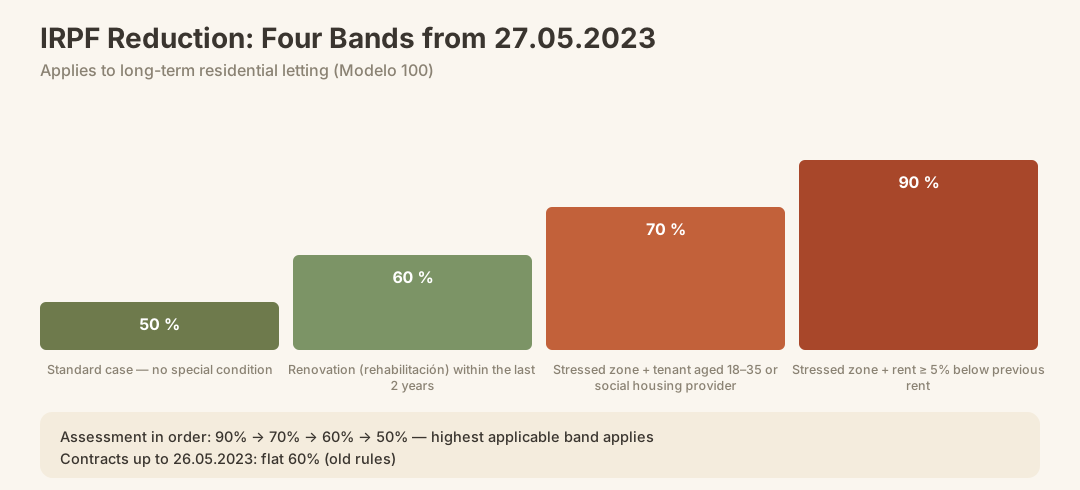
Overview of the four tiers
| Reduction | Requirement | Typical case in Mallorca |
|---|---|---|
| 90 % | New contract in a declared stressed-market zone (zona tensionada), initial rent at least 5 % below the last rent charged by the same landlord for the same property | Large cities and stressed municipalities; Palma de Mallorca could qualify once formally declared |
| 70 % | First-time letting in a stressed-market zone + tenant aged 18–35; or tenant is a public authority / non-profit organisation for social housing purposes / recognised housing programme | First contract with a young tenant in a declared zone; letting to a municipality or social housing provider |
| 60 % | The property underwent an approved renovation (rehabilitación) in the tax sense | Renovated period property where renovation costs exceed the tax threshold |
| 50 % | None of the above reasons apply | Standard long-term rental without special criteria |
Note on tension zones: In the Balearic Islands, the designation of zonas de mercado residencial tensionado is the responsibility of the regional government. Whether and which municipalities on Mallorca have been formally declared changes on an ongoing basis. Check the current status before signing a contract – the classification determines whether you are entitled to 50 %, 70 % or 90 %.
What applies if several tiers are met?
The tiers are mutually exclusive and ranked in order of priority. The highest applicable tier always takes precedence. The assessment is carried out in sequence: 90 % → 70 % → 60 % → 50 %.
Basis of calculation: What is the 'net rental profit'?
The reduction is not applied to the gross rent, but to the positive net rental profit (rendimiento neto positivo). This is calculated as gross rental income minus tax-deductible expenses.
Deductible expenses (selection)
| Type of cost | Deductible? | Notes |
|---|---|---|
| IBI (property tax) | Yes | In full |
| Interest on mortgage / loan | Yes | Only on the rented property, not repayment instalments |
| Community fees (Comunidad) | Yes | In full |
| Insurance premiums | Yes | Buildings, liability, and loss-of-rent insurance |
| Maintenance expenditure and repairs | Yes | Increases in value, however, are not deductible immediately but via depreciation (AfA) |
| AfA (tax depreciation) | Yes | Generally 3 % of the building value (cadastral value excluding land) |
| Management and agency fees | Yes | For ongoing management, not for purchase/sale |
| Uncollected rents | Yes | Where the tenant's insolvency is proven or the claim has been outstanding for at least 6 months |
Please note: If the net rental profit after deducting allowable expenses is negative (a loss), there is no reduction – however, the loss may be offset against other property income from capital in the same tax year.
Step by step: how to enter the reduction in your IRPF return
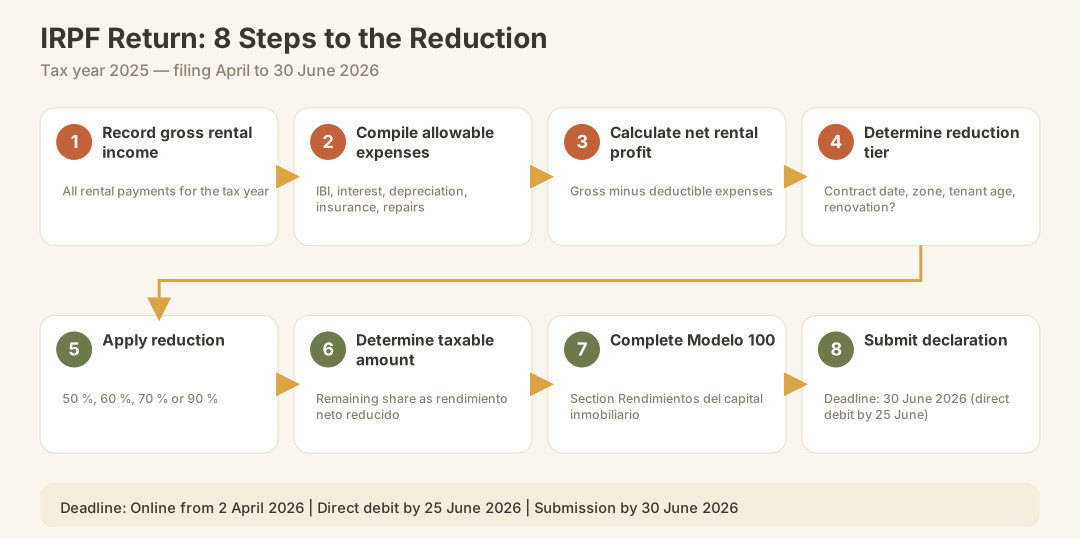
- Record gross rental income – all rental payments received during the tax year (net rent excluding utilities; deposits only count when retained).
- Compile allowable expenses – receipts for IBI, mortgage interest, Comunidad fees, insurance, repairs, AfA.
- Calculate net rental profit – gross rental income minus allowable expenses.
- Determine the applicable tier – was the contract concluded before or after 27.05.2023? Designated stress zone? Age of the tenant? Renovation?
- Apply the reduction – deduct the relevant percentage (50 %, 60 %, 70 % or 90 %) from the positive net rental profit.
- Calculating the taxable amount – the remaining share (10 %–50 %) flows into the tax base as rendimiento neto reducido.
- Completing the Modelo 100 – enter the details in the section 'Rendimientos del capital inmobiliario'; the AEAT software (Renta WEB) will guide you through the questions on the reduction conditions.
- Submitting the return on time – the filing deadline for the 2025 tax year is 30. Juni 2026; if paying by direct debit, note the cut-off date of 25. Juni 2026.
Worked example (simplified)
| Item | Amount |
|---|---|
| Annual rental income (gross) | 14.400 € |
| Deductible expenses (IBI, interest, depreciation, insurance) | 4.200 € |
| Net rental profit | 10.200 € |
| 50 % reduction (standard case) | – 5.100 € |
| Taxable amount | 5.100 € |
| IRPF at marginal tax rate 30 % | ca. 1.530 € |
Without the reduction, approximately 3.060 € would be payable on 10.200 €. The saving here amounts to around 1.530 € per year – and that is still the least favourable new rate (50 %).
The Balearic dimension: regional tax rate and local peculiarities
IRPF comprises a national and a regional component. The Balearen levy their own regional surcharge, which is already included in the combined rates of 19 % to 47 %. The reduction under Art. 23.2 LIRPF applies to both components simultaneously – meaning the tax advantage on the Balearen is just as great as anywhere else in Spain.
| IRPF tax band (combined national + Balearic) | Income bracket |
|---|---|
| 19 % | 0 – 12.450 € |
| 24 % | 12.450 – 20.200 € |
| 30 % | 20.200 – 35.200 € |
| 37 % | 35.200 – 60.000 € |
| 45 % | 60.000 – 300.000 € |
| 47 % | over €300,000 |
Separate rates apply to capital income (interest, dividends, capital gains) — these are not affected by the rental reduction.
Note for non-EU residents: If you have your tax residence (more than 183 days) in the Balearic Islands, you are subject to unlimited tax liability and must declare your worldwide income via Modelo 100. The reduction described here then applies to you in exactly the same way as to Spanish nationals.
Holiday letting vs. long-term rental: the crucial difference
The IRPF reduction under Art. 23.2 LIRPF applies exclusively to letting for permanent residential purposes. Anyone who lets a property as holiday accommodation (ETV) does not generate rendimientos del capital inmobiliario in the qualifying sense, but rather income from tourist letting, which is generally taxable in full without this reduction.
In Mallorca, the holiday licence situation is already under considerable strain. Many municipalities have placed significant restrictions on new ETV licences. Anyone considering a change of use or wishing to use a property exclusively for long-term letting is doing so not only because of the IRPF reduction, but also for licensing reasons.
More on this: ETV licence Mallorca – current status
The most common mistakes — and how to avoid them
1. Choosing the wrong reduction tier
Many landlords automatically assume 60% — either because that was the old rule or because they are unaware of the conditions for the higher tiers. Conversely, some claim 90% without a formally declared rent-pressure zone. Both mistakes can result in back payments plus interest.
2. Deductible expenses overstated or incorrectly applied
Renovation costs that permanently increase the value of the property are not immediately deductible expenses; they must be capitalised and depreciated over time. Anyone who deducts them in full in the year of payment risks a follow-up audit.
3. Reduction applied to a negative net rental profit
If the net rental profit is negative, there is simply no reduction. The result is treated as a loss.
4. Overlooking changes to the tenancy agreement
An addendum to the tenancy agreement, a rent increase clause, or a change of tenant can mean that the contract is treated as new for tax purposes — and the new system therefore applies, even if the original contract predates it.
5. No documentation of refurbishment works
Anyone claiming the 60% tier on the basis of a refurbishment must demonstrate that the works meet the tax definition of rehabilitación (Art. 41.1 Reglamento IRPF). Without planning permission, a completion certificate, and invoices, this is virtually impossible.
6. Missing deadlines
The IRPF return for 2025 can be submitted online from 2. April 2026 and by telephone from 6 May 2026, in person from 2 June 2026. Direct debits must be authorised by 25 June 2026; the filing deadline is 30 June 2026.
What comes next? Further tax obligations for landlords
The IRPF reduction is not the only tax dimension of long-term letting in the Balearic Islands. The following additional obligations apply:
| Obligation | Form / Authority | Deadline / Frequency |
|---|---|---|
| Advance payments on withholding tax (where tenant is a company) | Modelo 115 | Quarterly |
| IBI (property tax) | Municipality | Annually, date varies by municipality |
| Wealth tax (from €700,000 net assets) | Modelo 714 | By 30 June 2026 |
| Declaration of foreign assets | Modelo 720 | By 31 March 2026 |
| Annual IRPF return | Modelo 100 | 2 April – 30 June 2026 |
For the IBI tax in Mallorca and the Wealth Tax you will find further details in our guides.
Checklist: Claiming the IRPF Reduction Correctly
- Contract concluded before or after 27.05.2023 checked
- Use as permanent residential accommodation (not a holiday rental contract) confirmed
- Stressed-market zone status of the municipality at the time of contract conclusion verified
- Tenant's age (18–35 years?) and first-time tenancy checked (for the 70 % tier)
- Renovation works evidenced with supporting documents (for the 60 % tier)
- Rent reduction compared with the last previous contract documented (for the 90 % tier)
- All deductible expenses collected with receipts (IBI, interest, depreciation, Comunidad, insurance, repairs)
- Net rental profit correctly calculated (positive or negative?)
- Correct reduction tier selected and entered in Renta WEB
- Return submitted by 30. June 2026; if paying by direct debit, by 25. June 2026
Conclusion
The IRPF reduction for landlords is one of the most powerful tax privileges in Spanish income tax law — and the Ley de Vivienda has made it more nuanced, but also more complex. The standard rate of 50 % is already attractive; those who let in a formally designated stressed-market zone, have young tenants, or have renovated their property can exempt 70 % or even 90 % of their net rental profit from tax.
The key lies in thorough documentation: the date of the contract, the rent level, the tenant's age, evidence of renovation works, and receipts for deductible expenses must all be complete and on hand. In the Balearic Islands, the specific question of whether your municipality has been designated a stressed-market zone adds an additional layer — information that can change and that you should actively verify before entering into any new tenancy agreement.
For your first return, seek the support of a locally experienced tax adviser or a gestoría. The effort pays for itself within the very first year.
📩 Request Tax Advice Now | Yields and Investment in Mallorca | Taxes & Law at a Glance
Official Sources
- Agencia Tributaria (AEAT) – Reduction for Residential Lettings (Art. 23.2 LIRPF): sede.agenciatributaria.gob.es – 7.3.1.4 Reducción por arrendamiento de viviendas
- Ley 35/2006, de 28 de noviembre, del Impuesto sobre la Renta de las Personas Físicas (LIRPF): boe.es
- Ley 12/2023, de 24 de mayo, por el derecho a la vivienda (Ley de Vivienda): boe.es
- IRPF Regulations (Real Decreto 439/2007) – Art. 41.1 Rehabilitación: boe.es
- Agència Tributària de les Illes Balears (ATIB): atib.es
- Govern de les Illes Balears – Habitatge: ideib.caib.es