
Ley Vivienda Balearen: Rent Controls, zona tensionada and What Really Affects You in 2026
The Ley Vivienda Balearen — referring to the Spanish Ley 12/2023 (Ley por el Derecho a la Vivienda) and its Balearic implementation — has been the most widely discussed property law on the islands since it came into force in May 2023. It promises rent controls, new rent increase rules, and a mechanism known as the zona de mercado residencial tensionado, which is designed to enforce rent caps in overheated markets. What the Ley actually means in practice, however, depends greatly on whether and how the Balearen deploy these tools — and that is precisely where the situation in 2026 is more complicated than many expect. This guide explains how the rent index works, what qualifies as a zona tensionada, why the Balearen have so far declined to make that declaration, which IRPF bonuses apply to landlords, and which rules are relevant for large-scale landlords and buyers.

Are you renting out property on Mallorca or planning an investment and want to know which rules apply to you?
- 📩 Submit a personal enquiry — we will connect you with a vetted local tax and property law specialist.
- Guide: Long-term rental Mallorca — all rights and obligations for tenants and landlords
What the Ley 12/2023 actually covers
The Spanish housing act (Ley por el Derecho a la Vivienda, Ley 12/2023) has been in force since 26 May 2023. It intervenes in tenancy law at national level, while granting the Autonomous Communities far-reaching powers to activate or adapt certain instruments. The key points at a glance:
| Provision | What changes | Applies from |
|---|---|---|
| Annual rent increase | 2023: max. 2 %; 2024: max. 3 % | immediately upon entry into force |
| New rent index IRAV | Replaces IPC as the benchmark for rent increases | from 2025 |
| Zona tensionada | Autonomous Community must actively declare | following application + review |
| Estate agent commission | Generally borne by the landlord | since May 2023 |
| IRPF bonuses for landlords | Tiered according to rental price and area | since May 2023 |
| Definition of large-scale landlord | from 10 residential units | since May 2023 |
Note: The Ley 12/2023 is a framework law. Many measures — in particular the rent caps in zonas tensionadas — only come into force in the Balearic Islands once the Balearic regional government (Govern de les Illes Balears) expressly activates them. This has not happened to date.
The new rent index IRAV: what applies from 2025
Until the end of 2024, temporary statutory caps applied: 2 % in 2023, 3 % in 2024. From 2025, a new national reference index was introduced, the Índice de Referencia de Actualización de los Arrendamientos de Vivienda (IRAV), calculated by the Spanish statistics institute INE. The IRAV is intended to be more stable in the long term than the IPC and to dampen excessive rent increases upon contract renewal.
Practical consequence for landlords on Mallorca: If your existing tenancy agreement contains an annual adjustment clause, you must cap any increase since 2025 at the IRAV value for the relevant month. References to the old IPC or to a "contractually agreed market price" no longer apply without restriction to existing contracts.
Important: For new lettings in areas without a zona tensionada — and that currently covers the whole of Mallorca — the IRAV only applies to renewal clauses in existing contracts. As a landlord, you are free to set the initial asking rent for a new letting. That is the crucial difference from a zona tensionada.
Zona tensionada: what the instrument means — and why the Balearic Islands are not using it
The activation requirements
An autonomous community or municipality may designate an area as a mercado residencial tensionado declare, if at least one of the following conditions is met:
- The average housing cost burden (rent or mortgage payment plus basic costs) exceeds 30 % of median household income in that area.
- Purchase or rental prices have risen over the past five years by more than 3 percentage points above the regional cumulative inflation rate.
In the Balearic Islands, both criteria are considered met according to current knowledge — experts and parts of academia take this view. Forecasts for 2026 point to new rental price increases of between 8 % and 12 %, mainly because thousands of five-year contracts signed during the post-pandemic period are coming up for renewal.
The political deadlock
The Balearic Parliament has rejected a motion to declare the entire Balearic Islands a zona tensionada. The ruling PP faction argues that the instrument has "no real effect". Academics and housing experts counter that it could at least dampen renewal extensions in the short term, while structural solutions (more social housing, greater supply) take effect.
| Requirement for zona tensionada | Situation in the Balearic Islands (as of 2026) | Activated? |
|---|---|---|
| Housing cost burden > 30 % of household income | in the view of experts: yes | no |
| Price increase > IPC + 3 PP over 5 years | in the view of experts: yes | no |
| Political decision by the Govern | withheld so far | no |
What this means for you: As long as the Balearic Islands do not declare a zona tensionada, no statutory rent caps from the Ley 12/2023 apply to new lettings in Mallorca — including in Palma. Landlords can continue to enter into new contracts at market price.
What would apply if a zona tensionada were activated
For completeness: if the Balearic Islands or a Balearic municipality were to declare a zona tensionada declared, the following regulations would come into force:
- Existing tenancies (property has been rented out within the last 5 years): The new rent may not exceed the last agreed rent plus the maximum permissible annual increase rate (IRAV).
- Properties newly entering the market (not rented out for 5 years): The initial rent may not exceed the maximum value of the state reference index for the area in question.
- Large landlords (from 10 residential units): May not, in zonas tensionadas set any rent above the reference index as a general rule — not even for new lettings.
Large landlords (gran tenedor): Who is affected?
Ley 12/2023 defines a gran tenedor as any natural or legal person who owns 10 or more residential properties in Spain or holds a total residential floor area of more than 1.500 m² of inhabited living space. In some zonas tensionadas the autonomous communities may lower this threshold to 5 residential properties.
For large landlords in the Balearic Islands — even without a zona tensionada designation — enhanced disclosure obligations and stricter requirements apply to rent increases in existing contracts. Should a subsequent declaration as a zona tensionada ever be made, the binding reference index would apply to all new contracts immediately.
Please note: Anyone holding several holiday rental licences (ETV) alongside long-term rental properties should keep track of the total number of residential units. Legal advice is recommended when approaching the 10-unit threshold.
IRPF tax relief for landlords: the tiered system in detail
One of the immediately effective instruments of the Ley 12/2023 is the new IRPF bonus scale for landlords of long-term rental properties. The deduction applies to net income from vivienda habitual lettings and replaces the previous flat-rate 60% reduction.
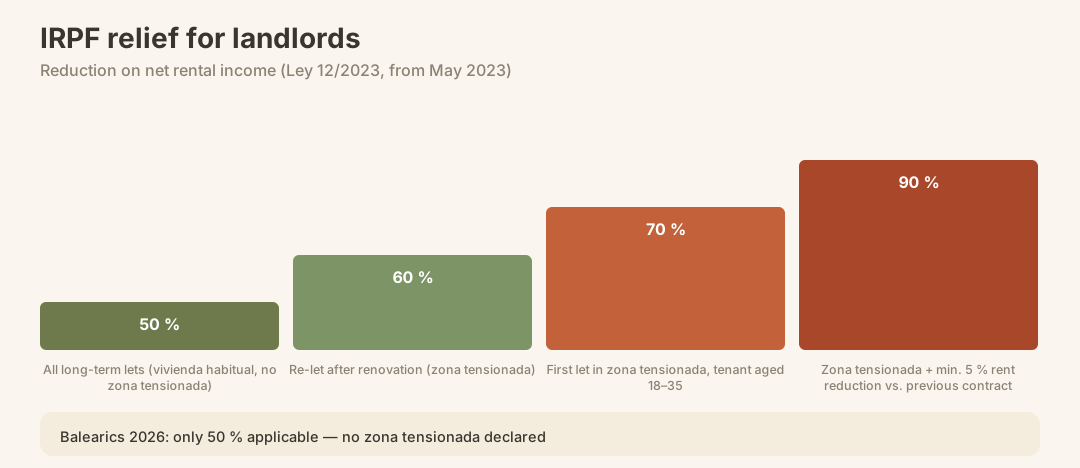
| Scenario | IRPF reduction on net rental income |
|---|---|
| New letting in a zona tensionada with a reduction of at least 5% in rent compared to the previous contract | up to 90 % |
| First-time letting in a zona tensionada to tenants aged between 18 and 35 | 70 % |
| Property re-let following renovation (zona tensionada) | 60 % |
| All other long-term tenancy agreements (vivienda habitual, not in a zona tensionada) | 50 % |
Please note: As no zona tensionada has currently been declared in the Balearic Islands, landlords in the Balearics can at present claim only the 50% reduction — the higher bonuses of 60%, 70%, or 90% require the rental property to be located in a declared zona tensionada. You can find more details on this deduction in the guide IRPF deduction for landlords in the Balearics.
Restrictions for buyers: what the Ley Vivienda means for purchasers
The Ley 12/2023 does not impose direct purchase price caps on the open housing market. However, it establishes a framework that affects buyers — particularly investors and non-residents — in indirect ways:
1. Social housing quota for new developments: New-build projects will in future be required to set aside a higher proportion of subsidised or price-capped housing. In the Balearic Islands, this is additionally governed by the Balearic Ley 5/2018 (Ley de la Vivienda de les Illes Balears) and the Ley 3/2024.
2. VPO/VPL purchase price restrictions: For protected housing (Vivienda Protegida de Precio Limitado, VPL, and Vivienda de Protección Oficial, VPO) the Balearic Government sets maximum permitted purchase and rental prices. The Consell de Govern adopted an update to these maximum prices on 20 February 2026. Details on VPO/VPL purchases can be found in the guide VPO/VPL Mallorca.
3. Public pre-emption rights: In zonas tensionadas and in social housing stocks, public authorities may exercise pre-emption rights. The same applies here: as long as no zona tensionada has been declared, this has no effect on the normal resale market in Mallorca.
| Buyer type | Restriction under Ley 12/2023 | Restriction under Balearic law |
|---|---|---|
| First-time buyer, primary residence (open market) | no price cap | ITP concessions possible (→ ITP Balearen) |
| VPO/VPL buyer | Purchase price subject to maximum price schedule | Consell resolution Feb. 2026 |
| Investor (> 10 residential units) | enhanced rental regulation | no additional purchase restriction |
| Non-EU buyer | no purchase restriction under Ley 12/2023 | no specific restriction (as of 2026) |
Balearic Housing Plan 2026–2030: 168 million euros
Alongside Ley 12/2023, the Balearic regional government has secured funding through the Plan Estatal de Vivienda 2026–2030. According to information from the Govern de les Illes Balears, the Balearic Islands will receive 168 million euros manage — with what is reportedly the largest share of own funds from the Autonomous Community compared to previous planning periods. The funds go towards subsidies for social housing construction, renovation, and rent assistance.
Tip: You can apply for the Bono Alquiler Joven — a government rent subsidy for young people — independently of the zona tensionada question. Full details in the guide Bono Alquiler Joven Balearen.
How the rental market on Mallorca will develop in 2026
Even without an activated zona tensionada designation, tenants are feeling the effects of a structural supply shortage. Some figures and developments from available sources:
- For 2026, market observers expect further rent increases of between 8 % and 12 %, driven by the renewal of post-pandemic contracts.
- According to market reports, the price per m² for resale properties in the Balearic Islands has now reached over 5,000 Euro/m² — and continues to rise.
- Reports suggest that rental listings in the Balearic Islands are sometimes available for less than one day before being snapped up — an indicator of extreme excess demand.
- According to experts, the proportion of household income spent on housing exceeds the 30 % threshold stipulated in Ley 12/2023.
These figures illustrate why the debate over the zona tensionada designation is politically charged — and why the Govern's decision not to activate it carries significant social consequences.
Most common mistakes regarding the Ley Vivienda in the Balearic Islands
1. Applying rent increases based on the IPC rather than the IRAV. From 2025 onwards, the IRAV applies as the reference index for rent increase clauses. Contracts that still refer to the IPC are not automatically invalid, but any increase must not exceed the IRAV. Anyone who nonetheless applies the IPC where it is higher risks a dispute with their tenant.
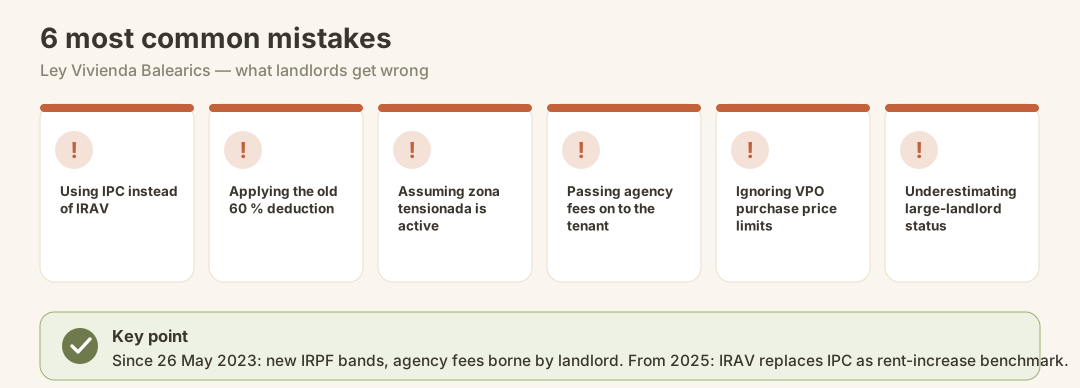
2. Continuing to apply the 60 % IRPF deduction. The old flat-rate 60 % reduction has been replaced by the new graduated scale. Anyone who continues to deduct 60 % without checking the conditions of the new scale risks additional tax demands. From 26 May 2023, the new rule applies to new contracts (and also to extended contracts).
3. Assuming the zona tensionada is already in effect. Numerous media reports give the impression that the rent brake is already active in the Balearics. This is not the case: without a formal resolution by the Govern, the special restrictions do not apply.
4. Passing the estate agent's commission on to the tenant. Since May 2023, the landlord is generally responsible for the agent's commission in residential tenancy agreements. Clauses that place this burden on the tenant are contestable.
5. Ignoring VPO purchase price limits. Anyone buying or selling a protected property must be familiar with the current maximum price tables — most recently updated by Consell resolution in February 2026. A purchase above the maximum price can lead to the unwinding of the transaction.
6. Underestimating large-landlord status. Anyone holding a total of 10 or more residential units in Spain — counting long-term rentals, holiday rentals, and owner-occupied properties together — should check whether they are classified as a gran tenedor . The requirements go beyond what small landlords need to consider.
What comes next? Possible developments in 2026 and beyond
Ley 12/2023 is not a static piece of legislation. Several developments are worth monitoring:
- Zona tensionada pressure: Political and public pressure on the Balearic government could intensify once the new wave of contract renewals demonstrably drives up rents. A reassessment by the Govern cannot be ruled out.
- Plan Estatal de Vivienda 2026–2030: The 168 millones euros will translate into concrete funding programmes over the coming years, potentially affecting both tenants and developers.
- Ley 3/2024 of the Balearics: The Balearic emergency legislation from 2024 contains its own measures for affordable housing, operating independently of the national Ley 12/2023.
- ETV licence moratorium: The existing moratorium on new holiday rental licences cements the limited supply. Fewer holiday rentals do not automatically mean more long-term rental supply — this is a central point of contention.
Checklist: what you as a landlord in Mallorca should review now
- Review rent increase clauses: Does your contract still reference the IPC? Have it switched to IRAV at the next renewal.
- Recalculate the IRPF reduction: Apply the 50 % band correctly; check whether you could benefit from the higher band in future.
- Clarify large-landlord status: Count all residential units in Spain — including VPO properties, holiday properties, and shell builds with planning permission.
- Remove estate agent commission clauses: Existing contracts containing tenant commission clauses are vulnerable — clean these up at renewal.
- Check the VPO/VPL status of the property: Is there a protection period or a maximum price regime in place?
- Keep an eye on zona tensionada: Subscribe to the BOIB (Butlletí Oficial de les Illes Balears) for alerts on housing law — activation can happen at short notice.
- Keep the energy certificate up to date: A requirement for letting; also relevant for renovation bonuses in the IRPF context. More on this in the guide Energiezertifikat Spanien.
- Bring in a tax adviser: The interaction between IRAV, the IRPF tiered system, and a potential zona tensionada is complex. A one-off consultation will pay for itself.
Conclusion
The Ley Vivienda Balearen is, in 2026, a law with considerable potential but limited local impact so far. The national framework legislation (Ley 12/2023) applies throughout Spain: the IRAV replaces the IPC, the estate agent's commission falls to the landlord, and the new IRPF bonus tier is in force. The key instrument for capping rents — the zona tensionada — has not yet been activated in the Balearic Islands. The ruling PP faction rejects it, while experts consider that the rental market has long since met the statutory activation thresholds. For landlords, this means: act now on the rental index and IRPF deduction, keep a close eye on zona tensionada developments, and take VPO/VPL price caps seriously. Open-market buyers are barely directly restricted by Ley 12/2023 — the indirect market effects (scarce supply, rising prices, social obligations in new builds) are all the more significant.
Official Sources
- Ley 12/2023, de 24 de mayo, por el derecho a la vivienda (BOE): https://www.boe.es/buscar/act.php?id=BOE-A-2023-12203
- Ley 5/2018, de 19 de junio, de la vivienda de las Illes Balears (CAIB): https://www.caib.es/sites/institutestudisautonomics/f/301150
- Ley 3/2024, de 3 de mayo, de medidas urgentes en materia de vivienda (CAIB-Normativa): https://www.caib.es/sites/normativa_dgha/es/normativa_vivienda/contenido.do?idsite=13687&cont=159809
- Acuerdo del Consell de Govern de 20 de febrero de 2026 (actualización precios VPO/VPL): published via BOIB (Butlletí Oficial de les Illes Balears): https://www.caib.es/eboibfront/?lang=es
- IRAV (Índice de Referencia de Actualización de Arrendamientos de Vivienda) — INE: https://www.ine.es
- ATIB — Agència Tributària de les Illes Balears: https://www.atib.es
- Plan Estatal de Vivienda 2026–2030 — Govern de les Illes Balears: https://www.caib.es/webgoib/es/
- Regulations on protected housing (CAIB): https://www.caib.es/sites/normativa_dgha/es/normativa_vivienda/contenido.do?idsite=13687&cont=159809