
Certificate of Good Conduct Spain: Applying for the Certificado de Antecedentes Penales
Anyone who signs an employment contract in Spain, applies for the Residencia or becomes self-employed will sooner or later come across the question of the Führungszeugnis Spanien – and discover that there are actually two relevant documents here. The German Führungszeugnis (certificate of good conduct) comes from the Bundesamt für Justiz in Bonn and documents entries in the German Bundeszentralregister. The Spanish equivalent, the Certificado de Antecedentes Penales, is issued by the Ministerio de Justicia from the Registro Central de Penados and is a completely separate register. This guide explains when you need which document, how to apply for the Spanish Certificado online, by post or in person, what deadlines apply, and what you need to bear in mind regarding apostille and translation.

- Find a lawyer in the business directory — for complex cases involving previous convictions or rejections
German Führungszeugnis vs. Spanish Certificado de Antecedentes Penales
The two documents do not replace one another. The German Führungszeugnis relates exclusively to entries in the German Bundeszentralregister, while the Spanish Certificado de Antecedentes Penales relates exclusively to entries in the Spanish Registro Central de Penados. When a Spanish authority, employer or residency office asks for a "Führungszeugnis", they generally mean the Spanish document – especially if you are already living or have previously lived in Spain. For applications still being processed from Germany (e.g. a visa application at the Spanish embassy in Berlin), however, the German Führungszeugnis with apostille is often required.
Note: Both certificates come from separate registers. A Spanish Certificado de Antecedentes Penales says nothing about any entries in the German Bundeszentralregister – and vice versa.
| Document | Issuing body | Register | Typical use case |
|---|---|---|---|
| Certificado de Antecedentes Penales | Ministerio de Justicia | Registro Central de Penados (Spain) | Residencia, employment contract, dealings with authorities in Spain |
| German Führungszeugnis | Bundesamt für Justiz, Bonn | Bundeszentralregister (Germany) | Visa application from Germany, proof for German employers |
Important to know: the Certificado de Antecedentes Penales does not automatically authorise you to work with minors. Anyone working professionally with children or young people additionally needs the Certificado de Delitos de Naturaleza Sexual – a standalone document that must be applied for separately.
When do you need which document?
The Spanish Certificado is most commonly required on the following occasions: for certain employment contracts (especially in the public sector or for sensitive roles), as part of the Residencia application, when applying for certain visa categories such as the Non-Lucrative Visa, and when registering as an Autónomo in certain regulated sectors. Anyone registering a household helper or seeking employment themselves should also check whether the employer requires a Certificado – this depends on the industry and the position.
Please note: If you're currently in the process of sorting out your NIE number or your Empadronamiento, plan the Certificado in right from the start – many administrative procedures in Spain build on one another and otherwise drag on unnecessarily.
Applying for the Certificado de Antecedentes Penales online
The fastest route is via the electronic Sede of the Ministerio de Justicia. This requires digital identification via Cl@ve or an electronic certificate (DNIe or a qualified certificate).
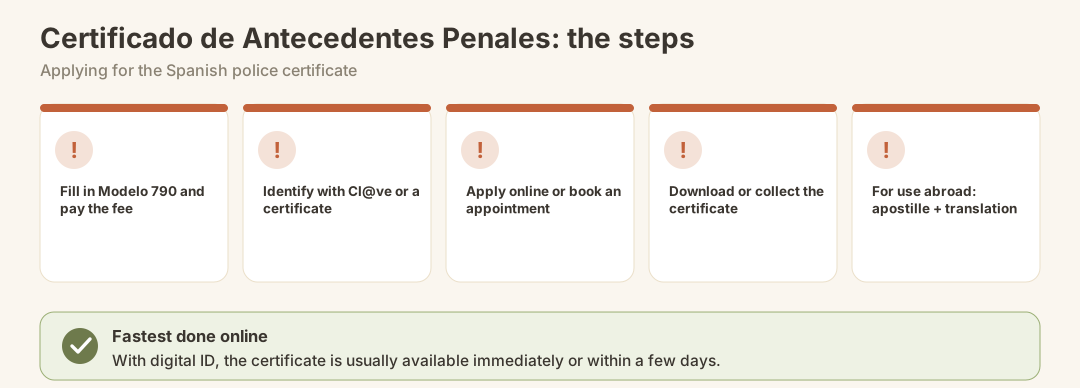
- Go to the online application at sede.mjusticia.gob.es and identify yourself via Cl@ve or your electronic certificate.
- Fill in the online form. During this process, you'll be asked whether you consent to a data request from the Dirección General de la Policía via the Plataforma de Intermediación de Datos – you can decline this, but you'll then need to choose a different application route.
- If the document is to be used abroad, select the Apostille option directly in the form.
- Pay the applicable fee via the AEAT's payment platform.
- In most cases, the Certificado is issued immediately. If this isn't possible, you'll receive a receipt with an application number for later download.
- Optionally, you can provide an email address to be notified as soon as the certificate is ready.
- From the following day onwards, you can check the status via the "Consulta de Estado" or "¿Cómo va lo mío?" service and download the finished document.
- The authenticity of a downloaded certificate can later be verified online using the CSV code (código seguro de verificación).
Note: If you haven't yet set up access to Cl@ve in Spain, registration via video call or by invitation letter through the AEAT's Sede is possible – this is worthwhile, as it will simplify almost all Spanish administrative procedures in future.
Applying by post or in person in Spain
Anyone who doesn't have Cl@ve or an electronic certificate can also apply for the Certificado in the traditional way – in person or by post to the Ministry.
| Method | What you need | Where |
|---|---|---|
| In person | DNI/Passport + completed form Modelo 790 | Gerencias Territoriales of the Ministerio de Justicia, Registros Civiles or Oficina Central de Atención al Ciudadano, Calle Bolsa 8, 28012 Madrid |
| By post | Completed form + certified copy of passport, sent to the Ministerio de Justicia | Postal submission according to the instructions on mjusticia.gob.es |
| Online (Cl@ve/certificate) | Digital identification | sede.mjusticia.gob.es |
The form Modelo 790 can be downloaded directly from the Sede Electrónica of the Ministerio de Justicia. Anyone living abroad who wishes to apply by post should send the application to the Oficina Central de Atención al Ciudadano, Sección de Penales, Ministerio de Justicia.
Applying through a representative or from abroad
Spanish nationals who are registered abroad and listed in the Registro de Matrícula Consular of the relevant consulate have the option of signing a power of attorney at the consulate so that a third party can apply for the Certificado in Spain. The process works as follows:
- Arrange an appointment at the relevant Spanish consulate at the place of residence abroad (the competent consulate is the one where the person concerned is registered in the Registro de Matrícula Consular).
- Fill in and have the power of attorney signed at the consulate.
- Present identity card or passport along with a copy.
- Provide the name and DNI number of the representative in Spain.
- The representative collects the Certificado in person from the assigned Gerencia Territorial – with passport/DNI and the legalised documents from the consulate.
Note:People with a nationality other than Spanish cannot apply for the Certificado de Antecedentes Penales not through Spanish embassies or consulates. For Germans, in this case only the online route, the postal route, or applying in person during a visit to Spain remain options.
Consulates generally do not issue the Certificado themselves and do not collect the associated fee either – they merely facilitate the application and/or certify copies.
Processing times and deadlines
The processing time depends heavily on whether immediate issuance is possible or whether additional checks are required – for example for EU nationals with ECRIS nationality such as Germans, where both the Spanish and German registers are cross-checked.
| Scenario | Processing time |
|---|---|
| Standard case (immediate issuance) | immediately upon application |
| If immediate issuance is not possible | usually within 24 hours, in individual cases up to 3 working days |
| Legal maximum processing time | 10 working days from receipt of application |
| EU nationals (ECRIS nationality, e.g. German citizens) | additional enquiry in the country of origin required, maximum 30 calendar days |
Note: As a German national, you fall under the ECRIS regulation, because Germany is a member of the European Criminal Records Information System. For important deadlines – for example, as part of a residencia application – it's advisable to plan for the 30-day variant rather than hoping for immediate issuance.
Apostille and certified translation: when are they needed?
If the Certificado de Antecedentes Penales is to be used abroad – for instance, before a German authority – it must be legalised. To do this, select the option Apostille already in the online application form, so that the document is issued directly with an apostille. Conversely: if a German certificate of good conduct is to be submitted in Spain, you will generally need an apostille from the Federal Office of Justice as well as a certified translation into Spanish so that Spanish authorities accept the document.
For the certified translation of a German certificate of good conduct into Spanish (or vice versa), you need a sworn translator. Via the directory of translators in Mallorca you can find suitable local contacts.
The German certificate of good conduct: the four types
If you (in addition to or instead of the Spanish Certificado) need a German certificate of good conduct, the Federal Central Register distinguishes four variants:
| Type | Purpose | Special feature | Fee |
|---|---|---|---|
| Simple certificate of good conduct | Standard for private purposes, most employers | Contains only more serious entries (juvenile sentences of 2 years or more, fines of 90 daily rates or more, custodial sentences) | 13 EUR |
| Extended certificate of good conduct | Work or voluntary activity with minors/vulnerable persons (§ 72a SGB VIII) | Also lists minor convictions, written employer request required | 13 EUR |
| European Criminal Record Certificate | For dual EU citizenship | Compiles entries from all EU countries, takes 1–2 weeks longer | 13 EUR |
| Official criminal record certificate (Type O) | Sent directly to an authority | Does not reach the applicant themselves | 13 EUR |
Most common mistakes
- Confusing the two documents. A Spanish Certificado de Antecedentes Penales is usually not accepted by German authorities as a substitute for a German criminal record certificate – and vice versa.
- Forgetting the apostille. Anyone who needs the document abroad must select the apostille option already when applying, as legalising it afterwards costs additional time.
- Not arranging a certified translation. Without a sworn translation, a German criminal record certificate is often not recognised by Spanish authorities.
- Rejecting the data comparison outright without having an alternative. Anyone who objects to the automatic identity check via the Policía definitely needs a different application route.
- Confusing the Certificado with the Certificado de Delitos de Naturaleza Sexual. For activities involving minors, the standard Certificado is not sufficient.
- Underestimating the ECRIS deadline. German nationals should factor in the possible 30 calendar days for time-critical applications, rather than assuming immediate issuance as the standard case.
What comes next?
As soon as you have your Certificado de Antecedentes Penales in hand, you can submit it directly to the relevant authority – for example as part of your Residencia application, when job hunting via Finding a Job in Mallorca or in the context of your visa application. Also keep the receipt with the application number and the CSV verification code in case an authority wants to verify its authenticity again later. For all further registration steps – from the NIE number until Empadronamiento – it's worth taking an overview of the entire Authorities & Registration section.
Checklist: Applying for a Certificate of Good Conduct for Spain
- Clarified whether the Spanish Certificado, the German Führungszeugnis, or both are required
- Cl@ve access or electronic certificate set up (for the online route)
- For use abroad: Apostille option selected in the application
- Payment of the fee via the AEAT payment platform prepared
- Email address for the notification provided
- For the German Führungszeugnis: correct type (simple, extended, European, official) determined
- If needed: sworn translator contacted via the industry directory
- For complex cases (previous convictions, refusal): lawyer consulted
Conclusion
The Certificado de Antecedentes Penales can in most cases be applied for easily and even issued immediately online via the Sede Electrónica of the Ministerio de Justicia – provided you have Cl@ve or an electronic certificate at hand. Anyone who does not yet have this access, or who as a German national needs to keep the ECRIS deadlines in mind, is best advised to plan in some extra time rather than relying on instant issuance. What matters most is clarifying early on whether the authority or employer requires the Spanish or the German document – and whether an Apostille or certified translation is needed. If in doubt, it's better to seek advice once too often than to end up standing at the authority's door with an incomplete document.
Official sources
- Ministerio de Justicia – Certificado de Antecedentes Penales (Sede Electrónica): https://sede.mjusticia.gob.es/tramites/certificado-antecedentes
- Ministerio de Justicia – Trámites y gestiones personales: https://www.mjusticia.gob.es/es/ciudadania/tramites/certificado-antecedentes
- Sede Judicial Electrónica – Solicitud de certificados con Cl@ve: https://sedejudicial.justicia.es/-/solicitud-de-certificados-con-cl-ve
- Ministerio de Asuntos Exteriores – Certificado de Antecedentes Penales (Consulado de España en Londres): https://www.exteriores.gob.es/Consulados/londres/es/Informacion-servicios-consulares/Paginas/Tr%C3%A1mites/Certificado-de-Antecedentes-Penales.aspx
- Auswärtiges Amt / German representations in Spain – Führungszeugnis: https://spanien.diplo.de/es-de/service/1694530-1694530