
Certificado de Empadronamiento: Apply for the Registration Certificate online
The Certificado de Empadronamiento is the official registration certificate confirming your entry in the local residents' register (Padrón Municipal) of your municipality. Without it, almost no other administrative procedure in Spain works: neither the Residencia renewal, nor the SIP health card, nor enrolling your children in school can be done without this document. In this guide you'll learn which documents you need, how to request the Certificado online via Cl@ve or Certificado Digital, what to expect regarding the different certificate types in Palma, where the difference to the simple Volante lies – and which mistakes can cost you unnecessary time.

What exactly is the Certificado de Empadronamiento?
The Padrón Municipal is the local register of residents kept by every Spanish municipality. Anyone who registers there ("empadronarse") appears with their name, address and personal details in the Ayuntamiento's database – and this data is passed on to the national statistics institute, INE. The Certificado de Empadronamiento is the written, official proof of this registration. The legal basis is Ley 7/1985 (Ley Reguladora de las Bases del Régimen Local): Article 15 requires anyone who lives permanently in Spain to register in the Padrón of the municipality where they spend most of the year. Article 16 describes the Padrón as an administrative register whose data serves as proof of residence and habitual address. In addition, Article 54 of the Reglamento de Población y Demarcación Territorial de las Entidades Locales turns this into an unambiguous legal obligation, not an optional extra.
Important for expats: NIE, Empadronamiento and Residencia are three different concepts, each serving a different purpose. The NIE is your tax identification number, the Residencia regulates your legal residency status, and the Empadronamiento simply documents where you actually live. All three are interlinked, but they don't replace one another.
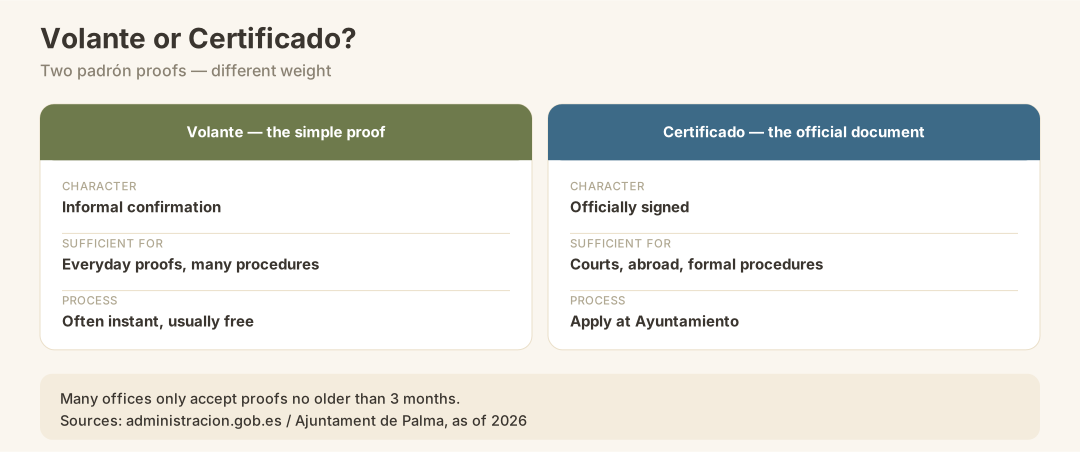
Volante or Certificado – what's the difference?
Many authorities, and even some advice centres, use these terms imprecisely. However, there is a practical difference between two types of document, both of which derive from the Padrón:
| Document | Nature | Typical use |
|---|---|---|
| Volante de Empadronamiento | Simple, informal registration confirmation | Quick internal proof, often without a full signature/stamp |
| Certificado de Empadronamiento | Official document, signed and stamped | Residencia renewal, SIP card, banks, authorities, courts |
Note: For official procedures such as renewing your TIE or registering with the Seguridad Social, the full Certificado is usually required, not the simple Volante.
In Palma, the Sede Electrónica additionally distinguishes by the purpose of the certificate:
| Certificate type (Palma) | Who it's for |
|---|---|
| Certificado de empadronamiento personal | Individuals currently registered in Palma |
| Certificado de empadronamiento domiciliario | Persons currently registered in Palma, including address details/household |
| Certificado de empadronamiento histórico | Persons who were previously registered in Palma but are no longer |
| Certificado de residencia para viaje | Residents who want to prove their resident discount (e.g. for ferry connections) |
Requirements and necessary documents
Before you can even apply for a Certificado, you must be registered in the Padrón of your municipality ("Alta en el Padrón"). For the initial registration as someone relocating from abroad or from another municipality, you generally need:
| Document | Details |
|---|---|
| Proof of identity | Passport or ID card, if applicable additionally proof of Residencia |
| Proof of residence | Rental agreement (usually with a minimum term) or property deed (Escritura) |
| Completed registration form | Provided by the respective Ayuntamiento |
| If applicable, consent of the main tenant/owner | In sublet/shared flat situations |
Note: In some Mallorca municipalities such as Artà or Llucmajor, the order is reversed: there, the Residencia is required first before the Empadronamiento registration is even accepted. Clarify this beforehand by phone with your Ayuntamiento to avoid unnecessary double efforts.
You can find more about the process of applying for Residencia in our guide to Residencia in Spain.
Apply online: Cl@ve and Certificado Digital
Once you are registered in the Padrón, you can retrieve your registration data and in some cases also the certificate digitally. Access to the INE's Padrón query is exclusively via the system Cl@ve, in order to guarantee the confidentiality of the data. Only the data from the most recent registration is displayed, as recorded in the INE database.
| Access method | How it works | Suitable for |
|---|---|---|
| Cl@ve PIN | One-time PIN via SMS, valid for only a few minutes | Occasional, simple enquiries |
| Cl@ve Permanente | Permanent username + password, optionally with 2FA | Regular online dealings with authorities |
| Certificado Digital (FNMT) | Software certificate in the browser, digital signature | Tax returns, applications, signatures with multiple authorities |
The Certificado Digital from FNMT (Fábrica Nacional de Moneda y Timbre) is free and valid for 4 years – there's no need for an annual renewal. However, the entire application process (from request to download) must be carried out on the same computer and with the same user account.
- Apply for the certificate: Start via the FNMT website or Cl@ve registration.
- Confirm your identity: In person at a registration office or via NIE/video verification, depending on the method chosen.
- Access the sede electrónica of your municipality and log in there with Cl@ve or Certificado Digital.
- Select the desired certificate (personal, domiciliario, histórico, residencia para viaje) and submit the application.
- Download and archive the PDF with the security code (CSV).
Note: If your registration details are not displayed online, contact your Ayuntamiento directly to check the accuracy of your registration and request corrections if necessary.
Applying in Palma: The Sede Electrónica in detail
For Mallorca residents living in Palma, the online application runs through the Sede Electrónica of the Ajuntament de Palma. The various certificate types are listed there as separate Trámites:
| Trámite | Link |
|---|---|
| Certificado personal (current residents) | Población.08 – Sede Palma |
| Certificado domiciliario (current residents) | Población.09 – Palma Office |
| Historical certificate (former residents) | Población.10 – Palma Office |
| Certificado de residencia for travel (without Cita previa) | Población.01 – Palma Office |
| Registration in the Padrón (moving from abroad/another municipality) | Población.02 – Palma Office |
Before the initial registration (Alta), the Ajuntament de Palma explicitly recommends first reading the official Hoja informativa with the exact document requirements before submitting your application – this way you avoid rejections due to missing documents.
Cost, processing time and validity
Applying for the Certificado de Empadronamiento is free of charge in most municipalities. The processing time depends on the chosen certificate type and channel (online vs. in person).
| Criterion | Common practice |
|---|---|
| Cost | Usually free |
| Online processing time | Short-term PDF download often possible, depending on the municipality |
| Validity of the registration data | Reflects the latest registration recorded in the INE register |
| Need for updates | Apply for a new one in case of a move or change of address |
Note: Some authorities (e.g. banks, consulates) only accept certificates that are no older than a few months. Check the requirements of the respective institution before submitting an older document.
What you need the Certificado de Empadronamiento for
The certificate acts as a gateway to numerous other procedures:
| Use case | Related guide |
|---|---|
| Initial or renewal application for Residencia | Residencia in Spain |
| Registration with the Seguridad Social | Cita Previa Seguridad Social |
| Proof of tax residency | Certificado Residencia Fiscal |
| SIP health card, doctor assignment | Health insurance Spain |
| Resident discount on travel (e.g. ferry) | Certificado de residencia para viaje, see Palma-Trámites above |
Peculiarities in Mallorca
There is no island-wide uniform procedure on Mallorca – each municipality handles the details differently. Besides the already mentioned reversed order in Artà and Llucmajor, you should also pay close attention to the duration of proof of residence: some Ayuntamientos require a minimum term for rental contracts before registration is accepted. Anyone who doesn't yet have a long-term rental contract should find out about the specific requirements of the municipality in advance – our guide to affordable living on Mallorca gives an overview of realistic rental options.
For questions about more complex constellations (property ownership, subletting, second residence), it's often worth consulting a specialised contact – in the industry directory Tax Advisors & Gestorías you'll find suitable contacts on Mallorca.
Most common mistakes
- Volante submitted instead of Certificado: Many authorities only accept the full, sealed Certificado – not the simple registration confirmation.
- Outdated document used: Some offices require certificates that are no more than a few months old.
- Order in Artà/Llucmajor disregarded: Anyone trying to register there without prior Residencia will get nowhere.
- Incomplete proof of residence: A missing minimum term in the rental contract or missing consent from the main tenant leads to rejection.
- Cl@ve access not prepared: Without valid Cl@ve registration or Certificado Digital, online access to registration data is blocked.
- Device change during certificate application: The FNMT process must be completed from start to finish on the same computer/user account.
What comes next?
Once you have your Certificado de Empadronamiento in hand, the next step is usually applying for or renewing your Residencia, followed by registration with Seguridad Social and the health system. Anyone working professionally in Spain should also look into the topics of Vida Laboral and Taxes as a resident in mind. Families with children also often need the certificate for school enrolment.
Checklist: Applying for the Certificado de Empadronamiento
| Step | Done? |
|---|---|
| Proof of residence (rental agreement/escritura) prepared | ☐ |
| Order of Residencia/Empadronamiento at your local town hall clarified | ☐ |
| Alta in the Padrón completed (if not yet registered) | ☐ |
| Cl@ve access or Certificado Digital set up | ☐ |
| Correct certificate type chosen (personal/domiciliario/histórico) | ☐ |
| PDF with CSV code downloaded and archived | ☐ |
| Currency requirement of the receiving authority checked | ☐ |
Conclusion
The Certificado de Empadronamiento is a small document with a big impact: without it, Residencia, the health card and many other administrative procedures remain out of reach. Anyone who knows the differences between Volante and Certificado, has fully prepared their proof of residence documents, and sets up the right online access (Cl@ve or Certificado Digital) early on will save themselves unnecessary waiting times and trips to the authorities. On Mallorca, it is also worth paying attention to local particularities, such as the reversed order in Artà or Llucmajor.
Official sources
- Punto de Acceso General / Administración del Estado: https://administracion.gob.es/
- Sede Electrónica Punto de Acceso General: https://sede.administracion.gob.es/
- INE – Padrón Continuo (Cl@ve access to registration data): https://sede.ine.gob.es/padronciudadano/?lang=es_ES
- Ajuntament de Palma – Sede Electrónica, Trámites Población: https://seuelectronica.palma.cat/
- Ley 7/1985, de 2 de abril, Reguladora de las Bases del Régimen Local (Art. 15-16)