
Getting Your Vocational Qualification Recognised in Spain: The Complete Guide (Grado Medio/Superior)
You completed a vocational or professional qualification in Germany, Austria, or Switzerland and want to work in your field on Mallorca or elsewhere in Spain? Then an important question arises early on: does your qualification need to be officially recognised — or is it enough to present it to your employer? The answer depends on whether your profession isregulatedin Spain or not. This guide explains the difference, walks you through the recognition process step by step, tells you where to apply and which documents you need. You will also find out why German vocational qualifications are generally only recognised at the level ofGrado Medio— and what you can do about it.

Do you already know whether your profession is regulated in Spain?
- 📩 Submit a personal enquiry— We will review your specific case and tell you which authority is responsible
- Everything you need to know about working on Mallorca
Regulated or free? The most important distinction
Before you gather a single document, you need to know which category your profession falls into. This is not a bureaucratic detail — it determines whether you need a formal recognition procedure at all.
Regulated professions
A profession is considered regulated in Spain if practising it is legally tied to a specific qualification or official authorisation. Anyone who works without recognition is committing an offence or at least risks civil-law consequences. Typical examples from the professional fields relevant to people relocating to Mallorca:
| Professional field | Regulated in Spain | Responsible authority |
|---|---|---|
| Doctor | Yes | Ministerio de Sanidad |
| Architect | Yes | Ministerio de Fomento / Colegio |
| Lawyer | Yes | Colegio de Abogados |
| Teacher (state schools) | Yes | Ministerio de Educación |
| Auditor / Chartered accountant | Yes | Competent specialist ministry |
| Electrician (self-employed) | Partially | Depending on activity and municipality |
| Nurse | Yes | Ministerio de Sanidad |
For regulated professions, you are required to obtain a Homologación (equalisation) or a Reconocimiento (recognition) – depending on the procedure.
Non-regulated (free) professions
For professions that are not regulated in Spain, there is no obligation to obtain official recognition. You can present your German qualification directly to an employer. Whether and how they assess it is at their discretion. Voluntary recognition may nonetheless be worthwhile if you wish to stand out from other applicants or aim for a better classification under a collective agreement.
Note: You can find out whether your profession is regulated in Spain via the official EU Commission database at ec.europa.eu/growth/tools-databases/regprof or directly through the Spanish Ministry of Education.
The Spanish vocational training system: Grado Medio and Grado Superior
To understand why your German qualification is typically classified as a Grado Medio, it is worth taking a brief look at the Spanish Formación Profesional (FP) system.
| Spanish qualification | Designation | EQF level | Roughly equivalent to |
|---|---|---|---|
| Técnico | Grado Básico (FP Básica) | EQF 2 | Basic vocational qualification |
| Técnico | Grado Medio (CFGM) | EQF 4 | Intermediate vocational qualification |
| Técnico Superior | Grado Superior (CFGS) | EQF 5 | Higher vocational qualification |
The German dual vocational training system is classified within the European Qualifications Framework (EQF) at Level 4. The Spanish Grado Superior, by contrast, sits at Level 5. Because classification at a higher level than the home-country qualification is not possible, German vocational qualifications are typically placed at the level of the Grado Medio – even though the dual training programme is often more demanding in its content than what a Grado Medio in Spain provides.
Please note: This structural gap is not an error, but a consequence of the European Qualifications Framework. If you wish to be recognised at Grado Superior level in the long term, further training or obtaining a Spanish qualification at that level is the only reliable route.
Further information on the Spanish FP system can be found at www.todofp.es.
The two recognition procedures: Homologación vs. Reconocimiento
In Spain there are two distinct procedural routes for regulated professions, which are frequently confused:
| Feature | Homologación | Reconocimiento profesional |
|---|---|---|
| Purpose | Academic equivalence of the qualification | Recognition for the purpose of practising a profession |
| Legal basis | National Spanish regulations | EU Directive 2005/36/EC |
| Responsible authority | Ministerio de Educación, FP y Deportes | Competent specialist ministry depending on profession |
| Outcome | Spanish equivalent qualification | Authorisation to practise a profession in Spain |
| Typical use case | Academic qualifications, university degrees | Regulated professions (doctor, lawyer, nurse …) |
| Compensatory measures possible? | No (or rarely) | Yes (aptitude test or adaptation course) |
For vocational qualifications (Grado Medio / Grado Superior) the homologación procedure with the Ministry of Education is generally the right route. For classic regulated professions such as medicine or law, it is the reconocimiento profesional with the relevant specialist ministry.
Step by step: how to apply for homologación
The procedure is handled centrally by the Spanish Ministry of Education (Ministerio de Educación, Formación Profesional y Deportes) in Madrid. You must submit your application there — not in Mallorca or with a Balearic authority.
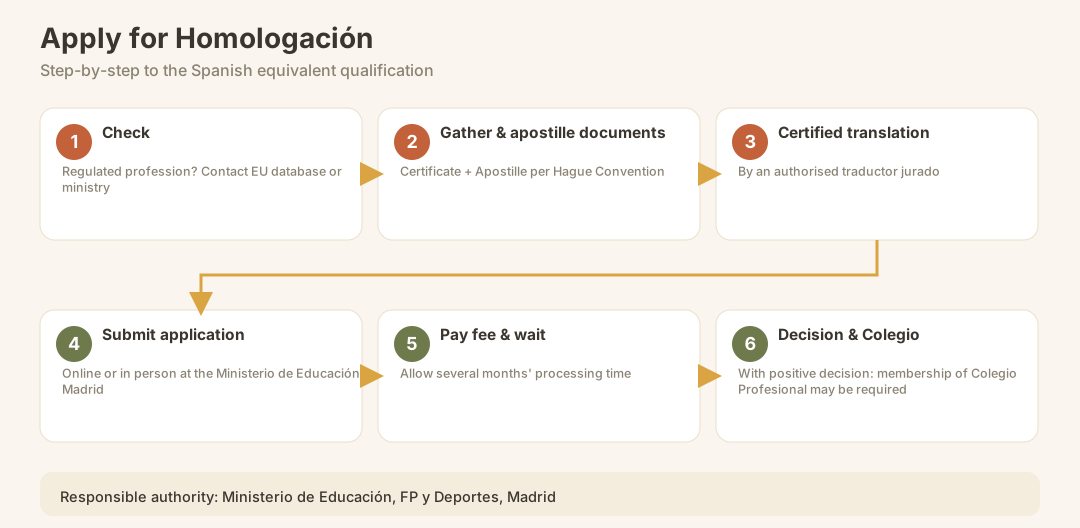
- Check whether your qualification requires recognition — use the EU database or contact the ministry directly.
- Gather all documents (see the checklist below).
- Have certified and translated all foreign documents into Spanish by a sworn translator (traductor jurado).
- Obtain an Apostille: All official German documents (certificates, deeds) must be apostilled in accordance with the Hague Convention.
- Submit the application: Online via the Ministry's portal or in person in Madrid. You can find the online portal at www.educacionyfp.gob.es/mc/convalidacion-homologacion.
- Pay the fee: The application fee must be paid. You can find the current fee amount directly on the authority's website, as this may change.
- Wait for the decision: The process typically takes several months, depending on the complexity of the case and the current volume of applications.
- Complete any compensatory measures (if required): Where there are substantive differences, an adaptation course or an aptitude test may be required.
- Receive the decision and use your qualification: With a positive decision, you are entitled to practise your profession in Spain.
Please note: Each application is assessed on an individual basis. There is no automatic recognition. Even professions with the same name may be assessed differently depending on the training system.
Compensatory measures: When might an aptitude test be required?
If there are significant substantive or temporal differences between your qualifications and the Spanish equivalent, the authority may impose what is known as a compensatory measure. You will generally then have a choice between:
- an adaptation course (curso de aptitud), in which you make up the missing content, or
- an aptitude test (prueba de aptitud), in which you demonstrate that you have compensated for the qualification gaps through professional experience or other knowledge.
The decision as to which of the two options is offered rests with the competent authority. As a rule, however — at least under EU law — you have the right to choose between both forms, provided no specific exception applies.
| Situation | Possible consequence |
|---|---|
| Training duration in the home country shorter than in Spain | Additional professional experience required or compensatory measure |
| Significant differences in content | Adaptation course or aptitude test |
| Substantial equivalence in content and duration | Recognition without compensatory measure |
Special consideration for Mallorca: Do I also need a regional authorisation?
For many professions, recognition by the national ministry is sufficient. However, there are fields in which additional registration with a Spanish professional association (Colegio Profesional) is required — including on Mallorca. Typical examples:
| Profession | Colegio in the Balearic Islands |
|---|---|
| Doctor | Col·legi Oficial de Metges de les Illes Balears |
| Architect | Col·legi d'Arquitectes de les Illes Balears |
| Solicitor / Lawyer | Il·lustre Col·legi d'Advocats de les Illes Balears |
| Nurse | Col·legi Oficial d'Infermeria de les Illes Balears |
Without membership of the relevant Colegio Professional, you will generally not be permitted to work in these professions in the Balearic Islands — either on a self-employed or employed basis — even if your qualification has been recognised at national level. It is therefore advisable to contact the relevant Colegio directly at the same time as pursuing your Homologación.
Please note: Membership of the Colegio is generally subject to an annual fee, the amount of which varies depending on the profession and the Colegio.
Documents you will need
The exact requirements depend on the individual case. As a basis for the Homologación of a German professional qualification, you will generally need:
| Document | Special requirement |
|---|---|
| Original graduation certificate / vocational training certificate | Bearing an Apostille |
| Certified Spanish translation of the qualification | By a sworn translator (traductor jurado) |
| Training certificate / curriculum of the training establishment | With Apostille and translation where applicable |
| Valid national identity card or passport | Copy and original |
| NIE number (Número de Identificación de Extranjero) | Required for all official procedures in Spain |
| Ministry application form | Download the current form from the Ministry portal |
| Proof of fee payment | In accordance with the official fee notice |
You will need your NIE number for all official procedures in Spain. Find out how to apply in our guide to the NIE number on Mallorca.
EU citizens vs. non-EU citizens: an important distinction
As an EU citizen (for example, a German or Austrian national) you benefit from EU Directive 2005/36/EC, which has been transposed into Spanish law. This means:
- You have the right to have your application examined.
- You have — subject to certain limitations — the right to choose between an aptitude test and an adaptation course.
- Compensatory measures may only be imposed where there are genuinely significant differences in content.
For non-EU citizens and nationals of countries without relevant bilateral agreements with Spain, stricter rules apply: these are governed not by EU law but by Spanish national law, which tends to be more restrictive.
A note for Swiss and British nationals: Swiss nationals and British nationals following Brexit (since 1 January 2021) are subject to particular conditions that should be assessed on a case-by-case basis. Since Brexit, British nationals are no longer covered by the automatic mutual recognition under EU law. You can find more information on the right of residence in the guide to the TIE card for British nationals.
The most common mistakes when seeking professional recognition in Spain
In practice, the same pitfalls come up time and again:
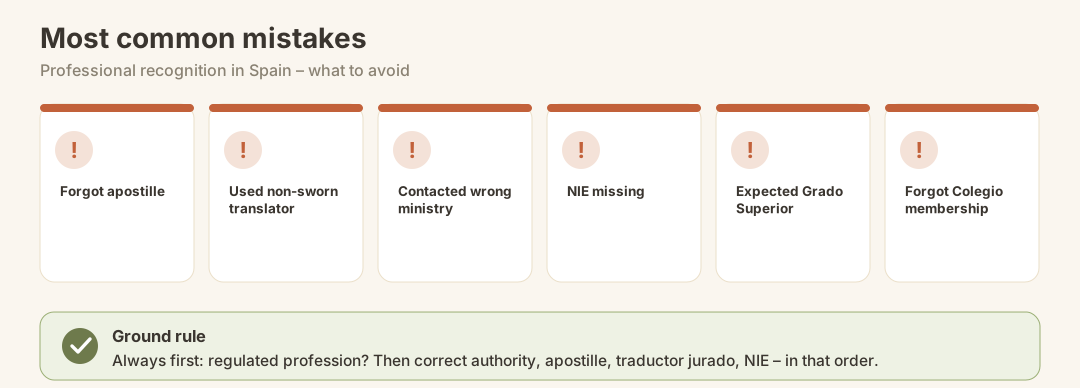
- Forgetting the Apostille: Many applicants submit their documents without an apostille. The application is then returned unprocessed.
- Using a non-sworn translator: Only a Spain-registered traductor jurado is recognised. Standard translation agencies are not sufficient.
- Contacting the wrong ministry: Anyone applying for a regulated healthcare profession to the Ministry of Education instead of the Ministry of Health will lose valuable time.
- NIE missing: Without a valid NIE number, the application cannot be processed.
- The Grado Superior illusion: Anyone expecting their German vocational qualification to be recognised as a Grado Superior will be disappointed. This is structurally not possible as long as the EQF classification remains as it is.
- No membership of the Colegio planned: Anyone who has national recognition but forgets to register with the local Colegio Professional still cannot legally practise.
- Insufficient time allowed: The process typically takes several months. Anyone who waits for it before taking up a position or going self-employed loses a great deal of time.
What comes next? Steps to take after recognition
With the positive recognition decision in hand, these are still the most important things to do:
- Join the Colegio Professional (if required for your profession)
- Apply for or update your Residencia, if you do not yet have one – find out more in the guide to Residencia in Spain
- Ensure your Empadronamiento is in order – your registration at your place of residence is a prerequisite for many further steps; read the guide to Empadronamiento on Mallorca
- Clarify your tax situation: As a resident you are liable to pay income tax in Spain – find out what this means in the guide to taxes as a resident (IRPF)
- Register as Autónomo, if you wish to work on a self-employed basis – find out more in the guide to Autónomo in Spain
- Sort out health insurance – depending on whether you are employed or self-employed; more on this in the guide to health insurance in Spain
Checklist: Getting your professional qualification recognised in Spain
Use this checklist before submitting your application:
- Established whether my profession is regulated in Spain
- Identified the responsible authority (Ministry of Education or specialist ministry)
- Original qualification certificate in hand
- Apostille obtained for all original German documents
- Certified Spanish translation by a traductor jurado completed
- Valid NIE number in place
- Current application form downloaded from the ministry portal
- Application fee paid and receipt kept ready
- Checked whether membership of a Colegio Professional is also required
- Residencia and Empadronamiento up to date
- Sufficient time allowed for (several months)
Conclusion
Getting a professional qualification recognised in Spain is not a quick process – but it is a manageable one. The most important first step is to distinguish between regulated and non-regulated professions and to contact the correct authority. For most German professional qualifications, the central Ministry of Education in Madrid is responsible, and the outcome is typically a classification as Técnico (Grado Medio) at EQF level 4. Knowing this in advance will save you disappointment. On Mallorca, registration with the relevant Colegio Professional is often required on top of this – this step should be factored in from the very beginning.
Official sources
- Ministerio de Educación, Formación Profesional y Deportes – Convalidación y Homologación: www.educacionyfp.gob.es/mc/convalidacion-homologacion
- Spanish Ministry of Education – Recognition for the Purpose of Professional Practice (in German): www.educacionfpydeportes.gob.es/alemania/de_DE/reconocimiento-titulos/en-espana/rec-profesional.html
- AHK Spain – Recognition of Vocational Qualifications: www.ahk.es/de/dienstleistungen/aus-und-weiterbildung/anerkennung-von-berufsbildungsabschluessen
- Todofp.es – The Spanish Vocational Training System: www.todofp.es
- EU Database of Regulated Professions: ec.europa.eu/growth/tools-databases/regprof
- EU Directive 2005/36/EC (Professional Qualifications): eur-lex.europa.eu
- Real Decreto 581/2017 (Transposition of EU Directive 2005/36 into Spanish law): BOE núm. 104, 2 May 2017