
International Schools Mallorca: Comparison, Costs & Admissions 2026
Families relocating to Mallorca with children typically sort out the school question even before looking for a home – and rightly so. The good news: with 19 international schools the island's offering is considerably broader than most families expect. From the British GCSE track and the International Baccalaureate to the state-recognised German Abitur and the French curriculum, Mallorca caters for almost every educational background. Over 16 per cent of all pupils in the Balearic Islands are foreign nationals – one of the highest proportions in the whole of Spain. This guide explains which schools are available, what they cost, where they are located, how the admissions process works, and which pitfalls to avoid. We also explain when the Spanish state school is a genuine alternative – and when it is not.

Which international school suits your family and where you live?
- 📩 Submit a personal enquiry — we'll connect you with experienced expats and local school advisers
- All you need to know about family life on Mallorca
An overview of the Spanish school system
Before deciding on an international school, it is worth taking a brief look at the three types of school that exist side by side on Mallorca. They differ fundamentally in language of instruction, costs, and qualifications offered.
| School type | Spanish | Costs | Language of instruction |
|---|---|---|---|
| Colegio Público (state) | State mainstream school | free of charge | Catalan (main language), Spanish |
| Colegio Concertado (semi-state) | Former private school with state funding | usually free, some voluntary contributions | Catalan/Spanish, partly bilingual |
| Colegio Privado (private) | Spanish private school | fee-paying | Spanish, some English as a subject |
| International school | – | from approx. 550 €/month | English, German, French or other |
State and semi-state schools teach predominantly in Catalan – which is a genuine barrier for newly arrived children with no prior knowledge of the language. Language support programmes exist but are time-intensive. Families who plan to stay on the island for only a few years, or who do not want to interrupt their children's international educational pathway, therefore almost always choose an international school.
Note:The school year in Mallorca typically begins in September and ends in June, with holidays at Christmas and Easter. This rhythm applies to all types of schools.
Some state-subsidised international schools receive public funding, but must meet certain conditions in return: at least 25 per cent of pupils must be local residents, each class must include at least 20 per cent local pupils, and the curriculum must be bilingual.
Curricula: Which qualification leads where?
Mallorca offers an unusually broad range of curricula. The right choice depends greatly on where your children plan to study or live in the future.
| Curriculum | Qualification | Suitable for … | Schools on Mallorca |
|---|---|---|---|
| British curriculum | GCSE, A-Level | Study in the UK, internationally recognised | Several schools, including Queen's College, King Richard III, Tudor Rose |
| International Baccalaureate (IB) | IB Diploma (DP), PYP, MYP | Globally recognised, top universities | Agora Portals (the only IB Continuum school in the Balearic Islands) |
| German curriculum | German Abitur (state-recognised) | Study in Germany/Austria/Switzerland | Eurocampus Deutsche Schule Palma |
| French curriculum | French Baccalauréat | Study in France | École Française |
| Swedish curriculum | Swedish qualifications | Swedish families, option to return | Available on the island |
| Spanish curriculum + Selectividad | Spanish Abitur | Studying at Spanish universities | Partly also offered at British schools |
| Bilingual curriculum | Combination | Integration + international background | Various schools |
The dominant curriculum on Mallorca is the British one. Those considering GCSEs and A-Levels have the widest choice of schools. The IB Diploma is only available at Agora Portals – the only authorised IB Continuum school in the Balearics offering all three IB programmes (Primary Years Programme, Middle Years Programme, Diploma Programme). The IB Diploma Programme was introduced there in 2011 – the first on the Balearics.
Please note: If you are planning to return to Germany after a few years, you should check whether the qualification you have chosen is recognised as equivalent in Germany. Only the Eurocampus, as a licensed German school abroad, leads directly to the state-recognised Abitur.
The most important international schools at a glance
According to current data, there are 19 international schools on Mallorca. Here are the most relevant ones for German-speaking and international families:
| School | Location | Curriculum | Year groups |
|---|---|---|---|
| Agora Portals International School | Portals Nous (SW Palma) | IB (PYP, MYP, DP), Spanish Bachillerato | Toddler to 18 yrs |
| Eurocampus Deutsche Schule | Palma | German curriculum, state-recognised Abitur | Primary school through to Abitur |
| Queen's College | Near Palma | British (GCSE, A-Level) | No information from research |
| King Richard III College | Portals | British + Spanish (dual) | up to 18 yrs. |
| Mallorca International School | Crestatx (North) | British + Spanish qualification possible | Infant, Primary, Secondary |
| Palma College | Palma | no info from research | no info from research |
| Green Valley School | Palma | no info from research | no info from research |
| Tudor Rose British College | Mallorca | British | no info from research |
| Escola Global International School | Mallorca | no info from research | no info from research |
| Rafa Nadal International School | Manacor | International (Infant, Primary, Secondary) | up to 18 yrs. |
Further schools are reportedly located in Santa Maria del Camí, Binissalem and Les Meravelles. The geographical focus is clearly in the south-west of Palma and in the greater capital area.
School fees: what does an international school really cost?
Mallorca is considered comparatively affordable for international education by European standards. Spain as a whole ranks among the least expensive countries in Europe for international schools – and on the islands, where demand is somewhat lower than in Madrid or Barcelona, prices are lower still.
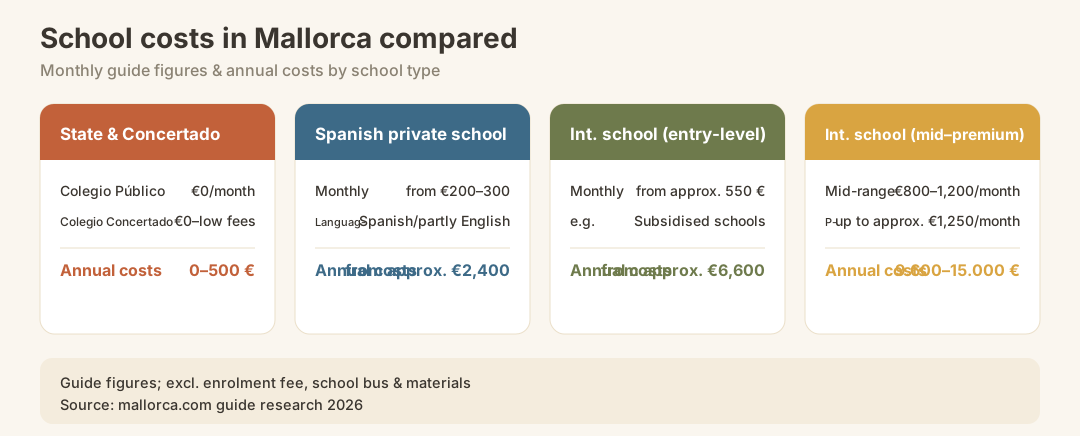
| School type | Monthly costs (indicative figure) | Annual costs (approx.) | Note |
|---|---|---|---|
| State school | 0 € | 0 € | Catalan as the main language of instruction |
| Concertado (semi-state) | 0 € to low contributions | approx. 0–500 € | Voluntary contributions possible |
| Spanish private school | from approx. 200–300 €/month | from approx. 2.400 €/year | Lessons partly in English |
| International school (entry level) | from approx. 550 €/month | from approx. 6.600 €/year | e.g. subsidised schools |
| International school (mid-range) | approx. 800–1.200 €/month | approx. 9.600–14.400 €/year | British curriculum, IB |
| International school (premium) | up to approx. 1.250 €/month | up to approx. 15.000 €/year | IB Diploma, premium segment |
Please note: The figures are indicative values based on our research. Exact annual fees vary depending on year group, programme and school. Registration fees, school bus costs and materials costs typically apply in addition. Please always enquire directly with the school.
For comparison: equivalent international schools in London, Munich or Paris generally cost considerably more than comparable schools on Mallorca.
Locations: where are the schools, and where should you live?
The location of the school has a direct bearing on your search for a place to live. Those enrolling a child at Agora Portals will be looking in the south-west of Palma, in Portals Nous or along the Calviá coastline. Those choosing the Deutsche Schule are well served by a centrally located home in Palma.
| Region | Schools (selection) | Characteristics |
|---|---|---|
| Portals Nous / Calviá (SW) | Agora Portals, King Richard III | Villa areas, internationally oriented, sea-view locations |
| Palma city | Eurocampus Deutsche Schule, Queen's College, Green Valley | Urban living, good infrastructure |
| North (Crestatx/Pollença area) | Mallorca International School | Rural, peaceful, finca area |
| East (Manacor) | Rafa Nadal International School | Rural, more authentic, lower expat density |
| Santa Maria del Camí / Binissalem | Further international schools | Central island, good road connections |
| Les Meravelles (South) | Further international schools | Close to the airport, near the coast |
School bus services are available at many schools, but do not cover all municipalities. Before you start your property search, check directly with the school office which bus routes are on offer.
Eurocampus Deutsche Schule Palma: What you need to know
The Eurocampus in Palma is the only licensed German school on Mallorca and, as such, offers the only curriculum that leads directly to the state-recognised German Abitur. For families who are specifically planning a return to Germany or wish to keep their children anchored within the German education system, this is a decisive factor.
The school teaches in German and, alongside the German curriculum, also imparts Spanish and Catalan language skills. As an overseas school with an official licence, it is recognised by the German Schools Abroad authority.
Those who choose the Eurocampus typically live in or around Palma – its central location makes this straightforward. For detailed, up-to-date fees and admission requirements, it is advisable to enquire directly with the Eurocampus.
Agora Portals International School: The IB flagship
Agora Portals is the only option on the Balearic Islands for families with an affinity for the IB. The school belongs to the international Globeducate group and in 2011 was the first school in the Balearic Islands to offer the IB Diploma Programme – today it is the islands' only IB Continuum school, authorised for all three IB programmes: PYP (Primary Years), MYP (Middle Years) and DP (Diploma).
Alongside the IB, Agora Portals also offers the Spanish Bachillerato. An in-house music conservatoire forms part of the school's profile. According to the school itself, particular emphasis is placed on multilingualism, STEAM subjects, sport, and values education. According to the MiCole 2026 ranking, Agora Portals is among the best schools in Spain and the Balearic Islands.
For parents who envisage their children attending internationally renowned universities, the IB Diploma is the globally respected qualification – and on Mallorca it is available exclusively here.
Admission: Step by step
The admissions process differs from school to school, but generally follows a typical pattern. Here is the usual procedure:
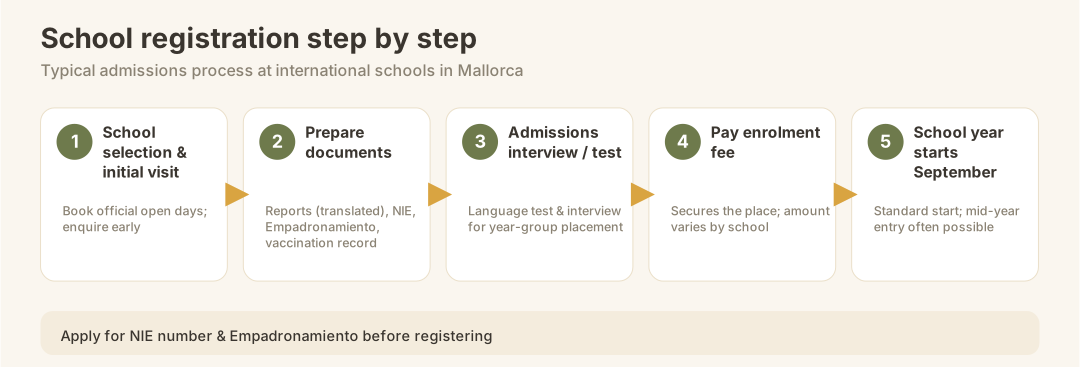
- School selection and initial visit – Schools offer official open days and visit appointments (at Agora Portals, for example, you can book a 'Book a Visit' slot). Get in touch early, as waiting lists at popular schools are very much a reality.
- Preparing your documents – You will typically need: recent school reports (translated into Spanish or English), vaccination records/health documents, passport or NIE number, proof of registration (Empadronamiento).
- Admissions interview / placement test – Many schools conduct a short language assessment or a conversation with the child and parents to determine the appropriate year group.
- Paying the enrolment fee – This secures the place; the amount varies by school.
- School year start in September – The standard start date; mid-year entry is often possible, but subject to available places.
Please note: You will generally need your NIE number and your Empadronamiento (proof of registration) before you can enrol your child at a school. Make sure to allow plenty of time for these administrative steps.
| Document | What it is needed for | Where to obtain it |
|---|---|---|
| NIE number | Identification number in Spain, required for all official procedures | National Police, consulate |
| Empadronamiento | Registering your place of residence, proof of address | Town hall (Ajuntament) |
| School reports (translated) | Placement into the correct school year | Certified translator |
| Vaccination records | School health requirements | Paediatrician / public health authority |
| Passport or Spanish identity document | Proof of identity | Own authorities |
State school as an alternative: when can it work?
State schools are free of charge and of a solid standard – but instruction in Catalan presents a significant hurdle for children who have just moved to the island. Integration programmes for non-native-speaking children do exist, but they require time and patience from everyone involved.
When can a state school still be a good choice?
- If you intend to stay on Mallorca permanently and full integration into Spanish-Catalan society is an explicit goal
- If the child is young enough (primary-school age) to absorb Catalan and Spanish quickly
- If the budget does not allow for an international school
- If an international qualification is not being pursued
For children who already have a well-established academic background, switching to the state Catalan-language system is generally very difficult and can lead to genuine gaps in their education.
The most common mistakes when choosing a school
Even experienced expat families make avoidable mistakes. These come up time and again in practice:
1. Leaving the school application too late Popular schools such as Agora Portals have waiting lists. If you move in January and only then start looking for a school, you risk not finding a place. Apply as early as possible before the intended start date.
2. Not checking qualification compatibility British A-Levels are not automatically equivalent to the Abitur in Germany. Anyone who wants to keep the option of returning home open should clarify in advance how the chosen qualification is recognised in their home country.
3. Not coordinating the school location with where you live Buying a house first, then looking for a school – only to discover that the preferred school is far away and does not run a bus in your direction. Always do it the other way round: school first, then location.
4. Looking only at the price The cheapest international school is not always the best choice. Class sizes, teacher qualifications, the proportion of native speakers on the staff, and inspection results are equally relevant criteria.
5. Underestimating children's language needs Even English-language international schools expect a certain basic level. Children who speak little English can make the start considerably easier by attending targeted language courses before the school year begins.
Checklist: things to sort out before enrolling in a school
- NIE number applied for for all family members
- Empadronamiento (residential registration) completed
- School reports translated into Spanish/English (certified translation)
- Schools visited and compared (official open-day appointments booked)
- Checked waiting-list status at preferred school
- Checked school bus routes and matched them to the property search
- Calculated annual fees and ancillary costs (enrolment, bus, materials)
- Checked whether qualifications are recognised in the home country
- Arranged health insurance for children (schools require proof)
- Assessed children's language level; arranged tutoring/language course if needed
What comes next? Practical matters after school enrolment
The school question is sorted – now come the next steps of everyday life on Mallorca. Particularly relevant for families:
- Residencia and registration with the authorities: Anyone living here permanently and sending children to school is generally classified as a tax resident. The Residencia and the Empadronamiento are the first steps towards this.
- Health insurance: Schools require proof of insurance. The options for families – statutory health insurance, private insurance, the S1 form for EU pensioners – are explained in the guide Health Insurance in Spain.
- Tax liability: With a permanent residence and school-age children, you are generally tax-resident in Spain. What this means is explained in our guide to Taxes as a Resident (IRPF).
- Organising daily life: From finding a flat to setting up internet, there is a great deal to sort out – an overview can be found under Housing & Everyday Life and in the Cost of Living Mallorca.
Conclusion
Mallorca is significantly better equipped for families with school-age children than its reputation as a holiday island might suggest. 19 international schools, several different curricula, fees noticeably below the European average, and a proportion of foreign pupils exceeding 16 Prozent at schools across the Balearen – that is a solid foundation for an educational decision you are unlikely to regret.
The key takeaways: the choice of school determines where you live, not the other way round. Register early, check whether qualifications are transferable for a return home, and factor in the hidden costs (bus, materials, enrolment). Anyone who needs the German Abitur has only one option: the Eurocampus. Anyone who wants the IB cannot look past Agora Portals. And anyone who prioritises integration into island society will find the state school a free, honest option – provided the children are young enough and the parents patient enough.
Official Sources
- Ministerio de Educación, Formación Profesional y Deportes – Recognition of foreign qualifications: https://www.educacion.gob.es
- Conselleria d'Educació i Universitats del Govern de les Illes Balears – School law in the Balearic Islands: https://www.caib.es/sites/educacio
- International Baccalaureate Organization (IBO) – official IB school search and programme information: https://www.ibo.org
- Bundesverwaltungsamt – Zentralstelle für das Auslandsschulwesen (ZfA) – Information on German schools abroad: https://www.auslandsschulwesen.de
- Agora Portals International School – official school website: https://portals.agorainternationalschool.es
- Govern de les Illes Balears – padrón registration and administration: https://www.caib.es