
School Registration Mallorca: The Escolarización Process Step by Step
Anyone moving to Mallorca with children, or already living on the island and wanting to change school, cannot avoid the so-called Escolarización process: the official registration procedure run by the Balearic education authority for all public and semi-state (concertado) schools. The process is split into two parts, Adscripción (automatic transition between stages) and Admisión (new application), runs mainly online via the GestIB portal, and follows a staggered calendar every year from the end of March to July. For the 2026/2027 school year there is also a fundamental change: a new, unified Escolarización regulation as well as a reformed school zoning system in Palma. This guide explains the specific deadlines, the necessary documents, the points system (Baremo) used when places are scarce, and the most common pitfalls in the Mallorca School Registration.

What exactly is the Escolarización process?
Escolarización is the official umbrella term for the annual admissions procedure at public and concertado schools in the Balearics, managed by the Dirección General de Planificación y Gestión Educativas of the Conselleria d'Educació i Universitats. It regulates how children obtain a place at a publicly funded school, from nursery (0-3 years) through pre-school (Infantil), primary school (Primaria), and ESO, up to Bachillerato. Private schools are excluded from this and handle registration directly themselves.
For the 2026/2027 school year, the Conselleria published a new Escolarización regulation in the Boletín Oficial de las Illes Balears (BOIB), which for the first time consolidates the entire process from 0 to 18 years into a single set of rules and aligns it with Decreto 43/2024 as well as the new curriculum decrees from 2025. Until now, the procedure had been spread across several regulations from 2012 and 2016. The specific annual resolution containing deadlines, documents, and operational Baremo details is published separately each year – for 2026/2027 this was scheduled for 5 March 2026.
Note: For children already attending a school and automatically moving up to the next affiliated stage (e.g. from pre-school to the assigned primary school), the Adscripción applies. Anyone applying for a place for the first time or wanting to change school goes through the Admisión.
Adscripción and Admisión: the two phases in detail
The overall process is divided into two clearly separate procedures, which start one after the other:
| Phase | Who is it for? | Procedure |
|---|---|---|
| Adscripción | Pupils with an automatic transition between stages at linked institutions (e.g. Infantil → Primaria at the same site) | Starts first in the calendar year, from 26 March 2026 |
| Admisión | New enrolments, school transfers, first applications for nursery school, newcomers to the island | Runs in stages by age group from April to June |
For emigrant families, the Admisión is generally the relevant process, as the children are entering the Balearic system for the first time. Important: Solicitud (application) and Matrícula (binding enrolment) are two separate steps, each with its own timeframe – an assigned place must be confirmed within the Matrícula deadline, otherwise it is forfeited.
Deadlines and calendar for the 2026/2027 school year
The dates are set anew each year by the Conselleria and published in stages according to age group. So far, only the start of the Adscripción and the deadlines for the 0-3 age range have been officially confirmed by the Conselleria. The remaining dates for Infantil, Primaria, ESO and Bachillerato are based on current media reports and should additionally be checked on the Conselleria's official calendar page before the deadlines begin:
| Procedural step | Affected stage | Period |
|---|---|---|
| Adscripción (assignment) | Primaria, Special Education, ESO, Bachillerato | from 26 March 2026 |
| Solicitud (application) 0-3 years | Nursery school | 13-21 April 2026 |
| Matrícula 0-3 years | Nursery school | 1-12 June 2026 |
| Solicitud Infantil, Primaria, ESO, Special Education | 3-16 years | 4-14 May 2026 (provisional) |
| Matrícula Infantil/Primaria/Special Education | 3-16 years | 22-29 June 2026 (provisional) |
| Matrícula ESO | 12-16 years | 25 June - 1 July 2026 (provisional) |
| Solicitud Bachillerato | 16-18 years | 19-25 June 2026 (provisional) |
| Matrícula Bachillerato | 16-18 years | 16-20 July 2026 (provisional) |
Note:Anyone who misses the Solicitud deadline must submit the application through the relevant Oficina de Información y Escolarización for their zone. Registration is generally possible all year round, but only subject to availability of places and no longer within the regular procedure with the full points system.
Step by step: How to apply for a school place
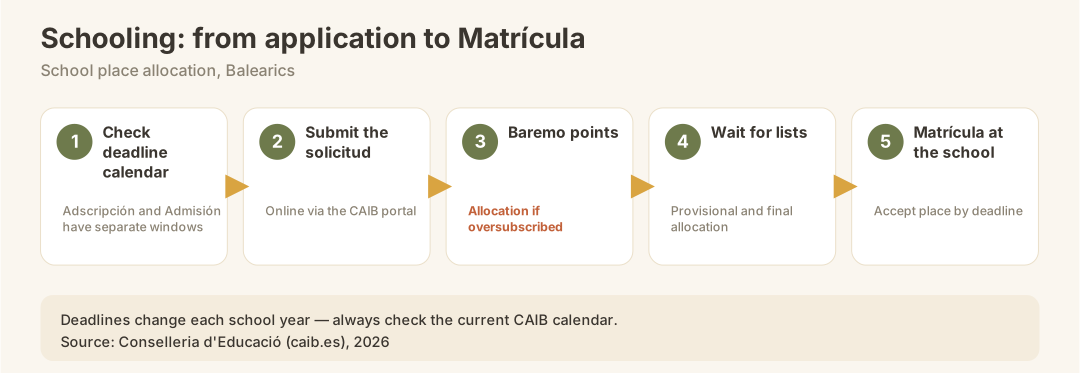
- Complete the Empadronamiento before the deadline begins.The registration certificate from the town hall is a prerequisite for proof of residence in the Baremo – plan this step in good time before April/May. More on this in the guide to Empadronamiento on Mallorca.
- Set up access to GestIB/Cl@ve.Applications are preferably submitted digitally via the escolarizacion.caib.es portal; this requires Cl@ve or GestIB access. Anyone who doesn't test this in time loses valuable days in the tight time window.
- Check whether Adscripción or Admisión applies.New arrivals and those changing schools usually start within the Admisión time window for their age group.
- Submit the Solicitud online.Prioritise your school preference (list several schools in order of preference) and upload documents relevant to the Baremo.
- If in doubt, ask in person.The Oficinas de Información y Escolarización provide advice on site and also help with technical problems with online access.
- Check the result.The assigned place can be viewed via the "Consulta Resultado del Proceso" function on the CAIB portal.
- Confirm the Matrícula on time.The place is only secured once enrolment has been completed within the Matrícula deadline.
Required documents
Which documents are specifically required depends on age, year group and, in some cases, on the individual municipality. In practice, the following documents are almost always required:
| Document | Note |
|---|---|
| Child's international birth certificate | Often required with a certified translation |
| Parents' ID card/passport | Required for the application |
| Empadronamiento certificate | Proof of residence for the "Domicilio" Baremo criterion |
| Residencia/NIE | Not compulsory everywhere, but frequently required additionally in some municipalities – such as Palma |
| Proof of parents' workplace | Alternative to the residence criterion, if relevant for the Baremo |
Note: Since foreign-language birth certificates usually require a certified translation, it's worth contacting a sworn translator in Mallorca early on – as experience shows, things get tight shortly before the deadline.
Baremo: How places are allocated when demand exceeds supply
If there are more applications than places at a preferred school, a points system, the Baremo, decides the allocation. The Conselleria takes into account a whole range of family and social criteria:
| Criterion | Effect |
|---|---|
| Siblings already at the school | Clear advantage in the allocation |
| Residence (Ubicación del domicilio) | Proximity to the school counts |
| Parents'/pupil's workplace | Can be used as an alternative to residence |
| Renta per cápita | Household income |
| Familia numerosa / familia monoparental | Large families or single-parent families |
| Siblings from a multiple birth | Additional criterion |
| Disability of the child or close relatives | Priority criterion |
| Chronic illness of the child | Priority criterion |
| Forced family mobility (movilidad forzosa) | Taken into account, e.g., for job-related relocation |
If the Baremo doesn't resolve a tie in points, additional criteria for the draw (Sorteos Desempate) apply, which the Conselleria publishes every year.
The 2026/2027 school zone reform: what's changing
One of the biggest changes for 2026/2027 concerns the territorial structure of allocation. Palma will, for the first time, have a single unified school zone instead of the previous eight zones – a transition that was already initiated two school years ago. Satisfaction figures seem to confirm the decision: in the 2025/2026 school year, 94.28% of families received a place at their first-choice school.
In the island's other municipalities, the Conselleria is introducing the unified zone wherever it seems sensible, to make school choice easier for families. In cases of large distances, single-class schools, or where a balanced distribution of pupils with specific support needs (NESE) must be ensured, the Ministry retains existing zone divisions or adjusts them according to technical criteria. In addition, the Localidad (the municipality) will now be used as the basic unit of allocation instead of the old zone logic – a system change that, according to the Conselleria, is meant to create more flexibility in school choice within a clear territorial framework.
Public, Concertado, or Private: A Cost Overview
Relevant for Escolarización are public and concertado schools; private schools operate outside this process. For an overview of costs:
| School type | Costs | Special features |
|---|---|---|
| Public (Colegio/Instituto Público) | Free of charge | Runs through the Escolarización process |
| Concertado | Basically free of charge, in practice often "voluntary" contributions | Church-run or secular provider, in some cases also via Escolarización |
| Private | Approx. €200-400 enrolment fee + approx. €400-1,000/month depending on grade level | Runs outside the Escolarización procedure, direct registration with the school |
For a detailed comparison of public, semi-state, and international schools, as well as the role of Catalan in teaching, it's worth taking a look at the guide School Mallorca for German children.
Most common mistakes when registering for school
- Confusing Solicitud and Matrícula. An allocated place that is not confirmed with a timely Matrícula is automatically forfeited.
- Applying for Empadronamiento too late. Without a registration certificate, a key Baremo criterion is missing – and the appointment at the town hall sometimes takes longer than expected.
- Assuming that Residencia is mandatory everywhere. The requirements differ from municipality to municipality; in Palma, experience shows it is enforced more strictly than in smaller towns.
- Mixing up Adscripción and Admisión. Anyone who mistakenly believes they'll be automatically assigned misses their own application window.
- Testing Cl@ve access only on the last day. Technical problems cost valuable time within a window that is often open for only a few days.
- Commissioning translations too late. Certified translations of birth certificates or school reports need lead time.
- Forgetting the Homologación for older children. Foreign school reports may need to be officially recognised for moving into higher year groups – more on this in the guide to Homologación of qualifications.
What comes next? After allocation
Once the place has been confirmed via the Matrícula, further organisational steps usually follow: the school's list of materials, possibly placement tests for older children, and clarifying whether foreign school reports require a Homologación. Since state schools in the Balearics mostly teach in Catalan, it's also worth getting in touch early with the school about language support programmes for newly arrived children.
Checklist: School Enrolment Mallorca
- Empadronamiento completed before the deadline started
- Cl@ve/GestIB access set up and tested
- Birth certificate certified and translated
- Checked whether Residencia is required in your own municipality
- Applicable deadline (0-3, Infantil/Primaria/ESO or Bachillerato) noted
- Solicitud submitted with prioritised school selection
- Result checked via Consulta Resultado
- Matrícula confirmed on time
- For older children: Homologación of previous school reports clarified
Conclusion
The Escolarización process on Mallorca is well structured, but tightly timed: anyone who knows the staggered deadlines between the end of March and July, organises Empadronamiento and translations early, and understands the difference between Adscripción, Admisión and Matrícula, will get through the process with ease. The new Escolarización regulations for 2026/2027 and the unified school zone in Palma are intended to make school choice even easier for families – make use of the official information offices if any questions remain.
Official sources
- Servicio de Escolarización (CAIB): https://www.caib.es/sites/escolaritzaciocurs/es/inici-45806_1/
- Escolarización 0-3 years (CAIB): https://www.caib.es/sites/escolaritzacio03/es/inicio/
- Calendario del proceso de escolarización: https://www.caib.es/sites/escolaritzaciocurs/es/calendario/
- Normativa y resoluciones: https://www.caib.es/sites/escolaritzaciocurs/es/normativa-9674/
- Information and Enrolment Offices: https://www.caib.es/sites/escolaritzaciocurs/es/oficinas_de_informacion_y_escolarizacion-4579_0/
- Check Process Result: https://www.caib.es/sites/escolaritzaciocurs/es/consulta_resultado_del_proceso-25569/
- Information note: New School Enrolment Order 2026 (Conselleria d'Educació i Universitats, CAIB): https://www.caib.es/webgoib/es/w/educaci%C3%B3-publica-una-nova-ordre-d-escolaritzaci%C3%B3-que-modernitza-i-unifica-tot-el-proc%C3%A9s-de-0-a-18-anys