
Nursery & Guardería in Mallorca: public, private, costs and the Cheque Canguro
You're moving to Mallorca with children – and suddenly you encounter terms you won't find in any guide aimed at Germany: Guardería, Escoleta, Educación Infantil, Cheque Canguro. What's compulsory, what does it actually cost, and where do you enrol your child? This guide explains the entire early-childhood care system on Mallorca: from infants in nursery through to pre-school children at six years old, from the free public Escoleta to German-speaking private nurseries, and from the practicalities of registration to the Balearic subsidy that reimburses part of your costs. You'll also learn which documents you need, how the Cheque Canguro 2026 works, and which common mistakes expat families should avoid when starting out.
Are you planning your move to Mallorca with your family and don't want to lose time searching for childcare?
- 📩 Submit a personal enquiry — we'll connect you with experienced relocation experts on the ground
- Everything about the Relocation Service Mallorca
The Spanish system: three phases you need to know
The Spanish education system divides early childhood into clearly defined stages. If you're coming from Germany, you'll think in terms of 'nursery up to age 3, kindergarten up to age 6' – Mallorca follows a similar logic, but with different names and different responsibilities.
| Age group | Spanish term | Compulsory? | Typical providers |
|---|---|---|---|
| 0–3 years | Guardería / Escoleta | No | Local authorities, private providers |
| 3–6 years | Educación Infantil (2nd cycle) | No, but commonplace | State schools, subsidised, private |
| From age 6 | Educación Primaria | Yes | State schools |
The key difference from Germany: Compulsory schooling does not begin until age 6. Nevertheless, according to available figures, around 95 % of children from the age of three attend an educational setting, because the second cycle of Educación Infantil (3–6 years) at state schools is free of charge.
Please note: In Mallorca, public institutions primarily operate in Catalan is the language of instruction, with Spanish introduced as a second language. Those seeking German-speaking or English-speaking care will need to look at private or international settings.
The youngest children (0–3 years) fall within the first cycle of Educación Infantil. In Spain, this isneither compulsory nor automatically free of charge – parents pay varying amounts depending on the type of setting and the municipality.
Public Escoletas: free from age 3
From your child's third birthday, they are entitled to a place in publicEducación Infantil (second cycle) in Mallorca, which is attached to primary schools. Core hours are free of charge – however, lunch and after-school care (Extraescolares) typically incur additional costs.
| Service | Cost status |
|---|---|
| Tuition (core hours) | Free of charge |
| Textbooks/materials | Partially subsidised |
| Lunch (Comedor) | Chargeable, approx. 100–150 €/month |
| After-school care (Extraescolares) | Chargeable, varies by school |
For children under 3 years of age, many municipalities in Mallorca run their ownEscoletas Públicas (municipal nurseries). Places are limited and in high demand – registration deadlines are typically several months before the desired start date. Places are allocated on a points-based system, which takes into account factors including household income, siblings already attending the setting, and padrón registration.
Please note: Without a validpadrón registration (registration with the local municipality), you will not be allocated a place at a public setting. This is the very first step to take, even before applying for a nursery place.
Private and international nurseries: costs and provision
Private settings generally accept children from around 4 months of age – meaning childcare becomes available in practice as soon as Spanish maternity leave ends. The range of options in Mallorca is broad, though the differences in quality are considerable.
Settings with German-language provision
| Setting | Location | Languages | Monthly costs (approx.) |
|---|---|---|---|
| Deutsche Schule Mallorca – Eurocampus (pre-school) | Playa de Palma | German / Spanish | ca. 500–600 € |
| Kindergarten Villa Bambini | Palma | German / Spanish / English | ca. 450 € |
| German International School | Santa Ponsa | German / English / Spanish | ca. 600 € |
The kindergarten of the Deutsche Schule Eurocampus at Playa de Palma accepts children aged 3 to 6, provides bilingual care in German and Spanish, and offers a canteen as well as structured daily activities (e.g. a dedicated sports day). Website: dsmallorca.de
English-language international settings
| Setting | Location | Age range | Monthly costs (approx.) |
|---|---|---|---|
| Baleares International College | Sa Porrassa | 2–18 years | ca. 500–700 € |
| Bellver International College | Palma | 3–18 years | approx. €550 |
| King Richard III College | Portals | 3–18 years | approx. €600 |
| Agora Portals International School | Portals Nous | 1–18 years | approx. €650 |
| Dragonfly British Nursery (Montessori) | Palma | from 6 months | on request |
The Dragonfly British Nursery in Palma operates according to Montessori principles and accepts babies from 6 months. Website: dragonflybritishnursery.com
Alternative education: Waldorf on Mallorca
The Escolasofia (Waldorf Palma) is the only Waldorf school on the Balearic Islands authorised by the Conselleria d'Educació i Formació Professional of the GOIB. It covers Early Childhood Education, Primary School, Lower Secondary and Upper Secondary (up to Year 10). Information and enrolment at waldorfpalma.com
For families in the Calvià area, the Children's Home Petit Club in Palmanova also offers childcare for children aged 3 to 6 years. Website: escoletapetitclub.com
Enrolment step by step
The enrolment process for a nursery or guardería on Mallorca varies depending on the type of institution. One thing they have in common: you should well in advance as in Germany.
Public institutions (Escoleta pública, Educación Infantil):
- Empadronamiento – register in the municipality; without this proof, no application is possible
- NIE (Número de Identificación de Extranjero) for all family members – including the child
- Submit the application during the official registration period of the Conselleria d'Educació (usually March/April for a September start)
- Await the points allocation, accept the place, and submit the required documents
- If applicable, apply for a subsidised school lunch
Private and international institutions:
- Get in touch early – popular institutions maintain waiting lists
- Arrange a viewing appointment (many schools offer formal open days)
- Submit the enrolment form, often accompanied by a registration fee
- Have the vaccination record / health documentation ready
- Review the contract: notice periods, holiday dates, additional costs
Please note: For a September start, you should apply to popular institutions by March of the same year at the latest. International schools, particularly those offering a German or British curriculum, are often fully booked a whole school year in advance.
Which documents does your child need?
| Document | Purpose | Where to apply |
|---|---|---|
| Child's NIE | Required for all official procedures | Immigration authority (Extranjería), National Police |
| Empadronamiento | Requirement for public nursery places | Town hall (Ajuntament) of the municipality of residence |
| Residencia (TIE/certificate) | Mandatory for non-EU citizens, recommended for EU citizens | Extranjería |
| Vaccination record / Cartilla de vacunación | Condition of admission at almost all institutions | Paediatrician (Pediatra) |
| Birth certificate (certified + translated) | Registration at public institutions | Registry office + sworn translator |
The Residencia for Spain and the NIE should be applied for as early as possible – ideally before arrival or within the first few weeks after moving.
The Cheque Canguro: up to €4,000 for childcare
The Balearic regional government (Govern de les Illes Balears, Conselleria de Treball) launched the so-called Cheque Canguro (officially: Bono Canguro) in January 2026. This is a subsidy designed to help parents with the costs of caring for young children – specifically for the employment of household staff for childcare purposes.
The key facts at a glance
| Feature | Details |
|---|---|
| Maximum funding amount | up to 4.000 € per family |
| Funding period | Costs incurred in 2025, are eligible for retrospective funding |
| Application deadline | 30. Juni 2026 – however: funds may be exhausted earlier |
| Purpose | Social security contributions and wages for household help providing childcare |
| Excluded | Part-time employees and many self-employed persons as a rule |
| Documents | Proof of childcare costs + proof of employment situation |
Please note: The funding is limited. Applications may be unsuccessful before 30. Juni 2026 if the budget is exhausted. Those who are eligible should act now.
Who is eligible?
In principle, families in the Balearen who can demonstrate childcare costs for young children and whose parents are in employment are eligible. Part-time employees and many self-employed persons are currently not entitled to apply. The precise income thresholds and conditions can be found in the relevant official call for applications issued by the Conselleria de Treball.
What the Cheque Canguro does not solve
The Cheque Canguro offsets a portion of the costs – but it does not address the structural shortage of childcare places on Mallorca. Families who are unable to secure a place at a state nursery and are forced to turn to private facilities continue to pay considerable monthly sums. The subsidy is a contribution towards achieving a work–life balance, not a substitute for a sufficient supply of places.
Tax deductibility of childcare costs
Anyone resident and liable to tax on Mallorca may, under certain conditions, claim childcare costs in their Spanish income tax return (IRPF). The Balearen also offer their own regional deductions.
Please note: The specific deduction amounts and conditions change each year. Seek advice from a tax adviser – you can find details on the Balearic deductions in our guide to IRPF deductions Balearen.
Anyone working as an autónomo (self-employed) who wishes to deduct childcare costs should keep the connection with their Modelo 303 & 130 obligations in mind.
Semi-state schools (Colegios Concertados): the middle ground
Between the fully state-run Escoleta and the expensive private nursery, there is a third option on Mallorca: the Colegios Concertados. These schools receive state subsidies but often charge moderate additional fees (for activities, lunches, etc.) and may have a partly religious or pedagogical ethos. According to available figures, there are around 115 such establishments on Mallorca.
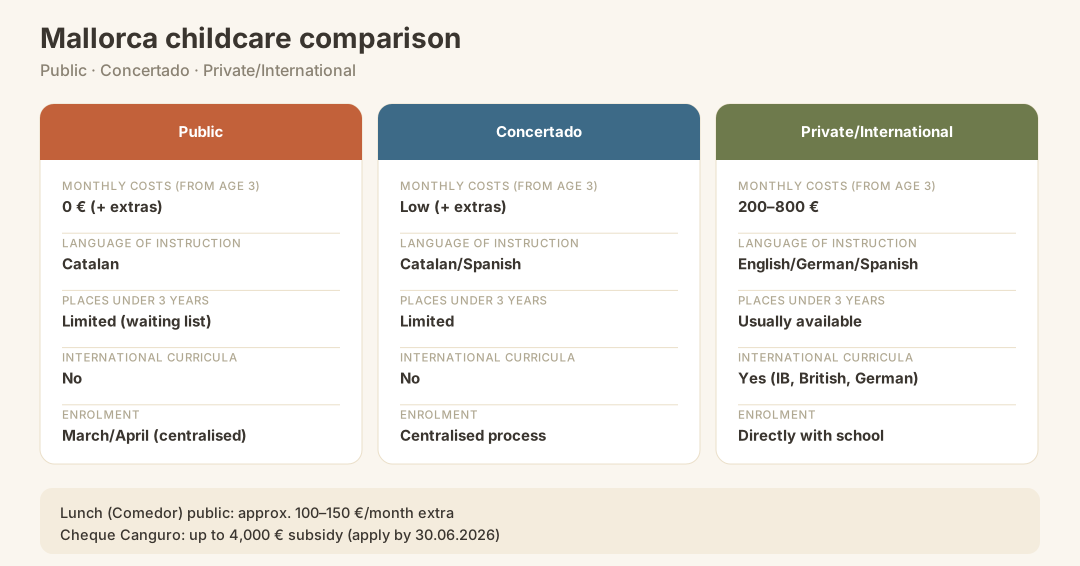
| Criterion | Public | Concertado | Private/International |
|---|---|---|---|
| Language of instruction | Catalan | Catalan/Spanish | English/German/Spanish |
| Monthly costs (from age 3) | 0 € (+ extras) | Low (extras) | 200–800 € |
| Places for under-3s | Limited (waiting list) | Limited | Usually available |
| International curricula | No | No | Yes (IB, British, German) |
| Enrolment | Centralised process (March/April) | Centralised process | Directly with the school |
The most common mistakes when searching for childcare on Mallorca
1. Starting too late The most popular international and private establishments are often fully booked a year in advance. Anyone who calls in summer hoping for a place in September is usually out of luck.
2. Forgetting the empadronamiento Without a certificate of registration at your address, there is no chance of securing a public place – and many funding applications also fail for this very reason. The Empadronamiento in Mallorca must be taken care of first.
3. Failing to apply for the child's NIE The child needs their own NIE – not just when registering for school, but already for the children's doctor (Pediatra) within the public health system. Leaving this too late will hold up several processes simultaneously.
4. Underestimating the language barrier Catalan is the predominant language in public institutions. For young children this is rarely an issue – they adapt quickly. However, parents who speak neither Catalan nor Spanish will face considerably more effort when it comes to parent–teacher meetings, forms, and dealing with authorities. Language courses are well worth it: Learning Spanish in Mallorca.
5. Discovering the Cheque Canguro too late The application deadline runs until 30 June 2026, but funds are limited. Anyone who only notices the subsidy in May risks missing out entirely.
6. Overlooking contract details at private nurseries Notice periods (often 1–3 months), fees during school holidays, and enrolment charges can significantly increase the actual annual cost. Always read the contract in full before signing.
What comes next? The transition to primary school
Compulsory schooling in Spain begins at 6 – that is the entry point into Educación Primaria (six years). For families who have been in an international nursery, the question now arises: continue at the private school or switch to the state system?
Key points for the transition:
- Enrolment for state Primaria is again handled through the central process of the Conselleria d'Educació (typically March/April).
- International schools usually offer a seamless continuation within the same establishment – saving children the time needed to settle in elsewhere.
- Anyone making use of the Beckham Law arrangement or planning their tax status as a new resident should bear in mind that school fees may be tax-relevant. Details: Beckham Law Spain.
You can find a comprehensive overview of school types, international qualifications, and enrolment procedures for older children in our guide Schools in Mallorca for German-speaking children.
Checklist: Starting nursery in Mallorca
- Register your empadronamiento in your municipality of residence
- Apply for an NIE for all family members (including the child)
- Apply for Residencia / TIE (EU citizens: Certificado de Registro)
- Complete the vaccination record and find a Spanish children's doctor (Pediatra)
- Decide between a state and a private setting
- For state settings: mark the March/April registration window in your calendar
- For private settings: request a viewing appointment and get on the waiting list early
- Have the birth certificate officially translated and certified
- Check the Cheque Canguro: eligibility, documents, submit application before 30 June 2026
- Clarify tax deductibility with a tax adviser
- Check contract details carefully for private nurseries (notice periods, holiday arrangements)
Conclusion
The childcare system on Mallorca is well structured, but can seem confusing at first for newcomers. The most important principle: Act early. This applies equally to official documents and to the nursery registration process itself. Anyone seeking public childcare for children under three needs patience and the right paperwork. Those looking for a German- or English-speaking setting have good options – but will pay between 450 and over 700 euros per month. The Balearic Cheque Canguro can reimburse up to 4,000 euros, but is subject to conditions and time-limited. And from the age of three: public Educación Infantil is free of charge and in practice well suited to expat children – provided the language barrier is not an obstacle.
Official sources
- Conselleria d'Educació i Formació Professional (GOIB) – Registration procedures, school calendar, Escoletes públiques: gov.ib.es
- Conselleria de Treball, Comerç i Indústria (GOIB) – Cheque Canguro / Bono Canguro 2026: caib.es
- AEAT (Agencia Estatal de Administración Tributaria) – IRPF and deductibility of childcare costs: agenciatributaria.gob.es
- ATIB (Agència Tributària de les Illes Balears) – Regional tax deductions Balearen: atib.es
- Ajuntament de Palma – Empadronamiento and municipal Escoletes: palma.cat
- Deutsche Schule Mallorca – Eurocampus: dsmallorca.de
- Escolasofia Waldorf Palma (authorised by the Conselleria d'Educació): waldorfpalma.com
- BOE (Boletín Oficial del Estado) – Ley Orgánica 2/2006 de Educación (LOE) and Amendments: boe.es