
Divorce in Spain: What German Expats Need to Know
Anyone living on Mallorca or the Balearic Islands who wants to end their marriage faces a legal framework that differs fundamentally from the German one – and in some respects is considerably more straightforward. Divorce in Spain requires no separation period, no grounds for divorce, and no automatic post-marital maintenance. At the same time, private international law is complex for German-Spanish couples: Which law applies? Which court has jurisdiction? What happens with custody, the jointly owned property, and pension equalisation? This guide explains step by step what you need to know as a German expat on Mallorca or elsewhere in Spain – from the choice of law through the proceedings to the typical pitfalls in mixed-nationality marriages.

The Balearic Islands: Europe's divorce hotspot
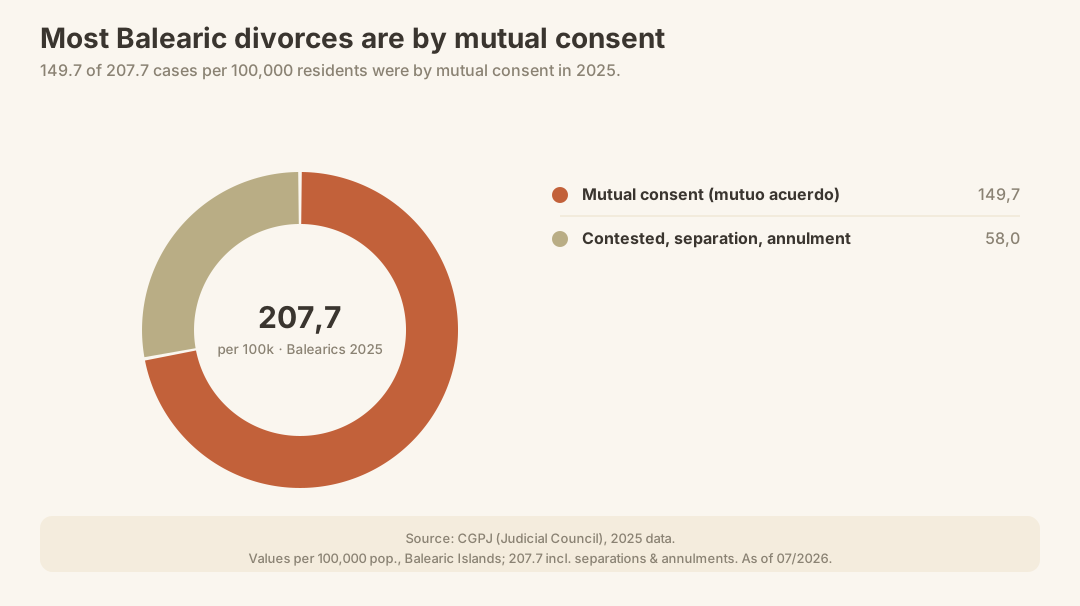
The figures speak for themselves: according to data from the Spanish General Council of the Judiciary (CGPJ), the Balearic Islands recorded the highest divorce rate in the whole of Spain in 2025. With 207.7 applications for dissolution of marriage per 100,000 inhabitants – including annulments, separations and divorces – the archipelago is noticeably above the Spanish national average of 171.9.
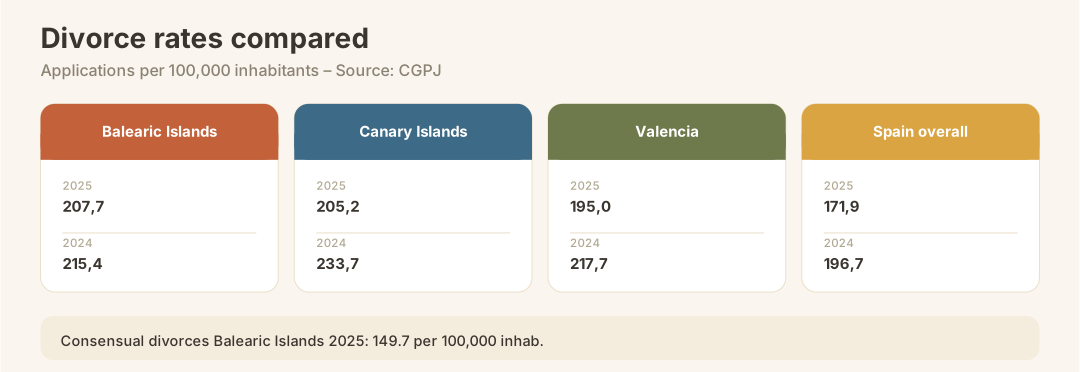
| Region | Divorce applications per 100,000 inhabitants (2025) | Previous year (2024) |
|---|---|---|
| Balearic Islands | 207,7 | 215,4 |
| Canary Islands | 205,2 | 233,7 |
| Valencian Community | 195,0 | 217,7 |
| Spain overall | 171,9 | 196,7 |
Source: CGPJ, 2025
Particularly notable: the proportion of uncontested divorces on the Balearic Islands continues to rise – from 145.1 to 149.7 per 100,000 inhabitants (2025), while the figure fell by 3 % nationally. This suggests that many couples – including numerous international residents – are deliberately taking advantage of the comparatively straightforward options available under Spanish law.
Why this is the case is explained by the distinctive features of Spanish divorce law – which often come as a genuine surprise to people relocating from Germany.
Which law applies? The Rome III Regulation
The key European legal basis for international divorces is the Rome III Regulation, which has been in force since 21 June 2012. It determines which national law is to be applied in a divorce with a cross-border element – regardless of the nationality of the spouses.
The core principle: The primary factor is the habitual residence of the spouses, not their passport.
If you are a German national living permanently in Spain and your centre of life is there, you can divorce under Spanish law – even if you hold German citizenship and may even have married in Germany.
| Situation | Applicable law (without choice of law) |
|---|---|
| Both spouses reside in Spain | Spanish law (Art. 8 Rome III Regulation) |
| One resides in Spain, one in Germany | Law of the last common habitual residence, otherwise a differentiated assessment |
| No joint choice of law made | Law of habitual residence pursuant to Art. 8 Rome III Regulation |
| Choice of law via prenuptial agreement / agreement | Chosen law (e.g. German family law) |
Important: In Spain, the choice of law must be established before the divorce or separation proceedings are initiated – unlike under German law. Anyone who acts too late loses this option.
For mixed-nationality marriages or couples living in different regions of Spain, Catalan or other regional Spanish foral law may also become relevant. This sounds abstract, but has very concrete implications for matrimonial property regime, maintenance and inheritance.
No separation period – the Spanish express divorce
This is the point that most surprises German emigrants: in Spain there is no mandatory separation period. The marriage can be dissolved immediately, without grounds for divorce and without any waiting period – provided it has lasted at least three months.
Compared to Germany, where the breakdown of a marriage must generally be demonstrated by one year of separate households (§ 1565 BGB), this represents a considerable simplification. Anyone wishing to divorce by mutual consent in Spain can complete the process in a comparatively short period of time.
| Feature | Germany | Spain |
|---|---|---|
| Separation year required | Yes (rule) | No |
| Grounds for divorce required | No (irretrievable breakdown principle) | No |
| Minimum marriage duration | None | 3 months |
| Divorce by mutual consent possible | Yes | Yes |
| Contested divorce possible | Yes | Yes |
Note: The advantage of the swift Spanish divorce applies directly to the divorce proceedings themselves. Ancillary matters such as child maintenance, custody, or division of assets can also require time and negotiation in Spain – particularly if the parties fail to reach an agreement.
By mutual consent or contested – the two procedural routes
Divorce by mutual consent (divorcio de mutuo acuerdo)
If both spouses are in agreement and submit a joint settlement agreement (convenio regulador), the process in Spain is comparatively straightforward. The convenio regulador covers, among other things:
- Use of the jointly owned property or home
- Custody and place of residence of the children (custody and care)
- access arrangements (régimen de visitas)
- child maintenance (pensión alimenticia)
- Any spousal maintenance (pensión compensatoria)
- Division of jointly held assets
Since a reform of Spanish family law, uncontested divorces without minor children can also be handled before a notary — without court proceedings. This considerably speeds up the process.
Please note: Where minor children are involved, the Family Court (Juzgado de Familia) retains mandatory jurisdiction, as it must assess the best interests of the child.
Contested divorce (divorcio contencioso)
Where no agreement can be reached, the proceedings become contested. Jurisdiction then generally lies with the Juzgado de Primera Instancia at the last shared place of residence of the spouses or — where children are involved — at their habitual place of residence.
In cases of domestic violence, the Juzgado de Violencia sobre la Mujer (specialist court for violence against women) has jurisdiction.
In contested divorces with an international dimension — for example where one spouse lives in Germany and the other in Mallorca — EU Regulation 2019/1111 governs court jurisdiction. Under this regulation, the divorce petition may in principle be filed at the habitual place of residence of either spouse.
Jurisdiction: Which court, which country?
EU Regulation 2019/1111 governs international jurisdiction in matrimonial matters and parental responsibility within the EU.
For uncontested divorces the following applies: the application may be filed with the court at the habitual residence of either spouse . If one of the partners therefore has their habitual residence in Spain – e.g. on Mallorca – a Spanish court has jurisdiction, even if the other still lives in Germany.
Important in practice: Anyone who has a habitual residence in Spain must also be able to prove this – ideally by holding Residencia and Empadronamiento .
| Situation | Court with jurisdiction |
|---|---|
| Both living on Mallorca | Juzgado de Familia Palma de Mallorca |
| One in Spain, one in Germany (uncontested) | Choice: Spanish or German court |
| Contested, joint children in Spain | As a rule, the Spanish court at the children's place of residence |
| Domestic violence | Juzgado de Violencia sobre la Mujer |
Maintenance under Spanish law – less than in Germany
One key difference from German law: in Spain there is virtually no post-marital maintenance. The system recognises only what is known as the pensión compensatoria – a compensatory allowance for cases where the divorce or separation leads to a significant deterioration in the financial situation of one spouse.
Requirements of the pensión compensatoria:
- The eligible spouse must genuinely be in need
- The obligated spouse must be financially capable
- Maintenance does not arise automatically – it must be claimed through legal proceedings
- An entitlement only exists from the date the claim is filed
This is a fundamental difference from German maintenance law, which recognises extensive post-marital maintenance obligations (maintenance for childcare, old age, illness, etc.). Those who would be required to pay substantial post-marital maintenance in Germany may, in certain circumstances, be considerably better off under Spanish law – and vice versa.
Please note: Whether German or Spanish law applies to maintenance depends on the choice of law made and the place of habitual residence. You must have this checked by a lawyer before initiating proceedings.
Child maintenance (pensión alimenticia)), on the other hand, is mandatory regardless of divorce law and is based on the needs of the child as well as the financial capacity of the parents.
Custody and parental responsibility
Spanish family law distinguishes between parental authority (patria potestad)) and the right to determine residence / day-to-day care (guarda y custodia).
| Term | Meaning |
|---|---|
| Patria potestad | Joint parental authority (the default position, also applicable after divorce) |
| Guarda y custodia exclusiva | Sole residence rights with one parent |
| Guarda y custodia compartida | Alternating residence / joint custody with shared care |
| Régimen de visitas | Contact arrangements for the non-resident parent |
The alternating residence model (custodia compartida) has gained considerably in prominence in Spain in recent years and is now in many places a preferred solution when both parents are cooperative and live in close proximity to one another.
For divorces with an international dimension – e.g. where one parent is planning to return to Germany with the children – the Hague Convention on the Civil Aspects of International Child Abduction (HCCAICA) applies. Taking a child unilaterally to another country without the other parent's consent or without court authorisation constitutes international child abduction and carries serious legal consequences.
Please note: If you wish to leave Spain with the children after the divorce, you will need either the other parent's written consent or authorisation from the competent family court.
You can find further information about schooling on Mallorca in our guide Schools on Mallorca – Children.
The Property: What Happens to Jointly Owned Assets?
A property on Mallorca is, in many divorce proceedings, the most contentious – and most complex – issue. This depends on the matrimonial property regime that applied at the time of the marriage or was agreed by contract.
Spanish law recognises – depending on the region – different statutory matrimonial property regimes:
- Community of property (sociedad de gananciales): All assets acquired during the marriage belong to both spouses in equal shares.
- Separation of property (separación de bienes): Each spouse retains what they personally brought in or acquired.
- Further variants under regional foral law (e.g. Catalan law).
Important for German nationals: Anyone who married in Germany was subject to the statutory matrimonial property equalisation (Zugewinnausgleich). This matrimonial property regime is not automatically recognised in Spain. Legal clarification by a qualified solicitor is essential.
Under the community of property regime, the jointly owned property must be divided during divorce proceedings – either by sale (with distribution of the proceeds), by one party buying out the other's share, or through a court-ordered partition procedure (procedimiento de división de la cosa común). This can have a significant impact on your tax obligations as a resident.
Divorce without being present in person – is that possible?
Yes – under certain conditions, a divorce in Spain is also possible if one of the spouses lives abroad. This requires a notarised power of attorney (poder notarial)) authorising a solicitor in Spain to represent the absent spouse.
A prerequisite remains that either one of the spouses has their habitual residence in Spain or that the jurisdiction of the Spanish courts is established on another legal basis.
Steps for a divorce with cross-border elements:
- Instruct a solicitor in Spain with dual qualification (Spanish and German law)
- Review the choice of law and, if necessary, agree it in writing (before initiating proceedings!)
- Convenio regulador (for an uncontested divorce) to be drawn up
- Have a notarised power of attorney issued for the absent spouse
- Submit the divorce petition to the competent court or notary
- Have the judgement / deed recognised in Germany (if required)
Recognition of the Spanish divorce in Germany
A divorce that has become legally final in Spain is in principle mutually recognised within the EU – this is governed by EU regulations on private international law. Separate recognition by a German court is, between EU member states, generally no longer required.
However: if the divorce in Spain includes ancillary matters (e.g. maintenance under Spanish law) that are to be enforced in Germany, the proceedings can be more complex. Even if one of the spouseslives exclusively in Germany, it is advisable to consult a German family law solicitor.
Please note: Automatic EU recognition applies only to EU member states. Where a third country is involved (e.g. if one of the spouses is a British national, post-Brexit), different rules apply.
Versorgungsausgleich – a German concept with no Spanish equivalent
The Versorgungsausgleich – the equal division of pension entitlements between spouses – is an exclusively German legal institution. Spanish law does not recognise this concept.
In practice, this means:
- Anyone who divorces in Spain under Spanish law is in principle not entitled to a Versorgungsausgleich
- This can have significant financial consequences for long marriages in which only one spouse was the breadwinner
- Anyone who wishes to obtain a German Versorgungsausgleich must choose German law – which in turn activates the separation year and other German legal requirements
This point is one of the most important considerations when deciding under which law and in which country the divorce should take place. For information on pensions in Spain, we recommend our guide Applying for a pension in Spain.
Marriage contract (Capitulaciones matrimoniales) – planning ahead
The most effective protection against unpleasant surprises in the event of divorce is a marriage contract (capitulaciones matrimoniales), which – ideally before the marriage takes place, but also possible afterwards – is drawn up before a notary.
In such a contract, spouses can stipulate, among other things:
- Which law applies in the event of divorce (Spanish, German, or regional Spanish law)
- Which matrimonial property regime is to apply (gananciales, separation of property)
- How property and assets are divided in the event of separation
Please note: A marriage contract notarised in Spain generally takes precedence over the statutory matrimonial property regime. However, it must comply with the mandatory provisions of the applicable law.
Clarifying these matters before getting married is particularly valuable for international couples – Germans who marry or live on Mallorca. Our guide Getting Married on Mallorca gives you an overview of the formal requirements.
The most common mistakes in a Spanish divorce
German-Spanish law firms see the same pitfalls time and again in practice:
Forgetting to choose the applicable law: No agreement on which law applies – this results in Spanish law governing the divorce, even though German law might have been more appropriate (or vice versa).
Overlooking the pension equalisation: Anyone who has built up pension entitlements in Germany over many years and then handles the divorce incidentally in Spain may lose claims of considerable value.
Risking child abduction: One parent travels to Germany with the child without authorisation – this constitutes international child abduction, even if the intention was entirely innocent.
Failing to check the matrimonial property regime: Which matrimonial property regime governed the marriage? Accrued gains equalisation in Germany, or in Spain gananciales or separation of property? This question determines the division of half of the jointly held assets.
Choosing a notary instead of a court when minor children are involved: A notarial divorce is only possible where there are no minor children.
No bilingual lawyer: A lawyer who knows only Spanish or only German law cannot assess the interplay between the two systems. You need someone with dual qualification or close cooperation between both sides.
No notarised power of attorney when residing abroad: Anyone who cannot or does not wish to travel to Spain must arrange a power of attorney in advance – this cannot be done at short notice.
What comes next? Legal and administrative follow-up steps
Once the divorce has become final, there are several practical steps you should not overlook:
- Registry office: Registration of the divorce in the German civil status register (via the relevant registry office in Germany or the embassy/consulate)
- Change of name: If you wish to revert to your birth name, an application must be submitted
- NIE / Residencia: Update address changes following a move in the course of the separation with the Empadronamiento and the Residencia
- Tax re-registration: After the divorce, tax obligations may change, particularly if properties are transferred – discuss this with a tax adviser in Spain
- Child benefit: If children are involved, entitlement to child benefit must be reassessed following the separation → Child benefit when moving abroad to Spain
- Health insurance: After the divorce, you may lose cover as a co-insured person – check your status → Health insurance in Spain
Checklist: Divorce in Spain for German nationals
- Clarify the habitual residence of both spouses (Residencia, Empadronamiento)
- Determine which law applies (Spanish, German, or foral law) – before initiating proceedings!
- Instruct a lawyer with dual qualification (German + Spanish)
- Clarify the matrimonial property regime (community of accrued gains, gananciales, separation of property)
- Have jointly owned properties on Mallorca inventoried and valued
- In the case of a consensual divorce: Convenio regulador to be drawn up
- Resolve children's matters: custody, care arrangements, maintenance, contact
- Review pension equalisation – consider opting for German law if applicable
- Have a notarised power of attorney issued if residing abroad
- Arrange for the divorce to be registered with the German registry office
- Check tax implications (property transfer, IRPF)
- Review health insurance status after divorce
Conclusion
The divorce in Spain offers German expats on Mallorca and the Balearic Islands a leaner, faster framework than German law in many respects – no separation year, no requirement to state grounds, accelerated consensual proceedings. At the same time, this very simplicity carries risks: anyone who divorces in Spain too hastily, without examining the applicable law, may forfeit entitlements to pension equalisation or post-marital maintenance that would exist under German law. The decision as to which country and under which law you proceed with the divorce is not a mere formality – it has significant financial and personal consequences. Have it assessed by a bilingual family lawyer who is familiar with both the Spanish and the German system.
Official Sources
- Rome III Regulation (EU) No. 1259/2010 – Applicable law in matrimonial matters: EUR-Lex
- EU Regulation 2019/1111 – Jurisdiction, recognition and enforcement in matrimonial matters: EUR-Lex
- Consejo General del Poder Judicial (CGPJ) – Divorce rate statistics: www.poderjudicial.es
- Código Civil español – Family law, divorce law (Título IV): BOE
- Hague Child Abduction Convention (HCAC) – Information from the German Federal Office of Justice: www.bundesjustizamt.de
- Agencia Tributaria (AEAT) – Tax consequences of property transfers: www.agenciatributaria.es