
Child Benefit When Emigrating to Spain: What Remains, What Lapses
Moving to Spain – whether to the Balearic Islands, Andalusia, or another region – fundamentally changes your social security situation. When it comes to child benefit when emigrating to Spain, many families make the mistake of assuming their entitlement ends automatically the moment they cross the border – or, conversely, that it simply continues without any action required. Neither is correct. EU coordination law decides, not nationality. In this guide, you'll learn about the various scenarios: when Germany remains responsible, when Spain takes priority, what the planned Spanish universal child benefit means, which reporting obligations protect you from clawback demands – and which social benefits beyond child benefit are affected by emigrating.

The EU coordination principle: why your nationality alone counts for nothing
German child benefit is governed by the Income Tax Act (§§ 62–78 EStG). Anyone wishing to claim it while living abroad, however, operates within the framework of European coordination law – which follows its own rules.
The decisive principle is: The country in which you are employed and subject to social insurance contributions is primarily responsible for family benefits. Not the country in which you live. Not your nationality.
This has concrete consequences: a German family living on Mallorca but still employed and paying social insurance contributions in Germany will generally retain their full German child benefit entitlement. Another family that emigrates to Spain and works there as an autónomo loses their German entitlement – and Spain becomes responsible.
Please note: Within the EU, the principle always applies: only one country pays as the primary payer. Overlaps are handled through top-up payments, not through double receipt.
The four main scenarios following a move to Spain
The question "Will I continue to receive child benefit?" cannot be answered in general terms. It depends on your specific employment and social insurance arrangement. The table below summarises the most common situations:
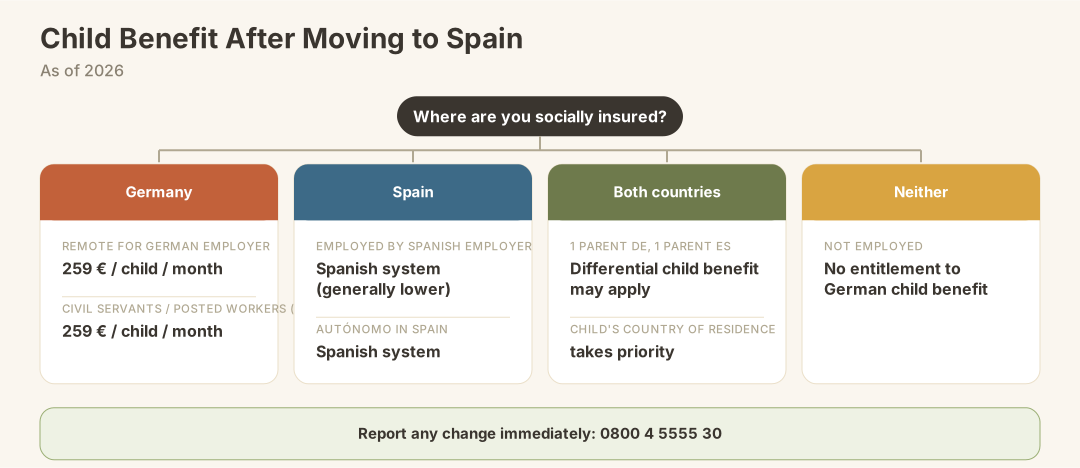
| Scenario | Social insurance | Responsibility | Amount (2026) |
|---|---|---|---|
| Remote work for a German employer, socially insured in Germany | Germany | Germany primary | 259 € / child / month |
| Employment with a Spanish employer | Spain | Spain primary | Spanish system (generally lower) |
| Registered as autónomo in Spain | Spain | Spain primary | Spanish system |
| One parent employed in DE, one in ES | Both countries | Child's country of residence takes priority | Top-up child benefit if applicable |
| Not employed, living off savings | None | No entitlement to German child benefit | Generally not applicable |
| Civil servants / posted employees (A1 certificate) | Germany | Germany primary | 259 € / child / month |
Scenario 1 (remote work for a German company): As long as your employment contract is in Germany and you are paying social security contributions there, Germany remains the primary competent state. You receive the full German rate of 259 € per child per month (as of 2026). This is the most common situation for many Mallorca expats with digital professions.
Scenario 4 (dual competence): Here the EU priority rules apply. As a general rule, the child's country of residence takes priority. Since the Spanish equivalent is currently in practice lower than the German one, the so-called top-up child benefit mechanism often applies: Germany pays the difference up to its own higher rate.
German child benefit 2026: amount, age limit, duration of entitlement
The following basic framework applies to children in Germany:
| Child's age | Entitlement | Amount (2026) |
|---|---|---|
| Under 18 years | Automatically | 259 € / month |
| 18–24 years | During education, studies, or a transitional period | 259 € / month |
| 18–24 years | Without education / employment | No entitlement |
| From 25 years of age | Only in cases of disability (exception) | 259 € / month |
Since January 2026, child benefit (Kindergeld) has been set at a uniform rate of 259 € per child per month – regardless of the number of children. Previously, rates were tiered from the third child onwards.
Please note: In Germany, Kindergeld serves two functions: it secures the basic financial support of children and alternatively acts as an advance payment towards the tax-free child allowance (Kinderfreibetrag). The tax office automatically assesses which option is more beneficial as part of the income tax assessment.
When does the entitlement to German Kindergeld cease?
The entitlement lapses once none of the relevant connecting factors to Germany remain. Specifically:
- Loss of German social insurance liability – you switch to a Spanish employer or register as an autónomo in Spain
- End of unlimited German tax liability – you fully relinquish your German domicile without continuing to be taxed in Germany on your entire worldwide income
- The child relocates permanently to Spain and neither parent works in Germany any longer – the Familienkasse scrutinises this combination particularly carefully
- End of secondment – if the time abroad was arranged as a fixed-term secondment and that secondment comes to an end, responsibility shifts once again
Important: Many families do not lose their Kindergeld as a direct result of emigrating, but because they report a change of employment to the Familienkasse too late or not at all. This is the most common trigger for repayment demands.
Reporting obligations: what you must notify the German Familienkasse about
The reporting obligations towards the Familienkasse are legally binding. Breaches can result in repayment demands – and these can be substantial if payments have been received without entitlement over a period of months.
Reportable events following a move to Spain:
| Event | Reporting obligation | Deadline |
|---|---|---|
| Change of residence abroad | Yes | Immediately |
| Taking up employment in Spain | Yes | Immediately |
| Switching from a German to a Spanish employer | Yes | Immediately |
| Registering as an autónomo in Spain | Yes | Immediately |
| Child moves to Spain | Yes | Immediately |
| Child begins an apprenticeship / degree course in Spain | Yes | Immediately |
| Child starts working | Yes | Immediately |
| Change of marital status | Yes | Immediately |
The authority responsible for Germans residing abroad is generally the Familienkasse Ausland at the Federal Employment Agency. You can reach the general child benefit helpline on 0800 4 5555 30 (free of charge from Germany).
How to apply: the process when moving to Spain
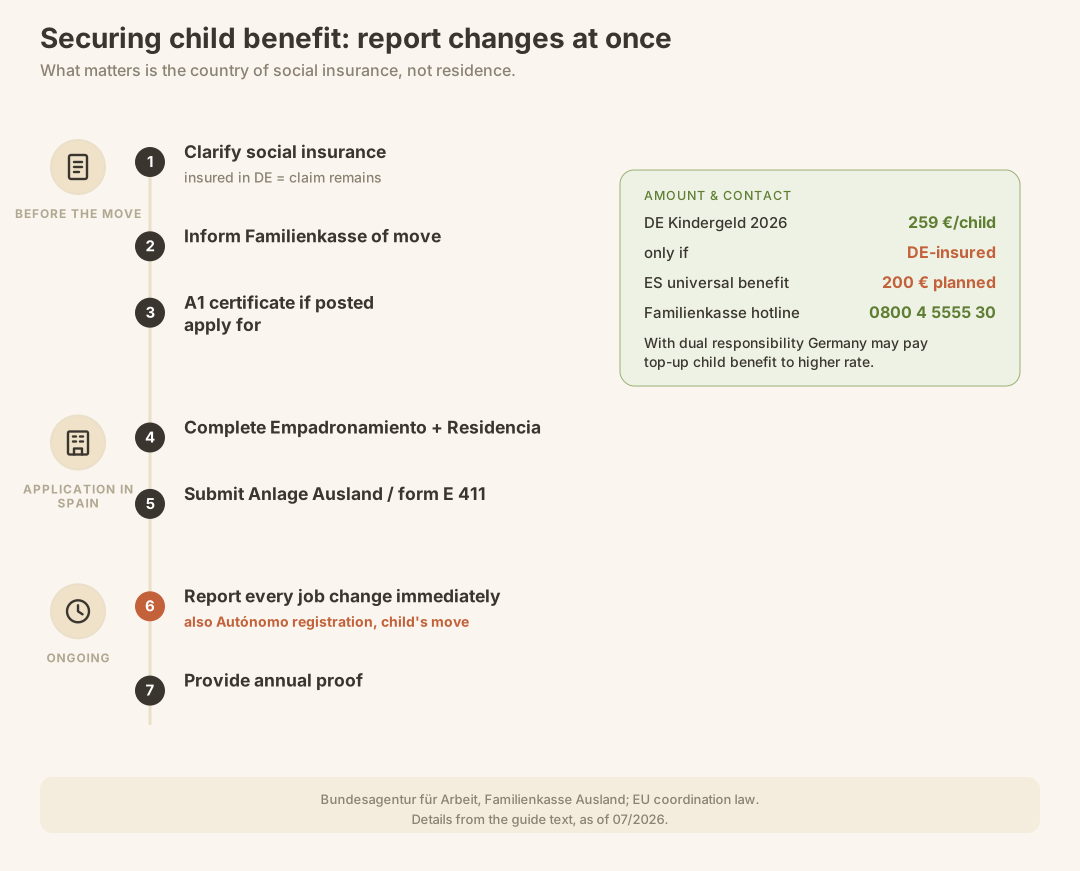
If you move to Spain and wish to continue receiving child benefit, you need to take action. The process is as follows:
- Deregistering from your current Familienkasse – report change of residence abroad; the file will be transferred to the Familienkasse Ausland
- Complete form E 411 / Appendix Abroad – proof that no equivalent benefits are being received in Spain (or submit a differential claim)
- Submit the following documents: Registration confirmation in Spain (Empadronamiento), where applicable the Residencia certificate, proof of German social insurance (A1 certificate in the case of a posting)
- Regular proof of entitlement – In cross-border cases, the Familienkasse generally requests updated documents on an annual basis
- Please note: Even if you were already receiving child benefit previously, you must submit a new or supplementary application when moving abroad
Note: The Residencia (Certificado de Registro de Ciudadano de la Unión) is generally the key proof of your legal residence in Spain and is accepted by the Familienkasse as evidence of a foreign domicile.
The Spanish child benefit system: what exists today, what is planned?
Spain has historically not had a flat-rate state child benefit system like Germany. Family benefits have primarily been regulated through tax law and means-tested allowances. This is gradually changing.
Existing Spanish family benefits
Spain currently has several instruments for supporting families, though none are comparable to Germany's universal child benefit:
| Benefit | Type | Eligible recipients |
|---|---|---|
| Prestación por nacimiento/adopción | One-off payment | Parents upon birth / adoption (means-tested) |
| Tax family deduction (IRPF) | Tax relief | Tax-resident taxpayers |
| Support for parents of seriously ill children (parental leave) | Benefit replacement payment | Specific illness cases |
| Familias numerosas | Benefits (tax, transport, housing) | Families with 3+ children |
Find out more about IRPF tax deductions for families in the Balearic Islands in our separate guide.
The planned universal child benefit
Spain has developed plans for a universal child benefit (UKG) amounting to €200 per child per month, to be paid regardless of income. The programme is intended to combat child poverty – Spain is among the EU countries with a comparatively high rate of child poverty.
Please note: At the time this guide went to press, the universal Spanish child benefit had not yet come into force. The budgetary situation and parliamentary majorities influence the implementation timeline. Follow the latest developments via official Spanish sources (imserso.es, seg-social.es).
Should the Spanish UKG be introduced, it would be relevant for families resident and working in Spain – and would affect the calculation of differential child benefit relative to Germany.
Other social benefits: what remains, what lapses after the move?
Child benefit is just one of several German social benefits that come under scrutiny when moving to Spain. Here is an overview:
| Benefit | After moving to Spain | Note |
|---|---|---|
| German child benefit (Kindergeld) | Continues with DE social insurance, otherwise lapses | Differential child benefit may be possible |
| Parental allowance (Elterngeld) | Generally still payable during the entitlement period | Apply before moving; place of residence plays a role |
| Child supplement (Kinderzuschlag) | Generally lapses | Only for families living in Germany |
| Housing benefit (Wohngeld) | Lapses | Only for residential accommodation registered in DE |
| ALG I | Temporarily exportable (generally 3 months / U2 form) | Must be re-applied for in Spain afterwards |
| ALG II / Bürgergeld | Not applicable | Not exportable |
| Statutory health insurance DE | Ends upon relinquishing residency | Spanish health insurance required |
| Long-term care insurance DE | Ends with statutory health insurance membership | Spanish system takes over |
| German pension entitlements | Remain intact and are paid out later | EU pension coordination applies |
On the subject of health insurance in Spain we have a dedicated in-depth guide — because this is the second major issue for emigrating families after child benefit.
Those familiar with the S1 form may, under certain conditions, be able to use their German health insurance for their stay in Spain — particularly relevant for retirees: S1 form Spain.
Special situations: self-employed, retirees, non-working residents
Autónomos in Spain
Anyone who registers in Spain as an Autónomo and pays social security contributions to the Spanish Seguridad Social will, as a rule, forfeit their entitlement to German child benefit. Spain then becomes the primary country of responsibility. For as long as the Spanish universal child benefit has not yet been introduced, this means that many families will in practice lose the benefit entirely or receive a significantly lower payment.
Important: The Cuota Autónomo in Spain is graduated according to income and can vary depending on profit. More on this in the guide Cuota Autónomo Spain.
Retirees
German retirees who emigrate to Spain no longer receive German social insurance benefits in the traditional sense (the obligation to pay into the pension insurance scheme ended with their working life). Child benefit is generally not an issue for retirees — unless there are still dependent children in education or training. In that case, the general rules on unlimited tax liability apply. On the German taxation of pensions in Spain: Taxing a German pension in Spain.
Non-employed persons / rentiers
Anyone living in Spain on savings, investment income or rental income, who is neither employed subject to social-insurance contributions in Germany nor in Spain, is generally not entitled to German child benefit — unless unlimited tax liability in Germany still applies (e.g. because a registered address in Germany is maintained). This should be clarified with a tax adviser without fail.
Most common mistakes when claiming child benefit from Spain
A clear pattern of errors emerges from practice. These are the points you should be aware of:
- Change of employer reported too late — A switch from a German to a Spanish employer is not reported to the Familienkasse, or is reported too late. Consequence: repayment demands, sometimes covering several months.
- Failure to report autónomo registration — Anyone who registers as self-employed in Spain without notifying the Familienkasse continues to receive child benefit unlawfully.
- Child moves to Spain — no notification given — The child's change of school to Spain must also be reported.
- Assumption that nationality provides protection — German nationality alone does not establish an entitlement to child benefit from abroad.
- No supplementary application filed after moving — Anyone who moves without actively submitting a new application for cross-border cases risks an interruption in payments.
- Double receipt not reported — If the child is simultaneously receiving family benefits in Spain while child benefit is still being paid in Germany, this is generally not permissible.
- Tax situation not reviewed — Unlimited tax liability in Germany can, in certain constellations, preserve the entitlement to child benefit — but this is often overlooked or incorrectly assessed.
What comes next? Spanish social benefits for residents
Anyone who lives and works permanently in Spain should familiarise themselves with the Spanish social-security system. The most important benefits for families:
- Seguridad Social — The Spanish social-security system covers health insurance, pension insurance, unemployment benefit and family allowances
- Public health system — After registering via the Empadronamiento and with a valid residence permit, you have access to Spanish healthcare. More on this: Healthcare on Mallorca
- Education — Spanish state schools are free to attend; on Mallorca there are also German-language school options. Details: Schools on Mallorca for German children
- IRPF deductions for families – The Balearic Islands have specific tax deductions for families that reduce the local tax burden
Please note: Spanish social security law is complex and is best navigated with the help of a gestoría (a tax and legal adviser for administrative matters). A professional gestoría can also help you correctly assess your child benefit situation: Gestoría Spain.
Checklist: Child Benefit When Emigrating to Spain – Before and After the Move
Before the move:
- Clarify your employment situation: Will I remain covered by German social insurance?
- Inform the Familienkasse of the upcoming move
- Review your tax status (unlimited tax liability in Germany) with a tax adviser
- Apply for an A1 certificate for your posting if applicable
- Secure your Elterngeld payments if still ongoing (submit the application before moving)
After the move:
- Complete your empadronamiento in Spain (a basic requirement for many subsequent steps)
- Apply for your residencia (Certificado de Registro)
- Notify the Familienkasse Ausland in writing of your change of residence
- Submit the forms for cross-border child benefit claims (Anlage Ausland, E 411)
- Apply for a Spanish social security number (NIE / Número de Seguridad Social)
- Review your child benefit situation annually (the Familienkasse will request proof)
- Report every change of job or change of status immediately
Conclusion: Emigrate with a plan, protect your entitlements
The good news is that anyone who approaches child benefit when emigrating to Spain in a structured way will, in many cases, not lose a single cent. What matters is not where you live, but where you are covered by social insurance. Remote workers with a German employment contract, posted workers and civil servants are often on the safe side. Those who take the leap and become autónomo or take up a local Spanish job, however, must be honest with themselves: the German entitlement lapses – at least until Spain's universal child benefit becomes a reality.
The risk lies not in the system itself, but in delayed notifications. A single missed communication to the Familienkasse can trigger demands for repayment covering many months. The rule is therefore: notify immediately, keep records, and when in doubt consult an expert in German-Spanish social security law.
Official Sources
- Bundesagentur für Arbeit – Child Benefit Abroad: https://www.arbeitsagentur.de/familie-und-kinder/infos-rund-um-kindergeld/kindergeld-ausland
- Federal Family Portal – Child Benefit Abroad: https://familienportal.de
- European Commission – Family Benefits in Other EU Countries: https://europa.eu/youreurope/citizens/work/social-security-and-benefits/family-benefits/index_de.htm
- European Commission – Social Rights in Spain (PDF, July 2025): https://employment-social-affairs.ec.europa.eu/document/download/c4767d73-7286-41ad-bc5a-557aedfff7e1_de
- Income Tax Act (EStG) §§ 62–78 – Child Benefit: https://www.gesetze-im-internet.de/estg/
- Spanish Social Security (Seguridad Social): https://www.seg-social.es
- AEAT (Agencia Tributaria) – IRPF Family Deductions: https://www.agenciatributaria.es
- Child Benefit Hotline Familienkasse: 0800 4 5555 30 (free of charge, Mon–Fri)