
Birth in Mallorca: registration at the Registro Civil and German documents
When your child is born in Mallorca, alongside nappies and sleepless nights comes a bureaucratic countdown: The birth in Mallorca must be registered with the Spanish Registro Civil within a few days, before you can even think about the German paperwork. Then comes the second step – birth notification and declaration of name at the German consulate, so that your child receives a German birth certificate and a German passport. Both procedures run in parallel, but follow different deadlines, authorities and document lists. In this guide you'll find the complete process: which documents you generally need for children born within and outside marriage, how the Spanish Certificado de Nacimiento works, when the so-called generational cut-off for German citizenship applies, what the whole thing costs – and which mistakes can cost you valuable weeks.

- Find a translator in Mallorca — for certified translations of foreign documents
The 10-day deadline: why speed matters
Under Spanish law, a birth must be reported to the relevant Registro Civil no later than 10 days after the delivery. Only if special circumstances apply can this deadline be extended to up to 30 days. If this deadline is also missed, the so-called "fuera de plazo" procedure applies, under which, according to the German foreign missions, the regular birth certificate can take several months to be issued.
The Registro Civil responsible is the one at the child's place of birth. In many clinics, the initial birth notification can already be initiated by hospital staff during the hospital stay – it's best to ask directly at the maternity clinic how this is handled there. Anyone giving birth at home or under special circumstances must arrange the trip to the Registro Civil themselves.
Please note: The 10-day deadline applies regardless of whether both parents are married, what nationality they hold, or whether not all documents are yet complete. If in doubt, go to the Registro Civil first with whatever documents you have and consult with them, rather than letting the deadline lapse.
Step 1: Registration with the Spanish Registro Civil
The process of the Spanish birth notification is divided into clearly defined steps:
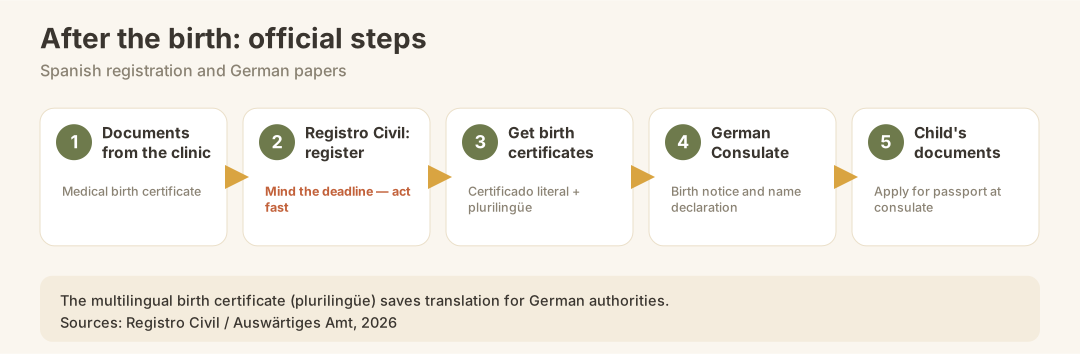
- Obtain the Certificado de alumbramiento. This is the medical birth certificate, signed by the doctor who was present at the delivery – stating the type of birth as well as the names of mother and child. A simple hospital certificate without this information is not sufficient, even if a doctor's name is stated.
- Fill in the Hoja declaratoria de datos.This form is usually signed by the parent with Spanish nationality, if applicable.
- Gather all identity documents (see table below) – in original and as a copy.
- Attend the appointment at the Registro Civil and register the birth. For parents who are not married to each other, it's important that both parents appear as "declarantes" in the system (see section further below).
- Have a copy of the complete registration form issued to you – it will be needed later at the German consulate.
Which documents you need: marital vs. non-marital
The following overview is based on the general requirements of the Spanish authorities for birth registration and may vary depending on the parents' nationality and the individual case – it's best to check in advance directly with the relevant Registro Civil or consulate:
| Document | Child born within marriage | Child born outside marriage (father acknowledges paternity) |
|---|---|---|
| Certificado de nacimiento of the child (local Registro Civil), original + copy | ✓ | ✓ |
| Certificado de alumbramiento (medical birth certificate) | ✓ | ✓ |
| Hoja declaratoria de datos, completed and signed | ✓ | ✓ |
| Certificado literal de nacimiento of the parent with Spanish nationality (if applicable), no more than 6 months old | ✓ | ✓ |
| Birth certificate of the foreign parent, apostilled/legalised | ✓ | ✓ |
| Valid passport/ID card of both parents | ✓ | ✓ |
| Residence card or Residencia of both parents, if applicable | ✓ | ✓ |
| Libro de Familia or marriage certificate of the parents | ✓ | not applicable |
Note: Foreign documents must bear a Hague Apostille if they are not already available in international or multilingual form. A sworn translation into Spanish is generally also required for documents not in Spanish – you can find translators on Mallorca here.
Parenthood without a marriage certificate: special considerations for unmarried parents
If the parents are not married to each other, the detailed Spanish birth certificate (certificado literal) must show that both parents jointly reported the birth. However, in purely digitally created, more recent birth entries, often only one parent appears as the "declarante". In this case, the German consulate requires additional proof of both parents' involvement, for example in the form of:
- "Acta de reconocimiento de filiación paterna" (acknowledgement of paternity before the Registro Civil)
- "Cuestionario para la Declaración de Nacimiento en el Registro Civil" (the so-called "yellow form") with signatures of both parents
- Registration form of the Ministerio de Justicia with signatures of both parents
A simple copy of one of these documents is sufficient. Therefore, be sure to obtain a complete copy of the registration form during your appointment at the Registro Civil – without this proof, processing at the consulate can be significantly delayed.
Applying for the Certificado de Nacimiento: Literal and Plurilingüe versions
For the German documents you need two versions of the Spanish birth certificate: the certificado literal (detailed version) and the certificado plurilingüe (multilingual international version). Both can be requested via the Spanish state's justice portal.
| Application method | Requirement | Processing |
|---|---|---|
| Online with Cl@ve identification | Digital certificate or Cl@ve registration | Immediate issue, if available online |
| Online without Cl@ve | No electronic identification required | Sent exclusively by post to the specified address |
| In person at the Registro Civil | – | Depending on how busy the office is |
Note: At least 15 days must pass between two applications for the same certificate – except for certificates that can be issued immediately online.
German nationality: automatic acquisition and the generational cut-off
If one parent is German, your child generally acquires German nationality automatically at birth – regardless of whether the birth takes place in Mallorca or in Germany. If the parents are not married to each other and only the father is German, the child acquires German nationality only if the father effectively acknowledges paternity under German law.
An important exception applies to families in which the German parent was themselves born abroad after 31.12.1999 – the so-called generational cut-off (§ 4 para. 4 Staatsangehörigkeitsgesetz, § 36 Personenstandsgesetz):
Please note: In this case, the child only acquires German nationality if the parents submit an application to have the birth registered in the German birth register within one year of the birth. The deadline is also considered to have been met if the birth notification is received by the relevant German mission abroad within this year. If the deadline is missed, the child does not automatically acquire German nationality.
Even if the generational cut-off does not apply, registering the birth in the German civil status register is generally advisable: it clarifies and establishes the naming, and conclusively confirms possession of German nationality. In the end, you receive a German birth certificate that you can present to all German authorities – instead of foreign certificates with translation, which have no evidentiary value for the naming.
Step 2: Birth notification and declaration of name at the German consulate
Responsible for accepting the declaration of name or the subsequent registration of the birth is the German registry office (Standesamt) at the last place of residence of a parent in Germany. If the parents have never lived in Germany, the responsible office is Standesamt I in Berlin responsible. The German diplomatic mission – for Mallorca the German Consulate Palma – accepts the registration, certifies the signatures and forwards the documents to the responsible registry office (Standesamt), where the final processing takes place.
- Book an online appointment via the interactive map of German diplomatic missions – in Barcelona, Málaga and Palma this can be done directly online.
- Complete the application form in full (declaration of name and/or birth notification).
- All original documents bring to the appointment (see list below).
- Pay fees in cash or with a physical credit card on site.
- After forwarding to the German registry office (Standesamt): Waiting time until the German birth certificate is issued – the duration depends on the respective registry office.
Documents required for the German side
| Document | Remark |
|---|---|
| Completed application form | Declaration of name and/or birth notification |
| Certificado literal de nacimiento of the child | Detailed Spanish version |
| Certificado plurilingüe of the child | International multilingual version |
| Marriage certificate of the parents | If married |
| Birth certificates of both parents | Original or certified copy |
| Proof of dissolution of the mother's previous marriages | If applicable (death certificate/divorce decree) |
| Identity documents of both parents | Original |
| Deregistration certificate from the last place of residence in Germany | If available |
| Birth certificates/ID documents of siblings | If available |
Note: Documents not in German without an international version (e.g. from Latin America) should be submitted with a Hague Apostille and a certified translation. The German registry office (Standesamt) may, in individual cases, request further documents.
Costs and payment arrangements
The fees at the consulate are independent of the later fees charged by the German Standesamt for the actual re-registration (Nachbeurkundung) and the issuing of the birth certificate – these depend on the respective federal state (Bundesland) and will be communicated to you directly by the Standesamt.
| Service | Fee |
|---|---|
| Birth notification with declaration of name / declaration of name | 85 € |
| Birth notification without declaration of name | 60 € |
| Certification of copies | 31–33 € |
| Re-registration + birth certificate at the German Standesamt | varies depending on the Bundesland |
Attention: Payment is made in cash or by credit card (Visa/Mastercard) – the card must be physically present and show the card number as well as the holder's name. Payments via smartphone or smartwatch are not accepted. At honorary consulates, usually only cash payment is possible.
Deadlines at a glance
So you can see at a glance which clock is ticking when:
| Deadline | Duration | Consequence if missed |
|---|---|---|
| Registering the birth with the Registro Civil | 10 days from birth (exceptional cases up to 30 days) | "Fuera de plazo" procedure, several months' waiting time possible |
| Application for registration in the German register in cases of a generational gap | 1 year from birth | Child does not automatically acquire German nationality |
| Renewed application for the same Certificado de Nacimiento | 15 days waiting period | Application is not processed |
Most common mistakes
- Underestimating the 10-day deadline. Anyone who first "calmly gathers all the documents" quickly ends up in the lengthy "fuera de plazo" procedure.
- Not obtaining proof of the joint declaration for unmarried parents. Without an "Acta de reconocimiento" or a form signed by both parents, processing at the consulate stalls.
- Overlooking the generation cut-off. If the German parent was themselves born abroad after 1999, some families miss the 1-year deadline – with the consequence that the child's German nationality does not arise automatically.
- Missing apostille for foreign documents. Without a Hague Apostille or legalisation, documents from third countries are often not recognised.
- Turning up at the consulate appointment with smartphone payment. Only physical credit cards or cash are accepted.
- Confusing the Certificado de alumbramiento. A simple clinic certificate without a doctor's signature and details of the birth is not sufficient for the Registro Civil.
What comes next?
Once the birth is registered in the Registro Civil and the German papers have been applied for, further administrative steps follow: register your child promptly for Empadronamiento in your municipality, sort out the health insurance and health card for the baby, and – depending on age – plan early for registration at nursery or school. Anyone already thinking about marriage or family planning on the island will find additional information on getting married in Mallorca in our separate guide.
Checklist: birth in Mallorca
- Certificado de alumbramiento obtained from doctor/clinic
- Hoja declaratoria de datos filled in
- All identity documents (original + copy) of both parents compiled
- For unmarried parents: proof of joint birth declaration secured
- Birth reported to the Registro Civil within 10 days
- Certificado literal and certificado plurilingüe applied for
- Online appointment booked at the Palma Consulate for birth notification/declaration of name
- Checked whether the generational cut-off applies – if applicable, marked the 1-year deadline in the calendar
- Organised apostilles and certified translations for foreign documents
- Cash or physical credit card arranged for consulate fees
- Empadronamiento and health insurance for the child initiated
Conclusion
The birth on Mallorca requires expat families to show organisational skill on two fronts simultaneously: the Spanish 10-day deadline at the Registro Civil and the German birth notification at the Consulate Palma, where, in the case of a generational cut-off, even a one-year deadline for your child's German citizenship may be at stake. Anyone who knows the document lists early on, prepares apostilles and translations, and keeps an eye on the deadlines will get through both procedures with ease – and in the end will hold both the Spanish and the German birth certificate for their child in their hands.
Official sources
- Ministerio de Justicia – Certificado de Nacimiento (online application): https://sede.mjusticia.gob.es/tramites/certificado-nacimiento
- Ministerio de Justicia – documentation on Inscripción de Nacimiento: https://www.exteriores.gob.es/DocumentosAuxiliaresSC/Estados%20Unidos/MIAMI%20(C)/Inscripci%C3%B3n%20de%20nacimiento.pdf
- Federal Foreign Office / German Embassy Spain – Birth in Spain: https://spanien.diplo.de/es-de/service/2568334-2568334
- Federal Foreign Office / German Embassy Spain – Birth notification and declaration of name: https://spanien.diplo.de/es-de/service/2568338-2568338
- Federal Foreign Office – FAQ on the birth of a child abroad: https://www.auswaertiges-amt.de/de/service/fragenkatalog-node/606800-606800
- Gobierno de España – Registering a birth at the Civil Registry in Spain: https://administracion.gob.es/pag_Home/en/Tu-espacio-europeo/derechos-obligaciones/ciudadanos/familia/menores/nacimiento.html
- Federal Family Portal – Registering the child at the Standesamt: https://familienportal.de/familienportal/lebenslagen/schwangerschaft-geburt/anmeldung-standesamt