
Heating on Mallorca: Electricity Tariffs, Gas, Pellets & Heat Pumps Compared
Anyone moving to Mallorca or buying a property there thinks first of the sea – and only come November of heating. Yet a Mallorcan winter can be thoroughly uncomfortable: damp air, night-time temperatures of around 8–12 °C, and old buildings with virtually no insulation. Heating in Mallorca is therefore not a luxury concern but a practical everyday reality for anyone living on the island year-round. This guide shows you which heating systems realistically work in Mallorca, what electricity, gas bottles and pellets actually cost, when a heat pump is worth the investment, and how you can extend your pool season to up to seven months with a pool heat pump – all with concrete figures rather than glossy promises.
Want to know which heating system suits your Mallorca property?
- 📩 Submit a personal enquiry — we connect you with experienced local specialist contractors
- All living & everyday topics for Mallorca residents
Why heat at all in Mallorca?
George Sand described her winter in Mallorca over 150 years ago as bitterly cold and damp – and at its core, little has changed. The Mediterranean climate brings warm, dry summers, but also a pronounced winter period from November to March. Temperatures during this time drop to around 8 to 12 °C at night, and below that on colder days. Add to this high humidity, which feels particularly unpleasant in poorly insulated stone buildings – the Mallorca standard.
Anyone who is only on the island in summer barely needs to think about heating. But anyone living as a resident year-round or using the property in winter cannot avoid a heating solution. According to Expatistan data (as of April 2026), monthly utility costs including heating, electricity and gas for an 85-m² flat with two people in Palma average 172 Euro – a figure that reflects the specific situation on the island.
Note: Old buildings in Mallorca are frequently uninsulated or barely insulated. Anyone investing should think about insulation and heating system together – this reduces ongoing costs far more significantly than simply swapping the system.
The most important heating systems at a glance
Mallorca has no island-wide mains gas network. This rules out conventional gas heating and makes other solutions necessary. The table below gives you a first overview of the most common systems:
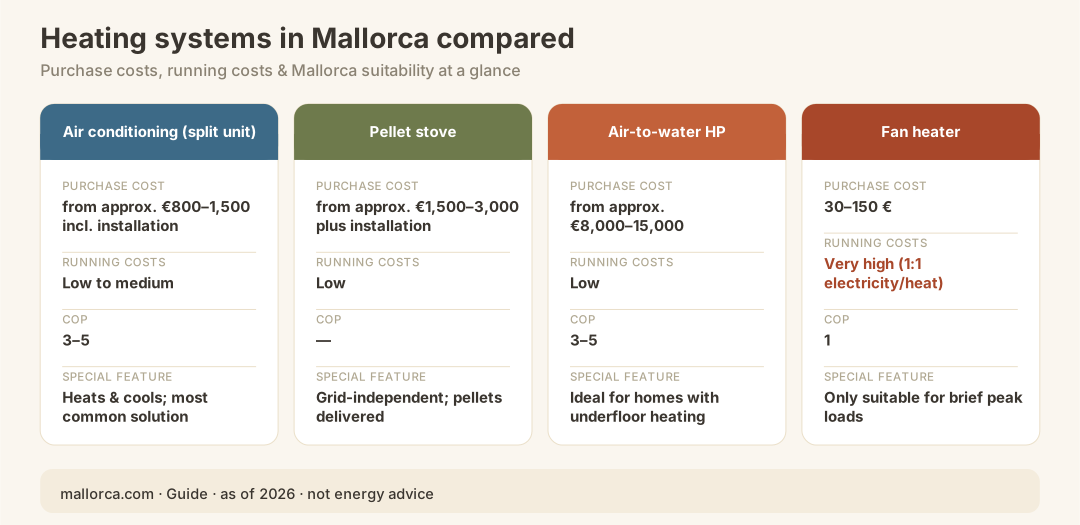
| Heating system | Purchase costs | Running costs | Mallorca-specific consideration |
|---|---|---|---|
| Air conditioning unit (air-to-air heat pump) | 300–700 € (portable) | Low to medium | Most widespread solution; also cools in summer |
| Split air conditioning unit (fixed) | from approx. 800–1.500 € incl. installation | Low to medium | More efficient than a portable unit |
| Fan heater | 30–150 € | Very high (1:1 electricity/heat) | Only worthwhile for short peak loads |
| Paraffin heater | approx. 100 € | Medium | Ventilation required; suitable for individual rooms |
| Pellet stove | from approx. 1.500–3.000 € | Low | Independent of the electricity grid; pellets can be delivered |
| Air-to-water heat pump | from approx. 8.000–15.000 € | Low | Ideal for houses with underfloor heating |
| Pool heat pump | 500–7.500 € | Low to medium | Extends the swimming season to up to 7 months |
Air conditioning as heating: the Mallorcan standard
By far the most widespread heating solution on Mallorca is the air-conditioning unit in heating mode – technically an air-to-air heat pump. The unit extracts thermal energy from the outside air and releases it indoors, which works efficiently even during Mallorca's mild winters. The decisive advantage: the same unit cools in summer – so you only need one system for both seasons.
Mobile units are available at DIY stores for 300 to 700 Euro and require no installation. The downside: they are noisier, less efficient, and only heat a single spot.Fixed split units (indoor unit + outdoor compressor) cost considerably more to purchase and install, but are significantly more efficient and quieter.
When choosing a model, you should pay attention to the energy efficiency rating. The highest class is A, subdivided into the grades A+++ to A. The higher the class, the lower the electricity consumption – on Mallorca, where electricity is the primary energy source, this makes a noticeable difference to your monthly bill.
Tip: For flats and smaller houses, a permanently installed inverter split system with a high energy efficiency rating is the most cost-effective overall solution – taking both purchase costs and ongoing electricity costs into account.
Electricity costs on Mallorca: what you actually pay
Electricity is the central energy source on Mallorca – for heating, air conditioning, hot water, and everyday life. This makes understanding your electricity tariff the most important lever for managing your energy costs.
Spain has a regulated electricity market system. For households there are essentially two options:
- PVPC (Precio Voluntario al Pequeño Consumidor): The regulated reference tariff, whose price fluctuates hourly and is set on the electricity exchange.
- Free market: A fixed or variable tariff with a private provider – often with an annual price guarantee.
| Feature | PVPC (regulated) | Free market |
|---|---|---|
| Pricing | Hourly variable (electricity exchange) | Usually fixed annual tariff |
| Predictability | Low | High |
| Better value for | Flexible consumption, smart home | Constant, inflexible consumption |
| Who can switch? | At any time | At any time |
| Supplier Mallorca | Endesa (network operator) | Various providers |
Note: In Mallorca, Endesa is the local network operator and default supplier. The electricity connection runs through Endesa, but you are free to choose your own supplier. Anyone running a heat pump should check whether a dedicated heat pump tariff with a flat rate regardless of time of day works out cheaper.
According to Expatistan data (April 2026), the average total monthly utility costs (electricity, gas, heating) for an 85-m² flat with two people in Palma come to 172 Euro.
Gas on Mallorca: bottled gas instead of a mains network
There is no island-wide mains gas network on Mallorca. Anyone wishing to cook or heat with gas must rely on liquefied petroleum gas (LPG/butane) — either in gas bottles (bombona) or via an underground tank at the property.
Bombonas (gas bottles) are the typical solution for individual appliances such as gas hobs or gas heaters. They are available from supermarkets, DIY stores, and local Repsol or Cepsa dealers. The price of a standard butane gas bottle (12.5 kg) is regulated by the Spanish government.
Underground tanks (depósito) are used at fincas and larger properties that have central propane heating. The tank, maintenance, and regular deliveries are arranged under contract — usually with Repsol, Cepsa, or Primagas.
| Gas type | Typical use | How to obtain | Advantage |
|---|---|---|---|
| Butane gas (12.5 kg bottle) | Hob, small heater | Supermarket, dealer | No installation required, flexible |
| Propane gas (bottle) | Outdoor and garden appliances | Dealer | Maintains pressure even in cold weather |
| Propane gas (underground tank) | Central heating, finca | Contracted supplier | Convenient, larger quantities |
Warning: Gas heaters and paraffin heaters absolutely require regular ventilation of the room — incomplete combustion can lead to carbon monoxide build-up.
Pellet stoves on Mallorca: independent of the electricity grid
Pellet stoves are widespread in Germany and Austria and are gaining popularity on Mallorca too — particularly among finca owners looking for a homely, decentralised heating solution that requires no complex infrastructure. The greatest advantage: a good pellet stove works even during a power cut and is independent of electricity or gas tariffs.
What does a pellet stove cost? Basic models start at around 1,500 to 2,000 Euro, while higher-quality units with a large hopper and automatic ignition cost 3,000 Euro or more — in each case excluding installation and chimney inspection.
Buying pellets on Mallorca: Pellets have to be shipped to the island, which makes them somewhat more expensive than on the mainland. Suppliers do exist, but the market is smaller than in Germany. Plan for storage capacity covering at least one full season.
When does a pellet stove make sense?
- Finca or country house without central infrastructure
- Preference for cosy radiant heat (no fan)
- Existing or retrofittable chimney connection
- Extended use in autumn and winter
Heat pump for house and finca: costs and efficiency
Anyone who owns a larger property on Mallorca or is carrying out comprehensive renovation work should seriously consider installing a air-to-water heat pump . The system heats water for underfloor heating or radiators and can simultaneously provide hot water.
The operating principle: rather than generating heat, it is extracted from the outside air and transferred indoors. For every kilowatt-hour of electricity used, a good heat pump typically delivers 3 to 5 times the amount of thermal energy depending on the outside temperature (COP 3–5). This makes it the most efficient electric heating system.
Mallorca's climate is particularly favourable for heat pumps: even in winter, temperatures rarely drop below 5 °C, which enables a high level of efficiency throughout the entire heating season.
| System type | Ideal for | COP range | Investment (approx.) |
|---|---|---|---|
| Air-to-air (split/air conditioning) | Flats, small houses | 3–5 | 800–3.000 € |
| Air-to-water | Houses with underfloor heating or radiators | 3–5 | 8.000–15.000 € |
| Air-to-water + pool | Houses with a pool | 3–5 | 10.000–18.000 € |
Please note: Heat pumps combined with a suitable overall climate concept are considered the most climate-efficient and long-term cost-effective heating system for properties on Mallorca — provided the property is appropriately configured (insulation, surface heating).
Pool heat pump: extending the swimming season to 7 months
A pool on Mallorca without heating is pleasant from June to August — but during the transitional months of April, May, September and October it is usually too cold for swimming. A pool heat pump changes this fundamentally: it keeps the water at a constant 26 to 28 °C and extends the swimming season from around three to up to seven months.
Calculating the right size
The rule of thumb for minimum output is:
Pool volume (m³) ÷ 4 = minimum kW of the heat pump
For a more precise calculation including a location factor:
Output (kW) = pool volume (m³) × C value × E value
- C value: 0.12 (temperature rise 2 °C/day) to 0.18 (3 °C/day)
- E value: 0.8 (warm, sunny) to 1.2 (cool, little sunshine)
On Mallorca, with its mild climate, the E value is typically below 1.0 — meaning you can choose a slightly smaller unit compared with calculations based on northern European conditions.
Costs and technology
| Pool size (volume) | Recommended output | Equipment costs (approx.) |
|---|---|---|
| up to 20 m³ (small pool) | 5–7 kW | from €500 |
| 30–50 m³ (standard finca pool) | 8–12 kW | 1.200–3.000 € |
| 60–100 m³ (large pool) | 14–20 kW | 3.000–7.500 € |
Full-inverter vs. on/off: Full-inverter models regulate output continuously — they run more quietly, consume less electricity under partial load, and maintain a more stable temperature. On/off units are cheaper to buy, but always switch on and off at full capacity, which costs more in electricity over the long term. For Mallorca pools that are in use for several months of the year, the premium for full-inverter is generally worth it.
Tip: A pool cover (solar blanket or roller cover) dramatically reduces heat loss overnight and can significantly lower the running costs of a pool heat pump.
Fan heaters and paraffin heaters: cheap to buy, expensive to run
Two solutions you will frequently come across in rental flats and holiday homes on Mallorca deserve a critical look:
Fan heaters generate localised warmth quickly — but their efficiency is 1:1: 1,000 watts of heating output means 1,000 watts of electricity consumption. Used continuously, they are therefore the most expensive heating system of all. A further drawback: the heat is delivered locally, and anyone who moves out of the airstream feels cold again immediately. They are fine for emergencies or brief peak demands (e.g. in the bathroom first thing in the morning) — but not as a primary heating system.
Paraffin heaters are inexpensive to buy (around 100 Euro), heat a room well, and need no electrical connection. The drawback: you must ventilate regularly, as combustion produces water vapour and CO₂. During damp winters on Mallorca this can seem paradoxical — you are heating against the moisture, yet venting the warm air straight back out again.
System comparison: what suits which type of property?
| Property type | Recommended heating system | Why |
|---|---|---|
| City flat in Palma (rented) | Portable split unit or air-conditioning unit in heating mode | No planning permission required, flexible |
| Owner-occupied flat | Fixed-installed inverter air-conditioning unit | Efficient, also cools, good resale value |
| Townhouse / adosado | Multi-zone air-conditioning or air-to-air heat pump | One unit per floor possible |
| Finca / country house (no gas network) | Air-to-water heat pump + pellet stove as a supplement | Comfort + independence |
| Finca with pool | Air-to-water heat pump + pool heat pump | Year-round solution, swimming season extended to 7 months |
| Holiday flat / part-time use | Air conditioning with remote control via app | Heating on demand, no standing charge |
Most common mistakes when heating on Mallorca
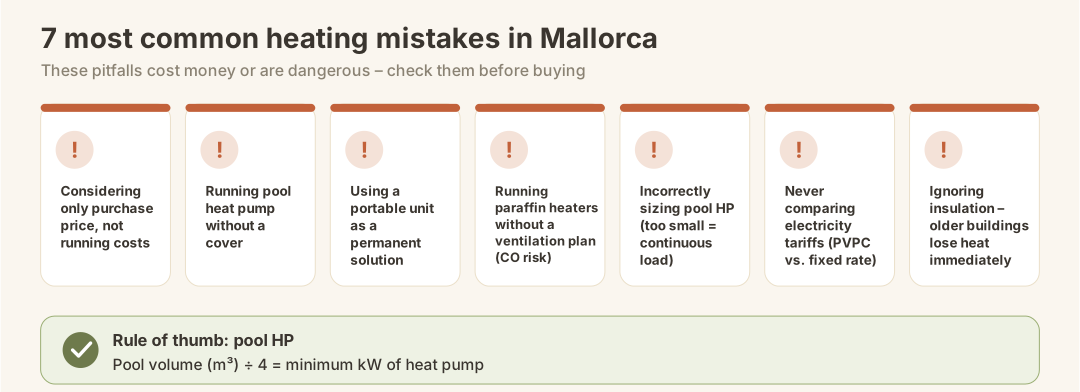
- Focusing only on the purchase price, not on running costs. A cheap fan heater costs several times more to run than an efficient air-conditioning unit.
- Not buying a pool cover. Anyone running a pool heat pump but not using a cover is wasting a large proportion of the heat generated.
- Using mobile devices as a permanent solution. Portable air-conditioning units have significantly worse COP values than permanently installed split systems.
- Running paraffin heaters without a ventilation plan. Risk of mould from moisture and risk of CO with inadequate ventilation.
- Incorrect sizing of the pool heat pump. A pump that is too small runs continuously at full load and wears out quickly. Rule of thumb: pool volume ÷ 4 = minimum kilowatts.
- Not comparing electricity tariffs. On Mallorca you can freely choose between the regulated PVPC tariff and fixed-price tariffs on the open market – comparing is especially worthwhile with high consumption.
- Ignoring insulation. Many older Mallorcan buildings have thin stone walls with no insulation. Even the most expensive heating system is wasted if the heat escapes straight away.
What comes next? Registering for electricity and keeping costs under control
Heating and energy costs are just one part of everyday budgeting on Mallorca. Anyone living on the island as a resident should also keep an eye on the other cost items:
- Registering for water: On Mallorca there are different water suppliers and tariffs depending on the municipality. Read our guide on registering for water on Mallorca.
- Overall cost of living: Electricity, gas and heating are part of a bigger financial picture. A full overview can be found in our guide to the cost of living on Mallorca.
- Tax considerations: As a resident you pay income tax in Spain. Investments in energy efficiency may in certain circumstances be tax-deductible – find out more under taxes as a resident (IRPF).
Checklist: choosing a heating system for your Mallorca property
- Clarify the type of use: primary residence, part-time or holiday property?
- Check the type of property and existing infrastructure (chimney, electrical capacity, exterior walls)
- Plan for the heating season: approx. November to March (5 months)
- Calculate the budget for purchase and running costs over 5 years
- Pay attention to the energy efficiency class when buying an air-conditioning unit (A+++ to A)
- Got a pool? → Size the pool heat pump (volume ÷ 4 = minimum kW)
- Plan for a pool cover for night-time and periods of non-use
- Compare electricity tariffs: PVPC vs. fixed price on the open market
- For a pellet stove: secure a local supplier and storage space for at least one season
- For gas heating (ground tank): take out a contract with a supplier (Repsol, Cepsa, Primagas)
- Engage a specialist contractor on Mallorca for installation (not from the mainland)
Conclusion
Heating on Mallorca is less demanding than in central Europe – but it is necessary for anyone living on the island year-round. By far the best solution for most properties is an efficient inverter-driven air-conditioning unit: it heats in winter, cools in summer, and benefits from optimal efficiency conditions thanks to Mallorca's mild winter temperatures. For larger houses and fincas, an air-to-water heat pump is well worth considering, combined with a pool heat pump to extend the swimming season to up to seven months.
Fan heaters and paraffin stoves are suitable at best as a supplement, not as a primary system. And anyone who has never checked their electricity tariff may well be paying more than necessary – a simple comparison between PVPC and fixed-price tariffs can be worthwhile.
Official sources
- Endesa (local grid operator Mallorca): www.endesa.com – electricity connection, tariffs, meter management
- Red Eléctrica de España / ESIOS (PVPC prices): www.esios.ree.es – real-time spot electricity prices
- IDAE – Instituto para la Diversificación y Ahorro de la Energía: www.idae.es – energy efficiency, heat pump subsidies in Spain
- Govern de les Illes Balears – Energy Department: www.caib.es – funding programmes for renewable energy in the Balearic Islands
- Expatistan Palma de Mallorca (cost-of-living reference): www.expatistan.com/cost-of-living/palma-de-mallorca