
Public Transport Mallorca: TIB, EMT, Train and Taxi 2026
Anyone living in Mallorca or spending an extended period there will find public transport virtually unavoidable – and that is no bad thing. The network of TIB buses, EMT city buses, SFM trains and a metro section covers most inhabited corners of the island. As a resident in 2026, the right smart card gets you free travel on buses, trains and the metro – a benefit that quickly makes itself felt in everyday life. This guide explains how each system works, how to obtain your free travel card, what tourists and non-residents pay, and where taxis and other alternatives come into play. You will also find out which routes have genuinely good frequency and where you should expect longer waiting times.

Moving to Mallorca and not sure where to start with the authorities, registration and everyday life?
- 📩 Submit a personal enquiry — We connect you with experienced local experts
- Everything about living and daily life in Mallorca
The big picture: who runs public transport in Mallorca?
Mallorca's public transport consists of two separate but interconnected systems. Both have their central interchange point at the Plaça d'Espanya in Palma, also known as the Estació Intermodal.
| Operator | Full name | Responsibility | Vehicle colour |
|---|---|---|---|
| TIB | Transports de les Illes Balears | Inter-urban buses across the whole island; operator of the trains and metro | Red and yellow |
| EMT | Empresa Municipal de Transports | City buses within Palma and its immediate surroundings | Blue and white |
| SFM | Serveis Ferroviaris de Mallorca | Train lines departing from Palma | — |
Although TIB and EMT have separate fare systems and timetables, the network is well coordinated. Since the Balearic government introduced the free-travel scheme, both systems are treated as free of charge for cardholders together – more on that in a moment.
Please note: Long-distance buses operated by other private providers (e.g. direct airport shuttles from certain operators) are not part of the subsidised network and are covered separately here.
TIB: the red-and-yellow inter-urban buses
The TIB network is the backbone of the island's public transport. With its red-and-yellow buses, it connects Palma with virtually all major towns – from Alcúdia and Pollença in the north, through Manacor in the east, to Santanyí in the south and Andratx in the west.
How are the TIB lines numbered?
Intercity bus lines carry three-digit numbers. The first digit indicates the region – a useful system once you get used to it. The current route map (summer and winter timetables) is available to download at tib.org/de/xarxa-de-transports/mapa-linies. All lines and timetables are available in German at tib.org/de/linies-i-horaris.
Seasonal differences
| Period | Frequency | Note |
|---|---|---|
| May – October (high season) | Hourly on many routes | To most beaches and tourist destinations |
| November – April (low season) | Reduced timetable | Some lines run less frequently or not at all |
Anyone living on the island year-round should check timetables in advance, especially in winter – the difference between summer and winter services is noticeable.
Example routes and cash fares (without a card)
Paying cash without a card, you'll pay between 3 and 13.50 Euro per single ticket, depending on the route. With the Single Card or the Intermodal Card, travel is free in 2026.
| Route | Cash payment (approx.) |
|---|---|
| Palma → Sóller (bus route) | approx. 3–5 € |
| Palma → Alcúdia | approx. 5–8 € |
| Palma → Manacor | approx. 5–8 € |
| Palma → Santanyí | approx. 8–13.50 € |
Please note: These cash prices apply to single journeys without a card. With a card, all journeys in 2026 are free of charge – however, you must validate the card when both boarding and alighting.
EMT: City Buses in and around Palma
The EMT serves the urban area of Palma with a dense network of blue-and-white buses. For residents, the EMT can also be used free of charge via the Intermodal Card or the Single Card – this applies explicitly to all EMT journeys, regardless of whether they involve a transfer to the TIB or rail network.
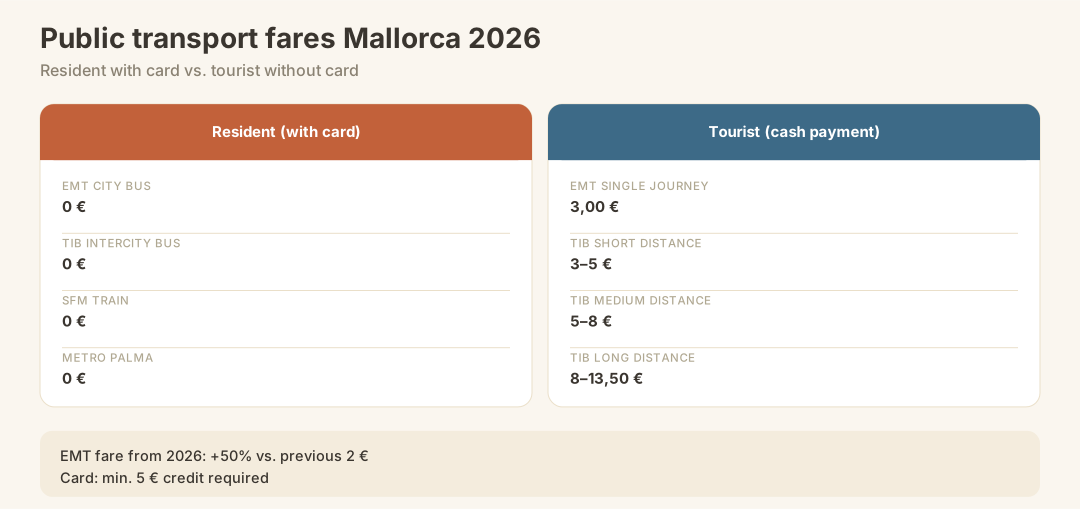
EMT Ticket Prices 2026
| Ticket | Price |
|---|---|
| Single journey (cash, non-resident / tourist) | 3,00 € |
| Single journey with Single/Intermodal Card (resident) | 0 € |
The single fare of 3 euros from 2026 represents an increase of 50 per cent compared to the previous price of 2 euros. The EMT attributed this to a rise in operating costs of more than 43 per cent between 2019 and the forecast for 2025 – while the standard ticket price had remained unchanged since February 2020.
For residents who commute daily, practically nothing changes – they continue to pay nothing. For tourists and short-term visitors without a card, every journey will become noticeably more expensive.
SFM Trains: The Island's Rail Lines
Mallorca's trains are operated by the Serveis Ferroviaris de Mallorca (SFM) and all depart from the Estació Intermodal at the Plaça d'Espanya in Palma. The network is compact, but very convenient for certain routes.
Overview of Train Lines
| Line | Route | Special Feature |
|---|---|---|
| Palma – Inca | Palma → Marratxí → Inca | Frequent service, commuter connection |
| Palma – Sa Pobla | Branch from Inca | Supplements the Inca line |
| Palma – Manacor | Palma → Sineu → Manacor | Eastern Mallorca |
Note: The famous Tramuntana Railway (Ferrocarril de Sóller) between Palma and Sóller is not part of the state-run SFM network – it is operated by a private company as a tourist heritage train and costs extra. It is a wonderful experience, but not part of the free travel offer.
Travelling for free with the card
With the Intermodal Card or the Single Card, all SFM train journeys are also free in 2026. The card must be validated at the turnstiles on the platforms – both when entering and exiting. A minimum balance of 5 Euro on the card is recommended so that the system can correctly record the journey (even if nothing is ultimately deducted).
Free travel: how the 2026 free-fare system works
The Balearic Government has officially confirmed free use of public transport for 2026. The Consell de Govern resolution applies to the entire year and continues the arrangement that has been in place since 2023, 2024 and 2025. The Spanish Congress has formally ratified the national subsidy programme for the Balearic Islands and the Canary Islands.
Who benefits?
| Group of people | Card required? | Cost |
|---|---|---|
| Residents (registered on the padrón, with NIE) | Yes, Single or Intermodal Card | 0 € |
| Foreign owners with longer stays | Yes, if card obtained | 0 € (card usable) |
| Tourists / short-term visitors without a card | No | Cash payment: 3–13,50 € |
Step by step: how to get your card
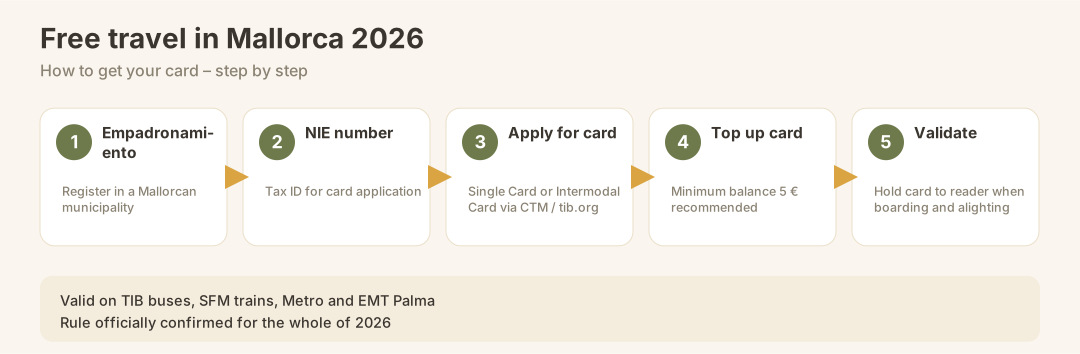
- Empadronamiento – You must be registered in a municipality on Mallorca. Without empadronamiento, nothing gets done. Find out how it works in our guide to empadronamiento.
- NIE number – Your tax identification number is required when applying for a resident card. Everything about the NIE number on Mallorca.
- Apply for a Single Card or Intermodal Card – The cards are issued by the CTM (Consorci de Transports de Mallorca). Information and applications via tib.org.
- Top up your card – A minimum balance of 5 Euro is recommended, even when no fares are being deducted.
- Validate your card – Always hold the card against the readers when boarding and alighting from buses, and at the turnstiles at train stations.
Please note: Free travel does not apply automatically – anyone travelling without a valid card must pay the standard cash fare or, in the worst case, risks being inspected.
Metro Palma
In addition to buses and trains, Palma has a small underground (Metro). It is also part of the subsidised system and can be used free of charge with the Intermodal Card in 2026. The Metro primarily supplements connections within Palma and between the city centre and the main railway station.
Airport transfer: From the Aeropuerto to Palma and beyond
Palma Airport (PMI) is located to the south-east of the city centre. There are several ways to get from the airport into the city or to other destinations.
| Option | Route / Provider | Destination | Note |
|---|---|---|---|
| EMT city bus | Line 1 | Palma city centre / Plaça d'Espanya | Free with a card, €3 in cash |
| TIB intercity bus | Various routes | Locations outside Palma | Free with a card |
| Taxi | Licensed taxis | Everywhere | Metered fare |
| Hire car | Various providers | Flexible | Available at the airport |
The EMT Line 1 connects the airport directly with Palma city centre. For residents, travelling with a card is the cheapest and most straightforward option – particularly if you don't have too much luggage with you.
Taxis on Mallorca: when it's worth it and what it costs
Taxis on Mallorca are licensed and readily available – especially in Palma and the main tourist areas. For places off the bus routes, or at night when public transport is no longer running, they are the most practical alternative.
Useful facts about taxis
- Taxis are recognisable by their white bodywork with a green stripe
- Taximeters are compulsory – if in doubt, insist that it is switched on
- A journey from the airport to Palma city centre typically follows a regulated fare depending on the time of day and amount of luggage – check current prices directly with the taxi company or the local municipal authority
- There are surcharges for luggage, night-time journeys and public holidays – depending on the tariff set by each municipality
- In many places outside Palma, taxis can only be called by phone; there are no street taxis
Please note: Ride-hailing apps such as Uber or Cabify are active in Spain and on Mallorca, but their offering on the island is limited. Check current availability in your app.
Practical tips for everyday life
Check timetables before you set off
The TIB website (tib.org/de/linies-i-horaris) is available in German and offers a search tool where you enter your starting point and destination. You can see current connections immediately. It is worth checking the timetables, especially in winter — the difference between summer and winter services on some routes is considerable.
Tips for commuters and new arrivals
- Plaça d'Espanya is your central hub: all bus routes and trains depart from here. Always arrive a little early, particularly during peak season when buses can get very full.
- Stops served on request: On some routes outside the larger towns, passengers simply raise their hand to stop the bus — much like a school bus.
- For rural areas: certain TIB routes (marked as coloured dashed lines on the route map) operate by pre-booking only — you should book these in advance.
- The Mallorca app or Google Maps generally show real-time data for many stops.
Combining public transport with a car
People who live outside Palma but need to travel into the city regularly often combine the two: drive to a park-and-ride point, then continue by bus or train. Everything you need to know about owning a car on Mallorca can be found here.
The most common mistakes when using public transport on Mallorca
- Not validating your card when you alight — Anyone who only taps in when boarding risks issues with the system. Always validate both when boarding and when alighting.
- No credit on the card — Even when the journey is free, a minimum balance of 5 Euro must be on the card for it to be accepted.
- Ignoring the winter timetable — Anyone planning a journey in November or December based on the summer timetable may end up waiting a very long time.
- Confusing the Ferrocarril de Sóller with SFM — The nostalgic wooden railway to Sóller is a tourist and privately operated service — it costs extra and is not part of the free network.
- Airport transfers without checking in advance — Anyone arriving on a flight with a lot of luggage who wants to take the bus on the spot should be aware: check the departure times of EMT line 1 beforehand.
- Underestimating cash payments – Anyone without a card who pays in cash will pay 3 Euro per journey on EMT services from 2026 – with several trips a day, that soon adds up.
What comes next? Public transport and everyday life as a resident
Anyone living on Mallorca quickly realises that public transport is not a last resort but a genuine everyday asset. Especially in Palma, it often makes far more sense to take the bus than to squeeze a car through the narrow lanes and hunt for a parking space. As a resident, you save considerable sums compared to tourists without a card.
Alongside public transport, there are further everyday topics you will encounter as a newcomer:
- Cost of living on Mallorca: an overview
- Setting up an internet connection on Mallorca
- Taking out a mobile phone contract in Spain
- Importing and re-registering a car on Mallorca
Checklist: setting up public transport on Mallorca as a resident
- Empadronamiento completed in your municipality
- NIE number obtained
- Single Card or Intermodal Card applied for via TIB/CTM
- Card topped up with at least 5 Euro
- Timetable for your most important routes saved / downloaded from tib.org
- Summer and winter timetable noted (different frequencies)
- Obligation to validate on boarding and alighting understood and remembered
- Taxi app or numbers saved for evening/night journeys
Conclusion
Public transport on Mallorca in 2026 is better value and better quality than ever before – at least for residents. Anyone who is registered and has the right card travels by bus, train and metro free of charge across the entire island. The network is not as dense as in a large German city, but it covers most inhabited areas and runs noticeably more frequently in summer than in winter. Anyone who understands the quirks of the system – validating correctly, keeping credit topped up, checking timetables – can get along perfectly well and stress-free on Mallorca without a car of their own, at least in and around Palma.
Official sources
- TIB – Transports de les Illes Balears (CTM): www.tib.org/de/inici — official page in German with timetables, route maps and card information
- TIB route map: www.tib.org/de/xarxa-de-transports/mapa-linies
- TIB lines & timetables: www.tib.org/de/linies-i-horaris
- CTM announcement – free public transport 2026: www.tib.org/en/w/el-transport-públic-interurbà-manté-la-gratuïtat-l-any-2026
- EMT Palma: www.emtpalma.cat — Palma de Mallorca urban bus network
- Govern de les Illes Balears – Mobility: www.caib.es