
Reporting a move within Spain: changing your address with the DGT, Padrón, IB-Salut and more
If you move within Spain or from another municipality to Mallorca, it's not enough to just pack the moving boxes. When re-registering your address after a move in Spain, you need to have your new address entered independently at several different offices: at the Ayuntamiento (Padrón), at the DGT (vehicle and notification address), at the health centre, and often also with your bank, insurance company and tax authority. Each office has its own deadlines, forms and channels – and some of them even carry statutory fines. In this guide you'll get a clear step-by-step sequence, all the relevant deadlines in table form, and the documents you need for each office.
- Relocation Service Mallorca — a complete relocation service including visits to the authorities
Why you need to inform several authorities after moving in Spain
Unlike in Germany, there is no central registration authority in Spain that automatically informs all institutions of your move. Padrón, DGT, tax office (Agencia Tributaria), social security and the health system each maintain their own registers. If you move to another municipality within Mallorca or from Germany to the island, you therefore have to report your new address separately, multiple times.
This isn't a mere formality: without a current Padrón, you won't get a TIE residencia card, an SIP health card, or a school place for your children. Without an updated DGT address, fine notices can't reach you, which means the appeal deadline can expire unnoticed. And if you live in Spain as a resident, it is even prohibited under Art. 68 Real Decreto Legislativo 6/2015 to permanently drive a vehicle registered abroad – another reason why re-registering your vehicle and your address are connected.
Note: Whether you count as a resident is determined by your actual living circumstances (place of residence, centre of your life), not solely by formal registration. Anyone staying in Spain on a permanent basis should therefore not delay re-registration.
Padrón: the basis for everything – re-registering at the Ayuntamiento
The Padrón Municipal de Habitantes is the municipal register of residents and the foundation for practically all further administrative procedures. Every person living in Spain – Spanish nationals, EU citizens or third-country nationals – must register at the address where they actually live. The registration process itself is called Empadronamiento, and the document is called Certificado de Empadronamiento (or Volante de Empadronamiento).
The Ayuntamiento (town hall) of your new municipality of residence is always responsible. Most municipalities require an in-person appointment for this.
| What you need | Details |
|---|---|
| Identity document | Passport/NIE or TIE card |
| Proof of address | Rental agreement or escritura (deed of purchase) |
| Cost | Usually free, printed certificates sometimes 0–3 € |
| Validity of the certificate | Usually 3 months for official purposes |
| Renewal requirement | Third-country nationals (non-EU): every 2 years; EU citizens: registered indefinitely |
Note: If you move within Mallorca to a different municipality, you need to register again with the new Ayuntamiento – the old registration is automatically overwritten in the process. You can find details on the full process, appointment booking and documents in the guide Empadronamiento Mallorca.
DGT: changing vehicle, driving licence and notification address
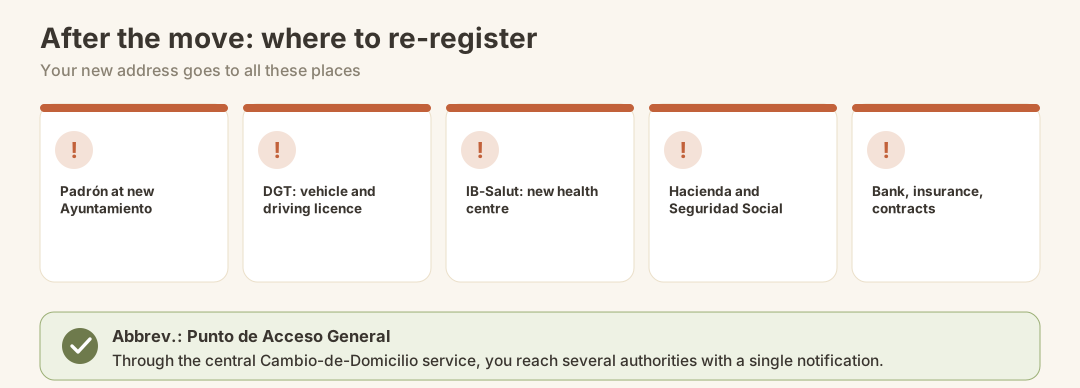
The Dirección General de Tráfico (DGT) requires two separate address changes once you've moved:
- Cambio de dirección para notificaciones – your personal contact address with the DGT, so that fine notices and correspondence reach you.
- Cambio de domicilio fiscal del vehículo – the tax address of your vehicle, relevant for vehicle tax (Impuesto de Circulación / IVTM).
According to the DGT, both are subject to a deadline of 15 days after the move, especially if you move to a different municipality. Vehicle tax is always due in the municipality where the vehicle is registered for tax purposes on 1 January of the current year – and this location must match your padrón municipality.
| Trámite | Deadline | Channels | Cost |
|---|---|---|---|
| Cambio de dirección (notification) | 15 days | Online (Cl@ve/certificate/DNIe), miDGT app, phone 060, in person | Free of charge |
| Change of tax domicile (vehicle) | 15 days | Online (Cl@ve), Registro electrónico for special cases, miDGT app, in person | Free of charge (special case: transfer from the Canary Islands/Ceuta/Melilla: €8.67 fee, Tasa 4.1) |
| Re-registration of old number plate (voluntary) | No fixed deadline | Online / in person | Depends on the case |
Here's how to proceed:
- Go to the "Cambio de domicilio" service on the DGT's Sede Electrónica (sede.dgt.gob.es).
- Log in with Cl@ve, a digital certificate, or DNI electrónico.
- Choose whether to change only the notification address, only the vehicle address, or both at the same time.
- Confirm the details – in standard cases, no further documentation is required.
- In special cases (e.g. vehicles from the Canary Islands, Ceuta/Melilla), you must also submit the customs proof via the Registro electrónico.
Note: If your old vehicle registration document still has the outdated format with the address recorded, the DGT will issue you a new registration document free of charge when you change your address. If you're moving to a different province, you can also voluntarily apply for a new number plate without a province code.
If you've only recently brought your vehicle to Spain, you'll find the complete guide to first-time registration in the guide Registering a car in Spain. The Spanish driving licence exchange is also often linked to the timing of your address change – more on this in the article Exchanging your driving licence. You can find a workshop for the subsequent ITV inspection in the Industry directory: Insurance in Mallorca, in case you also need to adjust your vehicle insurance policy at the same time.
Healthcare system: updating your health centre and IB-Salut
In addition to the padrón and the DGT, you should also have your assigned health centre (Centro de Salud) changed after a move. As a rule, your assignment to a health centre is linked to your padrón address, so having a current registration certificate is usually a prerequisite for updating your assignment within the regional healthcare system (in Mallorca: IB-Salut). Depending on the health centre and your situation, this may require an in-person appointment or a form – it's best to check directly with your new Centro de Salud as soon as you have your current padrón.
Please note: Without an updated health centre, delays may occur when booking appointments or getting prescriptions. Use the moving period to also review your private or statutory health insurance cover.
You can find more on the Spanish healthcare system, the SIP card, and choosing between public and private cover in the guides Health & Insurance and Health Insurance Spain.
Everything in one go: Cambio de Domicilio via the Punto de Acceso General
An often overlooked advantage: via the Punto de Acceso General of the Spanish administration, you can change your new address simultaneously with several agencies using your digital certificate, DNI electrónico or Cl@ve – according to the DGT, this includes the Agencia Tributaria (tax office), the Policía Nacional and the Seguridad Social. This saves you several separate applications.
| Agency | Possible via Punto de Acceso General? | Alternative |
|---|---|---|
| DGT (vehicle & notification) | Yes | Directly via sede.dgt.gob.es |
| Agencia Tributaria | Yes | Directly via sede.agenciatributaria.gob.es |
| Seguridad Social | Yes | Directly via sede.seg-social.gob.es |
| Policía Nacional (NIE/TIE register) | Yes | In person via Cita Previa |
| Padrón (Ayuntamiento) | No, separate registration required | In person at the town hall |
| IB-Salut / Health Centre | No, separate registration required | Directly at the Centro de Salud |
Taxes, bank, insurance and contracts: further agencies
In addition to the official registers, you should also inform your private contractual partners. These include your bank, your car and home contents insurance, your mobile phone provider and – if applicable – your tax advisor or gestoría. Anyone working as a self-employed person (autónomo) must also update their new address with the Agencia Tributaria and, where relevant, in their tax return, as this may also change your responsible tax office.
- Check your tax residency and Certificado de Residencia Fiscal – details on this can be found in the guide Certificado Residencia Fiscal.
- Update your electricity, water and internet contracts at the new address in good time so there's no gap in supply – more on this in Setting up electricity in Spain, Registering Water Supply in Mallorca and Mobile Phone Contract in Spain.
- For the tax side of things after moving, it's worth taking a look at Taxes & Finance as well as at Taxes as a Resident.
- If you're looking for a German-speaking professional for the tax re-registration, you'll find contacts in the Directory: Tax Advisors & Gestorías.
Special case: bringing a car from abroad as removal goods
If, as part of your move, you bring a vehicle from Germany, it counts under certain conditions as removal goods and can be imported with customs relief. The requirement is that the vehicle has belonged to you for at least six months and is intended for your personal use.
| Document | Requirement |
|---|---|
| Deregistration certificate from the municipality of origin | At least 12 months of registered residence at the last place of residence, apostilled/certified and translated into Spanish |
| Vehicle registration certificate Part I & II | Original vehicle registration document and title |
| COC document | EC certificate of conformity |
| Proof of transport | Ferry ticket/invoice or transport receipt |
| Empadronamiento | Current registration certificate at the new place of residence |
Note: Get advice before the transport so that all documents are available in the correct order – if, for example, the 12-month registration certificate from the country of origin is missing, the duty-free import can fail. More details on deadlines and forms in the guide Household removal goods duty-free.
Deadlines and costs at a glance
| Office | Deadline after moving | Typical costs |
|---|---|---|
| Padrón (Ayuntamiento) | Recommended immediately, no fixed penalty deadline | Free (certificate sometimes 0–3 €) |
| DGT – Notification address | 15 days | Free |
| DGT – Tax domicile vehicle | 15 days | Free (special case for transfer from Canary Islands/Ceuta/Melilla: 8.67 €) |
| Health centre / IB-Salut | Shortly after Padrón update | Usually free |
| Agencia Tributaria / Seguridad Social | Promptly, depending on procedure | Free via Punto de Acceso General |
Most common mistakes when re-registering after a move
- Only changing the Padrón and forgetting the rest. Padrón, DGT and the health system are separate registers – a change in one does not automatically transfer to the others.
- Letting the 15-day deadline at the DGT expire. Afterwards, missed fines can occur because notifications don't reach you at the old address.
- Vehicle domicile and Padrón municipality don't match. Vehicle tax is due where the vehicle and owner are officially registered – discrepancies lead to queries.
- As a resident, continuing to drive with a foreign licence plate. This is prohibited for residents under Art. 68 Real Decreto Legislativo 6/2015 and can lead to confiscation.
- Wanting to import a household removal vehicle without a 12-month registration certificate. Without this proof from the country of origin, the customs-privileged import no longer applies.
- Only switch health centres once there is an acute need. Better to sort this out right after the Padrón update to avoid waiting times.
What comes next?
After re-registering, you should check whether the move changes your tax residence, your responsible Finanzamt, or your health insurance situation. Anyone moving to Mallorca for the first time or applying for Residencia for the first time will find the right next steps in the guides Residencia Spain and Authorities & Registration. For anyone still looking for a suitable and affordable flat, it's also worth taking a look at Affordable living Mallorca.
Checklist: Re-registering a move within Spain
- Register the new address with the Ayuntamiento (Empadronamiento).
- Request the Certificado de Empadronamiento (for other authorities).
- Change the DGT notification address online, via app, or by phone on 060.
- Update the vehicle's DGT-Domicilio fiscal (within 15 days).
- Update the health centre / IB-Salut assignment.
- Change the address via the Punto de Acceso General with the Agencia Tributaria and Seguridad Social.
- Inform the bank, insurance companies, and mobile phone and internet providers.
- When importing a vehicle from abroad: check and fully assemble the removal-goods documents.
Conclusion
Moving within Spain or to Mallorca involves more bureaucracy than in Germany, because there is no central registration system. Knowing the correct order – first Padrón, then DGT within the 15-day deadline, followed by the health centre and the Finanzamt – saves you fines and waiting times. Use the Punto de Acceso General to inform several authorities at once, and keep an eye on the special removal-goods deadlines if you're bringing a vehicle with you.
Official sources
- DGT – Change of a vehicle's tax domicile: https://sede.dgt.gob.es/es/vehiculos/cambio-de-domicilio-fiscal/
- DGT – Change of address within Spain: https://www.dgt.es/nuestros-servicios/tu-vehiculo/cambio-de-domicilio-dentro-de-espana/
- DGT – Change of address for notifications: https://sede.dgt.gob.es/es/permisos-de-conducir/direccion-para-notificaciones/
- DGT – Catalogue of procedures: https://www.dgt.es/nuestros-servicios/conoce-todos-los-tramites/
- Real Decreto Legislativo 6/2015 (Traffic, Motor Vehicle Circulation and Road Safety Act), Art. 68 – BOE: https://www.boe.es/buscar/act.php?id=BOE-A-2015-11722