
Converting Your Driving Licence in Spain: Deadline, Process & Validity (EU & UK)
Anyone living permanently on Mallorca or elsewhere in Spain will sooner or later need to exchange their German, Austrian, or British driving licence for a Spanish one. permiso de conducción The 2-year deadline sounds relaxed — until you suddenly find yourself in a police check in the middle of the holiday season and receive a fine. This guide explains when the clock starts ticking, which documents you need, how the Psicotécnico appointment works, what the difference is between an EU and UK licence, and which mistakes residents on Mallorca make time and again. All information is current as of 2026, with all figures drawn from official sources.

- Apply for Residencia in Spain — Without Residencia there is no obligation to exchange — but also no right to do so
Who needs to exchange — and who doesn't?
The key distinction drawn by the DGT is between residents and non-residents.
| Group | Obligation to exchange | Right to exchange | Driving entitlement in Spain |
|---|---|---|---|
| EU citizens without Spanish residence (tourists, second-home owners) | No | No | Yes, unlimited with EU licence |
| EU citizens with Residencia / Empadronamiento | Yes, no later than 2 years after establishing residence | Yes | Until the deadline with EU licence |
| UK citizens with Residencia (post-Brexit) | Yes, separate bilateral agreement | Yes | Only with valid UK licence until deadline |
| Non-EU/UK citizens with Residencia | Depends on country of origin and applicable agreement | In some cases | Time-limited or new test required |
Please note: For DGT purposes, residence begins on the date of your first Empadronamiento or the date your Residencia was issued — whichever comes first. Anyone who retains their main residence in Germany and only owns a holiday home on Mallorca is not considered a resident under traffic law and is not required to exchange their licence.
The 2-year deadline in detail
The deadline begins to run as soon as you have officially established residence in Spain — that is, once your Empadronamiento is in place or your Residencia has been issued.
Open-ended or very long-term licence (old pink/grey paper format or credit-card format with a validity of more than 15 years): You have 2 years to apply for the exchange at the DGT.
Provisional driving licence (new EU card-format licence with an expiry date): If your document expires within these 2 years, the expiry date is the binding deadline. You must therefore have a Spanish licence in hand no later than that expiry date.
Please note: Anyone who misses the deadline is effectively driving without a valid licence. Fines may be imposed at a roadside check. Once the deadline has passed, the German licence loses its validity for road use in Spain – even if the physical document has not yet been confiscated.
The Psicotécnico: compulsory for all residents
One of the most common misconceptions: many new arrivals believe the medical test is only required when exchanging a licence. In fact, it is compulsory for all residents – regardless of whether they hold a German, Austrian, or Spanish driving licence.
The informe de aptitud psicofísico (known as the Psicotécnico) covers:
- Eyesight test – visual acuity, field of vision, depth perception, colour vision
- Reaction and coordination test (using a computer-based device)
- Brief medical history (general health, medications, chronic conditions)
The test is not carried out at your GP's surgery, but at a specially licensed medical assessment centre (centro de reconocimiento de conductores). There are several such centres in Palma and in the larger municipalities across Mallorca. The cost is typically 30 to 50 euros.
The certificate issued must be submitted with your exchange application and – while you are still driving on a foreign licence – should be carried with you at all times.
Documents you will need
| Document | Details |
|---|---|
| Original driving licence | Retained permanently at your DGT appointment |
| Valid national identity card or passport | Copy and original |
| Residencia / NIE proof | Green residency card or certificate |
| Empadronamiento (certificate of registration) | Generally no more than 3 months old |
| Psicotécnico certificate | From the licensed medical centre |
| 2 biometric passport photographs | Format 32 × 26 mm |
| Tasa receipt (proof of fee payment) | 28,87 € – Formular 790, Code 009 |
Please note: Formular 790 (Código 009) for paying the Tasa can be completed online on the DGT website and paid by bank transfer or at a bank branch. Always print the receipt and bring it to your appointment.
Step by step: how the exchange process works
- Book a Psicotécnico appointment – Search in your area for a centro de reconocimiento de conductores. No lead time required; walk-ins are often possible.
- Collect your certificate – You will usually receive the result on the same day.
- Pay the Tasa – Complete Formular 790, Código 009, transfer 28,87 €, and print the receipt.
- Gather your documents – All documents listed in the table above.
- Book a DGT appointment – Online at sede.dgt.gob.es or by phone. On Mallorca, the responsible authority is the Jefatura Provincial de Tráfico in Palma de Mallorca (Carrer de Luca de Tena, 6, Palma).
- Attend in person – The application cannot be submitted by post or through a representative; your personal attendance with your original driving licence is required.
- Receive your Spanish driving licence – Processing typically takes a few weeks. You will receive a temporary certificate (resguardo), which is valid as proof of entitlement to drive until the document is delivered.
Special case: UK driving licence after Brexit
With Brexit on 1. January 2021, the United Kingdom left the EU single market. This means that British nationals resident in Spain are no longer covered by the automatic EU-wide recognition of driving licences.
Spain and the United Kingdom have concluded a bilateral agreement on the mutual recognition of driving licences. For British residents in Spain, this means:
- Exchange is possible and recommended.
- The procedure broadly follows the same process as for EU citizens – including the Psicotécnico, the Tasa, and a personal DGT appointment.
- The British licence will likewise be retained permanently.
Please note: The precise deadlines and conditions for UK nationals may change within the framework of the bilateral agreement. British residents should check the current situation directly with the DGT or through the British Embassy in Madrid.
Validity and renewal of the Spanish driving licence
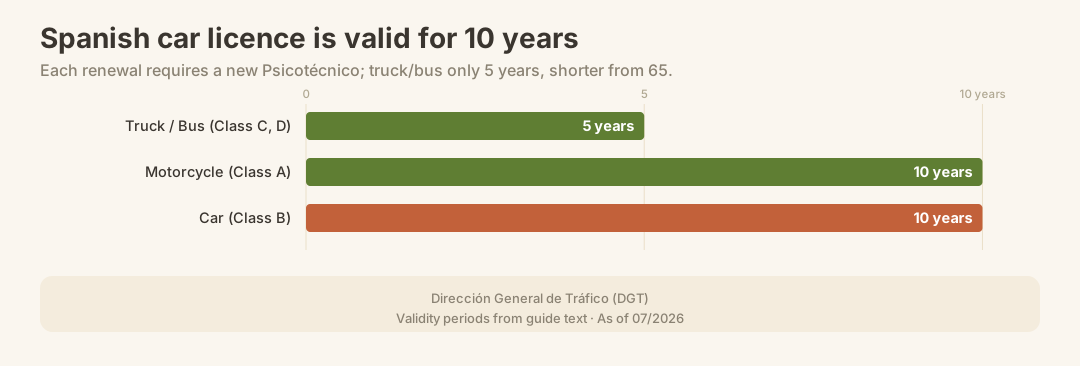
The Spanish driving licence you receive is a time-limited document. Its period of validity depends on the licence category and your age.
| Licence category | Period of validity (standard rule up to age 65) |
|---|---|
| B (car) | 10 Jahre |
| A (motorcycle) | 10 years |
| C, D (lorry, bus) | 5 years |
| Drivers aged 65 and over | Shortened intervals depending on category |
The new EU standard stipulates a validity of 15 years for all licences issued after 19 January 2013. For older documents, transitional periods apply; the standardised credit-card format will be mandatory for everyone in the EU from 2033.
Renewing a Spanish driving licence again requires a Psicotécnico – the principle of regular fitness-to-drive testing is therefore a fixed part of the Spanish system, not merely a one-off hurdle when converting your licence.
Cost overview
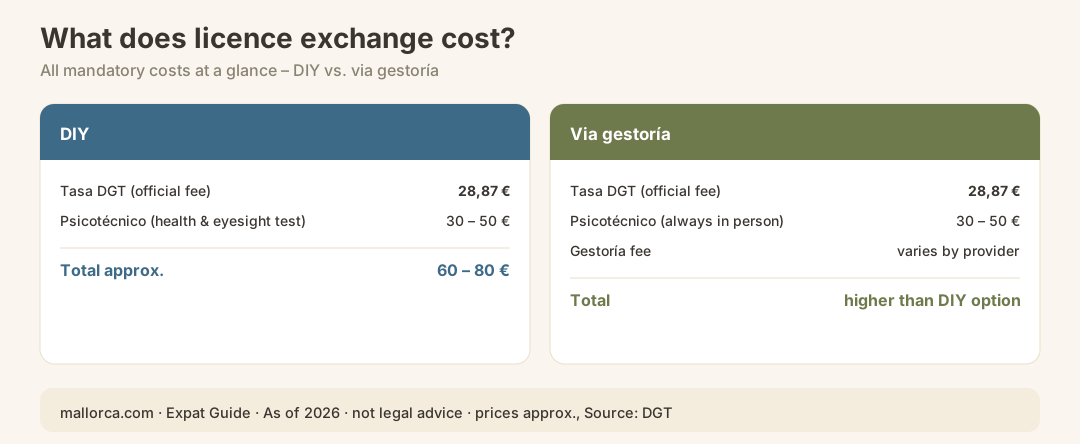
| Item | Cost (approx.) |
|---|---|
| Tasa DGT (official fee) | 28,87 € |
| Psicotécnico (health and eyesight test) | 30–50 € |
| Total if handled yourself | approx. €60–80 |
| Handled by a service provider / gestoría | varies depending on provider |
Anyone who wants to save time or does not speak Spanish can arrange the exchange through a gestoría (Spanish administrative office). They will complete all the forms, submit the documents and have the Spanish licence delivered to you – however, the Psicotécnico must always be taken in person.
Most common mistakes when converting a driving licence in Spain
1. Missing the deadline The most common mistake: residents do not know their deadline or believe their German licence remains valid indefinitely. The 2-year clock starts on the first day of official residence.
2. Empadronamiento certificate is out of date The Empadronamiento should be current at the time of your DGT appointment. Anyone who has been waiting months for an appointment should renew the certificate in good time.
3. Psicotécnico taken at the wrong doctor The test must be carried out at an officially approved centre. A simple certificate from your GP will not be accepted.
4. Forgotten the original The original driving licence must be presented at the appointment and will be retained. Anyone who forgets it will not be given a new appointment – and will be driving without a valid licence until the next one.
5. Tasa not paid Without proof of payment of €28.87, the application will not be processed. Payment must be made before the DGT appointment.
6. Attempting to convert as a non-resident The DGT only accepts applications from persons who are officially registered in Spain. Anyone unable to provide a valid Empadronamiento and residencia will be turned away.
What comes next? Further obligations as a vehicle owner
After successfully converting your licence, you are a fully-fledged participant in Spanish road traffic with a Spanish driving licence – including all Spanish obligations:
- ITV (Spanish MOT): Your vehicle must undergo regular roadworthiness inspections. On Mallorca you can find all the information about this in our ITV Guide for Mallorca.
- Psicotécnico on Renewal: A new medical fitness test is required at every renewal of a Spanish driving licence.
- Points System: Spain operates a driving licence points system – every driver starts with 12 points. At 0 points the licence is revoked.
- Vehicle Registration: Anyone bringing their German car to Spain permanently must re-register it. This is a separate procedure with the DGT.
You can find further topics on emigrating in our Cars & Transport Guide and in the Authorities & Registration Overview.
Checklist: Exchanging your driving licence in Spain
- Residencia or Empadronamiento in place – determine the start of the deadline
- Psicotécnico appointment booked and completed at an approved centre
- Certificate received from the medical centre
- Tasa (Formular 790, Código 009) of 28,87 € paid, receipt printed
- 2 biometric passport photos obtained (32 × 26 mm)
- Empadronamiento certificate up to date
- NIE / Residencia document and identity card / passport photocopied
- Original driving licence ready (it will be retained!)
- DGT appointment in Palma booked (sede.dgt.gob.es)
- Attended the appointment in person, Resguardo (provisional proof) received
- Spanish driving licence received by post and checked for accuracy
Conclusion
Having your driving licence exchanged in Spain is not an optional project for some point in the future – it is a legal obligation with a clear deadline. Two years after registering your residence, your German licence is no longer valid. The process itself is straightforward: a medical fitness test, a few documents, an official fee of just under 29 euros, and a personal DGT appointment. Planning ahead avoids stress, fines, and gaps in insurance cover.
Official Sources
- Dirección General de Tráfico (DGT) – Canje de permiso de conducción extranjero: https://sede.dgt.gob.es
- German Embassy Madrid / German Consulate Palma – Information page on German driving licences in Spain: https://spanien.diplo.de/es-de/service/2551508-2551508
- ADAC – Spain: Recognition of foreign driving licences: https://www.adac.de/verkehr/rund-um-den-fuehrerschein/aktuelles/spanien-anerkennung-deutscher-fuehrerschein
- Jefatura Provincial de Tráfico Illes Balears, Carrer de Luca de Tena, 6, 07007 Palma de Mallorca
- European Commission – Mutual recognition of driving licences in the EU: https://europa.eu/youreurope/citizens/vehicles/driving/index_de.htm