
Private jet Mallorca: PMI vs. Son Bonet, charter prices and basing 2026
Anyone living on Mallorca or commuting to the island regularly will sooner or later face the question: charter or base, PMI or Son Bonet, own aircraft or fractional ownership? The private jet Mallorca question is no mere luxury cliché — for many residents it is a logical response to the island's chaotic summer airports, and to the fact that Mallorca is within two hours by jet from London, Munich or Paris. This guide explains the difference between the two airports, sets out current charter prices for the most important routes, covers the specifics of hangar space and basing on the island, and gives you a realistic picture of the ongoing costs of owning your own aircraft in Mallorca.

Are you planning to base your jet on Mallorca or to book regular private charter flights?
- 📩 Submit a personal enquiry — we will connect you with aviation experts and tax advisers on the island
- Premium lifestyle on Mallorca: all guides
The two airports: PMI and Son Bonet at a glance
Mallorca has two usable airports — and they differ fundamentally in function, infrastructure and suitability for different types of aircraft.
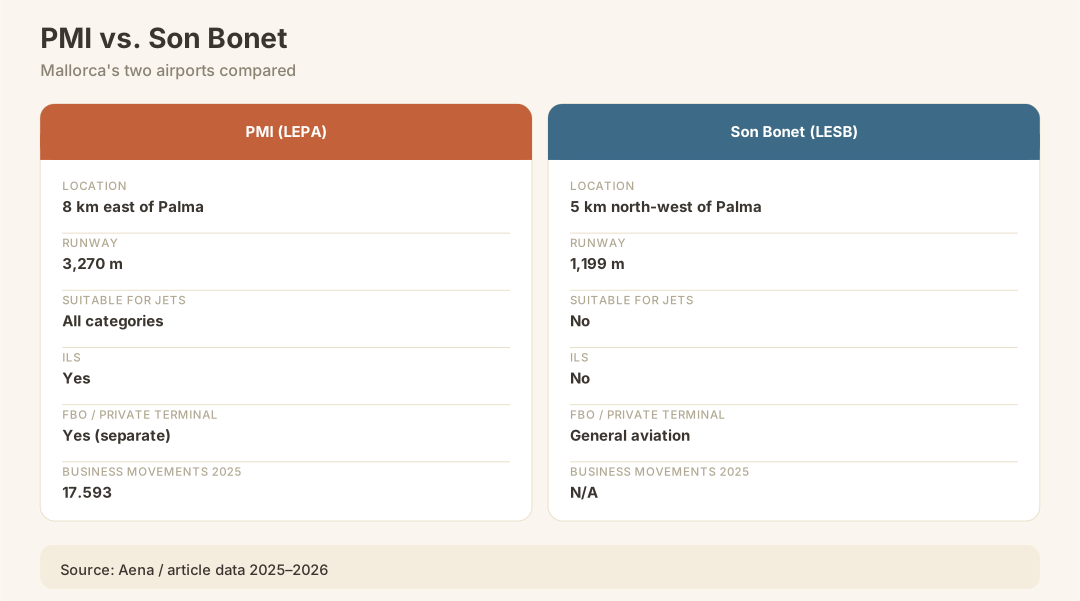
Palma de Mallorca Airport (LEPA / PMI)
Palma Airport is the Balearic Islands' primary international gateway, operated by Aena. It lies approximately 8 km east of the city centre and has two runways with a maximum length of 3.270 m — enough to accommodate all common jet categories, from light jets to large long-haul aircraft. In 2025, 17.593 business aviation movements were recorded at PMI, making it one of the most active private aviation hubs in the Mediterranean.
Private jets at PMI use a dedicated FBO (Fixed Base Operator) that is completely separate from the commercial terminal. This is the crucial difference in high summer: while tens of thousands of package-holiday travellers queue at check-in, you drive straight to the FBO, are welcomed in the lounge and board within 20–30 minutes.
Son Bonet Aerodrome (LESB)
Son Bonet lies approximately 5 km north-west of Palma in the municipal area of Marratxí. It is a purely civil airfield with no intercontinental or scheduled commercial services. The single paved runway measures 1.199 m — meaning Son Bonet is suited to piston aircraft and smaller turboprops. There is no instrument landing system (ILS). Operating hours according to available data: daily 07:00–23:00, including public holidays.
Son Bonet is the home airfield for flying schools, sport aviators and private pilots with their own propeller aircraft. As an arrival airport for international jet charters it is not suitable.
| Feature | PMI (LEPA) | Son Bonet (LESB) |
|---|---|---|
| ICAO code | LEPA | LESB |
| Location | 8 km east of Palma | 5 km north-west of Palma |
| Runway (max.) | 3.270 m | 1.199 m |
| ILS | Yes | No |
| Suitable for jets | All categories | No |
| Suitable for turboprops | Yes | Restricted |
| Suitable for pistons | Yes | Yes |
| FBO / Private terminal | Yes (separate from terminal) | General aviation |
| Commercial scheduled services | Yes (Aena) | No |
| Business aviation movements 2025 | 17.593 | N/A |
| Operator | Aena | Aena (General Aviation) |
Note:Anyone wishing to arrive at or depart from Mallorca on a private light jet or heavy jet flies exclusively via PMI. Son Bonet is reserved for propeller aircraft and general aviation.
Charter Prices 2026: What Does a Private Jet to Mallorca Cost?
The most important question first. Charter prices are always indicative prices – they fluctuate depending on availability, season, empty-leg proportion, and the aircraft category booked. The following figures are drawn from current market data provided by several charter operators and should be treated as guideline values forOne-way prices to or from PMI in 2026.
Major European routes to/from PMI
| Route | Flight time (approx.) | Turboprop | Light Jet | Midsize Jet | Heavy Jet |
|---|---|---|---|---|---|
| Madrid → Palma | 1 h | – | from €6.500 | – | – |
| Nice → Palma | 1 h 15 min | – | from €6.900 | – | – |
| Zurich → Palma | 1 h 40 min | – | from €8.200 | – | – |
| Munich → Palma | 1 h 50 min | – | from €9.000 | – | – |
| Paris → Palma | 2 h | – | from €9.500 | – | – |
| London → Palma | 2 h 20 min | €6.000–11.000 | €11.000–18.000 | €17.000–26.000 | €26.000–42.000+ |
Sources: Market data from Global Charter, AlbaJet, JetVice (2026). Prices without guarantee; real-time quotes available on request.
Aircraft categories and their characteristics on the Mallorca route
Turboprop (e.g. Pilatus PC-12, King Air 350): 6–9 seats, flight time London–Palma approx. 2 h 45 min–3 h. The most cost-effective category for smaller groups, particularly strong in the empty-leg segment.
Light Jet (e.g. Embraer Phenom 300, Cessna Citation CJ3+, Pilatus PC-24): 6–8 seats, London–Palma approx. 2 h–2 h 30 min. The most popular category on the Mallorca–London route – excellent value for money and sufficient baggage space for weekend luggage.
Midsize Jet (e.g. Citation XLS, Embraer Legacy 450, Challenger 300): 8–10 seats. Ideal for groups travelling with bulky luggage (bicycles, golf equipment, surfboards).
Heavy Jet (e.g. Gulfstream G550, Global 6000): Full cabin, maximum comfort, non-stop on intercontinental feeder routes as well. PMI's 3,270-m runway accommodates all of these aircraft without any difficulty.
A note on empty legs. Many operators offer so-called empty legs when a jet has to fly back after dropping off its passengers anyway. On the Mallorca–London or Mallorca–Zürich route, savings of 30–50 % may be possible – though with fixed times and no flexibility.
The FBO at PMI: the process and what to expect
The Fixed Base Operator terminal at Palma Airport is physically separate from the commercial terminal. The process for arriving private jet passengers:
- Pre-notification: Your charter broker coordinates the slot, handling, and customs clearance in advance.
- Arrival at the FBO: You drive directly to the private jet area – no public terminal, no queues.
- Customs and immigration: For flights from outside the Schengen Area (e.g. UK), border control takes place directly at the FBO, not at the main terminal.
- Baggage: Transferred directly from the aircraft to your vehicle – typically within a few minutes of landing.
- Transfer: Your driver waits on the FBO apron. Journey time to the city centre: typically approx. 15–20 minutes.
During peak summer (July/August), departure slots at PMI need to be coordinated in advance – your broker handles this as standard, but you should allow 24–48 hours' notice for late changes.
Basing an aircraft on Mallorca: what does that actually mean?
Anyone who wants to do more than charter occasionally and wishes to station their own aircraft on Mallorca needs to consider several aspects: hangar space, maintenance, crew, and the tax classification of the aircraft in Spain.
Hangar and parking
PMI has hangar capacity for private and business aircraft, managed through Aena and specialist handling providers. The actual hangar rental depends on aircraft size, the chosen provider, and the length of contract – no reliable public list prices are published. As a rough guide from the European market: monthly hangar fees for a Light Jet typically start at several thousand euros per month, with correspondingly higher rates for Heavy Jets.
Son Bonet also offers hangar facilities, though only for smaller propeller aircraft in keeping with its runway length. For jets, Son Bonet isnot suitable as a home base.
Maintenance and MRO
Various EASA-certified organisations operate on Mallorca and the Iberian Peninsula for regular maintenance, repair and overhaul (MRO). Anyone basing an aircraft on the island should clarify in advance whether their chosen MRO partner can service the specific aircraft type — or whether larger checks will require a transfer to the mainland.
Crew and AOC
A privately owned aircraft used for personal purposes does not necessarily need to be operated under an Air Operator Certificate (AOC). However, anyone wishing to use the aircraft for charter revenue will require an AOC — which is subject to the oversight of the SpanishAESA (Agencia Estatal de Seguridad Aérea). The requirements regarding crew licences, training cycles and documentation are considerable.
Tax considerations: owning an aircraft in Spain
The tax treatment of a private jet in Spain is complex and depends on how the aircraft is owned and used. Here are the key points —all tax decisions require individual advice from a specialist lawyer or tax adviser.
| Aspect | Key points |
|---|---|
| Value added tax (IVA) | Purchase and operation may be subject to IVA; input tax deduction possible under certain conditions |
| Income tax (IRPF) | Private use of the aircraft may be treated as a taxable benefit in kind |
| Corporation tax | Where a holding company is involved: depreciation of the aircraft's value is possible, but strict requirements to demonstrate business use apply |
| Registro de Aeronaves | Registration in the Spanish aircraft register where the aircraft is resident or operated in Spain |
| Modelo 720 | An aircraft held as an overseas asset is generally subject to reporting requirements where the relevant thresholds are exceeded |
Please note: Anyone who is tax-resident in Spain and holds an aircraft through a foreign company should keep in mind the transparency and substance requirements of the Spanish tax authority AEAT. For more on general tax obligations as a resident on Mallorca, see theGuide to taxes as a resident (IRPF).
Alternative models: fractional ownership and jet cards
Anyone not yet ready to purchase and base their own aircraft has several practical interim solutions available:
Fractional ownership: You purchase a share in an aircraft (e.g. 1/8 or 1/16) and are guaranteed availability for a set number of hours per year. The ongoing costs (management, maintenance, crew) are shared among all owners. Operators such as NetJets or VistaJet run this model professionally on the Mallorca route as well.
Jet Card: You purchase an hourly package from a provider, giving you access to a defined aircraft category on guaranteed terms – without any ownership responsibility. Suitable for 25–100 flight hours per year.
Ad-hoc Charter: For occasional flights (fewer than ~25 hours per year), straightforward charter is generally more cost-effective than any fractional model.
| Model | Makes sense from | Advantage | Disadvantage |
|---|---|---|---|
| Ad-hoc Charter | < 25 hrs/year | Maximum flexibility, no capital tied up | No guaranteed availability, price fluctuations |
| Jet Card | 25–75 hrs/year | Predictable costs, fixed terms | Expiry dates, restricted aircraft types |
| Fractional Ownership | 75–200 hrs/year | Ownership rights, potential tax advantages | High capital commitment, co-decision-makers |
| Full ownership | > 200 hrs/year | Full control, personalisation | Full operating costs, administrative burden |
Background: Why Mallorca is particularly attractive for private aviation in summer
PMI sees traffic volumes in July and August that push the airport to its capacity limits. According to available data, 17.593 movements were recorded in the business aviation segment alone in 2025 – and that is only a fraction of total traffic. The commercial chaos makes the advantage of the FBO physically tangible: while thousands of passengers have to be at the terminal two hours before departure, you can be on the apron 30 minutes before your planned block-off time.
At the same time, the island serves as a genuine hub for owners of holiday villas, yachts or second homes along the coast: Palma is approximately 30 minutes from Algiers, approximately 54 minutes from Madrid, and around 2 hours 20 minutes from London. This makes Mallorca not merely a destination, but a realistic European place of residence with private air access to the most important business centres.
The most common mistakes with private jets and basing on Mallorca
Even experienced private jet users make avoidable mistakes when entering the Mallorcan market:
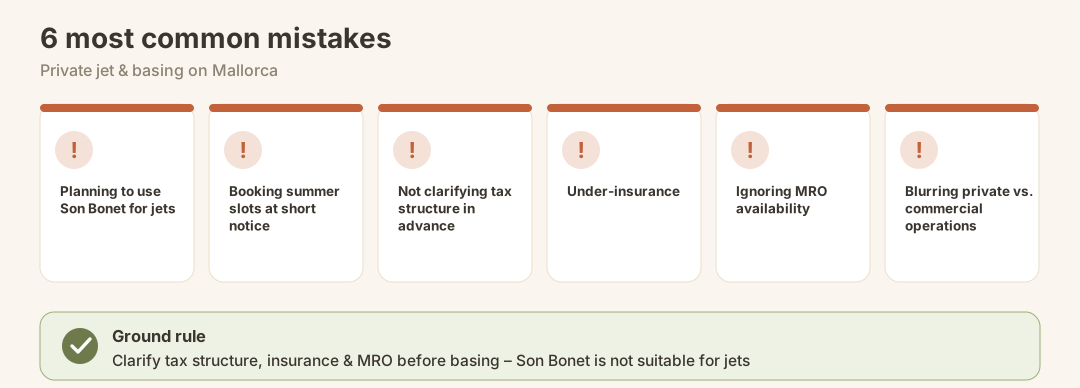
1. Planning to use Son Bonet for jet operations. The runway of 1,199 m categorically rules out all jets. Anyone eyeing a villa in Marratxí and thinking Son Bonet is "the nearer airport" will still have to use PMI.
2. Booking summer slots at short notice. In July and August, departure slots at PMI are limited. Anyone wishing to depart flexibly should coordinate with their charter broker at least 24–48 hours in advance.
3. Failing to clarify the tax structure of the aircraft holding in advance. Anyone holding an aircraft through a foreign company whilst living as a tax resident in Spain may run into difficulties with the AEAT. Have this checked beforehand.
4. Under-insurance. Aviation liability and hull insurance for an aircraft based in Spain must comply with Spanish and EU law. Existing foreign policies do not always cover this.
5. Ignoring MRO availability. Not every aircraft type can be maintained on Mallorca locally. If a major check requires a transfer flight to Barcelona or the mainland, unplanned costs and downtime will arise.
6. Blurring the line between private and commercial operation. Anyone who occasionally "lends" their aircraft to friends or shares costs may unwittingly cross the threshold into AOC-regulated operation.
What comes next? Setting up Mallorca as a premium residence
A private jet is usually part of a broader lifestyle package. Anyone who not only visits the island but settles there permanently needs to structure the entire premium environment: residency, tax structure, vehicles, and everyday infrastructure.
A few follow-on topics that many of our readers associate with private jet ownership:
- Tax optimisation as a resident: The Beckham Law may be tax-relevant for new arrivals, as may the IRPF deductions in the Balearic Islands.
- Importing luxury vehicles: Anyone bringing an exclusive vehicle to the island alongside their jet will find the complete guide at Luxusauto importieren Mallorca.
- Applying for residency: Formal registration as a resident is a prerequisite for many tax planning arrangements – everything you need to know is in the Residencia-Ratgeber.
- Organising the move: Anyone wishing to have the entire relocation process managed professionally will find an overview at Relocation Service Mallorca.
Checklist: basing a private jet on Mallorca
- Confirm PMI as the island's only jet-capable airport
- Compare FBO and handling providers at PMI and sign a contract
- Reserve a hangar or outdoor parking space for the specific aircraft category
- Identify an EASA-certified MRO partner for the aircraft type
- Review tax ownership structure with a Spanish tax adviser/specialist lawyer
- Clarify IVA input tax deductibility (private vs. commercial use)
- Check Modelo 720 reporting obligation (foreign assets → Modelo 720)
- Check insurance (liability, hull) for Spanish/EU compliance
- Clarify crew contracts and employment law in Spain (autónomo or employed)
- Summer operations: plan slot coordination with charter broker for July/August in advance
Conclusion
For private jet users in Mallorca, the situation is clear: PMI is the only functional airport for international jet operations. With a 3,270-m runway, a dedicated FBO and 17,593 business aviation movements in 2025, it is well placed for everything from light jets to heavy long-range jets. Son Bonet serves general aviation with propeller aircraft and is not suitable for jet operations.
Charter prices range, depending on route and category, from around 6,500 € (light jet Madrid–Palma) to over 42,000 € (heavy jet London–Palma one-way). Anyone flying more than 75–100 hours per year should calculate the economics of fractional ownership or owning an aircraft outright – whereby the tax structure in Spain must be agreed in advance with a specialist adviser.
The good news: Mallorca is closer to Europe than many people think. With a private jet, the island is no longer a remote retreat but a fully fledged place of residence with direct air access to all European business hubs.
Official Sources
- Aena – Palma de Mallorca Airport (LEPA/PMI): https://www.aena.es/en/palma-de-mallorca.html
- Aena – Son Bonet Aerodrome (LESB): https://www.aena.es
- AESA – Agencia Estatal de Seguridad Aérea (Spanish aviation authority): https://www.seguridadaerea.gob.es
- AEAT – Agencia Tributaria (tax and customs authority): https://www.agenciatributaria.es
- ATIB – Agència Tributària de les Illes Balears: https://www.atib.es
- Registro de Aeronaves – Ministerio de Transportes: https://www.transportes.gob.es
- Eurocontrol – Network Manager (slot coordination): https://www.eurocontrol.int