
Moving from Germany to Spain: What Happens to Your ETF Portfolio?
You've spent years building your ETF portfolio – the savings plan is running, tax deferral is ticking along, everything is on track. Then comes the decision: Mallorca. And suddenly questions arise that your portfolio dashboard can't answer. Does relocating trigger a tax liability? Is your broker even allowed to keep you as a client? What does Spain report, what does Germany report? This guide walks you through all the critical points surrounding Depot Deutschland Spanien Umzug – from the German exit tax to broker compatibility issues, Spanish capital gains tax, and the Modelo 720 reporting obligation. We explain which decisions you need to make before the removal lorry arrives, and which mistakes can turn into costly back-tax demands simply through inaction.

Why your investment portfolio becomes a top priority when you move
A change of residence is not a minor administrative matter in tax law – it is a change of status with immediate consequences for every asset you hold. Germany does not simply wave you off with a quiet smile, and Spain does not welcome you without something in return. Both states have legitimate taxation claims, and both states have reporting obligations whose breach comes at a high price.
When it comes to Depot Deutschland Spanien Umzug, there are four independent subject areas to consider:
- German exit taxation – does a tax liability in Germany actually arise upon departure?
- Broker compatibility – is your German broker permitted to maintain your portfolio once you are living in Spain?
- Spanish income tax on investment income (IRPF) – how does Spain tax dividends, interest, and capital gains?
- Reporting obligations – Modelo 720 and Modelo D-6 as potential pitfalls carrying significant fines
None of these four areas is optional. And none of them can be meaningfully addressed without first establishing exactly when you become tax-resident in Spain.
Please note: This guide provides a structured informational foundation but does not replace individual tax advice. Consult a tax adviser specialising in German-Spanish cases before you move.
When do you become liable to tax in Spain?
Spain classes you as a tax resident as soon as you spend more than 183 days in a calendar year on Spanish territory – or when the centre of your economic interests is located in Spain. Both criteria are assessed independently of one another.
| Criterion | Contents |
|---|---|
| 183-day rule | Spent more than 183 days in the calendar year in Spain (interruptions are counted) |
| Centre of economic activity | The main part of income or economic activities is based in Spain |
| Family ties | Non-separated spouse and/or minor children resident in Spain |
Crucial for your portfolio: Spanish tax liability does not begin only upon the granting of the Residencia or the Empadronamiento – it begins retroactively from the first day of the year in which you exceed the 183-day threshold. Anyone who moves in during March and spends their 183rd night in October is therefore liable to tax in Spain for the entire calendar year.
Please note: In practice, the date of departure is often not a clear-cut point but rather a gradual process. This is legally dangerous from a tax perspective, because Germany and Spain may date the change of status differently. Artax tax advisers explicitly point out that the relocation of one's centre of life can frequently not be pinned down to a fixed date.
German exit taxation: does it apply to ETFs?
Calculate German exit tax
Explanation
The market value of your own affected shares when you leave Germany, not the whole company (section 6(1), sentence 2, no. 1 of the Foreign Tax Act). Funds, exchange traded funds and special investment funds are excluded: section 19(3) of the Investment Tax Act has its own rule, including acquisition costs of at least EUR 500,000 in one fund; section 16(3) excludes the partial income method there.
Explanation
The tax cost basis of your own shares. This can differ from the purchase price through a substituted value on an earlier arrival (section 17(2), sentence 3), a predecessor’s carried over cost for a gift or inheritance (sentence 5), or subsequent costs including contributions (subsection 2a of the Income Tax Act). Without the correct basis, your result is not meaningful.
Explanation
Your annual German income after tax deductions, excluding these exit gains and foreign progression income. For joint assessment, enter both spouses’ combined amount (sections 26b and 32a(5) of the Income Tax Act).
Additional income tax and solidarity surcharge in the departure year (excluding church tax)
- Total additional tax
- €414,876.28
No child allowances or favourable assessment under section 32d(6) of the Einkommensteuergesetz (EStG), the German Income Tax Act.
Legal status: 1 January 2026
This calculation is provided for guidance only and is not a substitute for tax or legal advice in specific cases.
This is the most important fork in the road. German exit taxation under § 6 AStG applies primarily to substantial shareholdings in corporations – meaning: anyone holding at least 1 % in a GmbH or AG will have a notional disposal gain attributed to them by Germany upon departure.
For standard ETFs and listed shares held in a private portfolio, § 6 AStG in its classic form does not apply. The sources used in the present research (artax.com, mcdermottlaw.com) confirm this principle, whilst simultaneously drawing attention to a relevant special feature:
Exit taxation on investment fund units
Since the reform of the Investment Tax Act (InvStG) in 2018, there has been a separate rule for units in investment funds that is not identical to the classic § 6 AStG taxation. McDermott Law cites the following key points in this regard:
| Scenario | Tax treatment |
|---|---|
| Departure with fund units (ETFs) to another EU country | Deferral of tax generally possible as long as shares are not sold |
| Relocation to third countries | Immediate taxation of accrued gains possible |
| Significant shareholding (≥ 1 %) in a corporation | Deemed disposal gain upon relocation abroad |
As Spain is an EU member state, the following applies to most private investors relocating from Germany to Spain: gains accrued in ETFs and funds up to the point of departure are not immediately due, but only upon actual disposal. Nevertheless, Germany records the position as at the date of departure.
Important: If you hold shares in a GmbH, UG, or an unlisted corporation with a shareholding of at least 1 %, the exit taxation rules under § 6 AStG apply immediately. You should absolutely have this reviewed before you move. The Artax source also notes that a retrospective reversal of the consequences is possible under certain conditions – however, this is a highly specialised exceptional case.
The broker problem: who will close your account?
In practice, this is one of the most underestimated pitfalls. The research (abmelden.de, brokervergleich.de) makes it clear: Most German online brokers are not set up from a regulatory standpoint to service clients with a foreign address. As soon as you deregister and update your address to a Spanish one, you become a compliance issue – and many brokers resolve this by terminating your account.
Why brokers react this way
German securities service providers are subject to the obligation to withhold tax at source (Kapitalertragsteuer + Soli). Once you no longer have a German address, the broker cannot process this withholding correctly. On top of this, there are MiFID II regulatory requirements, which are interpreted differently depending on the broker.
What typically happens
| Broker type | Response upon relocation to Spain |
|---|---|
| Large retail banks | Switch to an 'overseas client' model often possible, but cumbersome |
| Direct banks (ING, DKB, etc.) | Varies – some tolerate an EU address abroad, some terminate the account |
| Neobrokers (Trade Republic, Scalable, etc.) | Account termination upon relocation is common, as compliance overhead is too high |
| International brokers (IBKR, Flatex AT, etc.) | Generally usable across the EU |
Note: Find out before registering with the residents' registration office what your broker does when you move to Spain. If they terminate the account, you will generally have a deadline to transfer the portfolio to a compatible provider — but that deadline can be short.
Portfolio transfer: tax-neutral, but not straightforward
A portfolio transfer from Broker A to Broker B — if carried out correctly as a transfer (not as a sale and repurchase) — is not a tax-relevant event. No notional sale takes place; the acquisition costs (historical purchase prices) are carried across. This applies both to a transfer within Germany and to a transfer to an EU-based broker.
Important: During the transfer, the acquisition costs (AC) must be transferred correctly . Errors in the transmission of the AC mean that the new broker will calculate excessively high gains on a subsequent sale and withhold too much tax. Make sure to verify the AC with the new broker after the transfer.
Spanish capital gains tax: what Spain wants from your returns
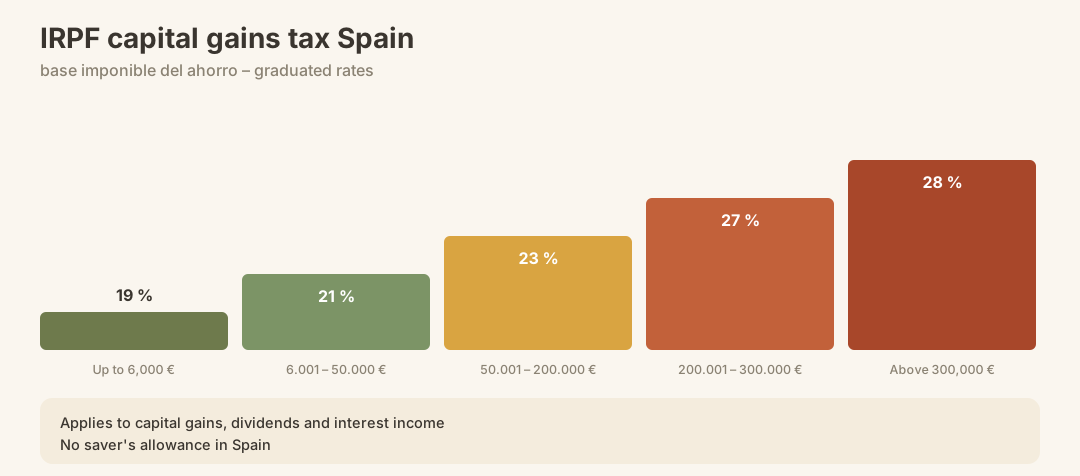
As a Spanish tax resident, you pay tax on your worldwide income in Spain. This also applies to returns from a German portfolio. The Spanish income tax (IRPF) has a separate tax scale for capital income (dividends, interest, capital gains), known as the base imponible del ahorro:
| Taxable capital income (banded) | IRPF rate |
|---|---|
| Up to 6.000 € | 19 % |
| 6.001 € – 50.000 € | 21 % |
| 50.001 € – 200.000 € | 23 % |
| 200.001 € – 300.000 € | 27 % |
| Over 300.000 € | 30 % |
These rates apply equally to disposal gains, dividends, and interest income. There is no saver's allowance as in Germany. No such tax-free allowance for capital income exists in Spain.
Please note: The Balearic Islands may set their own tax rates under autonomous legislation. The rates stated above are the national IRPF rates; the actual overall rate is made up of the national and the regional component. For current Balearic figures, it is worth consulting the IRPF deductions Balearic Islands.
Double taxation agreement between Germany and Spain
Germany and Spain have a double taxation agreement (DTA). It ensures that income is not taxed twice. For capital income from German sources (e.g. dividends from a German Aktiengesellschaft), Germany may withhold a withholding tax, which Spain then credits. In practice this means: the capital gains tax withheld in Germany is credited against the Spanish tax liability — you do not pay twice, but you must actively apply for the credit in your Spanish tax return.
Modelo 720: the declaration of assets held abroad
The Modelo 720 is Spain's instrument for recording assets held abroad. As a Spanish tax resident, you are required to file it if the value of your foreign assets — divided into three categories — exceeds €50,000 in each case.
| Category | Contents | Reporting threshold |
|---|---|---|
| Accounts abroad | Current, instant-access and fixed-term accounts held at foreign institutions | €50,000 total value |
| Securities/portfolios | Shares, ETFs, funds, bonds held with foreign brokers | €50,000 total value |
| Property abroad | Real estate outside Spain | €50,000 total value |
Deadlines and consequences
- Initial filing: By 31 March of the year following the first year of residency
- Subsequent years: Reporting is only required if the value of a category has changed by more than €20,000 compared to the last filing
- No change: Not falling below the threshold and no material change = no further filing required
Please note: The Modelo 720 in its original form was the subject of a European Court of Justice ruling (2022), which deemed the sanctions at the time to be disproportionate. Spain subsequently amended the legislation. The reporting obligation itself remains in place. Failures to comply can still be subject to fines. Read our detailed guide on this: Modelo 720 reporting obligation.
Modelo D-6: For shares in non-European companies
Less well known, but equally relevant: the Modelo D-6 is a filing with the Spanish Ministry of Economic Affairs (Ministerio de Economía) for investments in securities issued by companies headquartered outside the European Economic Area. If you hold, for example, US ETFs or individual US shares, this reporting obligation may apply to you.
Please note: The exact thresholds and exemptions of the Modelo D-6 are complex and have been revised several times in recent years. Have your portfolio checked to determine whether it is subject to reporting requirements.
ETFs in Spain: Particularities of Spanish fund taxation
ETFs in Spain are subject to a particular tax treatment that can be considerably disadvantageous compared to Germany: the tax-neutral switching between certain domestic investment funds that is possible in Germany does not exist for ETFs in Spain in this form.
| Feature | Germany | Spain |
|---|---|---|
| Advance lump-sum tax on accumulating ETFs | Yes (annually) | No (but full taxation upon sale) |
| Tax-free switching between funds | No (generally taxable for ETFs) | No |
| Saver's allowance | 1.000 € per person/year | No equivalent |
| Point of taxation for capital gains | Upon sale | Upon sale |
| Tax rate on capital gains | 25 % plus solidarity surcharge | 19–30 % (tiered) |
For more detailed information on ETF specifics in Spain, please refer to our guide ETF & Index Funds Spain.
Beckham Law: Special regime as an alternative?
The so-called Beckham Law (Régimen Especial para Trabajadores Desplazados) allows, under certain conditions, newly resident individuals in Spain to be taxed only on Spanish income — not on worldwide income — at a flat tax rate. This sounds enticing for investors in capital assets.
The downside: the Beckham regime is primarily designed for employees and self-employed individuals who are seconded to Spain or begin working there for the first time. There are strict requirements — among others, you must not have been tax-resident in Spain during the previous five years. Whether the regime applies to capital income from a German investment account and how it interacts with the Modelo 720 is a highly specialised matter. Read our guide on the Beckham Law Spain.
Most common mistakes when moving an investment account to Spain
From practical experience — and from research — five recurring mistakes can be identified:
1. Notifying the broker only after deregistering
Anyone who deregisters in Germany and only then realises that the broker is terminating the account finds themselves under time pressure and has to transfer the portfolio in a rush. The result: errors in the acquisition cost transfer, incorrect tax basis, and headaches at the next sale.
2. Failing to document the date of departure
Germany and Spain may have differing views on when tax residence changed. Without documentation (deregistration certificate, Mallorca tenancy agreement, Empadronamiento date), there is no basis for a clear demarcation.
3. Forgetting the Modelo 720 or submitting it too late
The deadline — 31 March of the following year — is fixed. Anyone who moves in October and fails to submit a Modelo 720 by the following March risks fines.
4. Failing to offset German withholding tax against Spanish IRPF
Anyone who neglects to claim the capital gains tax withheld in Germany in their Spanish tax return is effectively paying twice. The offset is not automatic — it must be actively applied for.
5. Overlooking a GmbH shareholding
Anyone who holds 1 % or more of a German GmbH and emigrates triggers exit taxation under § 6 AStG — even if their personal investment account is straightforward. This is regularly overlooked.
What comes next? Ongoing obligations as an investment account holder in Spain
After the move, the tax landscape does not become simpler — just different. As a Spanish tax resident, you have the following annual obligations relating to your investment account:
| Task | Deadline | Instrument |
|---|---|---|
| Spanish income tax return (IRPF) | April–June of the following year | Renta (Modelo 100) |
| Modelo 720 (if change exceeds >20.000 €) | By 31 March of the following year | Modelo 720 |
| Modelo D-6 if applicable | January of the following year | Modelo D-6 |
| Wealth tax return (above certain thresholds) | Simultaneously with IRPF | Modelo 714 |
Spanish wealth tax is another topic that becomes relevant for custody account holders with high-value portfolios. More on this under Wealth Tax Spain.
Checklist: Moving your investment portfolio from Germany to Spain
Go through this list before you book the removal van:
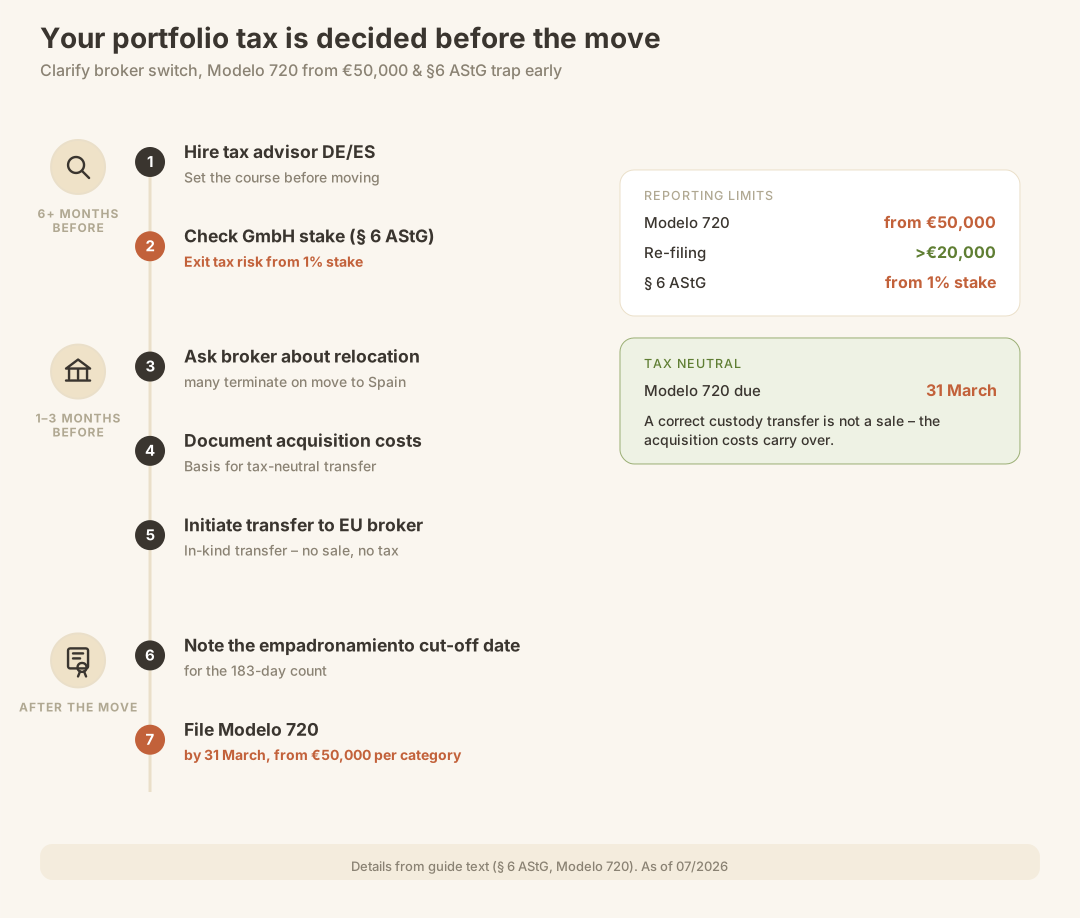
6+ months before the move
- Engage a tax adviser with German-Spanish expertise
- Contact your broker: how will they respond to your relocation to Spain?
- Review existing GmbH shareholdings (§ 6 AStG risk)
- Document the acquisition costs of all portfolio positions (screenshot/export)
- Research alternative brokers (operating EU-wide)
1–3 months before the move
- Initiate portfolio transfer to a compatible broker (if necessary)
- Have the acquisition cost transfer confirmed by the new broker
- Apply for your NIE number (a prerequisite for Spanish bank accounts and tax obligations)
- Document the empadronamiento date as the cut-off date
After the move (first tax year)
- Prepare Modelo 720 (deadline: 31 March of the following year)
- Check whether Modelo D-6 is relevant
- Retain all German annual tax certificates (for double taxation treaty offset)
- Schedule your first IRPF appointment with a Spanish tax adviser
- Open a bank account in Spain
Conclusion
The move of your investment portfolio from Germany to Spain is manageable – but it requires preparation. The central risk is not Spanish capital gains tax as such (which is quite competitive with Germany for smaller to medium-sized portfolios), but rather the Combination of broker termination, missing acquisition costs, and missed reporting obligations, which are barely possible to rectify cost-effectively after the fact.
The good news: anyone who starts six months before the move has time for all the steps involved. A specialist tax adviser — ideally one who is familiar with both the German and the Spanish system — is not an optional expense, but the investment with the best cost-benefit ratio when it comes to this topic.
Official sources
- Spanish Income Tax Act (IRPF): https://www.boe.es (Ley 35/2006, de 28 de noviembre, del IRPF)
- Modelo 720 – AEAT: https://sede.agenciatributaria.gob.es
- Double Taxation Agreement Germany–Spain (BMF): https://www.bundesfinanzministerium.de
- § 6 AStG – Foreign Tax Act (exit taxation): https://www.gesetze-im-internet.de/astg/__6.html
- Investment Tax Act (InvStG): https://www.gesetze-im-internet.de/invstg_2018
- ATIB – Agència Tributària de les Illes Balears: https://www.atib.es
- Modelo D-6 – Ministerio de Economía: https://www.bde.es
This guide provides a general overview of the legal position and does not replace legal or tax advice on your individual circumstances. Laws and deadlines may change; the linked official sources are authoritative.