
Cuota autónomo Spain 2026: Social Security Contributions, Income Brackets and Tarifa Plana
You're planning to become self-employed in Mallorca or elsewhere in Spain – or you already are and you're wondering whether your monthly Cuota is actually correct? Then this guide is just what you need. The Cuota autónomo Spain is the compulsory contribution to the Spanish social security system that every self-employed person must pay each month. Unlike in Germany, it is not a tax but a contribution to the Régimen Especial de Trabajadores Autónomos (RETA) – and it simultaneously determines your pension entitlements, healthcare cover, and protection against incapacity for work. Here you will learn: how the income-based tiered system works, what the 80-euro Tarifa Plana offers, which changes actually came into force in 2026 (and which alarming reports turned out to be nothing), how the registration process works step by step, and which mistakes expats make most often.

- Taxes as a resident in Spain (IRPF) — How income tax and the Cuota interact
What the Cuota autónomo actually is – and what it isn't
Many newcomers from Germany or Austria confuse the Cuota with a tax. This is a costly misconception. Legally, it is a compulsory social security contribution, governed by the General Social Security Act (Real Decreto Legislativo 8/2015) and, since 2023, specifically by the income-based system established under Real Decreto-ley 13/2022.
The contribution flows into the RETA and covers you for:
- Healthcare through the public Sistema Nacional de Salud
- Sick pay (prestación por incapacidad temporal) from the 4th day of illness
- Pension (jubilación) – the contribution base you choose directly determines the level of your pension
- Maternity and paternity benefits
- Benefits in the event of workplace accident or occupational disease
Please note: As an autónomo you have no employment relationship, so there is no 'employer's half'. You pay the entire contribution yourself – and you do so every month, even in a poor month when you have earned little or nothing.
Anyone who regularly, directly, and personally carries out an economic or professional activity in Spain is required to register with the RETA. This applies regardless of whether you are an EU citizen or a non-EU citizen – provided you hold a valid residence permit and a NIE number.
The income-based contribution system: 15 tiers since 2023
Until the end of 2022, as an autónomo you could largely choose your own contribution base (base de cotización) freely – which tempted many people to opt for the minimum base and thereby build up only modest pension entitlements. Since January 2023 that has changed.
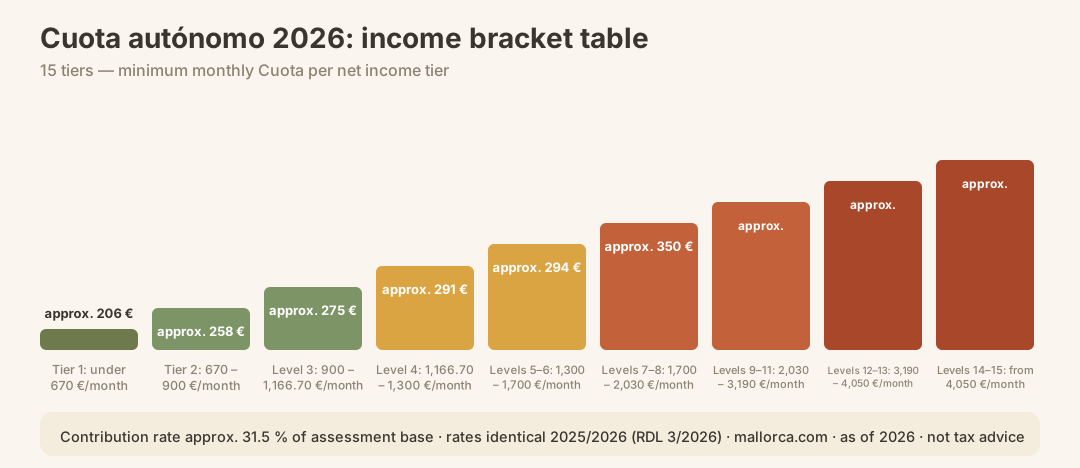
The new system links contribution obligations to your actual net income (rendimientos netos). You estimate your expected income at the start of the year (or upon registration), choose the appropriate tier, and pay accordingly. After filing your annual tax return, a regularisation takes place: if you have paid too little, the Seguridad Social will claim the difference – if you have paid too much, you will receive a refund.
The table below shows the 15 income tiers for 2026 (identical to 2025 following the agreement under Real Decreto-ley 3/2026):
Lower income tiers (Tiers 1–7)
| Tier | Monthly net income | Min. contribution base | Max. contribution base | Cuota approx. (Min.) |
|---|---|---|---|---|
| 1 | under 670 € | 735,29 € | 816,98 € | approx. 206 € |
| 2 | 670 € – 900 € | 816,98 € | 900,00 € | approx. 258 € |
| 3 | 900 € – 1.166,70 € | 872,55 € | 1.166,70 € | approx. 275 € |
| 4 | 1.166,70 € – 1.300 € | 950,98 € | 1.300,00 € | approx. 291 € |
| 5 | 1.300 € – 1.500 € | 960,78 € | 1.500,00 € | approx. 294 € |
| 6 | 1.500 € – 1.700 € | 960,78 € | 1.700,00 € | approx. 294 € |
| 7 | 1.700 € – 1.850 € | 1.143,75 € | 1.850,00 € | approx. 350 € |
Upper income brackets (brackets 8–15)
| Bracket | Monthly net income | Min. assessment base | Cuota approx. (Min.) |
|---|---|---|---|
| 8 | 1.850 € – 2.030 € | 1.143,75 € | approx. 350 € |
| 9 | 2.030 € – 2.330 € | 1.209,15 € | approx. 370 € |
| 10 | 2.330 € – 2.760 € | 1.274,55 € | approx. 390 € |
| 11 | 2.760 € – 3.190 € | 1.395,45 € | approx. 427 € |
| 12 | 3.190 € – 3.620 € | 1.516,35 € | approx. 464 € |
| 13 | 3.620 € – 4.050 € | 1.637,25 € | approx. 501 € |
| 14 | 4.050 € – 6.000 € | 1.758,15 € | approx. 538 € |
| 15 | over 6.000 € | 1.928,10 € | approx. 590–623 € |
Note: The cuota amounts are based on a contribution rate of approx. 31,5 % applied to the chosen assessment base. Within each bracket you can choose between the minimum and maximum base – those wishing to build up higher pension entitlements should opt for the maximum base.
What has actually changed in 2026
In the second half of 2025, alarming reports were circulating: the Spanish government wanted to raise the cuotas for higher income brackets by up to 206 Euro per month. Here is what actually came of it:
Nothing – at least not as far as the contribution brackets themselves are concerned.
The story behind it is quickly told: in October 2025 the ministry put forward a new contribution table for 2026–2028. Freelancer associations protested vehemently. In December 2025 the government froze the rates by emergency decree (Real Decreto-ley 16/2025). In January 2026 Congress rejected this decree by 178 votes to 171 – a brief legal limbo. In February 2026 the government passed the replacement RDL 3/2026, which was confirmed by Congress on 26. February 2026.
The only actual change in 2026:
| Mechanism | 2025 | 2026 |
|---|---|---|
| MEI surcharge (Mecanismo de Equidad Intergeneracional) | 0,8 % | 0,9 % |
| Effect on minimum bracket (approx.) | — | + approx. 1–5 € / month |
The MEI is a solidarity surcharge intended to benefit the pension fund. The additional burden is barely noticeable in the lower brackets.
Tarifa Plana: 80 Euro in the first 12 months
Anyone registering as an autónomo for the first time can apply for the so-called Tarifa Plana for the first twelve months. Instead of the regular cuota, you then pay only a flat-rate contribution of €80 per month – regardless of how much you earn.
Requirements
- First-time registration with RETA or no RETA membership in the last two years (if the Tarifa Plana was claimed previously: three-year waiting period)
- The application must be submitted at the time of registration – retrospective applications are not possible
- Also valid for people with a recognised disability of at least 33 %, victims of domestic violence or victims of terrorism – these groups can even benefit from the €80 rate for 24 months
What the Tarifa Plana does not cover
The €80 refers to the Grundcuota. If you voluntarily choose a higher assessment base or optional additional benefits, surcharges will apply. Furthermore: the Tarifa Plana is tied to the expected continuation of the activity – anyone who deregisters within the first year and re-registers shortly afterwards risks losing their entitlement.
Please note: To apply for an extension beyond the first year, you must declare that your expected net income will remain below the applicable minimum wage (SMI). If your income exceeds this, the Tarifa Plana ends automatically after 12 months.
Cuota Cero: When even the €80 is waived
Some autonomous communities – and under certain conditions the national framework as well – have a so-called Cuota Cero, under which contributions are waived entirely for the initial period. The conditions for this vary; enquire specifically with the Tesorería General de la Seguridad Social (TGSS) or a tax adviser to find out whether you are eligible for this scheme.
Registering as an autónomo: step by step
Before you start issuing invoices, you must notify two authorities: the social security office and the tax authority. The order in which you do this matters.
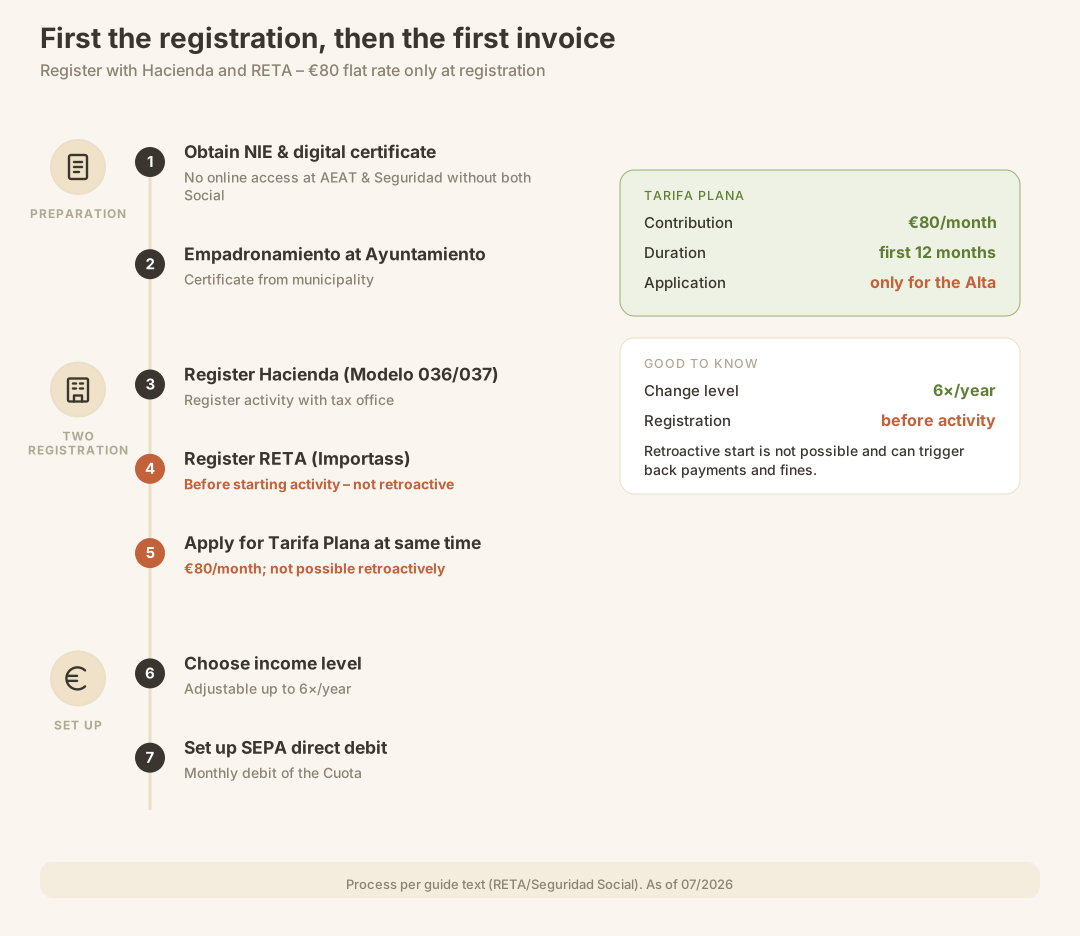
Prior requirements
| Document / requirement | Where to apply |
|---|---|
| NIE (Número de Identificación de Extranjero) | Comisaría de Policía, immigration authority |
| Digital certificate (Certificado Digital) or Cl@ve | FNMT or AEAT office |
| Residencia / TIE if applicable | Comisaría; Residencia guide |
| Empadronamiento (proof of registration) | Ayuntamiento (local council office); Empadronamiento guide |
The six registration steps
- Obtain your NIE and Digital Certificate – without these, nothing works online with AEAT or Seguridad Social.
- Alta en Hacienda (Modelo 036 or 037) – Registration of your self-employed activity with the tax authority (AEAT). Modelo 037 is the simplified version for most cases. This is also where you set the start date of your activity, the Epígrafes del IAE (activity code), and your VAT scheme.
- Alta en el RETA – Registration with the Tesorería General de la Seguridad Social, either online via Importass (sede.seg-social.gob.es) or in person. Apply for the Tarifa Plana at the same time, if you meet the eligibility requirements.
- Declare your estimated income bracket – You select the tier based on your expected monthly net income. You can adjust your choice up to six times per year.
- Set up a bank account for SEPA direct debit – The Cuota is debited automatically each month, typically on the last working day of the month.
- Check whether a professional licence or permit is required – Some regulated professions (doctors, architects, solicitors) additionally require a Colegiación (professional association membership).
Please note: Registration must be completed before commencing your activity. Backdating the start date is generally not possible and may result in back payments and fines.
How the year-end reconciliation works
The income-based system relies on retrospective settlement. The process works as follows:
- During the year: You pay monthly contributions based on your estimate.
- Tax return (IRPF): After submission (typically April–June of the following year), the AEAT reports your actual net income to the Seguridad Social.
- Comparison: The Tesorería determines whether you were in the correct tier.
- Outcome:
- Underpaid: You receive a demand for the shortfall, which must be settled within the specified deadline.
- Overpaid: The Seguridad Social refunds the difference, usually within a few months.
This mechanism means that deliberately choosing a lower tier is not a saving – it is simply a deferral followed by a back payment. Those who consistently under-declare risk being charged interest.
The Cuota and IRPF: How they interact with income tax
The Cuota autónomo and Spanish income tax (IRPF) are two separate obligations, but they are closely linked. The key points:
| Aspect | Cuota (RETA) | IRPF |
|---|---|---|
| Type | Social security contribution | Income tax |
| Payment | Monthly (direct debit) | Quarterly advance payment (Modelo 130) + annual declaration |
| Deductibility | The cuota is fully deductible from IRPF as a business expense | — |
| Basis | Assessment base (base de cotización) | Actual profit (income minus expenses) |
The full deductibility of the cuota is one of the few genuine tax advantages of the autónomo system: someone paying, for example, 294 Euro per month in cuota reduces their taxable IRPF profit by 3.528 Euro per year.
You can find more on IRPF obligations, Modelo 130, and the annual tax return in our Tax guide for residents.
Special provisions for certain groups
Autónomos societarios (shareholder-directors)
Anyone who is the director of a Sociedad Limitada and is simultaneously an autónomo is classified as an autónomo societario. Different minimum assessment bases apply to this group and the Tarifa Plana is not available. The Wolters Kluwer analysis of May 2026 notes that the 2026 changes include specific new rules for this group as well as for contributing family members (familiares colaboradores) — you should clarify the details with a tax adviser.
Family members as employees (autónomo colaborador)
If family members living in the household work in the business, they may be registered as an autónomo colaborador in the RETA, provided that an employment relationship (Alta en SS como trabajador) is not possible.
Multiple employment: autónomo and employee at the same time
Anyone who is simultaneously employed and works independently as a self-employed person may, under certain circumstances, pay contributions into both systems. In this case there are rules on the contribution ceiling — a matter for a tax adviser, as the calculation is complex.
Healthcare as an autónomo
Through RETA membership you have access to the Spanish public health system (Sistema Nacional de Salud). You will receive a Tarjeta Sanitaria Individual (TSI), which gives you access to GPs, specialists, and hospitals.
Many autónomos on Mallorca supplement this coverage with private health insurance — whether for convenience (shorter waiting times) or because certain specialisms are less well represented in the public sector on the island. More on this in our guide to health insurance in Spain.
The most common mistakes — and how to avoid them
These are the mistakes tax advisers on Mallorca and throughout Spain encounter time and again:
- Choosing too low an income band and forgetting about the back payment. The regularisation will come — it is better to estimate realistically.
- Failing to apply for the Tarifa Plana at the point of registration. The application cannot be submitted retrospectively. Anyone who forgets it immediately pays the full rate.
- Registering only after issuing an invoice. Even a single invoice issued without prior RETA registration can trigger fines and back payments.
- Treating the cuota as a tax in the quarterly return. The cuota is neither IVA nor IRPF — it is a business expense that is only deducted in the annual tax return.
- Failing to adjust the band regularly. You can switch up to six times a year — make use of this whenever your income changes significantly.
- Mixing up residence permit status and social security status. Visa status (e.g. digital nomad visa) does not automatically exempt you from the cuota obligation in Spain. It is worth seeking advice here, particularly regarding which country has social security priority (EU Coordination Regulation 883/2004 for EU citizens, bilateral agreements for others).
- Simply not paying the cuota during poor months. Late-payment interest and reminder fees add up quickly. Better to: reduce your contribution tier or, in cases of genuine hardship, apply for a deferral.
Checklist: Autónomo registration on Mallorca
- NIE number obtained (NIE number guide)
- Empadronamiento completed at the Ayuntamiento (Empadronamiento guide)
- Digital certificate or Cl@ve applied for and active
- Activity code (Epígrafe IAE) researched
- Modelo 036/037 completed and submitted to AEAT
- RETA alta submitted to Tesorería (Importass)
- Tarifa Plana applied for at the same time (if eligible)
- SEPA mandate set up for monthly direct debit
- Income tier realistically chosen and noted
- Tax adviser (Gestor / Asesor fiscal) engaged or a good software solution set up
- Quarterly deadlines for IRPF (Modelo 130) and IVA (Modelo 303) entered in the calendar
What comes next?
Registration is done – now the real day-to-day routine begins:
Quarterly obligations as an Autónomo:
| Form | Content | Deadline (per quarter) |
|---|---|---|
| Modelo 130 | IRPF advance payment (income tax) | 20 April / July / October / January |
| Modelo 303 | IVA return (VAT) | 20 April / July / October / 30 January |
| Modelo 349 | Recapitulative statement of EU transactions (if applicable) | Monthly or quarterly depending on turnover volume |
Annual obligations:
- Modelo 390 (annual IVA summary): by 30 January
- Modelo 100 (annual IRPF return): typically April–June
- Modelo 720 (assets held abroad exceeding 50.000 €): by 31 March
Anyone with parallel rental income, capital gains or foreign earnings needs careful overall planning. Our guide Taxes & Finances for Expatriates provides an overview of the entire tax landscape.
Conclusion
The Cuota autónomo Spain 2026 is nothing to be afraid of – but it does require care from the outset. The new income-based system with 15 brackets is fundamentally fairer than the old opt-in system, yet it has one catch: the year-end regularisation always comes. Anyone who selects an overly optimistic low bracket will face an additional payment later.
The good news: the announced increases for 2026 have failed politically, and the rates remain at 2025 levels. The only change – the MEI surcharge rising from 0.8 to 0.9 per cent – amounts to at most a few euros per month. Anyone registering for the first time should apply for the Tarifa Plana via the registration process – this flat rate of €80 for twelve months is a genuine start-up advantage, but it is only available at initial registration.
On Mallorca there is an additional consideration: many sectors – tourism, rentals, construction – carry further licensing and tax obligations that go beyond the basic autónomo registration. A local Asesor fiscal knows the particularities of the Balearen and will generally pay for themselves within the first year.
Official Sources
- Real Decreto Legislativo 8/2015 – General Social Security Act (Texto Refundido de la Ley General de la Seguridad Social): https://www.boe.es/eli/es/rdlg/2015/10/30/8/con
- Real Decreto-ley 13/2022 – Introduction of the income-based contribution system for Autónomos: https://www.boe.es/eli/es/rdl/2022/07/26/13
- Real Decreto-ley 3/2026 – Confirmation of the frozen Cuota rates for 2026 (approved by Congress 26.02.2026): BOE
- Tesorería General de la Seguridad Social (TGSS) – Importass: https://sede.seg-social.gob.es
- Agencia Tributaria (AEAT) – Modelo 036/037: sede.agenciatributaria.gob.es
- Seguridad Social – RETA information page: https://www.seg-social.es/wps/portal/wss/internet/Trabajadores/Afiliacion/10817
- BOE (Boletín Oficial del Estado): https://www.boe.es