
Arraigo Social Spain: Regularise Your Stay Without a Standard Visa (2026)
Anyone staying in Spain without valid residency rights is operating in a grey area – legally, fiscally, and in everyday life. The Arraigo Social Spain is the most widely used route out: a residence permit for exceptional circumstances, which non-EU nationals can obtain after demonstrating proven roots in the country. Since Royal Decree 1155/2024, which came into force on 20 May 2025, the procedure has changed fundamentally – the previously applicable three-year qualifying period is a thing of the past, and a completely new variant, the Arraigo Sociolaboral, now exists. This guide explains the current situation, the specific requirements for both routes, the documents needed, typical pitfalls, and what happens after approval is granted.

Not sure which Arraigo route suits your situation – or want to make certain your application goes through first time?
- 📩 Submit a personal enquiry — We connect you with vetted immigration lawyers in Mallorca and across the rest of Spain
- An overview of all visa and residency options
What is Arraigo – and why is the date of your application crucial?
The Spanish word arraigo literally means "rootedness" or "putting down roots". In immigration law it is an umbrella term for residence permits under exceptional circumstances (residencia por circunstancias excepcionales), which allow people in an irregular situation to regularise their status – without first leaving the country, and without having to apply for a visa in their country of origin beforehand. This was previously governed by Ley Orgánica 4/2000 and Royal Decree 557/2011; since 20 May 2025 the fundamentally revised Royal Decree 1155/2024.
Please note: Almost every guide online that mentions a three-year qualifying period for Arraigo Social is describing outdated law. Since 20 May 2025, two years of continuous residence are sufficient. Anyone planning on the basis of the old rules risks unnecessary waiting time or avoidable rejections.
The procedure is designed for non-EU nationals. EU citizens – including Germans and Austrians – have their own pathways to residency (→ Applying for Residencia). Swiss nationals who did not secure their rights before the free movement agreement ended may, depending on their circumstances, find themselves in an irregular situation – this should be checked with a lawyer.
An overview of the Arraigo variants
Since the reform, several recognised routes exist. Not all of them are suitable for the same starting position:
| Variant | Core requirement | Employment contract required? | Special feature |
|---|---|---|---|
| Arraigo Social | 2 years of continuous residence | Not mandatory (but often helpful) | Social integration must be demonstrated |
| Arraigo Sociolaboral | 2 years of continuous residence | Yes, at least 30 hrs/week or self-sufficiency | New since RD 1155/2024; no integration report required |
| Arraigo Laboral | Proven employment over a specified period | No | Employer must certify employment |
| Arraigo Familiar | Spanish first-degree relative or minor child | No | Family tie must be documented with official records |
| Arraigo para la Formación | Confirmed training place following a period of residence in Spain | No | Introduced in 2022; course place replaces employment contract |
| Segunda Oportunidad (2nd Chance) | Previous permit expired (within the last 2 years), with residence in ES since then | No | No proof of financial means required |
Please note: This guide focuses on Arraigo Social and Arraigo Sociolaboral. Different documentation requirements apply to Arraigo Familiar or Formativo; seek legal advice for each of these.
Arraigo Social: Requirements in Detail (as of May 2025)
Length of residence
You must demonstrate that you have been resident in Spain for at least two years without interruption immediately prior to submitting your application. According to the sources consulted, time spent as an asylum seeker is not counted.
Social Integration
The integration report (informe de integración social) is the cornerstone of the Arraigo Social. It is issued by the municipality or the autonomous community and typically assesses:
- Language skills (Spanish or the co-official language of the region)
- Social and professional connections
- Empadronamiento history (the longer, the better)
- Courses, voluntary work, social ties
Note: Not every municipality uses the same template. In the Balearic Islands, the Ajuntament (municipal office) issues the report. Processing times vary; allow several weeks.
Financial Means
With Arraigo Social you do not need to demonstrate active employment – but you must make a plausible case that you can support yourself. An existing employment contract or a job offer considerably strengthens the application. Alternatively, personal funds or proof of financial support from family members can be documented.
Clean Criminal Record
- No Spanish criminal record
- No entry in the country of origin for offences that would also be punishable in Spain
- Not on the watch lists of countries with which Spain maintains migration agreements
Arraigo Sociolaboral: the new route with an employment contract
The Arraigo Sociolaboral was only introduced by Royal Decree 1155/2024. It is an attractive option for anyone who has already secured a specific job:
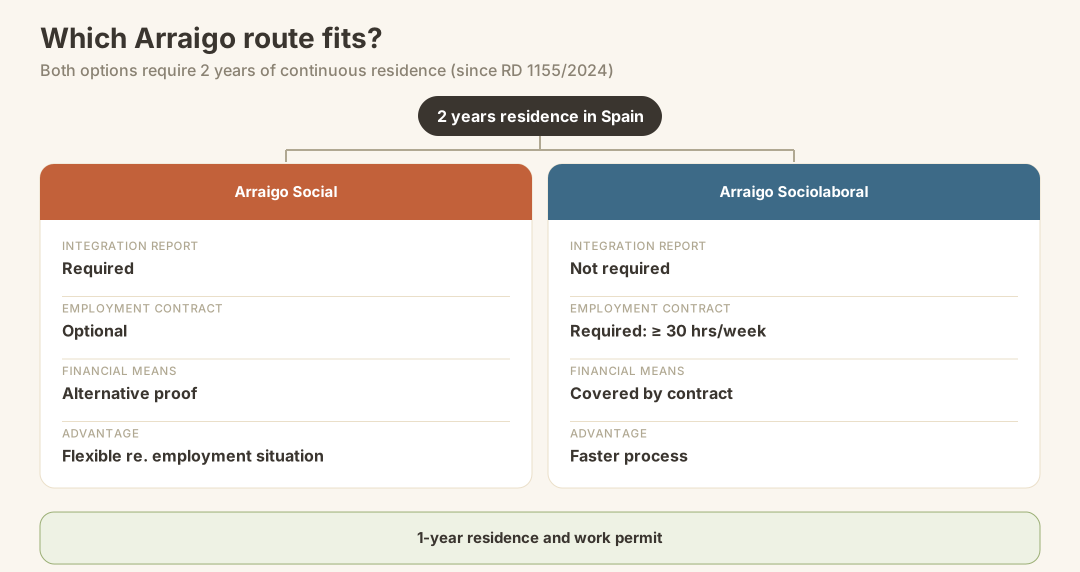
| Feature | Arraigo Social | Arraigo Sociolaboral |
|---|---|---|
| Length of residence | 2 years | 2 years |
| Integration report | Required | Not required |
| Employment contract | Optional | Mandatory: ≥ 30 hrs/week or self-employment |
| Financial means | Alternative proof accepted | Covered by employment contract |
| Advantage | More flexible regarding employment situation | Faster process without integration report |
This route is particularly interesting for employers who employ (or wish to employ) skilled workers in an irregular situation: a compliant contract of at least 30 hours per week is sufficient to meet the financial requirement – no lengthy wait for an integration report.
The Segunda Oportunidad – the "second chance"
Also new under Royal Decree 1155/2024 is the so-called Arraigo de Segunda Oportunidad (second chance). It is aimed at people who previously held a regular permit but lost it for administrative or personal reasons:
Who can apply?
- You have held a residence permit within the past two years (not a special permit granted under exceptional circumstances)
- The permit was not renewed – for reasons unrelated to public order, health, or security
- You have been living since the permit expired continuously in Spain (min. 2 years prior to application)
- No criminal record, no entry bans
What sets the Segunda-Oportunidad route apart from all others: there is no proof of financial means required at the time of application Typical cases include forgetting to renew a contract after a change of employment, the expiry of a family member's card, or administrative errors when switching between types of residence permit.
Extraordinary Regularisation 2026: Application deadline 30. Juni 2026
Running in parallel to the regular Arraigo routes, a historic special process has been under way since April 2026:
| Feature | Details |
|---|---|
| Legal basis | Royal Decree 316/2026, approved on 14. April 2026 |
| Online applications open | 16. April 2026 |
| In-person applications open | 20. April 2026 |
| Application deadline | 30. Juni 2026 – no extension |
| Residence in ES no later than | 31. Dezember 2025 |
| Min. period of residence to be evidenced | 5 months continuously |
| Criminal record | Must not exist |
| Outcome | 1-year residence and work permit |
| Estimated number of eligible applicants | Up to 500.000 persons |
Please note: This extraordinary regularisation is expressly only for individuals without a currently valid residence permit. Anyone who already holds a TIE, a NIE with residence rights, or another valid authorisation is not eligible and does not need to go through this process.
If you fall into this group, you should act now – the deadline is running and will not be extended, according to the information currently available.
Documents: What you need to gather
The list of required documents differs depending on the variant. Below is an overview for Arraigo Social and Sociolaboral:
Documents required by both variants
| Document | Note |
|---|---|
| Valid passport (all pages copied) | Or equivalent travel document |
| Empadronamiento certificate | Current, ideally showing an unbroken history |
| Proof of 2 years' residence | Padrón extracts, doctor's visits, school records, bank statements, social welfare evidence, etc. |
| Spanish criminal record certificate | Certificado de antecedentes penales |
| Criminal record certificate from country of origin | Apostilled and translated |
| Form EX-10 | Official application for residence under exceptional circumstances |
| Modelo 790, Código 052 | Fee form (check the current amount with the Oficina de Extranjería) |
Additionally required for Arraigo Social
| Document | Note |
|---|---|
| Informe de integración social | Issued by the Ayuntamiento or the autonomous community |
| Proof of financial means | Employment contract, bank statements, third-party maintenance declaration |
Additionally required for Arraigo Sociolaboral
| Document | Note |
|---|---|
| Employment contract ≥ 30 hours/week | Signed by employer and employee |
| Proof of employer compliance | The employer must have fulfilled their social security obligations |
Please note: Foreign documents must generally be submitted apostilled and certified translated (by a translator authorised in Spain).
The application process step by step
Ensure Empadronamiento – If not yet done: register without delay at the Ayuntamiento of your place of residence. The padrón entry is essential as proof of residence. (→ Empadronamiento Mallorca)
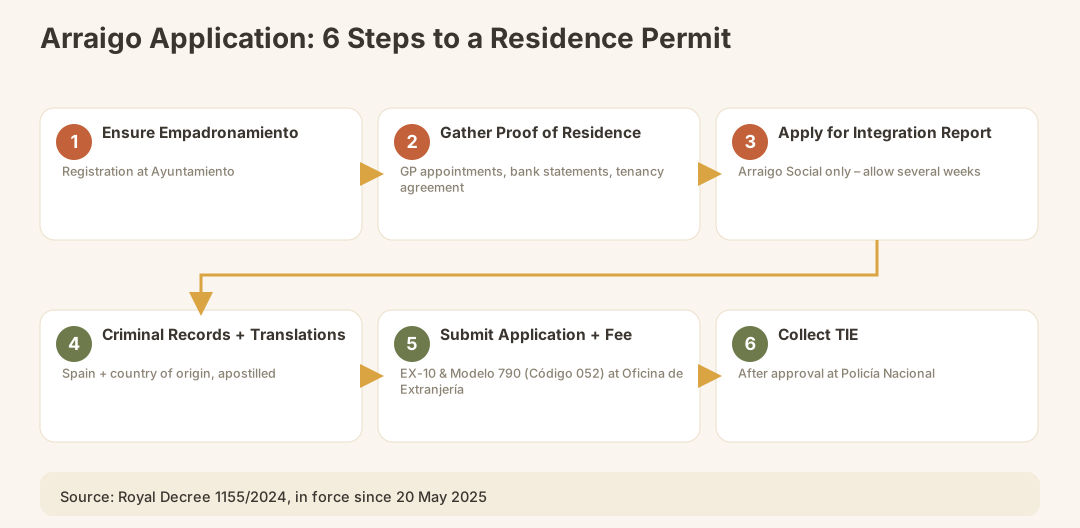
Gather proof of residence – Doctor's appointments, bank statements, children's school enrolments, tenancy agreements, receipts – anything that documents your physical presence in Spain. The more complete, the better.
Request an integration report (Arraigo Social only) – From the Ajuntament or the regional authority. Ask about processing times well in advance.
Obtain certificates of good conduct – Spanish certificate of good conduct online via the Ministry of Justice; home-country certificate via the relevant embassy or authority. Don't forget the apostille.
Have documents translated – All documents in a foreign language require a certified translation into Spanish.
Submit the application – The responsible authority is the Oficina de Extranjería of the relevant province. In the Balearic Islands, this is the Delegación del Gobierno in Palma. Submission is also possible via Registro Electrónico possible if you hold a Certificado Digital or Cl@ve PIN.
Pay the fee – Modelo 790, Código 052 at the relevant bank or online.
Wait for the decision – The authority may request further documents (subsanación). Respond within the stipulated deadline.
Collect your TIE – Once approved, you must collect the physical residence card (Tarjeta de Identidad de Extranjero) from the Policía Nacional and have your biometric data recorded.
What counts as proof of two years' residence?
In practice, this is one of the trickiest questions. The authorities generally accept a combination of:
- padrón extracts: Uninterrupted Empadronamiento entries are the strongest evidence
- Doctor and hospital appointments (records from the public health system)
- School reports or enrolment documents for children in Spanish schools
- Bank statements with a Spanish IBAN and regular local transactions
- Tenancy agreements and utility bills
- Course certificates (language courses, vocational training)
- Witness statements from private individuals or organisations (less significant, but supplementary)
The broader and more consistent the body of documentation, the lower the risk of rejection due to doubts about the length of stay.
What happens after approval
Arraigo permits have a duration of one year and always include a work permit – both as an employee (cuenta ajena) and as self-employed (autónomo). This is a decisive advantage over many other special permits.
After the first year, the residence permit can be renewed – initially for two years, then for a further two years. After a total of five years of legal residence, permanent residence (residencia de larga duración) becomes possible.
The path to Spanish citizenship generally opens up after ten years of legal residence – for nationals of certain countries (Latin America, the Philippines, Equatorial Guinea, Portugal) after just two years. (→ Applying for Spanish citizenship)
Practical ongoing obligations
- Tax liability: As a resident, you are generally liable to pay tax on your worldwide income. (→ Tax as a resident in Spain)
- Social security: Registration with the Seguridad Social if you are working
- Health insurance: As an employee via the Seguridad Social; as self-employed, this needs to be arranged separately (→ Health insurance in Spain)
- Modelo 720: Anyone holding assets abroad above certain thresholds must report them (→ Modelo 720 reporting obligation)
Most common mistakes and how to avoid them
According to legal practice, these mistakes regularly lead to avoidable rejections or lengthy delays:
| Mistake | Consequence | Remedy |
|---|---|---|
| Planning the application based on the old three-year requirement | Unnecessary waiting period of 12 months | The two-year period has applied since May 2025 |
| Forgetting the integration report (Arraigo Social) | Mandatory ground for rejection | Apply early, allow several weeks |
| Incomplete proof of residence | Doubts about continuity; rejection | Combine several document types |
| Criminal record certificate without apostille | Not recognised | Obtain the apostille in the country of origin |
| Translation not by a certified translator | Not recognised | Only traductores jurados should be commissioned |
| Missing the subsanation deadline | Application is deemed withdrawn | Note deadlines in the calendar, seek legal assistance |
| Arraigo Social submitted even though Sociolaboral would have been possible | Longer route without an employment contract | Have both options assessed |
| Counting asylum time as residence time | Length of residence officially insufficient | Only regular or irregular periods of residence count |
Arraigo for Britons after Brexit
British nationals who resided in Spain before or after Brexit without having properly registered under the Withdrawal Agreement may find themselves in an irregular situation. The Arraigo Social – requiring two years of evidenced residence and a social integration report – is a realistic route to regularisation for this group. The 2025 reform introduces additional flexibility for such cases, according to the sources available. Early legal advice is particularly recommended here. (→ TIE card for Britons)
Checklist: Am I ready to apply?
Go through these points before you submit:
- I have been residing in Spain for at least two years without interruption
- I am registered on the padrón of my municipality (ideally from the start of my period of residence)
- I have documented my residence (doctor's appointments, bank statements, tenancy agreement, etc.)
- I have applied for a Spanish certificate of good conduct
- I have an apostilled criminal records certificate from my country of origin
- All documents in foreign languages have been translated by a certified translator
- I have decided: Arraigo Social (with integration report) or Sociolaboral (with employment contract ≥ 30 hrs.)
- The integration report has been applied for and is in hand (Arraigo Social only)
- The Form EX-10 has been completed correctly
- The fee (Modelo 790, Código 052) has been paid
- I have checked whether the extraordinary regularisation 2026 applies to me (deadline: 30 June 2026)
Conclusion
The Arraigo Social has become more accessible since Royal Decree 1155/2024 – two years of residence instead of three, a new variant with an employment contract (Sociolaboral), and a dedicated route for those who were previously in a legal situation and subsequently lost their status (Segunda Oportunidad). Added to this is the one-off extraordinary regularisation, whose deadline falls on 30 June 2026.
This sounds simpler than before – and in some respects it is. However, the pitfalls lie in the detail: incomplete proof of residence, missing apostilles, overlooked deadlines for remedying deficiencies, or choosing incorrectly between Social and Sociolaboral. Those who compile their documents carefully, choose the right route, and ideally have legal support will, upon approval, receive a one-year permit with full employment rights – the first real step towards long-term residency and Spanish citizenship.
Official sources
- Royal Decree 1155/2024 (Reglamento de Extranjería, in force since 20 May 2025): https://www.boe.es/buscar/act.php?id=BOE-A-2024-24099
- Ley Orgánica 4/2000 (Spanish Immigration Act, the legal basis for Arraigo): https://www.boe.es/buscar/act.php?id=BOE-A-2000-544
- Ministerio de Inclusión, Seguridad Social y Migraciones – information on residence permits under exceptional circumstances: https://www.inclusion.gob.es
- Royal Decree 316/2026 – Extraordinary Regularisation 2026 (approved 14 April 2026)
- Delegación del Gobierno en Illes Balears – Oficina de Extranjería Palma: https://www.delegaciondelgobierno.gob.es/islas-baleares
- Instrucción SEM 1/2025 on the application of RD 1155/2024 to Arraigo permits: https://www.inclusion.gob.es/documents/d/migraciones/instrucciones-sem-1_2025-sobre-las-autorizaciones-de-residencia-temporal-por-circunstancias-excepcionales-por-razon-de-arraigo-aprobado-por-el-real-decreto-1155_2024