
EES & ETIAS Spain 2026: What the New EU Entry System Means for You
Two new digital border systems are changing the way non-EU citizens enter Spain and Mallorca – and how rigorously the 90-day rule is enforced. EES & ETIAS Spain 2026 primarily affects British and American second-home owners as well as non-EU nationals without a Spanish Residencia. However, those who are already registered as residents, hold a valid residence permit, or are EU citizens fall outside the scope of these systems. In this guide, you will find out what EES and ETIAS actually are, when they come into effect, who is and isn't affected, what happens in practice at your first entry, how to avoid overstays and bans – and why all of this makes a compelling case for obtaining a genuine Residencia in Mallorca.

Not sure whether your current residency status is EES-compliant?
- 📩 Submit a personal enquiry — We will clarify your specific situation with a lawyer specialising in Spain
- Everything about Residencia in Spain — The complete guide to residence permits
What is EES – and when does it apply in Spain?
The Entry/Exit System (EES) is an automated EU IT system that digitally records every entry and exit of non-EU citizens at the external borders of the Schengen Area. It replaces the manual passport stamp – biometric kiosks have been installed for this purpose at airports such as Aeropuerto de Palma (PMI).
The rollout began on 12 October 2025 with a phased introduction starting at airports, followed by sea borders and finally land borders. Until 9 April 2026, the old stamping system ran in parallel; since then, EES has been fully operational at all external Schengen border crossing points.
| Milestone | Date |
|---|---|
| Start of phased rollout (airports) | 12 October 2025 |
| End of parallel phase (passport stamps) | 9 April 2026 |
| Full operation at all border crossing points | from 10 April 2026 |
| ETIAS mandatory start | expected late 2026 |
Please note: Individual member states may temporarily pause EES checks after 9 April 2026 – for a maximum of 90 days, with an optional extension of 60 days – in order to manage peak load during the summer travel season. This is not a system failure, but part of the legal framework. Do not rely on it.
Why were there delays? Since the launch in October 2025, there have been system crashes and significantly extended waiting times at several European airports. At Gran Canaria Airport, the border gate system reportedly collapsed on multiple occasions during the weeks around the turn of the year 2025/26. Processing times increased by up to 70% at some locations.
Who is affected by EES – and who is not?
This is the crux of the confusion: EES affects not all travellers to Spain, but exclusively non-EU nationals on a short stay.
| Group of persons | Subject to EES? |
|---|---|
| EU citizens (Germans, Austrians, etc.) | ❌ No |
| British nationals without a Spanish Residencia | ✅ Yes |
| US, Canadian, Australian nationals | ✅ Yes |
| Non-EU nationals with a valid Spanish residence permit | ❌ No |
| Non-EU nationals with a short-stay Schengen visa | ✅ Yes |
| British residents in Mallorca with a TIE card | ❌ No |
The key sentence from official sources: 'Non-EU national' in the context of EES refers to someone who holds neither the nationality of an EU country nor that of Iceland, Liechtenstein, Norway or Switzerland.
For you as a Mallorca resident with a valid Spanish residence permit – whether a Tarjeta de Residencia (TIE), Certificado de Registro Comunitario or another valid document – virtually nothing changes at border control. You identify yourself as before with your Residencia card.
What actually happens at the first EES entry?
If you are an EES-obligated traveller (e.g. a British second-home owner without a Spanish Residencia) arriving at Palma de Mallorca airport, the process will run roughly as follows:
- Scan your passport at the biometric kiosk or with the border officer
- Facial image captured (photo is checked against the passport image)
- Capture fingerprints – upon first entry into the EES system
- Length-of-stay calculation – the system automatically checks how many days you have already spent in the Schengen area (on a rolling 180-day basis)
- Green light or warning – if the 90 days are exceeded, a warning appears immediately
On every subsequent entry within the period during which your biometric profile is stored, scanning your passport is sufficient – fingerprints will not be captured again.
Please note: Since a central European database now consolidates entry and exit data from all Schengen states, days spent in France, Portugal, Italy, etc. count towards your "90 days" just as much as days spent on Mallorca. Overlooking this was still possible under the old stamp system – with EES it is no longer.
The 90/180-day rule: now without any room for interpretation
The rule itself is not new: non-EU nationals without a residence permit may stay in the Schengen area for a maximum of 90 days within any 180-day period. What has changed is the enforcement.
Previously, a border officer checked the stamps in your passport – sometimes inconsistently, sometimes leniently. With EES, an algorithm checks a seamless database. Anyone identified as an overstayer upon exit must, according to available sources, expect substantial fines and a temporary entry ban for the entire Schengen area.
| Scenario | Consequence |
|---|---|
| Stay of exactly 90 days within 180 days | No problem |
| 1 day over 90 days within 180 days | Automatic flag upon exit |
| Repeated overstay | Possible Schengen-wide entry ban |
| Residence permit expired, no new one applied for | Treated the same as a third-country national without authorisation |
Anyone who, as a British or non-EU citizen, owns a Mallorcan finca and spends more than 90 days there per half-year faces a clear choice: either limit their time there to a disciplined 90 days – or apply for Spanish residencia.
Read our comprehensive guide on this: The 90/180-day rule in Spain – everything you need to know
What is ETIAS – and when does it come into effect?
ETIAS stands for European Travel Information and Authorisation System. It is a kind of electronic pre-screening – comparable to the American ESTA or the Australian ETA. ETIAS is not a visa, but a travel authorisation that must be applied for online before departure and is electronically linked to the passport.
ETIAS is not yet in force. According to the current schedule, it is due to be introduced in late 2026. Without a valid ETIAS authorisation, the airline will not be permitted to allow you to board.
| Feature | Details |
|---|---|
| What it is | Electronic travel authorisation (not a visa) |
| Who needs it | All travellers from visa-free countries (60+ states) |
| Which countries it covers | All 29 Schengen states (incl. Spain) |
| Cost | €7 (free for under-18s and over-70s) |
| Validity | 3 years or until passport expiry (whichever comes first) |
| How to apply | Online form |
| Application time | Generally under 20 minutes |
| Processing time | Usually a few minutes to hours; longer in exceptional cases |
Important: ETIAS is only valid for short stays of up to 90 days. Anyone who already holds a valid residence permit (Residencia, visa) does not need no ETIAS.
ETIAS step by step: how the application works
Once ETIAS is active (expected towards the end of 2026), the application process will work roughly as follows, according to sources:
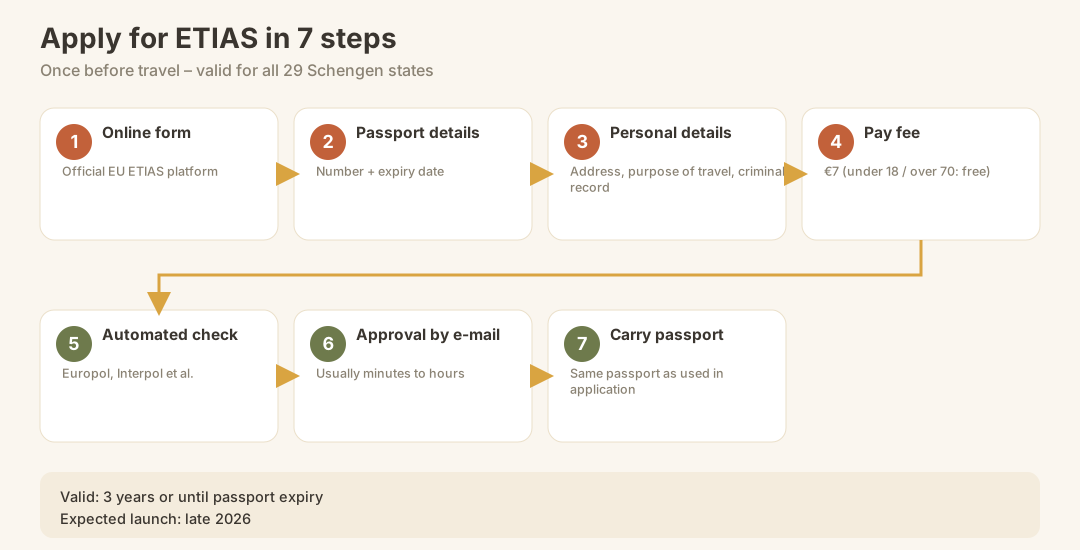
- Complete the online form on the official EU ETIAS platform
- Enter your passport details – including the biometric passport number and expiry date
- Personal information – home address, purpose of travel, criminal record, health questions
- Payment of the €7 fee by credit card or other online payment methods
- Automated check – the system cross-references your data against Europol, Interpol, and other security databases
- Receive authorisation – usually within minutes by email; in exceptional cases, processing may take longer if a manual review is required
- ETIAS is tied to your passport – you must present the same passport at the border that you used to apply for the authorisation
Please note: ETIAS also applies to children and infants – there is no minimum age. Only travellers under 18 and over 70 are exempt from the €7 fee.
The differences between EES and ETIAS at a glance
The two systems are often confused, but they complement each other:
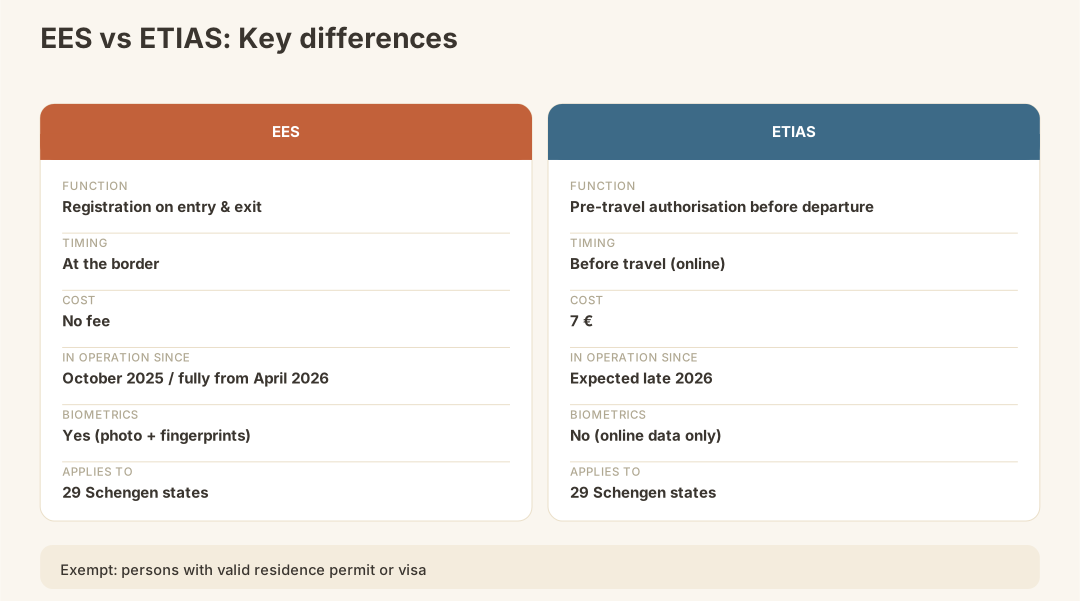
| EES | ETIAS | |
|---|---|---|
| Function | Registration on entry and exit | Prior authorisation before departure |
| Timing | At the border | Before travel (online) |
| Who is affected | Non-EU citizens on short stays | Travellers from visa-free countries |
| Cost | No direct fee | €7 |
| In effect from | October 2025 / fully from April 2026 | Expected end of 2026 |
| Applies to | 29 Schengen countries | 29 Schengen countries |
| Biometrics | Yes (photo + fingerprints) | No (online data only) |
| Exempt if | Residence permit held | Residence permit or visa held |
What applies to Spain residents? And to EU citizens?
Short answer: You don't need to worry about this if you are in one of the following situations.
Fully exempt from EES and ETIAS are:
- EU citizens (Germans, Austrians, etc.) – regardless of whether they hold a Residencia
- Non-EU citizens with a valid Spanish residence permit (TIE, Residencia, long-term visa)
- British nationals with a TIE card (Tarjeta de Identidad de Extranjero), provided it is valid
This applies regardless of how long they stay in Spain or the Schengen Area.
What you should still keep in mind:
- Your residence permit must be current. An expired TIE renders you a regular third-country national in the eyes of the EES system.
- When entering from a non-EU country (e.g. a visit from the UK), you must present your TIE – the border officer scans it to exclude you from EES tracking.
- Anyone who has not yet applied for a Residencia but is de facto spending more than 90 days on Mallorca is now visibly living outside the legal framework.
If you don't yet have a Residencia or your residence permit needs to be renewed, read on here: Applying for Residencia in Spain and Empadronamiento Mallorca
EES and Mallorca in practice: what happens at PMI airport
At Aeropuerto de Palma de Mallorca (PMI) biometric kiosks have been installed as part of the EES rollout. The procedures in the arrivals hall have changed noticeably for affected travellers:
- Queues at passport control may be longer, particularly for first-time registrations
- Processing time per person has increased, as biometric capture requires additional time
- During peak periods (summer, Easter holidays) the system may be partially paused – in which case the officer will stamp passports manually again, but will still check the database
Practical tip: Allow extra time on arrival if you are entering Mallorca for the first time since EES launched. The processing times reported by the Airports Council International as being up to 70 % longer at some locations make it clear: the system is running, but not without friction.
Proof of finances at the border: a new reality
Alongside EES, Spain is stepping up balance-of-funds checks in 2026. According to sources, Spanish border authorities are requiring travellers from non-EU countries to provide proof of sufficient financial means – specifically at least 122 € per day of the intended stay.
| Length of stay | Required funds (indicative figure) |
|---|---|
| 7 days | approx. 854 € |
| 30 days | approx. 3.660 € |
| 90 days (maximum) | approx. 10.980 € |
Accepted forms of proof are generally: cash, bank statements, credit card limits, traveller's cheques. A printed bank statement or a screenshot of a banking app may be requested at the border. This is not a new right, but it is being enforced more consistently in the context of EES.
The end of the Golden Visa – and what counts instead
In April 2025, the Spanish government Golden Visa programme scrapped, which had granted non-EU investors a residence permit through a property purchase from €500,000. This means that for British and US buyers, the previously simplest route to a Spanish residencia through property ownership no longer exists.
What does this mean in practice? Property ownership alone no longer establishes any residencia. Anyone who buys a villa on Mallorca and wishes to stay there for more than 90 days per half-year will need a different residence permit – for example:
- Non-Lucrative Visa (NLV): For retirees or wealthy individuals without gainful employment in Spain; proof of passive income required
- Digital Nomad Visa: Available since 2023 for location-independent workers who work for non-Spanish employers/clients
- Arraigo routes: For individuals who have already been living in Spain for an extended period
More on alternative routes to residency: Arraigo Social Spain and Applying for Spanish citizenship
The most common mistakes – and how to avoid them
From practical experience, the typical misconceptions can be clearly identified:
- "I was only briefly in France, that doesn't count" – Wrong. EES counts every day spent within the entire Schengen Area.
- "My house on Mallorca gives me the right to reside" – Wrong. Property ownership alone has no longer conferred any right of residence since the end of the Golden Visa.
- "The border officer will turn a blind eye" – Not any more. A database decides, not a person.
- "I'll wait until ETIAS actually comes into force" – Anyone who doesn't have an ETIAS when it is introduced simply won't be allowed to board.
- "My TIE expired a year ago, but I still have it" – An expired residence permit offers no protection from EES registration.
- "EU citizens are never affected" – True, but a family member from a third country is – even if they are travelling with EU citizens.
- "I don't need an ETIAS, I've been to Spain so many times" – Previous trips do not constitute an exemption.
What comes next? Further EU digital border systems
EES and ETIAS are not the end points, but part of a larger infrastructure:
- SIS II (Schengen Information System): Already active; database for wanted persons alerts, stolen documents, etc.
- VIS (Visa Information System): Already active; manages Schengen visa data
- Eurodac: Fingerprint database for asylum seekers
- Interoperability: The EU is working to link all these systems together – a border officer will in future see data from all sources simultaneously
The consequence: the window for 'informal' long-term stays without a Residencia is closing for good. Anyone who lives or wishes to live on Mallorca should clarify their residency status now.
Tax liability is closely linked to this: anyone who spends more than 183 days per year in Spain becomes a tax resident – regardless of whether they are registered or not. Read more: Taxes as a Resident (IRPF) and Non-Resident Tax Spain
Checklist: Am I EES/ETIAS-ready?
For British and non-EU citizens without a Spanish Residencia:
- Have I counted my time in the Schengen Area over the last 180 days (all countries combined)?
- Am I staying under 90 days – or do I need a Residencia?
- Do I have proof of finances to hand (bank statement, credit card)?
- Do I know which Residencia route I would take if I want to stay longer?
- Have I applied for ETIAS once it becomes available (expected late 2026)?
- Is my passport still valid for at least 3 months beyond my planned departure date?
For existing residents (EU and non-EU citizens):
- Is my residence permit (TIE / Certificado) currently valid?
- Do I have my NIE document to hand? → Lost your NIE – what to do?
- Is my Empadronamiento registration up to date?
- Am I clear about my tax Residencia obligations?
Conclusion
EES is a reality – the system has been running since October 2025, and since April 2026 without a parallel phase. ETIAS is expected to follow towards the end of 2026. For you as an EU citizen or existing resident on Mallorca, this means little in day-to-day life – you are simply exempt. For everyone else who visits Spain regularly, owns a finca, or effectively lives here, the message is clear: the digital border turns an informal situation into one that is legally and technically visible. This is no cause for panic, but it is a good moment to put your own residency status on solid footing – before an algorithm does it for you.
Official sources
- EU Commission – EES official: https://travel-europe.europa.eu/ees/what-is-the-ees
- EU Commission – ETIAS official: https://home-affairs.ec.europa.eu/policies/schengen-borders-and-visa/smart-borders/european-travel-information-authorisation-system_en
- Airports Council International – ACI Europe (EES implications): https://www.aci-europe.org
- ZDFheute – EES launch 12 October 2025: https://www.zdfheute.de/politik/ausland/eu-europa-einreise-ausreise-abschiebung-grenzkontrolle-100.html
- ABTA – EES implementation deadline: https://www.abta.com/tips-and-advice/planning-and-booking-a-holiday/upcoming-changes-travel-europe
- Jobbatical – proof of funds Spain 2026: https://www.jobbatical.com/de/blog/spain-proof-of-funds-2026-entry-rules