
Applying for Spanish Citizenship: Requirements, Timelines & Naturalisation Test
Applying for Spanish citizenship – for many Germans on Mallorca, this is the logical next step after years as a resident. A Spanish passport opens doors to all 27 EU member states, secures the right to permanent residency and to vote, and makes everyday life on the Balearic Islands noticeably easier. Since 27 June 2024, Germans no longer need to give up their German passport: dual nationality is now generally permitted – you no longer need to apply for a retention permit. This guide explains all routes to naturalisation, the specific requirements, which documents you need, how the CCSE test works, and where to submit your application. Everything you actually need – without bureaucratic jargon.

Would you like to know which route to citizenship is the fastest for your specific situation?
- 📩 Submit a personal enquiry — we'll analyse your case and give you a realistic timeline
- All visa & residency topics at a glance
The six routes to Spanish citizenship
Spanish nationality law is based primarily on the Civil Code (Código Civil). It draws a fundamental distinction between nationality by birth/descent and by naturalisation. In practice, the following routes are most relevant for Germans on Mallorca:
| Route | Required period of residence | Special features |
|---|---|---|
| Naturalisation (residencia) | 10 years of legal residence | Standard route for most applicants |
| Marriage to a Spanish national | 1 year of residence after marriage | Marriage must be in place at the time of application |
| Descent (ius sanguinis) | No residency required | Spanish parent or – under certain conditions – grandparent |
| Birth in Spain | No minimum period of residence | Parent is stateless or of unknown origin |
| Adoption by a Spanish national | No residency required | Only for adoptions before the age of 18 |
| Law on Democratic Memory (2022) | No residency required as a rule | Descendants of exiled Spaniards |
Note: Nationals of certain Ibero-American countries, the Philippines, Equatorial Guinea and Andorra generally only require 2 years of residence instead of 10. Germans do not fall into this category.
Dual citizenship: what has changed for Germans
This is the most important news for anyone who has been hesitating: since 27 June 2024 multiple nationality is generally permitted in Germany (amendment to German nationality law). Germans who acquire Spanish nationality through naturalisation will therefore no longer lose their German nationality (§ 25 StAG). The previously required retention permit has been abolished entirely.
Since 28 August 2007, the principle of multiple nationality had already applied to the acquisition of the nationality of an EU member state — the 2024 reform has now extended this to all cases.
Caution: Regardless of German regulations, Spain assesses the question of multiple nationality under Spanish law. Check the current Spanish legal position with a lawyer or gestoría specialising in naturalisation before submitting your application.
Requirements for naturalisation by residence
By far the most common route for Germans who have been living on Mallorca for years is naturalisation through legal and uninterrupted residence. The following requirements must be met at the time of application:
Length and continuity of residence
Ten years of continuous and legal residence in Spain. Short periods abroad do not generally interrupt the qualifying period, provided that your actual centre of life remains in Spain. The residencia and the empadronamiento are the most important pieces of evidence for this.
Language skills
All applicants who do not come from a Spanish-speaking country are required to provide official proof of language proficiency. The DELE A2 issued by the Instituto Cervantes — or a higher level — is accepted. The DELE can be taken at examination centres in Palma de Mallorca.
Constitutional knowledge test CCSE
In addition to the language requirement, you must pass the CCSE (Prueba de Conocimientos Constitucionales y Socioculturales de España). The test assesses knowledge of the Spanish constitution, history, society and culture through 25 multiple-choice questions. At least 15 must be answered correctly. The test is also organised by the Instituto Cervantes.
| Examination | Organiser | Minimum score | Validity period |
|---|---|---|---|
| DELE A2 (language) | Instituto Cervantes | Pass | Unlimited |
| CCSE (constitutional test) | Instituto Cervantes | 15 out of 25 questions | 4 years |
Further requirements
- No serious criminal record
- Proof of sufficient means of financial support
- No ongoing expulsion proceedings
- Valid identity documents (passport, NIE)
The CCSE naturalisation test in detail
The CCSE is an unexpected hurdle for many applicants — yet with good preparation it is very manageable. The Instituto Cervantes provides official practice materials free of charge on its website. The examination lasts 30 minutes, is taken on a computer and consists of 25 questions across four topic areas:
- State organisation and political system – Constitution 1978, autonomous communities, parliament
- History and culture – From the Reconquista to democracy, Spanish art and literature
- Society – Festivals, traditions, regional characteristics (Balearen included)
- Geography – Provinces, capitals, physical geography
Note: The test is in Spanish. You can retake it as many times as you like, but you must pay the fee each time. A passed CCSE is valid for four years.
Naturalisation through marriage to a Spanish national
Those married to a Spanish citizen can apply for naturalisation after just one year of legal residence in Spain. The marriage must still be in effect at the time of application – a previous marriage that has since ended in divorce does not count. The language requirement (DELE A2) and the CCSE also apply here. You can find information about getting married in Mallorca in our dedicated guide.
Naturalisation by descent
Those with Spanish ancestors may be able to obtain Spanish citizenship by the fastest route – without years of residence in Spain.
Spanish parent
If one of your parents holds Spanish nationality, you are generally entitled to Spanish citizenship from birth – regardless of where you were born. You must assert this entitlement at the relevant registry office (Registro Civil).
Spanish grandparent / Law of Democratic Memory
The Law of Democratic Memory of 2022 broadened the circle of those eligible: descendants of Spaniards who were forced to leave their country as a result of the Civil War or the Franco dictatorship may also apply for citizenship under certain conditions – generally without any residence requirement in Spain.
Please note: The specific requirements under the Law of Democratic Memory are complex and should be examined in detail by a lawyer. Not every line of descent meets the eligibility criteria.
| Route by descent | Residence in Spain required? | Language test required? |
|---|---|---|
| Spanish parent | No | Generally no |
| Adoption before the age of 18 | No | Generally no |
| Law of Democratic Memory (2022) | Generally no | Depending on the individual case |
Step by step: The application process
Here is how a naturalisation by residence works in practice:
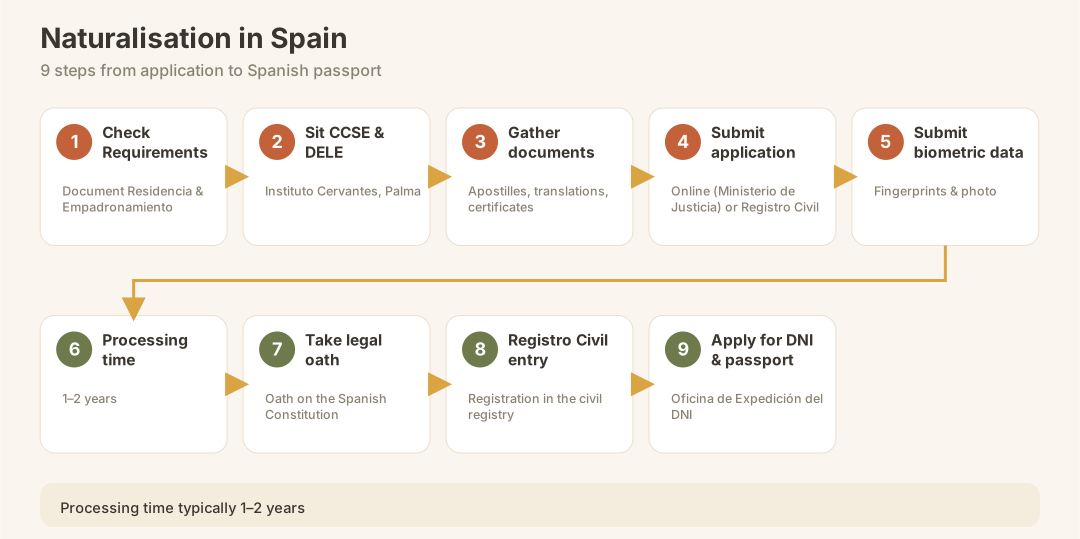
- Check eligibility – Document residencia periods, prepare for the CCSE and DELE
- Sit the CCSE and DELE – Book appointments at the Instituto Cervantes in Palma
- Gather documents – Full list (see table below)
- Submit application – Online via the Ministerio de Justicia portal or in person at the relevant Registro Civil
- Provide biometric data – Fingerprints and photograph, usually at the Registro Civil or the Policía Nacional
- Wait for processing – In practice this typically takes one to two years, in some cases longer
- Take the oath of allegiance – Following a positive decision, swear an oath on the Spanish constitution (jura) before the Registro Civil
- Registro Civil registration – Entry into the Spanish civil register
- Apply for DNI and passport – At the nearest identity document office (Oficina de Expedición del DNI)
Required documents
The following overview applies to naturalisation by residence (10 years). Other routes may require additional or different documents. All foreign certificates must generally be submitted with an apostilled translation into Spanish.
| Document | Note |
|---|---|
| Valid passport | Original and certified copy |
| NIE certificate | Proof of identification number |
| Residencia proof (Certificado de Registro) | Issued by the Oficina de Extranjería |
| Empadronamiento certificate (histórico) | Shows residential history; obtainable from the Ayuntamiento |
| Birth certificate | Apostilled + Spanish translation |
| Certificate of good conduct from Germany | Apostilled + Spanish translation; no more than 3 months old |
| Spanish certificate of good conduct (Certificado de Antecedentes Penales) | Can be applied for at the Ministerio de Justicia |
| CCSE certificate | No more than 4 years old |
| DELE A2 (or higher) | Original certificate |
| Tax and income documents | Most recent tax returns / IRPF |
| Completed application form | Form from the Ministerio de Justicia |
Please note: The Certificado Digital greatly simplifies online submission. With it, you can submit many documents digitally and track the progress of your application online.
Most common mistakes when applying
From practical experience, a number of mistakes can be identified that significantly delay the process:
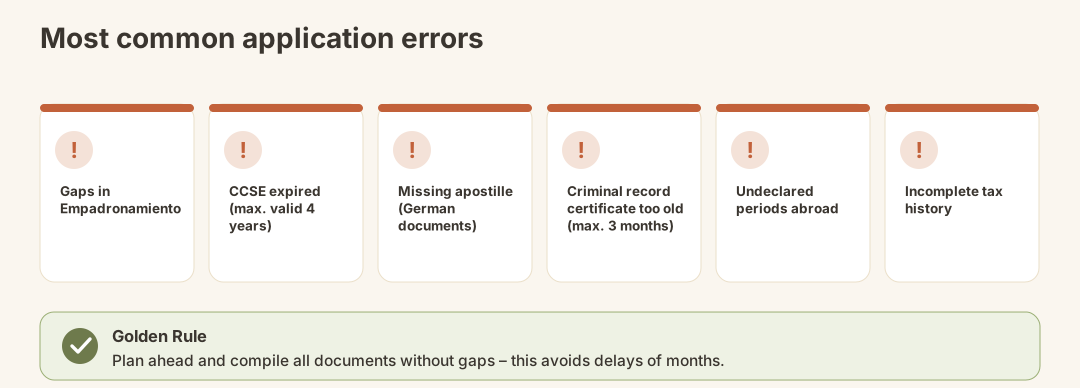
- Gaps in the Empadronamiento record: Anyone who has moved in the meantime and failed to update their registration will need to provide alternative proof for those periods. The padrón histórico should be complete and without gaps.
- Expired CCSE: The certificate is only valid for four years. Anyone who passed the test early and then waited a long time before submitting their application will need to sit it again.
- Missing apostille on German documents: A birth certificate and certificate of good conduct from Germany must bear an apostille — a simple notarisation is not sufficient.
- German certificate of good conduct that is too old: It must be no more than three months old at the time of application. Timing is crucial here.
- Gaps in residency due to unregistered periods abroad: Longer stays outside Spain may need to be explained if any doubt arises.
- Incomplete tax history: Missing tax returns may be interpreted as evidence of a lack of genuine residency. Find out more in our guide to taxes as a resident.
- Submitting the application without prior legal advice: Particularly in borderline cases (periods abroad, previous convictions, questions of descent), it is worth consulting a Gestoría or a solicitor.
What does naturalisation cost?
The following cost items are typically relevant based on experience:
| Cost item | Explanation |
|---|---|
| CCSE examination fee | Fee per sitting (Instituto Cervantes; check the exact amount when registering) |
| DELE examination fee | Varies depending on level; enquire with Instituto Cervantes |
| Apostilles and translations | Vary depending on the number of documents and the translator |
| Solicitor / Gestoría | Depending on the complexity of the case |
| DNI and passport | Fees incurred following a positive decision |
Please note: The actual naturalisation application to the Ministerio de Justicia is generally free of charge; costs arise mainly through examinations, documents and, where applicable, advisory services.
What comes next? Life as a Spanish citizen
Once you have received a positive decision and taken the oath, the real administrative follow-up begins:
- Apply for a DNI: The Spanish national identity card (Documento Nacional de Identidad) is indispensable for everyday life.
- Apply for a Spanish passport: This entitles you to consular protection by Spain worldwide.
- Review your tax situation: As a citizen resident in Mallorca, you are a tax resident in Spain. Topics such as IRPF deductions in the Balearic Islands and the Modelo 720 remain relevant.
- Notify the German authorities: Thanks to the 2024 reform, you do not have to relinquish your German citizenship. Nevertheless, it is advisable to notify your local registration office (Einwohnermeldeamt) and, where applicable, the German Embassy in Madrid.
- Check pension entitlements: Anyone who has worked in Spain for many years should have their entitlement to a pension in Spain and the implications for taxing a German pension in Spain reviewed.
Checklist: applying for Spanish citizenship
- Document periods of residence (Residencia, complete padrón histórico without gaps)
- Book and pass a CCSE appointment at the Instituto Cervantes (min. 15/25)
- Provide proof of DELE A2 (or higher)
- Obtain birth certificate with Apostille + Spanish translation
- German certificate of good conduct (max. 3 months old) with Apostille + translation
- Apply for Spanish certificate of good conduct from the Ministerio de Justicia
- Review tax history (IRPF declarations from recent years)
- Activate Certificado Digital for online submission
- Complete the Ministerio de Justicia application form in full
- Submit application (online or at the Registro Civil)
- Provide biometric data (when requested)
- Take the oath (jura) upon receiving a positive decision
- Apply for DNI and passport
Conclusion
Spanish citizenship after ten years on Mallorca is a realistic and clearly structured goal. Since the German legal reform in June 2024, you no longer need to worry about your German passport — dual nationality is straightforward for Germans. With consistent preparation, the CCSE test presents no major obstacle, and the list of documents is manageable if you plan ahead. The biggest challenge, in our experience, is the processing time: one to two years is realistic, sometimes more. Having the process professionally supported helps you avoid costly delays caused by missing documents or formal errors. If you would like to discuss your specific situation, feel free to send us a personal enquiry.
Official Sources
- Código Civil (Civil Code) – Nationality law: https://www.boe.es/eli/es/rd/1889/07/24/(1)/con
- Ministerio de Justicia – Naturalisation applications online: https://www.mjusticia.gob.es/
- Instituto Cervantes – DELE and CCSE: https://www.cervantes.es/
- German Consulate Palma – Dual nationality / naturalisation: https://spanien.diplo.de/es-de/service/2561098-2561098
- Federal Foreign Office – Nationality law: https://www.auswaertiges-amt.de/vn-de/staatsangehoerigkeitsrecht-2088844
- Registro Civil Central: https://www.mjusticia.gob.es/es/ciudadania/registro-civil
- BOE – Ley de Memoria Democrática (2022): https://www.boe.es/eli/es/l/2022/10/19/20