
Mobile phone contract in Spain: SIM card, prepaid and number porting
Anyone living permanently on Mallorca or elsewhere in Spain will sooner or later reach the point of questioning their German mobile contract. EU roaming makes short-term stays straightforward – but for residents, a Spanish SIM quickly pays off, as local tariffs are often significantly cheaper than comparable German offerings. This guide explains everything you genuinely need to know about a mobile contract in Spain: which providers are available, what prepaid costs, why you need your NIE number, how to transfer your existing number – and which tariff suits your situation.

Are you moving to Mallorca and not sure where to start when it comes to mobiles, registration, and dealing with the authorities?
- 📩 Submit a personal enquiry — We connect you with experienced relocation advisers on Mallorca
- All official processes at a glance
Mobile network quality on Mallorca: what to expect
The mobile network on Mallorca is generally well developed. 4G coverage is near-universal, meaning it is reliably available even in smaller villages and along the coast. 5G is expanding steadily, particularly in Palma and the surrounding area. Anyone living in or frequently travelling through the Serra de Tramuntana should be aware, however, that coverage in the mountains and remote gorges noticeably thins out across all providers – and this applies to hiking routes towards Valldemossa or Sa Calobra as well.
| Provider | Network strength Mallorca / Balearic Islands | Particular strength |
|---|---|---|
| Movistar (Telefónica) | Very good, strongest area-wide network | Rural areas, islands |
| Vodafone España | Good | 5G in cities |
| Orange España | Good | Coast and tourist zones |
| Yoigo | Good in cities | Most affordable urban tariffs |
For everyday use on the island – navigation, WhatsApp, occasional streaming – any of the four major providers is a solid choice. Anyone who regularly travels into the island's interior or up into the mountains is best served by Movistar.
EU roaming: when your German contract is sufficient
Since June 2017, the following has applied within the EU, the EEA (Iceland, Liechtenstein, Norway) and for travellers from these countries: no additional roaming charges. You use your German tariff on Mallorca under exactly the same conditions as at home – including data allowance, inclusive minutes, and SMS flat rate.
In practical terms this means:
- Holiday-makers and short-term visitors can manage perfectly well with their German contract.
- Calls from Germany to your Spanish number may incur costs, as these count as international calls.
- Anyone who regularly calls Spanish numbers from Mallorca (landlords, authorities, tradespeople) may, depending on their home tariff, face additional charges for calls to Spanish landlines or mobile numbers.
Please note: EU roaming only applies to temporary stays. If you use your German contract permanently as your primary connection in Spain, your provider may, following a fair-use review, impose restrictions or charge additional costs. Residents are well advised to switch to a Spanish tariff sooner rather than later.
The major providers and their MVNOs
In addition to the four network operators Movistar, Vodafone, Orange, and Yoigo, there are numerous virtual providers (MVNOs) that use their infrastructure and often offer cheaper tariffs. Particularly relevant on Mallorca is ConectaBalear, a regional provider operating across the Balearic Islands that offers mobile tariffs with no minimum contract term.
| Provider type | Examples | Typical advantages |
|---|---|---|
| Major network operators | Movistar, Vodafone, Orange, Yoigo | Own shops, full network coverage, on-site customer service |
| MVNOs / Regional providers | DIGI Mobil, ConectaBalear | Often cheaper, flexible contract terms |
| Pure prepaid options | All major providers offer prepaid | No tie-in, no NIE strictly required for basic packages |
ConectaBalear (reachable on the free number 1699) offers, among other things, tariffs with no minimum term and unlimited calls — one example of what regional providers on the Balearen can deliver. Shops are available in Palma and other locations across the island.
Prepaid SIM in Spain: here's how it works
A prepaid SIM card is the quickest way to get a local number on Mallorca — no NIE requirement, no credit check, no minimum term. You can buy prepaid cards at:
- Mobile phone shops of the major providers (in Palma and all larger towns)
- Supermarkets (e.g. Mercadona, Lidl)
- Tobacconists (Estancos)
- Airport kiosks at the Aeropuerto de Palma (PMI) — but be aware: airport prices are, according to several sources, 30–50 % higher than in-town prices
Typical prepaid ballpark figure: A package with around 20 GB of data and calls usually costs between 8 and 15 Euro for 28 days. Such deals vary seasonally; you should check current prices directly on the providers' websites.
Note: Prepaid packages are generally valid for 28 days and can be renewed online or via app. If you do not top up in time, the number will expire after a grace period (which varies by provider).
NIE number: when it is required
Here is a point that surprises many newcomers: to take out a mobile phone contract (i.e. not prepaid, but a regular monthly contract) you will need your NIE number (Número de Identificación de Extranjero) in Spain. The same applies to taking out a fibre or landline contract — where a Spanish bank account (IBAN) is also required.
| Contract type | NIE required? | Spanish bank account needed? |
|---|---|---|
| Prepaid SIM (basic packages) | Generally no | No |
| Prepaid with registration / app | Usually yes (identity document) | No |
| Monthly mobile contract | Yes | Recommended / usually required |
| Fibre/landline contract | Yes | Yes (for SEPA direct debit) |
If you don't yet have a NIE number, that's your first step. We explain in detail how to apply for the NIE in our NIE guide.
Step by step: taking out a Spanish mobile contract
Once you have your NIE number and a Spanish bank account, signing a contract is straightforward. Here's how it typically works:
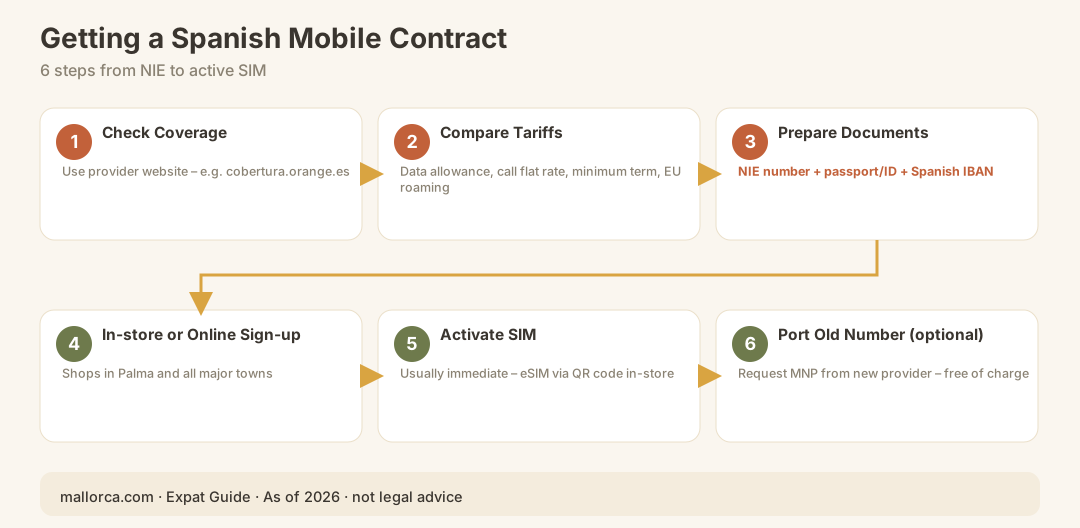
- Check network coverage – Use the providers' websites to find out which network has the best signal at your address. Orange offers a quick look-up tool at cobertura.orange.es.
- Compare tariffs – Pay attention to data allowance, inclusive calls (not all basic tariffs include them), minimum contract length, and EU roaming allowance.
- Prepare your documents – NIE number, passport or identity document, Spanish IBAN (for contracts with direct debit).
- Visit a shop or sign up online – All major providers have shops in Palma and the larger towns. Many contracts can also be taken out entirely online.
- Activate your SIM – Activation usually happens immediately or within a few hours. On an eSIM-compatible device it can be done instantly in the shop via QR code.
- Port your existing number (optional) – If you'd like to keep your current number, let the provider know when you sign the contract (more on this in the next section).
Keeping your number (MNP): how to port your number
The transfer of an existing Spanish number from one provider to another is regulated by law in Spain and is free of charge. The process is called Portabilidad del número (MNP – Mobile Number Portability).
Key steps:
- Sign a contract with your new provider and explicitly request number portability.
- The new provider takes care of the transfer – you don't need to cancel your old contract yourself; as a rule, the new provider handles this as part of the porting process.
- Porting typically takes a few working days. There may be brief interruptions during this time.
Please note: If you want to bring a German number to Spain, this is technically not possible – number portability only works within the same country. You can keep your German number alongside your Spanish one (e.g. using a dual-SIM or eSIM) or cancel it with your German provider.
| Scenario | Possible? | Note |
|---|---|---|
| Spanish number to new Spanish provider | Yes, free of charge | MNP, requested from new provider |
| German number to Spanish provider | No | Different country number ranges |
| German + Spanish number in parallel (Dual-SIM) | Yes | Many modern smartphones support this |
| German eSIM + Spanish physical SIM | Yes | Practical solution for residents |
Tariff overview: What does a mobile phone contract cost in Spain?
A typical monthly tariff with around 20 GB of data and a flat-rate for calls is, according to 2026 sources, between 8 and 15 euros per month – often considerably less than comparable packages in Germany. As a rule: the larger the data package, the relatively cheaper the price per GB.
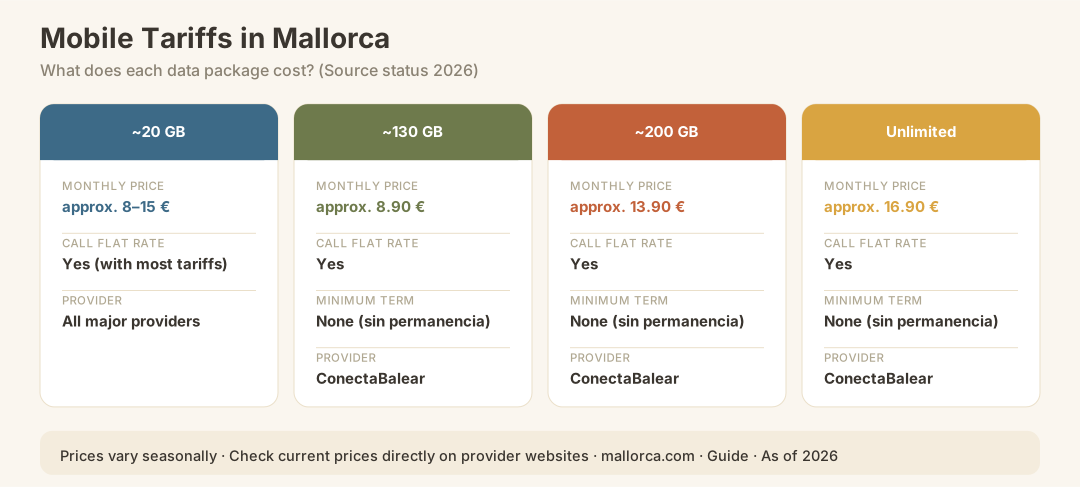
| Data allowance | Approximate monthly price | Flat-rate calls |
|---|---|---|
| ~20 GB | approx. 8–15 € | Yes (with most tariffs) |
| ~130 GB | approx. 8.90 € (ConectaBalear, no minimum contract term) | Yes |
| ~200 GB | approx. 13.90 € (ConectaBalear) | Yes |
| Unlimited | approx. 16.90 € (ConectaBalear) | Yes |
Please note: Prices and promotional offers change regularly. The figures quoted here are taken from 2026 sources and are intended as a guide. Please check current prices directly on the providers' websites.
All packages from ConectaBalear mentioned here have no minimum contract term – an advantage if you are not yet sure how long you will be staying on the island.
Combining fibre-optic broadband and mobile
Anyone living permanently on Mallorca will generally combine a fibre-optic connection (Fibra Óptica) with a mobile tariff. Spain is one of the best-connected countries in Europe when it comes to fibre-optic coverage. Speeds of 100 to 1,000 Mbit/s are not uncommon in Palma and the larger towns.
Many providers offer Bundle packages of fibre and mobile that are cheaper than individual tariffs. ConectaBalear explicitly allows this for its tariffs in the Balearic Islands.
The same requirements apply to a fibre connection as to a mobile contract: NIE number and a Spanish bank account. Installation typically takes one to two weeks after the contract is signed.
Note: In rural areas, on old fincas, or in remote parts of the island's interior, fibre may not yet be available. Here, mobile tariffs, WiMAX, or satellite internet are the alternatives. Check availability in advance on the respective provider's website.
eSIM: The modern alternative for new arrivals
If your smartphone is eSIM-compatible (most current iPhones, Samsung Galaxy, and Pixel models support this), an eSIM offers a practical bridging solution: you can keep your German card as a physical SIM and add a Spanish eSIM on top — no swapping, no waiting for a delivery card.
All four major Spanish network operators now offer eSIM cards, as do regional providers such as ConectaBalear. International eSIM providers operating on Spanish networks are also available as a stopgap — but for long-term use as a resident, they are usually not the most cost-effective solution.
Most common mistakes with a mobile contract in Spain
1. No NIE before signing the contract Without a NIE number, there is no regular contract. Get it sorted first — everything else builds on it.
2. Buying a SIM at the airport Kiosks at the Aeropuerto de Palma (PMI) are convenient, but expensive. If you have the time, buy the SIM in the city.
3. Overlooking the fair-use limit of the German contract EU roaming is intended for temporary stays. Anyone living permanently in Spain and using their German contract as their primary line risks restrictions imposed by their home provider.
4. Signing a contract with a long minimum term Not all tariffs come without a minimum term. If you are still unsure how long you will be staying, ask explicitly for tariffs sin permanencia (without a minimum term).
5. Not porting the old number If you switch without requesting a port, you will lose your existing Spanish number. The new provider must submit the MNP request — not you yourself with the old provider.
6. Using a single SIM instead of a dual-SIM option Many residents benefit from keeping their German number (for family and old contacts) alongside their Spanish one. Modern smartphones make this straightforward.
What comes next?
A Spanish mobile contract is one of many building blocks when settling in on Mallorca. Directly connected to it are:
- Empadronamiento (registration with the town hall): many providers ask for a Spanish registered address. Our Empadronamiento guide.
- NIE number: Essential for any contract — everything about the NIE here.
- Residencia: Anyone staying permanently needs a residence permit — to the Residencia guide.
- Cost of living: Our cost-of-living overview.
- Registering water: Also an early step when moving in — registering water on Mallorca.
Checklist: Taking Out a Spanish Mobile Phone Contract
- NIE number applied for and received
- Spanish bank account opened (for direct debit contract)
- Network coverage checked at your address (provider website)
- Tariffs compared: data allowance, unlimited calls, minimum contract term, EU roaming allowance
- Decision made: Pay-as-you-go or contract? With or without a fibre broadband bundle?
- Documents ready: passport/ID card + NIE + IBAN
- Number porting (MNP) requested, if you wish to keep your existing number
- German contract reviewed: cancel or keep running (dual SIM)?
- eSIM option checked, if smartphone is compatible
Conclusion
A mobile phone contract in Spain is no bureaucratic mountain for residents on Mallorca — it can be sorted in just a few steps, as long as you know what you need. Network quality is good, prices are often lower than in Germany, and the range of tariffs — from pay-as-you-go to fibre bundles — covers every requirement. The only real stumbling block: no NIE number, no contract. Once you have that, everything else is a formality. Anyone unsure which provider and package suits their situation — particularly when fibre, business connections, or more complex administrative processes are involved — will be well served by seeking personal advice.
Official Sources
- European Commission – EU Roaming Regulation: europa.eu/youreurope/citizens/travel/within-eu/roaming-costs
- Comisión Nacional de los Mercados y la Competencia (CNMC) – Portabilidad numérica: cnmc.es
- ConectaBalear – Mobile Tariffs Balearic Islands: conectabalear.com/de/movil
- Ministerio de Asuntos Económicos y Transformación Digital – Telecommunications: mineco.gob.es