
Estate agent fees for rentals in Spain: Who pays what – and what has been prohibited since 2023?
Since 26 May 2023, the question of who pays the estate agent's fees in a long-term rental in Spain has been clearly settled by law: the landlord pays — always. Nevertheless, some estate agencies and private landlords still demand commissions from prospective tenants, sometimes disguised as an "administration flat fee" or "processing fee". This guide explains what the Spanish Housing Act (Ley 12/2023, Ley de Vivienda) specifically stipulates, which practices are illegal, how you can defend yourself as a tenant — and what the exceptions are that you should be aware of. We also look at the particularities of the Mallorca market, where supply and demand are so far apart that informal pressure on tenants remains widespread despite the law.

Are you currently being charged an estate agent's fee — or being asked to pay one?
- 📩 Submit a personal enquiry — We will assess your situation and recommend experienced local lawyers
- Everything about housing & everyday life in Spain
The law: what the Ley de Vivienda 2023 actually says
The Spanish Housing Act (Ley 12/2023 por el derecho a la vivienda) came into force on 26 May 2023 and brought with it one of the most important changes for tenants in years. The key point for renters: All costs and fees arising in connection with the arrangement of a long-term rental property are to be borne by the landlord. This includes the estate agent's commission, arrangement fees, contract costs, and any other administrative expenses incurred by the agent.
In practical terms, this means: when a landlord instructs an estate agent to find tenants, they enter into a service contract with the agent — and it is the landlord who pays the commission. The tenant is a third party to that contractual relationship and may not be asked to foot the bill.
Please note: The law applies to residential tenancy agreements (contrato de arrendamiento de vivienda) under the tenancy law LAU (Ley de Arrendamientos Urbanos). Commercial tenancies and short-term seasonal rental agreements are not automatically covered — more on that shortly.
What is specifically prohibited
| Type of fee | Permissible for tenants? | Legal basis |
|---|---|---|
| Estate agent's commission (long-term residential rental) | ❌ No | Ley 12/2023 |
| Agent's "administration flat fee" | ❌ No | Ley 12/2023 |
| Contract costs (preparation of tenancy agreement) | ❌ No, borne by the landlord | Ley 12/2023 |
| Deposit (fianza) 1 month's rent | ✅ Yes, provided for by law | LAU Art. 36 |
| Additional guarantee of up to 2 months' rent | ✅ Yes, if agreed contractually | LAU Art. 36 |
| Agent's commission for commercial lettings | ✅ Yes, freely negotiable | LAU Título III |
| Commission for seasonal tenancy agreements | Grey area – depending on how it is structured | no clear regulation |
Before 2023: How things used to be – and why the practice has proved so persistent
Prior to the Ley de Vivienda coming into force, there was no uniform statutory rule in Spain governing who bears the agent's costs in rental arrangements. Practice varied considerably depending on the region, the agent, and the landlord. In many cases the tenant paid a commission equivalent to one full month's rent – sometimes more. This was not necessarily enshrined in law, but nor was it expressly prohibited, and it had become established market practice.
In Mallorca and other tight rental markets it was particularly common for tenants, when moving in, to pay upfront both the statutory deposit (fianza) and an agent's commission and a voluntary additional guarantee – which could push the total move-in costs to three or four times the monthly rent.
The fact that this practice did not change immediately, even though the law has been in force since May 2023, has several reasons:
- Many agents and landlords count on tenants being unaware of their rights.
- The rental market is so tight (particularly in Palma, Sóller, Santanyí) that tenants often do not object, for fear of losing the property.
- Fees are disguised under other names – "administration fee", "document processing charge".
- Enforcement depends on the tenant actively raising an objection; there is no proactive government oversight.
What the illegal practice looks like in reality
The following scenarios are encountered time and again by renters in Mallorca and elsewhere in Spain – and all of them are in breach of the Ley de Vivienda:
- "Administration fee" at the point of signing the contract: Flat fees "for drafting the contract" – an unlawful shifting of costs onto the tenant.
- Explicit commission "one-off 1 month's rent": Clearly illegal in residential lettings, yet still encountered.
- Offset against the deposit: The agent retains a portion of the deposit as a "commission" – likewise unlawful.
- Pressure on tenants due to housing shortages: "Other prospective tenants would pay" – a purely informal lever with no legal basis.
Please note: If an agent or landlord charges you a commission, you have the right to reclaim it in writing. In the event of a dispute, the competent court is the Juzgado de Primera Instancia in your place of residence.
Deposit and additional guarantee: what you actually have to pay
Not every upfront payment is illegal. Spanish tenancy law recognises two legitimate forms of security for the landlord:
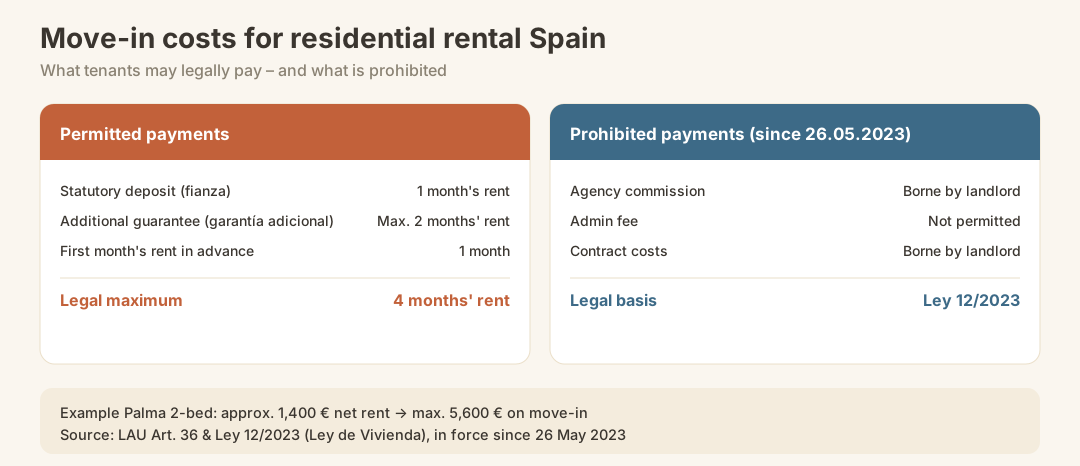
| Security | Designation (Spanish) | Statutory amount | Due date |
|---|---|---|---|
| Mandatory deposit | fianza | 1 month's rent | Upon signing the contract |
| Voluntary additional guarantee | garantía adicional | Max. 2 months' rent | Upon signing the contract |
| Agent's fee | honorarios de agencia | Borne by the landlord | — |
| First month's rent in advance | — | 1 month | Upon moving in |
In practice, many landlords in Mallorca – particularly with international tenants who have no Spanish rental history – demand the maximum permitted combination: 1 month's deposit + 2 months' additional guarantee + 1 month's rent in advance. That amounts to a legally permissible total of up to 4 months' rent upon moving in. Anything beyond that (estate agent's commission, fees) is not permitted.
Please note: The fianza must be lodged by the landlord with the relevant regional housing authority (in the Balearic Islands: IBAVI – Institut Balear de l'Habitatge). That is the landlord's obligation, not yours.
Exceptions: When tenants may (legitimately) pay something
The law is clear – but it has loopholes you should be aware of:
1. Seasonal tenancy agreement (contrato de temporada)
If a property is let not as a permanent residence but on a seasonal basis – i.e. under a contrato de temporada – the strict protective provisions of the LAU governing residential tenancies do not automatically apply in full. The legal position in this area is less clear-cut, and in practice estate agent's fees charged to the tenant are more commonly enforced.
Important for expats: Many landlords in Mallorca push for a seasonal tenancy agreement (often structured as an 11-month contract) in order to circumvent tenant protections and notice periods. However, for your Empadronamiento and your Residencia you will need a genuine residential tenancy agreement (contrato de arrendamiento de vivienda). A seasonal contract is not accepted by many local councils.
2. Commercial tenancy
Anyone renting office or commercial premises is operating outside the LAU's protective provisions. In such cases, estate agent's fees are freely negotiable and may be contractually passed on to the tenant.
3. Direct rental without an estate agent
Where an owner lets a property privately and without the involvement of an estate agent, no commission arises – for either landlord or tenant. Some owners do, however, charge 'administration fees' for drawing up the contract; this too is not permissible in the case of residential tenancies.
The Mallorca factor: Why the market overrides the law
Average rents in Palma stood at around 18,70 €/m² in 2026, which for a 2-bedroom flat equates to approximately 1.400 € per month in base rent. Supply grows more expensive each year, while available stock continues to shrink. Flats are being converted to holiday lets, new-build projects in the affordable segment are lacking, and international tenants are competing with local residents.
| Property type in Palma | Average base rent 2026 |
|---|---|
| 1-bedroom flat | approx. €1,000 |
| 2-bedroom flat | approx. €1,400 |
| 3-bedroom flat | approx. €1,750 |
| Average per m² | approx. €18.70 |
In this environment, many tenants are afraid to insist on their legally enshrined rights – and landlords as well as estate agents know this. That does not change the legal position, but it does explain why you as a tenant in Mallorca should be particularly well prepared.
Step by step: how to fight back against illegal fees
- Document the demand: Ask for the fee demand in writing – by email, invoice, or in the tenancy agreement. Verbal demands are difficult to enforce, but also difficult to prove.
- Object in writing: Write to the estate agent or landlord by email stating that you consider the fee unlawful under the Ley 12/2023 and that you will not be paying it.
- Reclaim fees already paid: If you have already paid, you can demand a refund in writing. If the recipient refuses to repay, you can send a burofax (a registered letter with legal consequences).
- Mediation or legal action: The competent court is the Juzgado de Primera Instancia at your place of residence. For smaller amounts, the procedure is relatively straightforward. A solicitor specialising in tenancy law (abogado de arrendamientos) can help you assess whether pursuing a claim is worthwhile.
- Contact the consumer protection authority: The Balearic consumer protection authority (Oficina de Información al Consumidor) accepts complaints. The Colegio de Agentes de la Propiedad Inmobiliaria (API) can also take action in the event of violations.
What estate agents charge for a purchase – the difference from renting
To avoid any confusion: property purchases in Spain are governed by entirely different rules. There is no legal requirement stipulating who pays the estate agent's commission — this is freely negotiable and regulated by contract. In practice, in Spain it is often the seller who pays the commission, though a contribution from the buyer is also possible and does occur.
| Transaction | Who pays the agent's fee? | Typical amount |
|---|---|---|
| Residential rental (long-term) | Landlord (by law) | Borne by landlord |
| Commercial rental | Negotiable | Negotiable |
| Seasonal rental | Grey area | Depends on the contract |
| Property purchase | Negotiable, often the seller | Depends on region and agent |
The most common mistakes regarding agent's fees
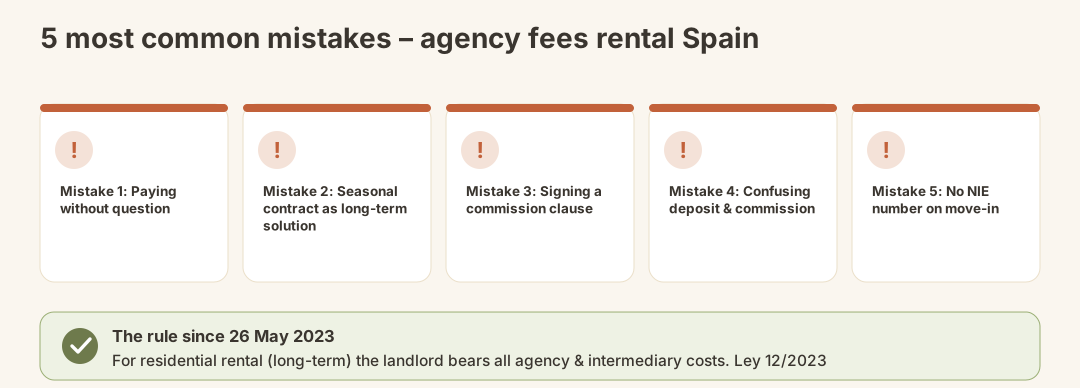
- Mistake 1: Paying without question. Many people pay out of convenience or ignorance — even though they are not obliged to.
- Mistake 2: Accepting a seasonal contract as a long-term solution. A contrato de temporada does not afford you the same protections as a residential tenancy agreement and is often not recognised for official administrative purposes.
- Mistake 3: Signing a commission clause in the tenancy agreement. Some tenancy agreements contain clauses that impose fees on the tenant. Such clauses are void — but you should identify them and have them removed before you sign.
- Mistake 4: Confusing the deposit with the commission. The deposit (fianza) is legal and protective; charging the estate agent's commission to the tenant is not.
- Mistake 5: No NIE number when moving in. Without a NIE number you can neither sign a tenancy agreement nor set up a bank direct debit — and you will lose valuable time in the competition for sought-after properties.
What comes next? Next steps after renting
Once you have found the property and signed the contract, there are a number of important follow-up steps to take:
- Empadronamiento (registration of residence): Many town halls refuse to register you without a valid long-term tenancy agreement. You can find the details here: Empadronamiento on Mallorca
- Apply for Residencia: As an EU citizen with a fixed place of residence you are entitled to the right of residence — the tenancy agreement is a key document. More on this: Residencia in Spain
- Transfer electricity, water and internet: Contracts in Spain are often still in the previous tenant's name; take over existing contracts or take out new ones. Information: Registering water supply on Mallorca
- Check tax residency obligations: Anyone who lives in Spain for more than 183 days a year becomes liable to pay tax. Taxes as a resident in Spain
- Sort out health insurance: With Residencia and Empadronamiento you have access to the public healthcare system. What you should arrange beforehand: Health insurance in Spain
Checklist: estate agent fees for renting in Spain
- Check the type of tenancy agreement: contrato de arrendamiento de vivienda (long-term) or contrato de temporada?
- Do not pay any estate agent's commission as a tenant (residential letting)
- Deposit (fianza) max. 1 month's rent
- additional deposit (garantía adicional) max. 2 months' rent
- Document any fee demands in writing
- Obtain your NIE number and a Spanish bank account before flat-hunting
- Check the tenancy agreement for unlawful commission clauses before signing
- Require the landlord to lodge the deposit with IBAVI
- If pressured to pay: object in writing and, if necessary, consult a solicitor or the consumer protection authority
- After moving in: apply for Empadronamiento and Residencia promptly
Conclusion
The legal position in Spain has been clear since May 2023: for long-term residential lettings, the landlord pays the agency fees — the tenant pays only the deposit and additional guarantee at the amounts defined by law. What was previously standard market practice is today illegal. Nevertheless, the old practice persists in tight markets such as Mallorca — driven by scarcity, information asymmetry, and the desire to pass costs on to tenants.
As a tenant, you need to know your rights and — where necessary — assert them actively. This requires preparation, the correct documentation, and sometimes professional support. If you are unsure, a brief consultation with a solicitor specialising in tenancy law on Mallorca is worthwhile before you sign anything or make any payment.
Official sources
- Ley 12/2023, de 24 de mayo, por el derecho a la vivienda (Housing Act): https://www.boe.es/eli/es/l/2023/05/24/12
- Ley 29/1994, de 24 de noviembre, de Arrendamientos Urbanos (LAU) – Tenancy law: https://www.boe.es/eli/es/l/1994/11/24/29/con
- IBAVI – Institut Balear de l'Habitatge (lodging of rental deposits in the Balearic Islands): https://www.ibavi.es
- AEAT – Agencia Tributaria (tax aspects of tenancy arrangements): https://www.agenciatributaria.es
- Conselleria de Territori, Energia i Mobilitat – Govern de les Illes Balears (Balearic Housing Law): https://www.caib.es