Setting up electricity in Spain: Endesa contract, meter changeover & potencia contratada in Mallorca
Anyone moving to Mallorca will sooner or later face the question: do I need to register for electricity from scratch, or is a simple change of name sufficient? The answer determines whether you spend 50 euros or several hundred euros – and whether you wait one week or four for the lights to come on. On Mallorca, Endesa is both the network operator (Distribuidora) and the most obvious contract partner, even though you are technically free to choose any licensed supplier on the open market. This guide walks you through every scenario: transfer of contract after a purchase or start of a tenancy, a genuine new connection, choosing the right potencia contratada, and the dreaded Boletín – with concrete steps, costs, and the mistakes German expats make most often.
Would you like to sort out electricity, water, and Empadronamiento all at once – without speaking Spanish?
📩 Submit a personal enquiry — we recommend vetted Gestorías and guide you through your first dealings with the authorities
The Spanish electricity system: Distribuidora vs. Comercializadora
Before you sign anything, you need to understand a fundamental distinction that does not exist in the same way in Germany.
Term
Role
Can you choose?
Distribuidora
Owns the cables, meters, and network
No – on Mallorca it is always Endesa
Comercializadora
Issues invoices and sets the tariff
Yes – Endesa, Iberdrola, Naturgy, and many more
CUPS
The property's unique supply-point ID
Fixed – never changes
The Distribuidora on Mallorca (and throughout the Balearic Islands) is exclusively Endesa Distribución. You have no choice in the matter – it is part of the network. The Comercializadora, on the other hand, is freely selectable. In practice, most expats take out their contract directly with Endesa Comercializadora, which simplifies the process as everything comes from a single source. Those who shop around occasionally find cheaper fixed-rate tariffs on the open market.
Please note: You can find the CUPS code (Código Unificado de Punto de Suministro) on the previous owner's or landlord's most recent electricity bill. It starts with 'ES' and is 20–22 characters long. Without it, no registration can proceed.
When do you actually need to register for electricity?
This is the first and most important question – because it determines the effort and cost involved.
Situation
What you need
Cost (approx.)
Supply is still active and the previous owner has not cancelled it
Cambio de Titular (change of account holder)
Low to no cost
Supply was cancelled by the previous tenant
New contract, reactivation of the connection
Low reactivation fee
Connection has been inactive for many years
Boletín required, plus inspection if necessary
200–500 € (depending on condition)
Property never previously connected
Full new connection
Individual, often €500 upwards
Supply cut off due to non-payment
Settle outstanding debt + reactivation
Amount outstanding + charges
The most common case with properties for purchase is the Cambio de Titular: the supply is already running and you simply transfer the connection into your name. This is often free of charge and can be done entirely online – provided the Boletín (installation certificate) is still valid.
The three documents without which nothing can proceed
Regardless of which scenario applies – you will always need these documents:
NIE number (Número de Identificación de Extranjeros) – the Spanish tax ID for foreign nationals. Without it, no contract can be registered in your name. You can find out how to apply for one in the NIE guide.
Spanish bank account with IBAN – electricity in Spain is generally paid by direct debit (domiciliación bancaria). Most suppliers will not accept a non-Spanish IBAN. How to open an account is covered in the Spanish bank account guide.
CUPS code + proof of ownership or rental agreement – the Escritura (title deed) or the tenancy agreement confirms that you are entitled to take over the supply.
For a genuine new connection or following a lengthy period of disconnection, you will also need the Boletín Eléctrico – the electrical installation certificate (more on this below).
Step by step: setting up electricity with Endesa in Mallorca
Scenario A: Cambio de Titular (standard case)
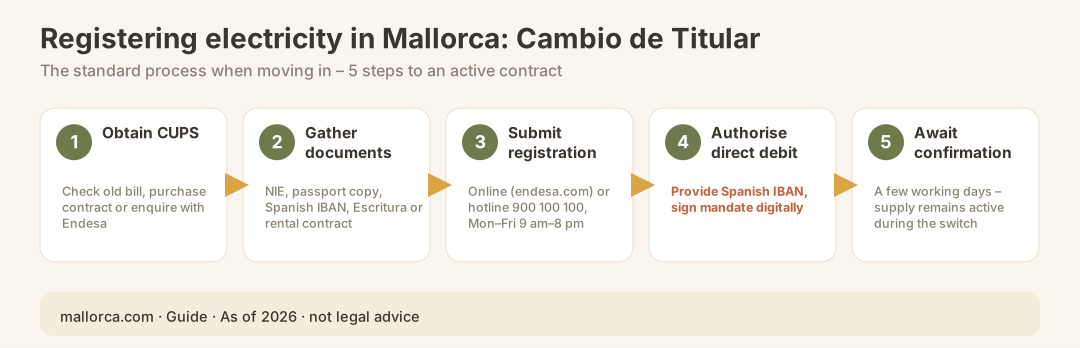
Find your CUPS – check an old bill, the purchase contract, or ask Endesa directly.
Gather your documents – NIE, copy of passport, IBAN, Escritura or tenancy agreement.
Online or by phone – via endesa.com (under "Alta de suministro" / "Cambio de titular") or by calling 900 100 100 (Mon–Fri, 9–20). Customer service is also available in Catalan; English is possible, German is not generally available directly.
Set up a direct debit – provide your IBAN and sign the direct debit authorisation (can be done digitally).
Await confirmation – usually a few working days; the supply remains active during the change of account holder.
Scenario B: Reactivation of a cancelled connection
Steps 1–4 as above.
Endesa will additionally check whether the Boletín is still valid.
If it is valid, reactivation will be carried out for a fee by the network operator.
A technician must attend the property to unlock the meter – appointment to be arranged through Endesa.
Scenario C: New connection or expired Boletín
Hire a qualified electrician (instalador autorizado).
The electrician inspects or rewires the property's installation and issues a new Boletín Eléctrico.
The Boletín is registered with the Balearic industry authority.
Only then will Endesa install a new meter and connect the supply.
Please note: The Boletín is not a mere formality. Outdated installations frequently fail the inspection. Allow 2–4 weeks' lead time and an appropriate budget for older fincas or properties that have been vacant for a long time.
Endesa Palma: office, hotline and online channel
For most matters you do not need to visit the office in person — everything can be handled online or by phone. For more complex cases (disputes, new connections, meter checks) there is the Endesa customer centre in Palma.
Channel
Details
Phone
900 100 100 (freephone, Mon–Fri 9 am–8 pm)
Online customer area
endesa.com → "Área de Clientes"
Palma office
Palma de Mallorca (address and opening hours at endesa.com/es/oficinas)
Fault hotline
Current number at endesa.com (24 h, network faults)
Please note: The fault hotline number 900 150 212 was quoted in earlier sources but may change. Please check the current number directly at endesa.com.
You need a customer account to access the online area. There you can view bills, switch tariff, submit meter readings and make account changes. The website is in Spanish and Catalan; a full English-language interface is not available.
Potencia contratada: the underestimated cost factor
The potencia contratada is the contracted supply capacity you book — measured in kilowatts (kW). It largely determines the standing charge (término de potencia) you pay each month, regardless of actual consumption.
Household type
Recommended potencia
Typical appliances
Small flat, no electric hob
3,45 kW
Fridge, lighting, laptop
Standard flat with electric hob
4,6–5,75 kW
+ washing machine, microwave
House with air conditioning
8,05–10 kW
+ Split ACs, dishwasher, pool
Larger property, pool, heat pump
10–15 kW
+ Heat pump, electric car
Two important rules:
If you consistently exceed your contracted capacity, the ICP (main circuit breaker) will trip and you will lose power.
If you book too much, you pay every month for capacity you never use.
Changing the potencia contratada is possible, but not on a daily basis. It triggers a technical inspection and may incur a fee. Ask your electrician to recommend the right capacity when carrying out the Boletín check.
Please note: The regulated tariff (PVPC) has an upper limit of 10 kW. Anyone requiring more must switch to the open market.
PVPC or open market – which tariff is right for you?
Criterion
PVPC (regulated)
Open market (mercado libre)
Price
Hourly variable (spot market electricity)
Fixed price or variable terms depending on contract
Best suited to
Flexible users who consume at night or midday
Predictable consumption, price certainty desired
Access
Authorised PVPC suppliers only
All Comercializadoras
Capacity limit
Max. 10 kW
None
Cancellation
Possible at any time
Note contract terms
The PVPC price fluctuates daily. Wholesale average prices in 2024 were around 63 € per MWh; in early 2025 there were days with as little as around 26 € per MWh, but also periods above 100 € per MWh. Those who can manage the timing of their consumption (e.g. running the washing machine at night) can save money on the PVPC. Those who want planning certainty should choose a fixed-price tariff on the open market.
The Boletín Eléctrico: what it is and when it is required
The Boletín Eléctrico (officially: Certificado de Instalación Eléctrica) is the official installation certificate for a building's electrical system. It confirms that the property's internal wiring meets current Spanish standards.
When is it mandatory?
For a completely new connection (where there has never previously been electricity)
When the connection has been inactive for a certain period of time
When the property's electrical installation is outdated and no longer meets current standards
When there is a significant increase in the potencia contratada
Who issues it?
A certified electrician (instalador autorizado) prepares the Boletín and registers it with the relevant authority in the Balearic Islands (Direcció General d'Energia i Canvi Climàtic). Endesa requires the registration number before the connection can be activated.
What does it cost?
The costs depend on the condition of the installation and the amount of work involved. If an inspection reveals no repairs are needed, a few hundred euros is a realistic figure; if the entire electrics need to be replaced, costs can be significantly higher.
The most common mistakes when registering electricity in Mallorca
Based on experience, these points lead to delays, unnecessary costs, or contractual headaches:
Applying for a new connection when a change of name would have sufficed – If the connection is active and only the account holder is changing, a Cambio de Titular is all that is needed. A new connection is more expensive and takes longer.
Trying to sign a contract without an NIE – This simply does not work. The NIE is mandatory. Make sure you apply for it in good time.
Providing a German bank account – Direct debits fail with most suppliers. Open a local bank account first.
Choosing too low a potencia – Air conditioning units, pool pumps, and an electric cooker running together will instantly exceed 3.45 kW. Calculate realistically.
Ignoring an outdated Boletín – An expired or never-issued Boletín will halt the entire activation process. Have it checked before you move in.
Overlooking the previous owner's debts – Outstanding electricity debts are tied to the connection (CUPS), not to the account holder's name. Before purchasing, check that the connection is free of debt.
Failing to document the meter reading on moving in – Photograph the meter on your first day. This ensures you cannot be billed for the previous occupant's consumption.
Cost overview
Item
Amount (approx.)
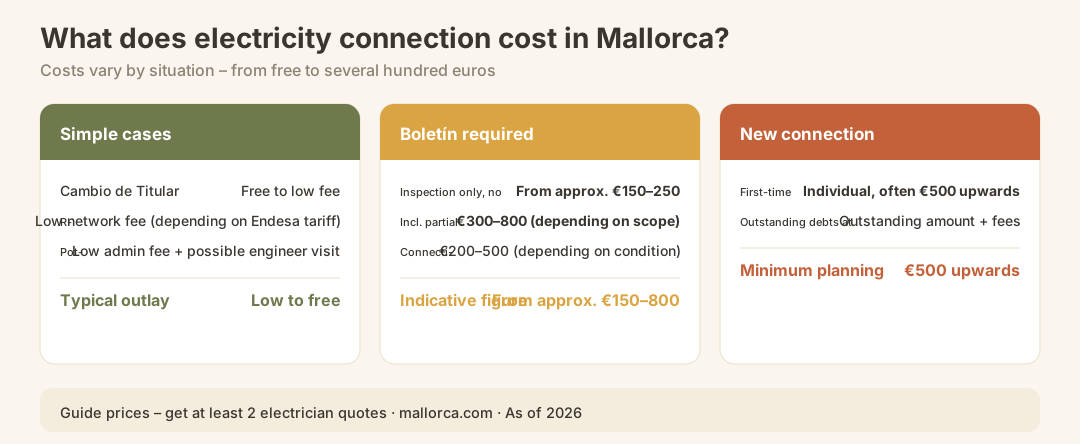
Cambio de Titular
Free or a small administrative fee
Reactivation of an inactive connection
Small network fee (depending on Endesa tariff)
Boletín Eléctrico (inspection only, no repairs)
From approx. 150–250 €
Boletín including partial rewiring
300–800 € (depending on scope)
Full new connection (first-time installation)
Individual quote, often 500 € upwards
Increasing the potencia contratada
Small processing fee + possible technician visit
Please note: These figures are indicative. Electrician fees in Mallorca vary depending on the region, time of year, and workload. Always obtain at least two quotes.
What comes next?
Once your electricity contract is active, day-to-day practicalities are generally straightforward. Here are the next logical steps after moving in:
Registering water: This is handled separately – depending on the municipality, either through the Ayuntamiento or a private water supplier. Details in the Guide to Setting Up Water in Mallorca.
Empadronamiento: Registration with the Ayuntamiento is a prerequisite for many official procedures and social services. Find out more in the Guide to Empadronamiento in Mallorca.
Budgeting for living costs: Ongoing electricity costs need to be factored into your budget – you'll find all the figures in the Guide to Cost of Living in Mallorca.
Print this list out or save it – it covers every scenario:
NIE number obtained
Spanish bank account with IBAN opened
CUPS code of the property identified
Escritura or rental contract to hand
Copy of passport prepared
Current meter reading photographed (moving-in day)
Boletín status checked (valid / expired / not in existence)
Electrician commissioned if Boletín is missing
Appropriate potencia contratada calculated
Tariff chosen (PVPC or open market)
Cambio de Titular or new registration submitted with Endesa
Outstanding debts on the connection ruled out (in the case of purchase)
First bill checked for accuracy
Conclusion
Setting up electricity in Spain is no dark art – but it is a different system from what you may be used to elsewhere. The key advantage: anyone who correctly assesses the situation (Cambio de Titular rather than a brand-new connection) will get there quickly, cheaply, and without any nasty surprises. The three non-negotiable requirements are your NIE number, a Spanish IBAN, and the CUPS code of the property. Add to that a realistic potencia contratada, a current Boletín, and – on moving-in day – a photo of the meter reading. Get all that sorted and you'll have the most important piece of infrastructure for your new life in Mallorca firmly under control.
OMIE – Iberian Energy Market Operator (wholesale prices):www.omie.es
Govern de les Illes Balears – Direcció General d'Energia i Canvi Climàtic (Boletín registration):www.caib.es
CNMC – Comisión Nacional de Mercados y la Competencia (electricity market regulation):www.cnmc.es
What is the difference between a Distribuidora and a Comercializadora?
The Distribuidora (on Mallorca exclusively Endesa) owns the network and the cables — you cannot choose them. The Comercializadora issues your bill and sets the tariff — you are free to choose them. In practice, you sign a contract with a Comercializadora of your choice, which then communicates with Endesa in the background.
What is the CUPS code and where do I find it?
The CUPS (Código Unificado de Punto de Suministro) is the unique identification number for your electricity connection — comparable to a meter ID. It appears on any older bill from the previous owner, in the purchase contract, or can be requested directly from Endesa. Without it, registration is not possible.
Do I really need a Spanish bank account?
Yes, in practice it is generally unavoidable. Electricity in Spain is paid by direct debit (domiciliación bancaria). Most suppliers do not accept foreign IBANs. Open your bank account first, then set up the electricity contract.
When is a Boletín Eléctrico required?
For a genuine new connection, after a prolonged disconnection, or when the property's wiring is outdated and no longer meets current standards. A certified electrician issues it and registers it with the relevant Balearic authority.
What does potencia contratada mean and how high should it be?
The potencia contratada is the contracted supply capacity in kilowatts. It determines the monthly fixed-cost element. A small flat can manage with 3.45–4.6 kW; a house with air conditioning and a pool typically requires 8–10 kW. Too little leads to regular cut-outs; too much means unnecessary fixed costs.
What is the PVPC tariff?
The PVPC (Precio Voluntario para el Pequeño Consumidor) is the regulated default supply tariff. The price varies hourly in line with the wholesale electricity market and is restricted to connections of up to 10 kW. It can be cheaper than fixed-price contracts if you are able to manage your consumption flexibly.
Can I inherit the previous owner's debts on the electricity connection when buying a property?
Outstanding debts are tied to the CUPS code — that is, to the connection itself, not to the name. You should therefore check before purchase that the connection is free of debt. Your solicitor or gestoría can enquire with Endesa on your behalf.
How do I contact Endesa on Mallorca?
The free customer helpline is 900 100 100 (Monday to Friday, 9–20 h). For faults and power outages there is a separate 24-hour number (current number available at endesa.com). Many matters can also be handled entirely through the online customer portal at endesa.com.