Registering Water Supply in Spain: The Complete Mallorca Guide
Registering for a water supply in Spain — and on Mallorca in particular — may sound like a straightforward formality, but it can quickly turn into a multi-day test of patience if you don't know who to contact. Water supply on the island is divided along municipal lines: in Palma, EMAYA is responsible, while Aguas de Mallorca covers large parts of the rest of the island — and some municipalities have their own individual companies. Add to this the peculiarity that Mallorca has no year-round rivers, with water sourced from aquifers, reservoirs, and seawater desalination, and an infrastructure that is partly ageing. This guide explains step by step how to transfer the contract into your name, what appears on your bill, what the drinking water quality is really like — and what you can do during a summer of shortages.
New to Mallorca and not yet sure which official errands need to be sorted first?
- 📩 Submit a personal enquiry — we'll help you coordinate your utility provider, NIE, and registration
- All official topics at a glance
Water suppliers on Mallorca: who is responsible?
Before you sign anything, you need to know who is responsible for your address. There is no single unified utility company on Mallorca.
| Area | Responsible supplier | Note |
|---|---|---|
| Palma de Mallorca | EMAYA (Empresa Municipal d'Aigues i Clavegueram) | Municipal company of the City of Palma |
| Most of the island (many municipalities) | Aguas de Mallorca | Island-wide supplier for numerous localities |
| Individual municipalities | Their own municipal companies | Varies depending on the local council |
Please note: When buying or renting a property, always ask explicitly which supplier is responsible. Your landlord or property manager will usually know — but if in doubt, check directly with the Ayuntamiento (local council).
Aguas de Mallorca and EMAYA are the dominant players. In smaller, tourism-oriented municipalities such as Deià on the west coast — known for acute supply shortages in the summer of 2025 — the supply situation can be considerably more strained than in the capital.
Transferring a water contract: step by step
When you take over a flat or house, the water contract will initially still be in the name of the previous owner or tenant. You need to transfer it into your name — a cambio de titularidad. This does not happen automatically.
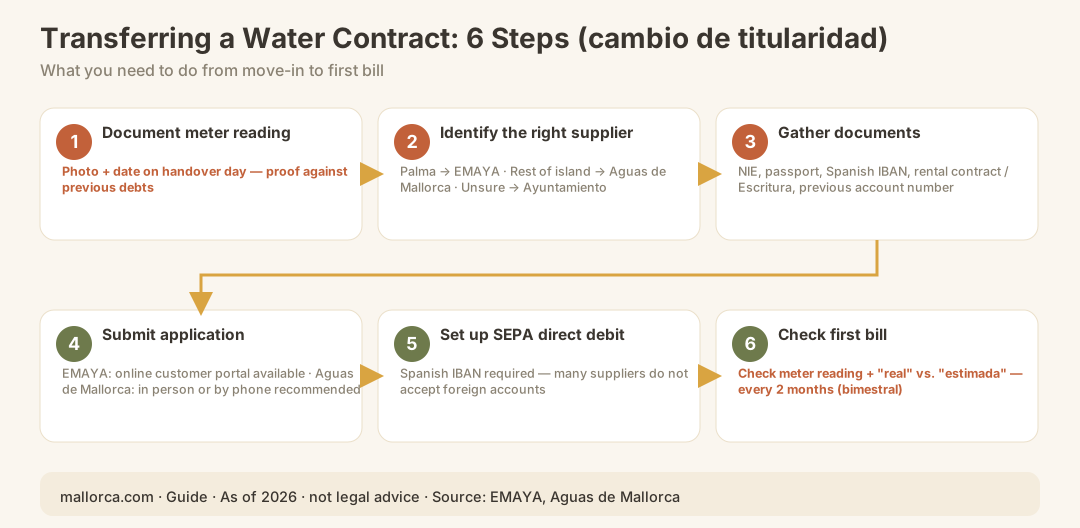
What you will need:
- Valid ID (passport or DNI/NIE)
- NIE number (Número de Identificación de Extranjero) — no contract without a NIE
- A Spanish bank account number (IBAN for direct debit)
- Current meter reading on the day of handover (take a photo!)
- Proof of the property — tenancy agreement or title deed (escritura)
- Reference number of the existing contract — found on the previous owner's most recent bill or on the meter
Important: If you don't yet have a NIE, you'll need to apply for one first. This can take several weeks. More details in the guide to the NIE number in Mallorca.
Typical process:
- Photograph and note the meter reading (with date)
- Identify the responsible supplier (EMAYA or Aguas de Mallorca)
- Visit the customer centre in person or complete the online form on the respective website
- Submit the required documents
- Provide bank details for SEPA direct debit
- Await confirmation and the first bill
With EMAYA, you can also initiate the cambio de titularidad online via the customer portal. With Aguas de Mallorca, a personal appointment or phone contact is often faster.
Applying for a new water connection: when no connection yet exists
For a new build or a property that has been vacant for a long time with no active connection, the process is more involved. In this case, you are not dealing with a cambio de titularidad, but rather an alta de suministro (new connection).
Typical documents required for a new connection:
| Document | Note |
|---|---|
| NIE / CIF (for companies) | Mandatory |
| Escritura or rental agreement | Proof of ownership |
| Cédula de habitabilidad | Habitation certificate issued by the local authority |
| IBAN of a Spanish bank account | For direct debit mandate |
| Boletín de enganche | Electrical installation certificate (sometimes required) |
| Site plan / cadastral reference | For laying the supply line |
The cédula de habitabilidad is often the bottleneck: it must be issued by the Ayuntamiento and can take — depending on the municipality and the current processing backlog — weeks to months. Factor this into your timeline.
Note: For rural fincas outside the supply network, there is frequently no mains connection available. In such cases, cisterns, private wells, or water deliveries by tanker are the norm. More on this in the section on cisterns and alternative solutions.
What appears on a water bill?
Spanish water bills are not always self-explanatory. Here are the most important line items you will come across with EMAYA or Aguas de Mallorca:
| Line item on the bill | What it means |
|---|---|
| Cuota de servicio / Término fijo | Standing charge, regardless of consumption |
| Consumo de agua (m³) | Consumption price per cubic metre |
| Canon de saneamiento | Wastewater charge (Balearic canon) |
| Impuesto sobre el valor añadido (IVA) | VAT |
| Tasa de alcantarillado | Sewerage charge (varies by municipality) |
| Lectura del contador | Meter reading – either estimated or actual |
Bills are issued every two months (bimestral). Occasionally, consumption is not read directly but estimated and corrected later – look out for the note estimada or real on your bill.
Please note: Water is more expensive on Mallorca than in many other European countries, owing to the scarcity of the resource and the high proportion of desalination costs. Bills vary considerably depending on the municipality and consumption tier. For current tariffs, contact your local supplier directly, as these change regularly.
Where does Mallorca's water come from?
Mallorca has no rivers that flow year-round. The water supply rests on three pillars:
1. Groundwater The most important source. The island's aquifers are replenished by winter rainfall but come under severe pressure in summer – due to the high resident population, tourism, and agriculture.
2. Reservoirs There are several reservoirs on the island that act as a buffer. In dry years – such as 2023/24 – water levels fall considerably.
3. Seawater desalination Increasingly important. Spain ranks 4th worldwide in installed desalination capacity (after Saudi Arabia, the USA, and the United Arab Emirates). Across the country, around 5 million cubic metres of desalinated water are produced every day. For the Balearic Islands, desalination is a critical buffer during the summer months.
There is also a structural problem: estimates suggest that around 20 % of water seeps away through ageing pipework before it ever reaches the consumer.
Drinking water quality: tap water on Mallorca
There is a great deal of uncertainty on this topic – and it can be cleared up:
Tap water on Mallorca meets European drinking water standards and is tested regularly. It is generally not harmful to health.
There are, however, regional differences:
| Situation | Details |
|---|---|
| Palma (city centre) | Considered safe to drink; the city also operates free public water dispensers throughout the city |
| Rural municipalities, west coast | Quality can be affected by high mineral salt content (lime, chloride) |
| Very old household pipework | Possible deposits in your own pipes – independent of the mains water supply |
| Desalinated water | Meets standards, sometimes tastes 'flat' |
Most residents and many locals cook with tap water, but prefer filtered or bottled water for drinking – less for health reasons, more for taste (limescale, a slight chlorine smell after treatment).
Practical options:
- Table water filter (e.g. Brita): Affordable, reduces limescale and chlorine taste
- Reverse osmosis system under the sink: Delivers very pure water, installed and maintained by specialist companies on the island (e.g. Aquateam in Palma, Tel. +34 971 73 31 06)
- Water softener: Worthwhile for household appliances, as the water in Mallorca has a very high limescale content
- Public water dispensers in Palma: Free of charge, safe to drink directly
Water scarcity in summer: what you need to know
Summer is the critical time of year. According to a study by the Fundación Renovables (in collaboration with the Spanish Ministry for Ecological Transition, Miteco), the average tourist in the Balearen consumes between 300 and 1,000 litres of water per day – while residents use between 127 and 140 litres per day. That is three to six times as much.
In the summer of 2025, the municipality of Deià on the west coast suspended the water supply completely on several days per week (Mondays, Wednesdays and Fridays). Around 37 % of the municipality's requirements were delivered by tanker. Major consumers such as hotels were cut off as a priority.
What does this mean for you as a resident?
- In Palma: Supply interruptions are rare, but shortages are possible
- In small west coast municipalities or rural locations: Interruptions and restrictions are a realistic prospect in high summer
- Cistern or tank: Anyone living on a finca should have a buffer tank – underground cisterns are traditionally widespread on Mallorca and take up little space
- Mindful everyday water use: Short showers, not leaving the tap running while brushing teeth, drip irrigation in the garden
Please note: The Balearen government can declare emergency zones in extreme situations. This can mean local restrictions on pools, irrigation or commercial use. Keep yourself regularly informed via your municipality's official communication channels during summer.
Cisterns and rainwater harvesting: an alternative for finca owners
Anyone living in the countryside or on the coast outside the supply network cannot avoid having their own water solution.
| Solution | Advantage | Note |
|---|---|---|
| Underground cistern | Space-saving, cool, well protected | Professional installation recommended |
| Above-ground tank | Easier to install | Heats up more quickly |
| Rainwater harvesting | Relieves pressure on the mains network, reduces costs | For garden, pool and household use only (not drinking water without treatment) |
| Tanker delivery | Flexible for short-term shortages | Expensive during peak season |
Rainwater saves costs and takes pressure off local groundwater reserves. On Mallorca it is quite readily available during the winter months – when the system is properly sized, the collected water serves as a reserve throughout the dry summer months.
Note: Rainwater may not be used as drinking water without an appropriate treatment system. For garden irrigation, toilet flushing and filling a pool, however, it is ideal.
The most common mistakes when registering water in Spain
Knowing these pitfalls saves time, stress and money:
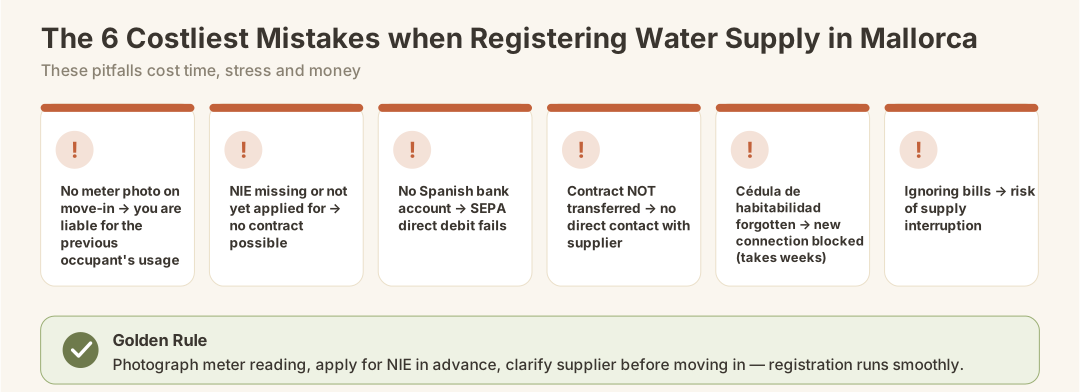
- No photo of the meter reading on moving in – Without documentation you may be held liable for the previous owner's consumption.
- Failing to transfer the contract into your own name – If a dispute arises and you are not a party to the contract, you have no direct point of contact with the supplier.
- NIE missing or not yet applied for – No NIE, no contract. Sort this out beforehand! → Apply for a NIE number
- No Spanish bank account – Direct debits run via SEPA, but many suppliers require a Spanish account.
- Forgetting the cédula de habitabilidad – Often mandatory for new connections; obtaining one takes time.
- Misidentifying the supplier – In border areas between municipalities there is sometimes confusion; always check with the Ayuntamiento.
- Ignoring invoices – Falling behind on payments risks a supply cut-off. Set up a direct debit.
- Making blanket assumptions about water quality – Palma is not Deià; find out the situation specific to your location.
What comes next? Setting up your other utilities
The water connection is usually just one of several steps when setting up your household on Mallorca. It makes sense to deal with the following at the same time:
- Empadronamiento: Registering your place of residence with the Ayuntamiento is the foundation for many dealings with the authorities → Empadronamiento on Mallorca
- Residencia: As an EU citizen, you are required to register after three months of residence → Applying for Residencia in Spain
- Electricity and Gas: Similar process to water, different providers (including Endesa, Iberdrola, Naturgy)
- Sort out Health Insurance: As a resident, you need clear cover → Health Insurance in Spain
Checklist: Registering Water Supply on Mallorca
- Identify the responsible provider for your address (EMAYA or Aguas de Mallorca)
- NIE number in hand (if not, apply for one first)
- Spanish bank account with IBAN in place
- Photograph the meter reading on moving in and save it with the date
- Obtain the last contract / customer number from the previous owner
- Have the tenancy agreement or Escritura ready
- Check the Cédula de habitabilidad (required for a new connection)
- Make an appointment with the provider or submit an online application
- Set up a SEPA direct debit mandate
- Check the first bill for accuracy (meter reading, reading shown as "real" or "estimada")
- Install a water filter or softener if needed
Conclusion
Registering water supply in Spain – more specifically, on Mallorca – is no great mystery, but it does require preparation. You will need your NIE, a Spanish bank account, and the right point of contact for your address. The tap water is safe to drink and meets EU standards, though taste and limescale content vary by region. In summer, supplies can run short in some municipalities – those living on a rural finca would do well to rely on a cistern and rainwater harvesting. Anyone who knows the pitfalls – lack of meter-reading proof, incorrectly identified provider, missing cédula – will complete the registration smoothly and can focus on what truly makes Mallorca special.
Official Sources
- EMAYA – Water provider for Palma de Mallorca: https://www.emaya.es
- Aguas de Mallorca – Island-wide provider: https://www.aguasdemallorca.com
- Govern de les Illes Balears – Water policy and environment: https://www.caib.es
- Ministerio para la Transición Ecológica y el Reto Demográfico (Miteco) – Water supply and resources: https://www.miteco.gob.es
- Fundación Renovables – Study on water consumption by tourists and residents in the Balearic Islands and Canary Islands (published 2026 in collaboration with Miteco)
- Germany Trade & Invest (GTAI) – Seawater desalination in Spain: https://www.gtai.de