
Emigrating to Mallorca: complete checklist & process
Emigrating to Mallorca as an EU citizen is easier than the many bureaucratic acronyms might suggest. No visa, no customs, no residence permit with a waiting period – you have freedom of movement, and the removal van simply rolls. The real work begins after arrival: NIE, Empadronamiento, Residencia and health insurance all need to be sorted in a sensible order, otherwise you'll go round in circles. This checklist guides you through the entire process step by step – with real addresses, current fees and realistic costs, so you know exactly what to expect on the island.

Who Mallorca is right for – and an honest reality check
Mallorca is defined by an image: sunshine, sea and a slower pace of life. That's true – and it's only half the story. Before you start packing furniture, it's worth taking a sober look at whether your vision for life here will actually work out.
Mallorca suits you well if:
- you work location-independently or remotely, receive a pension or live off assets – in which case you're insulated from the difficult local wage situation.
- you are willing to learn Spanish. In the south-west expat bubble you can get surprisingly far with German and English, but every visit to a government office, every GP surgery outside a private clinic and any genuine circle of local friends will require Spanish.
- you plan to stay for at least several years. The bureaucratic and financial effort of moving doesn't add up for just one year of trial living.
Be honest with yourself if:
- you need to earn money on the island. Wages are low, and good jobs outside tourism and construction are scarce. On the bright side: general living costs are typically around 15–25 % lower than in Germany (food and electricity are noticeably cheaper) – island surcharges, import prices and premium rents are the exception and sit above that.
- you expect affordable rental accommodation. The long-term rental market is chronically tight and expensive – more on that later.
- you underestimate the winter months. Mallorca in January is damp, many homes are poorly insulated, and tourist spots are half shut. Anyone who only knows August will encounter a different island entirely.
The most common misconception: emigrating as an extended holiday. Mallorca is a fully functioning place to live, with taxes, government offices, school places and a shortage of tradespeople – not a permanent resort.
The bureaucracy roadmap in a sensible order
This is where your start will be either smooth or a slog. The four core steps build on one another, and the order is no coincidence: many subsequent steps require the outcome of the previous one. As an EU citizen, you have three months after entry to register (Real Decreto 240/2007).
A tried-and-tested, practical sequence on Mallorca:
| Step | What | Where (Mallorca) | Cost | Duration / Deadline | Do you need this beforehand |
|---|---|---|---|---|---|
| 1 | NIE (Foreign Identification Number, 'white NIE') | Oficina de Extranjería, C/ Felicià Fuster 7, Palma – or Comisaría of the Policía Nacional, with Cita Previa | free of charge for the straightforward assignment | Issued in approx. 1–2 weeks, appointment often weeks away | Passport/national identity card, form EX-15 |
| 2 | Empadronamiento (registration of residence on the padrón) | Ayuntamiento of your municipality of residence; in Palma: Padrón, Plaça de Santa Eulàlia 9, with Cita Previa (Tel. 010) | free of charge | usually immediate, certificate issued on the same day | Rental contract + utility bill or escritura, identity document/NIE |
| 3 | Residencia / CUE (Certificado de Registro, 'green NIE', form EX-18) | Oficina de Extranjería or Comisaría of the Policía Nacional, Palma, with Cita Previa | 12 € Tasa (Modelo 790-012) | Certificate often issued on the day of the appointment, otherwise within a few days | Proof of health insurance and financial means (for non-employed persons) |
| 4 | Tarjeta Sanitaria Individual (TSI) | Centro de Salud (IB-Salut) in your place of residence | free of charge | Card delivered by post, generally after 10–15 days | Padrón, proof of entitlement (employment/Convenio/S1) |
The important logic behind this:
- NIE first is the practical approach, as you need the number for almost everything – bank account, rental contract, electricity and water registration, car. The NIE alone does, incidentally, not automatically make you liable to tax in Spain; it is simply an identification number. Note: As an EU citizen, you can often skip the separate 'white NIE' (EX-15), because the Certificado de Registro (EX-18, green NIE) assigns your NIE to you directly.
- Empadronamiento requires proof of residence (rental contract or property ownership). Many town halls will accept the registration even without a prior NIE, while others require it beforehand – this depends on the municipality. The padrón is subsequently a prerequisite for residencia, tarjeta sanitaria, school enrolment and local authority services.
- Residencia (CUE): Mandatory after a stay of more than three months. The Certificado de Registro de Ciudadano de la Unión assigns your NIE (if not already in existence) or records it on the certificate. When it is issued, you must demonstrate, depending on your status, what you are living on: employment contract/registration with the Seguridad Social (employees), censo registration (self-employed), or – if you are not in employment – health insurance plus sufficient financial means.
- Tarjeta Sanitaria comes last, as it is based on the padrón and a clarified insurance entitlement.
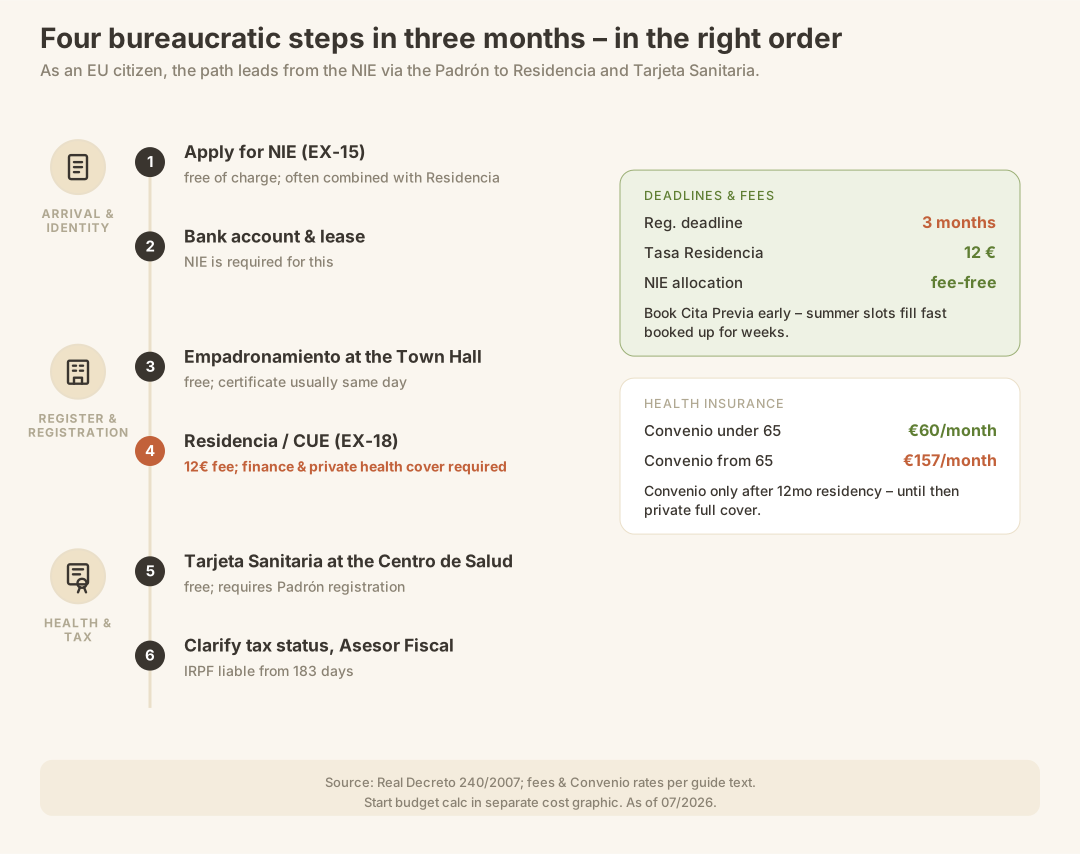
Practical tip: On Mallorca you can often combine the NIE and residencia in a single visit to the authorities, as both the Oficina de Extranjería and the Comisarías of the Policía Nacional in Palma have jurisdiction (though the specific counter may differ). State this explicitly when you arrive for your appointment. And book your Cita Previa as early as possible – during the summer months, the next available appointment is often several weeks away.
What does emigrating really cost
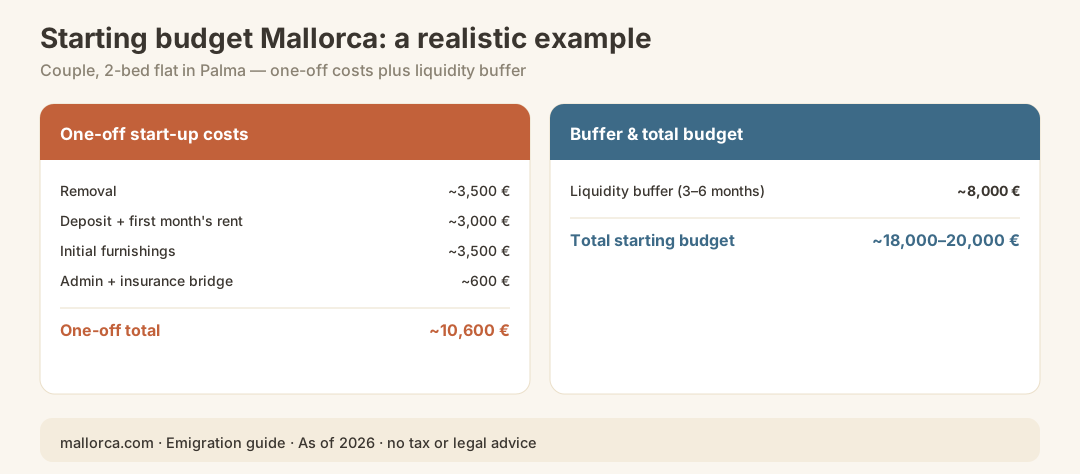
The move itself is just one item. The expensive part of starting out is what you have to advance all at once, before the first salary or the first pension payment lands in your Spanish account. Plan therefore with a liquidity buffer, not just with the removal firm's quote.
| Item | Realistic range | Note |
|---|---|---|
| Removal company (DE → Mallorca, by lorry + ferry) | 2.500 – 5.000 € | Mid-to-high estimate for full households; overland route via Barcelona/Valencia, then overnight ferry; no customs (EU single market). Small households and part-loads considerably cheaper |
| Container/part-load as a rule of thumb | 80 – 120 € per m³ | Calculate volume in advance; small household with part-load from ~1,200 € |
| Rental deposit (1 month's cold rent by law) | 1.000 – 2.500 € | Plus often up to 2 additional months' rent permitted as extra security |
| First month's rent + any estate agent's commission | 1.000 – 2.900 € | For long-term rentals, the estate agent's fee is in principle borne by the landlord |
| Initial furnishings (furniture, kitchen, household goods) | 2.000 – 6.000 € | Highly dependent on what is being brought along |
| Authorities & translations (NIE/Residencia, certified translations) | 100 – 600 € | Tasa Residencia only 12 €; costs rise with gestor/lawyer and legal translations |
| Health insurance (private, compulsory bridging at first) | 50 – 150 € per month per person | Until you gain access to the public system through employment or Convenio |
| Financial/liquidity buffer | 6.000 – 10.000 € | 3–6 months' living expenses until everything is up and running |
Worked example for a couple renting a 2-room flat near Palma: removal ~3,500 €, deposit + first month's rent ~3,000 €, initial furnishings ~3,500 €, authorities/insurance bridging ~600 €, buffer ~8,000 € – realistically you're looking at around 18,000–20,000 € as a starting budget that you should have available. Anyone buying rather than renting should add the purchase ancillary costs on top, calculated separately.
You can find full details of the purchase ancillary costs when buying a property (transfer tax, notary, land registry) in our guide to purchase ancillary costs on Mallorca.
Housing: renting or buying
Most expats rent first – for good reason. You get to know regions, micro-locations and neighbourhoods at your leisure before tying up capital. Only then do you decide whether to buy.
Renting – what you need to be prepared for:
- The long-term rental market is tight and highly competitive. In Palma, the average rent is around 18.70 €/m² (as of January 2026). Basic apartments outside central locations start at the lower end at ~650 €; in the centre, studios are typically more in the 750–900 €+ range; a 2-room flat starts at ~1,400 €, with premium locations such as Santa Catalina, Portixol or the south-west coast considerably higher.
- The minimum statutory tenancy period is 5 years for private landlords and 7 years for companies – with automatic renewal. This gives you security as a tenant.
- The deposit is legally set at one month's net rent (fianza); in addition, the landlord may require up to two further months' rent as security.
- For a tenancy agreement you will generally need a NIE and a Spanish bank account – yet another reason to sort out your NIE right at the start.
The typical pitfalls – damp in winter, contractual clauses, allocation of utility costs – are covered in depth in the Expat Guide.
Buying makes sense if you are confident about both the region and your long-term plans. A well-founded market overview with price levels by location is provided in our Mallorca Market Report, and the legal steps and ancillary costs in our Property Guide.
Health insurance: your route into the system
Health insurance in Spain
Explanation
The calculator identifies your access route. Public insurance routes are not freely interchangeable options.
Explanation
Completed years on the reference date.
Explanation
Have you lived continuously in Spain for at least twelve months immediately before applying?
Explanation
The municipal population register is called the Padrón. Are you currently registered in the municipality where you are applying?
- Monthly cost of your route
- €60.00
- Your route
- Convenio especial (special agreement with the health service)You can apply · Art. 3 a)–c), Art. 4.4 RD 576/2013
Do you have another public healthcare entitlement?: No
Legal status: 1 January 2026
This calculation is provided for guidance only and is not a substitute for tax or legal advice in specific cases.
This is the point that many people underestimate. When applying for residencia, non-working applicants must provide proof of health insurance with full coverage in Spain. There are three routes into the system:
- Through employment (Seguridad Social): If you are employed or self-employed as an autónomo, you pay into the social security system and are covered (along with your family) by public insurance. For newly self-employed individuals, contributions in the first year are significantly reduced (tarifa plana of around 80 € per month for the first 12 months; with the MEI surcharge effectively ~88 €) and cover, among other things, health insurance and pension contributions.
- Via an S1 form: Retirees receiving a statutory pension from Germany can "export" their entitlement to health insurance coverage via the S1 form from their German health insurer to Spain, and are then treated as publicly insured within the IB-Salut system.
- Convenio Especial (voluntary public insurance): The fallback route for anyone who does not qualify under either of the other two options. Through IB-Salut you voluntarily buy into the public system.
| Convenio Especial (IB-Salut) | Value |
|---|---|
| Contribution under 65 years of age | approx. 60 € per month |
| Contribution from age 65 | approx. 157 € per month |
| Requirement | at least 12 months of uninterrupted residency immediately prior to the date of application (registration in another EU/EEA/Swiss/UK country counts towards this); registered in a Balearic municipality at the time of application |
| Included | Basic care within the cartera común básica (GP, specialists, pre-existing conditions) |
| Not included | Prescription medicines (pharmacy), orthopaedics/prosthetics, non-emergency patient transport |
Important: Due to the 12-month requirement, the Convenio Especial is not available on day 1 (unless residency time from another EU/EEA/Switzerland/UK country is credited to you). For the transitional period – and without employment or an S1 – you will need comprehensive private health insurance, which you will also need to present for your Residencia application. Make sure you plan for this bridge period.
More details and provider comparisons can be found in our Expat Guide to Health Insurance.
Working and taxes: the key points upfront
Days spent in Spain
Explanation
Days of presence are every day you were in Spain, including days between two documented stays unless you can prove you were abroad. Arrival and departure days each count in full.
Explanation
Sporadic absences (“ausencias esporádicas” — short trips abroad) are days not included in the figure above. The law adds them rather than subtracting them.
Explanation
A tax residence certificate (“certificado de residencia fiscal”) is confirmation from a foreign tax authority that you are tax-resident there; it is valid for one year. It excludes only sporadic absences, not your presence in Spain.
Based on your entries, neither criterion is met.
Interim result: the calendar year is still in progress.
- Total residence days counted
- 150 days
- Statutory threshold (more than)
- 183 days
150 = 150 days
Days needed to cross the threshold: 34.
Legal status: 1 January 2007
This calculation is provided for guidance only and is not a substitute for tax or legal advice in specific cases.
Once you move the centre of your life to Spain and spend more than 183 days per year here, you will generally become tax resident in Spain – and therefore liable to pay income tax (IRPF) on your worldwide income. This is independent of the NIE, which is merely an identification number; registration of residence alone does not in itself establish tax liability – what counts is the 183-day rule and/or the centre of your economic interests.
The key points:
- Employed: Your employer registers you with the Seguridad Social; income tax and social security contributions are processed via the payroll.
- Self-employed (Autónomo): Registration with the tax office (Censo, Modelo 036/037) and with the Seguridad Social. Quarterly VAT and advance payment declarations are mandatory. In the first year the tarifa plana applies (around 80 €, with MEI approximately 88 € per month).
- Retirees/those of independent means: Foreign pensions and investment income must in principle also be declared in the Spanish tax return; double taxation is prevented by the double taxation agreement between Germany and Spain.
Taxes on Mallorca are not straightforward. A local tax adviser (Asesor Fiscal) is almost always the right investment here – the subject matter is structured differently from Germany. A well-founded overview is provided in our Expat Guide.
The best places for expats
Where you end up shapes your Mallorca experience more than anything else. Three categories help you get your bearings – from premium to more affordable.
| Region | Character | Best suited for | Rental level (approximate) |
|---|---|---|---|
| Palma & South-West (Andratx, Port d'Andratx, Portals, Santa Ponsa, Bendinat) | International, well connected, lively year-round, premium hotspot | Working professionals, families, anyone who wants infrastructure and an international atmosphere | Palma apartments 1.400–2.900 €, premium south-west 2.500–4.000 € |
| Son Vida | Exclusive villa enclave, the most expensive location on the island | Buyers/renters in the ultra-luxury segment | predominantly villas, long-term ~11.000–35.000 €/month |
| Tramuntana Premium (Deià, Valldemossa, Sóller) | Culture, nature, tranquillity, exclusivity, and limited supply | People of independent means, creative professionals, nature lovers with the budget | Upmarket, supply tight |
| More affordable alternatives (Llucmajor, Marratxí, Santa Maria, inland villages) | Quieter, closer to genuine island life, less expensive | Budget-conscious buyers, families who want space over location | Noticeably below Palma/South-west |
The South-west and Palma are the heart of the international community – here you'll find doctors, schools, clubs, and networks in German and English, though you pay the highest rents for the privilege. Son Vida is the most expensive address on the island, essentially a villa enclave with correspondingly high long-term rents; more affordable premium apartments are more readily found in Bendinat, Santa Ponsa, Portals, or in the centre of Palma. The Tramuntana villages of Deià, Valldemossa, and Sóller represent premium culture and nature, but are expensive and very quiet in winter. Those looking for more affordable living should look inland and to the commuter-belt municipalities around Palma – more square metres for your money, though with more Spanish in daily life and less within walking distance.
The most common mistakes when relocating to Mallorca
These pitfalls regularly cost people relocating to the island time, money, and stress:
- Ignoring the order in which to approach the authorities. Anyone who turns up for a rental contract without an NIE, or heads to the Tarjeta Sanitaria office without a padrón, will be turned away. The sequence NIE → padrón → residencia → TSI makes for the smoothest start.
- Booking a cita previa too late. Without an appointment you won't be seen, and in summer available slots are booked out for weeks. Book as soon as you arrive.
- Underestimating the proof-of-funds requirement. For non-working residents the authorities scrutinise this carefully, and there is no legally fixed amount – assessment is made on an individual basis. Bring comprehensive documentation (bank statements covering several months, pension award letter, proof of assets).
- Overlooking the health insurance gap. The affordable Convenio Especial only kicks in after 12 months of residencia – without a private bridging policy you'll lack the proof of insurance needed for your residencia application.
- Ignoring tax obligations. Having your centre of life in Spain and spending more than 183 days there means filing a Spanish tax return. Without a local asesor you risk errors and penalty payments.
- Blanking out the winter. Poorly insulated properties, high humidity, and the risk of mould – when renting, pay close attention to heating and ventilation.
- Underestimating the pace of the rental market. Good long-term rentals are gone within hours. Without an NIE, a bank account, and complete paperwork you'll lose the property to the next applicant.
Your 6-month checklist
A realistic roadmap from the decision to move through to settling into everyday life:
Before the move (months -3 to -1)
- Establish your budget and liquidity buffer (guideline figure for a couple: ~18.000–20.000 €)
- Compare removal companies, calculate volume, check part-load options
- Take out comprehensive private health insurance to cover the transition period
- Gather important documents and have them officially translated where necessary (Apostille/Hague Convention)
- Narrow down your preferred area, research long-term rental options
First weeks (Month 1)
- Book a Cita Previa for NIE / Residencia
- Open a Spanish bank account
- Sign the tenancy agreement, pay the deposit
- NIE apply (EX-15) – or combine directly with the Residencia
Arriving (Months 1–2)
- Empadronamiento complete at the Ayuntamiento (padrón)
- Residencia / CUE apply (EX-18, 12 € Tasa, proof of finances and insurance)
- Set up electricity, water, and internet
- Clarify your tax status, find an Asesor Fiscal
Settling in (Months 2–6)
- Tarjeta Sanitaria apply at the Centro de Salud (once your entitlement has been confirmed)
- Re-register your car or register a Spanish vehicle
- If working: complete your Seguridad Social / autónomo registration
- Start a Spanish course, build a local network
- After 12 months of residency: consider switching to the Convenio Especial
Conclusion
Moving to Mallorca is not a legal minefield – as an EU citizen you have freedom of movement, and the four key steps of NIE, Empadronamiento, Residencia, and Tarjeta Sanitaria can be completed within a few weeks if you follow the right order and book appointments early. The bigger hurdles lie elsewhere: in the tight, expensive rental market, in the 12-month gap before you qualify for the affordable public Convenio, in your tax obligations, and in taking an honest look at whether your income and lifestyle plans are a realistic fit for the island. Good to know: general living costs are usually lower than in Germany – which eases budget planning, as long as you factor in the expensive rental market. Those who arrive with sufficient funds, a well-chosen area, and realistic expectations will find that Mallorca offers a way of life that many people can only dream of on holiday. Plan your move carefully – then you'll have time for the things that brought you here in the first place.
Official sources
- Policía Nacional – EU citizens / Certificado de registro (Cuerpo Nacional de Policía)
- Form EX-18 – Certificado de residencia comunitaria (Ministerio de Inclusión)
- Modelo 790-012 – Tasa payment (Sede Electrónica Policía)
- Ayuntamiento de Palma – Alta en el Padrón Municipal
- IB-Salut – Tramitación de la tarjeta sanitaria individual
- IB-Salut – Convenio Especial de asistencia sanitaria
- IPREM – Indicador Público de Renta de Efectos Múltiples (official table)
Disclaimer: This guide is intended for general orientation purposes only and does not replace individual legal, tax, or insurance advice. Official requirements, fees, and thresholds are subject to change and may vary depending on the authority concerned. Always check the official sources before taking any step, and seek qualified professional advice for legal, tax, or health-related matters.