
Biniamar, Mallorca: Village Life on the Edge of the Tramuntana

Places to stay in Biniamar
AdTo load the accommodation map by our partner Stay22, we need your consent for marketing cookies. Your consent applies to all marketing content on mallorca.com.
Biniamar is one of those small places in Mallorca whose appeal does not come from a long list of tourist attractions. The village belongs to the municipality of Selva and lies in the centre of the island at the foot of the Serra de Tramuntana, between the plain around Inca and the first foothills of the mountains. Old stone houses, a small central square and two very different churches define its appearance. For visitors, Biniamar is especially worthwhile as a peaceful stop on a drive through the island’s interior: the unfinished Església Nova is an unusual structure, while the parish church of Santa Tecla and the surrounding lanes offer a glimpse of a village that does not stage its daily life for tourism. Large museums, shopping areas or a packed sightseeing programme should not be expected here.
For people who want to live permanently in Mallorca, this limited tourist influence is precisely what makes the village interesting. Biniamar offers rural residential settings near the Tramuntana while remaining connected to the centre of the island and the capital by the roads towards Inca and Palma. The weekly market, church festivals and events in the Església Nova show that the village consists of more than homes and still has its own meeting places. Anyone seeking peace, enjoying walks through established village centres or wishing to combine Biniamar with Selva, Mancor de la Vall, Inca and a drive along the edge of the Tramuntana will find a small, distinctive place here. Biniamar is less suitable as the sole destination of a long sightseeing day; its quality lies in its intimacy, scale and details.
History of Biniamar
The architectural history of Biniamar can be seen particularly clearly in its two churches. Santa Tecla was built in the 17th century, when the local community needed a place of worship of its own. The church remained comparatively modest and was extended in the 20th century. It represents the older village structure that developed gradually over a long period around today’s centre.
At the beginning of the 20th century, a considerably more ambitious project was pursued. The Spanish politician and prime minister Antonio Maura Montaner, who had connections to Biniamar, supported the construction of a new church. The plan was for a larger religious building with Gothic-inspired forms. However, the project lost its financial foundation and was abandoned in 1909 without a roof or interior. Unlike many abandoned building projects, the ruin was not later demolished.
The different treatment of the two places of worship continues to shape Biniamar today. Santa Tecla remained the village’s religious church, while the Església Nova developed into an open space for sport and culture. There is a playing court inside; the building also serves as a setting for concerts, theatre and other community events. The historical failure of the church project thus became part of contemporary village life.
Biniamar’s development can therefore be understood less through major political events than through its built environment. The narrow streets lined with traditional stone buildings lead to the small village centre, while the unfinished church at the edge of this established fabric appears like a monument to an unrealised modernisation project. The village has no monumental old town, but it offers a clearly legible juxtaposition of older community life and an unusually repurposed building project from the early 20th century.
Sights in Biniamar
Església Nova
The Església Nova is Biniamar’s most striking building. Its high, Gothic-inspired walls enclose a space that lacks both a roof and a conventional church interior. Construction was abandoned unfinished in 1909 after the financing of the project backed by Antonio Maura Montaner collapsed. As a result, the site feels simultaneously like a church, a ruin and an open courtyard.
Its present-day use makes the building even more unusual. There is a sports court inside, and cultural events, concerts and theatre performances are also held here. Anyone visiting the Església Nova outside an event should therefore not expect a museum-style attraction. What is interesting instead is the visible connection between historic architecture and everyday use. During events, its character changes completely: the unfinished church walls become a stage and a communal space.
Església de Santa Tecla
Santa Tecla is the actual village church and stands in the centre of Biniamar. It was founded in the 17th century and extended in the 20th century. Compared with the Església Nova, it remains small and understated; this is precisely why it fits the scale of the surrounding village square and neighbouring residential streets.
A relic of Saint Thecla is kept inside. The saint is honoured every year on 23 September, linking the building to the local festival calendar. Visitors will not find a major art-historical display here, but rather the village’s religious centre, which remains in use. Whether it is possible to look inside depends on current opening arrangements and services.
Plaça Major
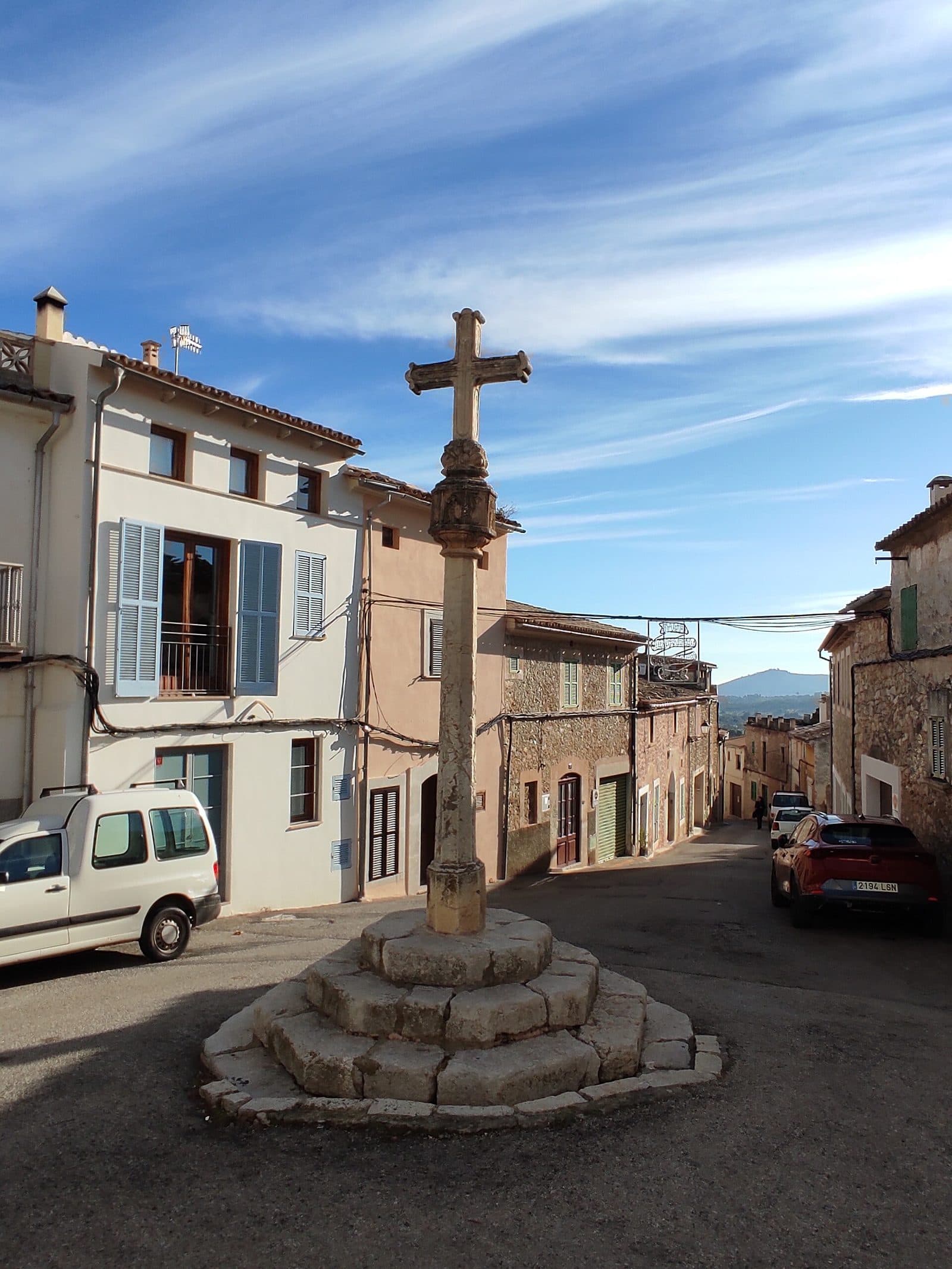
Plaça Major is the natural point of orientation for a walk through the village. The square is small and enclosed by traditional Mallorcan buildings and the church of Santa Tecla. It does not have the imposing scale of the main squares in larger places on the island, but for that very reason it clearly conveys how closely public space, church and homes are grouped together in Biniamar.
The square is a suitable starting point for exploring the village centre without a fixed route. Short streets lead from here through the old village fabric and onwards towards the Església Nova. What is worth seeing lies less in individual façades with information panels than in the interplay of natural stone, narrow streets and the transition to the rural surroundings.
The Old Village Streets
Between the central square and the Església Nova are streets lined with old stone houses, simple façades and the intimate scale typical of Mallorca’s interior. A walk is particularly worthwhile for visitors who do not define architecture solely by outstanding monuments. Entrances, walls and street perspectives show that Biniamar has remained, first and foremost, a place where people live.
Consideration is important: the lanes are not an open-air museum but the residents’ immediate living environment. The quiet transitions between the compact centre and the more open areas at the edge of the village are especially interesting. From there, Biniamar’s geographical position also becomes clear—still in the centre of the island, but already distinctly below the mountainous edge of the Serra de Tramuntana.
The Weekly Market
Biniamar’s weekly market is small and geared towards local needs. The main products on offer are fresh goods from the surrounding area, with local agricultural produce, goat’s cheese and preserves specifically mentioned. This distinguishes it from large, heavily tourist-oriented markets where clothing, souvenirs and extensive food services often account for a significant share of the stalls.
Its importance, however, is not limited to shopping. In a place of this size, the market is also a regular meeting point and a visible part of village life. Visitors gain a better impression of Biniamar here than they would from a simple photo stop at the Església Nova. The selection remains manageable, and the market can easily be combined with a walk through the village centre and a break at Plaça Major.
The market is particularly interesting for self-catering visitors staying nearby and looking for regional food. However, it is not a substitute for a large grocery shop. Anyone expecting an extensive selection, specialist shops or the scale of one of the island’s well-known markets should not compare Biniamar with Inca or other larger market towns.
On market mornings, the small centre is naturally busier than on ordinary days. Because everything takes place within a confined area, it is advisable not to try to park directly beside the square. After shopping, the visit can continue past the church of Santa Tecla and through the old streets to the Església Nova. The market is therefore not a separate tourist event, but part of a short, coherent visit to the village.
Activities and Excursions
Walking Tour of Biniamar
The most obvious activity is a walk between Plaça Major, Santa Tecla and the Església Nova. A fixed route is not necessary: the village centre is compact, and the most important impressions are found along the connecting streets. Anyone wishing to photograph the architecture should also remember that many of the subjects are private homes.
The walk is also suitable for families, provided that a conventional entertainment programme is not expected. Children often find the open church more engaging than an ordinary religious building because its current use as a sports and event space is immediately apparent. The streets in the historic centre nevertheless require attention because of local traffic.
Serra de Tramuntana and Neighbouring Villages
Biniamar lies at the foot of the Serra de Tramuntana and is suitable as a peaceful beginning or end to a day along the edge of the mountains. Selva and Mancor de la Vall are among the most obvious places to include on a village tour through this part of the island. Here, the landscape shifts between the flatter island interior and the rising terrain of the Tramuntana foothills.
For more demanding hikes, Biniamar should not automatically be regarded as a designated starting point. It makes more sense to choose a specific route in the Serra in advance and combine it with a visit to the village. This leaves enough time for the churches and village centre without turning Biniamar into a hiking hub that its tourist infrastructure does not support.
Inca
Inca is the practical counterpart to the small village. The town offers a much more urban setting, shopping facilities and a rail connection towards Palma. An excursion can therefore be divided effectively: Biniamar for architecture and village atmosphere, Inca for errands, dining and other urban amenities.
This combination is also relevant for travellers without their own car. The train runs from Palma to Inca, but another stage of transport is required for the remaining section to Biniamar. Anyone wishing to travel flexibly should plan this connection in advance rather than searching for an improvised solution only after arriving at the station.
Festivals and Events
Festival of Santa Tecla
Santa Tecla is the village’s religious patron. Her relic is kept in the village church, and the annual observance takes place on 23 September. For visitors, this date is an opportunity to experience Biniamar not merely as a quiet place of architecture, but as an active village community.
During a local patronal festival, the central area is livelier than on ordinary days. The church and square then regain their original roles as the religious and social centre. Anyone mainly seeking peace and undisturbed architectural photography would be better choosing another day; those wishing to experience village life will find the festival a fitting occasion.
Culture in the Església Nova
The Església Nova regularly serves as a venue for concerts, theatre and other events. The open building provides a setting that is markedly different from a conventional hall. The high, unfinished walls remain visible, while the interior is used as a sports area, stage or audience space depending on the occasion.
Because the building is not a permanently equipped cultural centre with a daily programme, its special appeal comes from its changing uses. On an ordinary walk, the architecture is the focus; during a concert or theatre evening, the history of the failed church project becomes the backdrop to a contemporary event.
Vins a Biniamar
With Vins a Biniamar, the Església Nova has also been used for an event combining Mallorcan wine, gastronomy and live music. An edition on 16 May is documented for 2026. Tastings of various island wines and food offerings were brought into the open church space for the occasion.
The format demonstrates the role the Església Nova can play for Biniamar: it is neither exclusively a monument nor merely a sports facility, but a versatile public venue. Anyone planning to travel for a specific event should check the current events calendar, as individual dates and programmes cannot be inferred from ordinary village life.
Travel and Getting Around
By Car from Palma Airport
From Palma Airport, the road route follows the Ma-30, then the Ma-13 and finally the Ma-2130 to Biniamar. The distance is 41 kilometres by road, and the journey takes around 46 minutes. In practical terms, most of the trip follows high-capacity main roads; only the final section enters the smaller road network at the edge of the Tramuntana.
For travellers with luggage or accommodation outside the village centre, a car is the most straightforward option. Within the village itself, the streets are narrower than the approach roads. For a walk, it is more pleasant to park legally outside the tightest part of the centre and connect Plaça Major with the Església Nova on foot.
By Car from Palma
From central Palma, the distance is 38 kilometres by road via the Ma-13 and the Ma-2130. The journey takes around 51 minutes. Biniamar is therefore still within reach of the capital, but it is not a directly connected suburb. For daily journeys, the transition from the local roads to the Ma-13 is particularly important.
The route is easy to plan for a day trip: from Palma, it first heads towards the centre of the island and then to the edge of the Tramuntana. When travelling during typical commuting hours, additional time should be allowed for city traffic in Palma; the basic reference point nevertheless remains the measured journey of around 51 minutes.
By Train and Bus
Biniamar does not have its own railway station. The train from Palma reaches Inca, from where another connection towards the village is required. For visitors without a car, the journey therefore does not work as a direct train ride. Timetables and connections should be planned as a complete travel chain, especially for the return journey.
Bus stops are located around the surrounding places. The timetable module on the page shows which connection is practical on the relevant travel date. Public transport is less flexible than a car or taxi for a spontaneous short visit because the journey between the village and the chosen connection must also be considered. Anyone wishing to combine several places along the edge of the Tramuntana in one day is considerably more independent with a vehicle.
Getting Around the Village
Walking is the most sensible way to get around Biniamar. The central square, Santa Tecla, the residential streets and the Església Nova can be experienced as one connected walk. A vehicle provides no sightseeing advantage in the tight centre and tends to make orientation more difficult on market or event days.
The routes are ordinary village streets, not a completely closed pedestrian zone. Particular attention should therefore be paid to local traffic at driveways, junctions and narrow sections. People with limited mobility are advised to check the condition of their chosen route on site rather than assuming a continuously accessible circular walk.
Bus lines to Biniamar at a glance
| Line | Route | Departures/day | First | Last |
|---|---|---|---|---|
| 313 | Selva - Inca | 56 | 06:58 | 21:43 |
| 312 | Lluc - Inca - Muro | 32 | 08:08 | 18:20 |
From the official GTFS feeds (TIB/SFM), no real-time data. The figures cover all stops in the town; weekend and holiday services differ — check with the operator before travelling.
Getting there by bus
Selva 2 (58002) · 1.0 km as the crow flies
- 312Lluc - Inca - Muro · Daily
- 313Selva - Inca · Daily
Selva 1 (58011) · 1.0 km as the crow flies
- 312Lluc - Inca - Muro · Daily
- 313Selva - Inca · Daily
Camarata 2 (58001) · 1.2 km as the crow flies
- 312Lluc - Inca - Muro · Daily
- 313Selva - Inca · Daily
Camarata 1 (58010) · 1.2 km as the crow flies
- 312Lluc - Inca - Muro · Daily
- 313Selva - Inca · Daily
Timetable data: official GTFS feeds (TIB/EMT), no real-time — check with the operator before travelling.
Living in Biniamar
Daily Life and Local Amenities
Biniamar is primarily a residential village, not a holiday centre. The small weekly market provides a regular opportunity to buy fresh produce, goat’s cheese and preserves from the region. For a complete weekly shop and a wider selection, nearby Inca plays the more practical role. Shopping, urban services and the rail connection to Palma come together there.
This division of functions is crucial to daily life: the village offers peace, short distances within the centre and a manageable social environment, while more extensive errands must be planned elsewhere. Anyone considering a move should look beyond the residential street and specifically assess personal routes to work, shops, medical care and school.
Living in the Old Centre and on the Village Edge
In the centre, older stone houses, narrow streets and proximity to Plaça Major and Santa Tecla define residential life. This location offers immediate contact with village life, but it also brings the spatial characteristics of historic centres: narrow access roads, limited street space and more activity in the centre during festivals or on market mornings.
At the edge, development becomes more open and the transition to the rural surroundings is clearer. The square is less prominent as a social centre there, while proximity to the landscape and exit roads becomes more important. The right residential location therefore depends greatly on whether closeness to the village centre or an easier daily departure is the priority.
Commuting to Palma
The drive to central Palma follows the Ma-2130 and the Ma-13, covers 38 kilometres by road and takes around 51 minutes. Biniamar is therefore an option for people who want to live in the countryside while still travelling regularly to the capital. However, this is a genuine commute, not a short urban journey.
Without a car, the commute involves several stages because Biniamar has no railway station. Inca provides the train connection to Palma, but the section between the village and station must also be arranged. For regular commuting, not only the train times but also the feeder connection and the evening return are therefore crucial.
Living Without a Car
A car-free daily life requires planning rather than spontaneity. The village itself is easy to navigate on foot, but important destinations lie outside the centre. The railway connection in Inca is useful for journeys to Palma, but it depends on a reliable way of reaching it. The nearby bus stops do not automatically provide a direct door-to-door connection either.
For households without their own vehicle, the precise location of the home is therefore particularly important. Before moving, it is advisable to check how the workplace, school, shopping and medical appointments fit with the connections that can actually be used. Someone who mainly works from home and can combine larger errands will assess the situation differently from a person with fixed daily working hours in Palma.
Biniamar Outside the Holiday Season
Biniamar does not depend on a seafront promenade, large hotels or seasonal leisure businesses. Its rhythm is shaped more strongly by residential life, the market, the church and local events. The core of village life therefore does not disappear in winter when the traditional holiday season ends. At the same time, there is no tourist industry to compensate for missing everyday amenities.
For residents, this is a distinct advantage if they are seeking a peaceful, locally shaped environment. Anyone expecting many restaurants, shops and cultural offerings within walking distance throughout the year will instead look more often towards Inca or Palma. Biniamar is best suited to people who consciously choose village tranquillity and accept the necessary journeys as part of daily life.
Practical Information for Your Visit
The Right Time to Visit
A quiet morning is suitable for a first impression, when the village centre can be explored comfortably on foot. Anyone who also wants to experience regional products and more everyday life should choose market morning. On event days in the Església Nova or around the festival of Santa Tecla, the village is livelier, but access and parking in the centre may be less convenient.
The Església Nova is especially clear in daylight because its open design and missing roof structure are immediately visible. A cultural event, by contrast, reveals another side of the building. Both experiences are interesting, but they are not the same: a quiet architectural visit is suited to looking closely, while an event allows visitors to experience the building’s present-day use.
Duration and Expectations
Biniamar is a compact sightseeing destination. Anyone wishing to see Plaça Major, Santa Tecla, the old streets and the Església Nova does not need an entire holiday day. More time is worthwhile if the visit includes the market, a break or an event. The village is not designed for a long sequence of conventional sights, museums and shops.
For that very reason, a visit should not begin with an overloaded checklist. A slow walk focusing on the differences between the old parish church and the unfinished new building is more rewarding. Anyone wishing to continue afterwards can easily combine Biniamar with Inca and the villages of Selva and Mancor de la Vall.
Parking and Consideration in the Village Centre
The streets around the old centre are narrow and used by residents every day. A parking space directly beside Plaça Major is therefore not a sensible fixed point for planning. It is more practical to look for a permitted parking place outside the narrowest streets when entering the village and complete the rest of the route on foot.
On market and festival days, it should also be remembered that public life is concentrated around the square and churches. Entrances and driveways must remain clear. The village is not a tourist exhibition space; considerate treatment of private façades, courtyards and residents is part of a successful visit.
Recommended Combinations
Biniamar fits well into a route through the centre of the island and along the edge of the Serra de Tramuntana. Inca provides an urban contrast, while Selva and Mancor de la Vall continue the region’s village character. Anyone already planning an excursion into the mountains can use the walk as a peaceful beginning or end.
Visitors should not expect a beach, nightlife, large shopping streets or a full-day family entertainment programme. Biniamar is appealing as an inhabited village with two remarkably different churches, a small market and short distances. Its value lies precisely in this scale.
Eating, drinking and staying in Biniamar
The best-rated businesses from our directory, ordered by Google rating — not by advertising.
Restaurants
Latest news from Selva
- Mallorca electric cars and fire demo fill Palma
- Mallorca school start hit by heat, leaks and staff gaps
- Palma protest: up to 19,000 demand Sánchez quit
- Mallorca schools get €624,641 for roof repairs