
Ariany, Mallorca: Village Life in Pla de Mallorca

Places to stay in Ariany
AdTo load the accommodation map by our partner Stay22, we need your consent for marketing cookies. Your consent applies to all marketing content on mallorca.com.
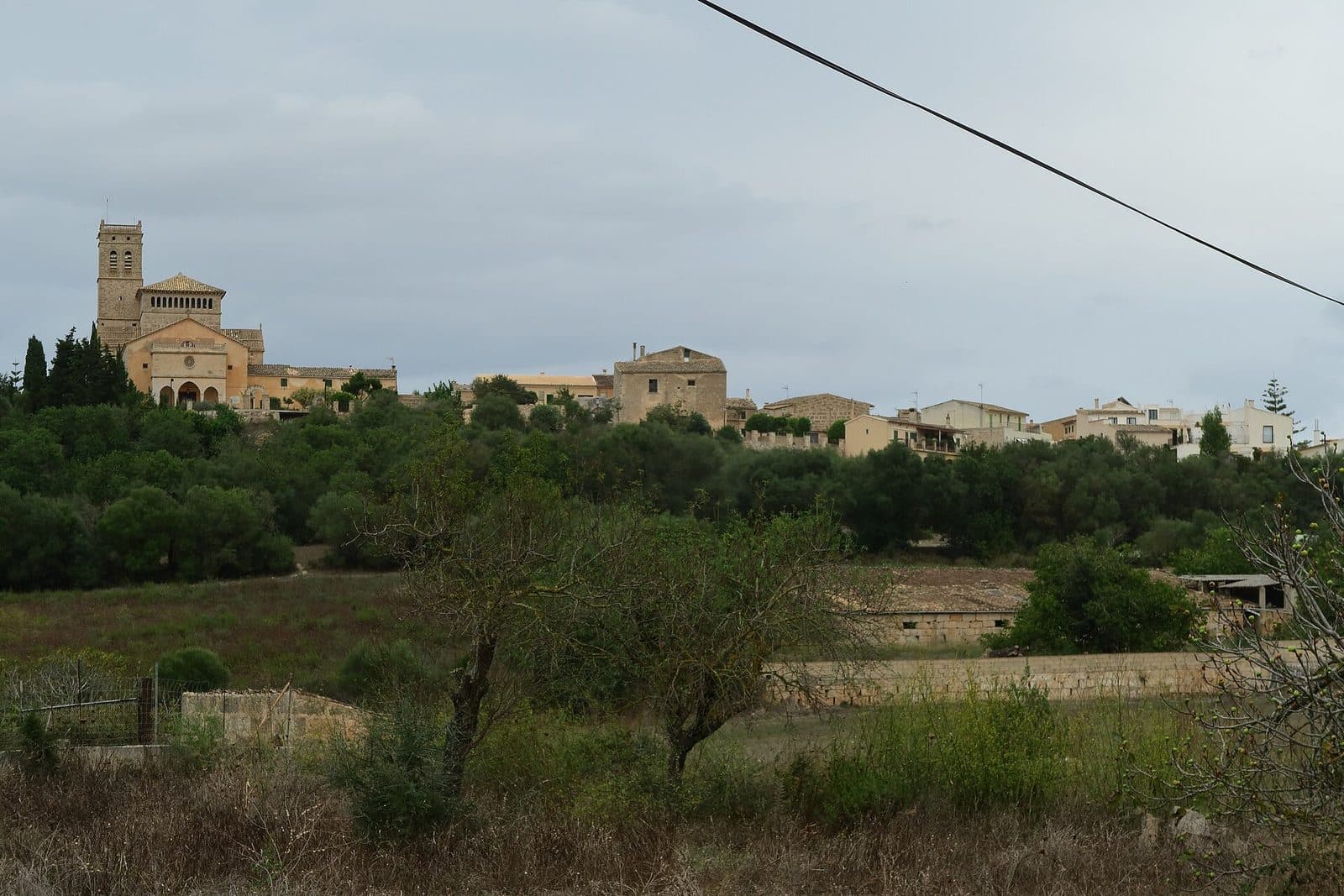
Ariany is one of those places where Mallorca does not feel staged for visitors. The small village stands on a hill in the eastern part of the island’s centre, between Petra and Santa Margalida. There is little sense of the coast here: fields, scattered country houses and the expansive landscape of Pla de Mallorca shape the impression. The centre is defined not by major attractions but by a church, old residential and agricultural architecture, and traces of a community long shaped by farming.
The village is interesting for travellers who deliberately explore rural Mallorca, want to visit small churches, look for windmills or walk through a little-visited village. Ariany fits particularly well into a route through Petra, Sineu and the Pla plain. Cyclists will also find it a peaceful starting point for tours through the island’s interior.
Its distinctive value is equally evident in everyday life. Ariany is not a seasonal coastal resort but a small residential community with an established village structure. The streetscape brings together simple houses, larger old properties and fincas on the edge of the built-up area. Holiday rentals play a visible role. Those who live here or spend an extended period in the village choose it primarily for its tranquillity, landscape and proximity to other places in the Pla.
A walk around the village is manageable, but it should not be reduced to the church alone. The setting on Puig de sa Cobetera, the historic s’Auberg estate, the preserved windmills and the view across the open countryside together explain why Ariany feels different from the larger market towns in the island’s centre.
History of Ariany
Prehistoric traces
Archaeological finds in the surrounding area indicate that the region was already inhabited in prehistoric times. The Talaiotic culture is mentioned in this context. Above all, the finds help place the landscape in context: the hills and arable land formed part of Mallorca’s settlement area long before the present village emerged.
Ariany after the Christian conquest
Under Jaume I., the conqueror of Mallorca, the settlement already appeared under its present name. Nevertheless, its medieval origins are not as monumentally visible in the village as they are in fortified towns or old monastic settlements. Ariany developed as a small rural community whose history remained closely linked to landownership, agriculture and a number of larger estates.
S’Auberg as an early settlement nucleus
S’Auberg played an important role in the village’s development. The historic estate is cited as the starting point of the later settlement nucleus. Its gateway, built with wedge-shaped stones, is one of the architectural details that still reveal the older building history. Ariany therefore did not emerge from a systematically planned town centre but grew out of a rural structure of paths, farmsteads and scattered buildings.
The path to becoming an independent municipality
For a long time, Ariany was connected to Petra and also belonged to its ecclesiastical sphere of influence. It was not until 1982 that the village separated from Petra and became an independent municipality. This comparatively recent municipal status explains part of its present identity: Ariany may have remained small, but it does not regard itself as a district of a larger neighbour.
History has not left a grand urban backdrop here. It can be read in the village’s location, its old estates, the church and the technical remains of agriculture. This understated heritage is precisely what makes Ariany a good example of how many small settlements in the Pla developed over the centuries.
Things to See in Ariany
Parish Church of Nuestra Senyora d’Atotxa
The Parish Church of Nuestra Senyora d’Atotxa is the village’s principal landmark. It is one of Mallorca’s more recent religious buildings, and its elevated position makes it the visible centre of Ariany. Its impact comes primarily from its relationship with the village: the building rises above the low houses and makes Ariany’s silhouette recognisable from the surrounding countryside.
During a walk, it is worth looking beyond the façade. The square and streets around the church convey Ariany’s scale particularly well. Homes stand almost directly beside the religious centre, and after only a few steps the village begins to merge back into the open plain. The church is therefore not merely an individual building but the best starting point for understanding the structure of the village.
S’Auberg
S’Auberg is one of Ariany’s most historically significant buildings. The historic estate represents the large rural properties around which the village developed. Its old gateway, with stones arranged in a wedge-shaped pattern, is particularly noteworthy. It reflects a type of construction in which a prestigious entrance also marked the transition between a public path and agricultural property. Its value lies in its historical context: the estate shows that Ariany originally emerged from an agrarian settlement landscape. Anyone viewing the building is therefore seeing less an isolated attraction than part of the early village nucleus.
The windmills of Ariany
Seven windmills have been preserved around Ariany. They are among the clearest reminders of the area’s agricultural past and shape the appearance of the hills and village outskirts. For visitors, the mills provide a good reason to leave the central streets and explore the transitions between village and fields. They are best understood as a group of landmarks that appear from different viewpoints. Together with the country houses and fields, they provide a vivid picture of the working landscape from which Ariany emerged.
Puig de sa Cobetera
Ariany stands on Puig de sa Cobetera, a prominent elevation in the north-eastern part of Pla de Mallorca. Its position explains why the village is clearly visible from the plain despite its small size. From elevated points and roads along the edge of the built-up area, views open across the flat to gently rolling surroundings.
The scenery is not a dramatic mountain panorama like that of Serra de Tramuntana. Its appeal lies in its breadth: fields, paths, individual farmsteads and distant villages structure the horizon. The Puig is therefore less a single viewpoint than the geographical foundation of the entire village.
Streets and traditional houses
The streets themselves are also among the sights worth seeing. Ariany has a small-scale built environment of modest village houses, larger rustic estates and buildings directly connected with agriculture. Elaborate groups of façades are not the main focus. More interesting are the proportions, stone surfaces, gateways and short transitions from continuous rows of houses to open countryside.
A slow walk reveals this structure more clearly than driving through. Precisely because Ariany does not offer a long list of spectacular individual monuments, the village is best understood through the relationship between its church, homes, windmills and landscape. It is enough to walk from the church centre in several directions to the edge of the built-up area.
The Weekly Market
Ariany’s weekly market is a small village market rather than a major visitor attraction. It takes place in the central area and is aimed primarily at everyday needs. Goods on offer include fruit and vegetables, textiles, plants and flowers. Its size and exact composition may vary depending on the season and the traders present.
Its modest scale is essential to its character. Anyone arriving from Inca, Sineu or one of the larger market towns should not expect long rows of stalls or a wide selection of souvenirs. In Ariany, the market remains closely connected to village life. Shopping, brief conversations and a visit to the centre blend into one another without the village being completely taken over by market stalls for several hours.
For travellers, the market is particularly worthwhile when a tour through Pla de Mallorca is already planned. The market alone will not fill half a day, but it gives a visit a clear rhythm: first browse the stalls, then see the church and surrounding streets, and finally walk to an elevated edge of the village. In this way, the small range of goods becomes a coherent introduction to Ariany.
For residents, too, the market has a different significance from a tourist-oriented farmers’ market. It regularly brings mobile traders into the village and creates a recurring meeting point in the centre. The selection of food, clothing and plants demonstrates its practical focus. Anyone looking for special delicacies, specialised crafts or a large food and drink area will be better served by the more extensive markets in neighbouring towns.
On market day, the centre feels livelier than on ordinary days. At the same time, the scale remains small enough to appreciate the church, squares and streets without large crowds. The period after the market is also suitable for photography and a peaceful walk around the village, when activity in the centre subsides and the architecture once again comes to the fore.
Activities and Day Trips
Cycling in Pla de Mallorca
The landscape around Ariany is particularly suitable for cycling tours through the island’s interior. The village does not lie on a tourist coastal route but within a network of country roads and rural connections between Petra, Santa Margalida and Sineu. The open plain offers expansive views, while smaller hills provide variety. Windmills, fields and scattered farmsteads give the routes a clear connection to the landscape.
Ariany serves more as a stop along the way than as the centre of a single signposted attraction. The church provides an easily visible landmark, and a break in the village can be combined with a short walk. When planning a route, bear in mind that even quiet country roads may carry regular traffic. For longer tours, carefully chosen minor roads are therefore more suitable than the direct through road.
Walking through the village and along the fields
A route from the centre to the windmills and the edge of the built-up area is ideal for a walk. The terrain does not require a mountain hike; its appeal lies in the alternation between narrow village streets, old houses and open countryside. As the sights are not concentrated in a clearly defined historic district, the best impression comes from freely exploring several streets. The elevation of Puig de sa Cobetera means that views across the Pla repeatedly open up along the way.
Petra
Petra is the most obvious addition to a visit to Ariany. The two places are directly connected by road but differ in scale and role. The Petra Estació bus stop is listed in the surrounding area. A combined route can begin with compact Ariany before allowing more time for Petra. Conversely, Ariany offers a peaceful conclusion after a livelier stay in Petra. The connection also illustrates the historical relationship that existed until their municipal separation.
Sineu
Sineu is another suitable destination on a driving or cycling tour through the Pla. The town has a centre with a parish church; at the entrance to the town, the Molí d’en Pau windmill is also a notable sight. Ariany retains its character as a small village on a hill.
Son Real
Those continuing north can combine the rural route with the necropolis of Son Real. The prehistoric burial site offers a different historical focus from Ariany while also bringing the route closer to the north coast. A full day trip can thus follow a coherent progression from the agricultural landscape of the Pla through a small village to an important archaeological site.
Festivals and Events
Fira Nocturna d’Ariany
Held in summer as a night fair, it combines culture, food and Mallorcan tradition. For Ariany, this marks a distinct change from the usual daily rhythm: streets and squares that are normally quiet become the setting for a communal evening celebration.
The night-time setting shapes the atmosphere. Rather than a traditional weekly market, the event places greater emphasis on lighting, food and social encounters in the centre than on the simple sale of goods. Visitors then experience Ariany not as a quiet stop on a tour but as a village making collective use of its public spaces. Its small size ensures that the event remains closely connected to the streets and squares of the village centre.
For 2026, the Fira Nocturna has been announced for 25 July. As specific programmes, traffic arrangements and individual offerings may change from year to year, the relevant events calendar should be consulted for later editions. Its fundamental character remains that of a summer night fair with local food and cultural contributions.
Anyone visiting the Fira should expect a very different situation from a normal day. The centre is busier, access may be less straightforward, and the village’s peaceful atmosphere temporarily recedes into the background. For people who already know Ariany from everyday life, however, the festival reveals an important second side of the village: for one evening, the small community can transform its squares into a lively shared meeting place.
The weekly market and the Fira Nocturna should not be confused. The market mainly serves practical shopping needs; the night fair is a summer festival.
Getting There and Getting Around
By car
Ariany lies on the route between Petra and Santa Margalida. Its location is central enough for a tour through the Pla while remaining away from the main tourist traffic routes. From many directions, the practical route first leads through one of the better-known neighbouring towns. The final section runs through open agricultural countryside before the church and buildings on the hill come into view.
A car offers the greatest flexibility, especially when combining Ariany with Sineu, Petra, Santa Margalida or a destination on the north coast. As the village centre itself is small, there is little benefit in driving along every street. It is more sensible to leave the vehicle outside the narrowest areas and explore the church, s’Auberg and residential streets on foot. More activity should be expected in the centre on market day and during the Fira Nocturna.
By public transport
Travelling by public transport requires more planning than reaching a larger town with a direct rail connection. The Petra Estació bus stop is listed in the surrounding area. The timetable information displayed on the page is more useful for this purpose than a general daily plan.
For a spontaneous visit without a car, Ariany is therefore less straightforward than Petra or Sineu. Anyone arriving by public transport should plan the outward and return journeys together and should not assume that onward travel is possible at any time. Within the village, however, there are few mobility issues: the church, centre and adjoining residential streets are close together and can be linked on foot.
By bicycle
Cycling suits Ariany’s location in Pla de Mallorca. The village can be included in circular routes between neighbouring municipalities and provides a natural stop on the hill. The direct road to Petra or Santa Margalida is easy to find, but quieter rural connections offer a more appealing cycling experience. In the village itself, the bicycle can be left for the short walk around; the distances between the central points do not justify constantly riding on.
Getting around the village on foot
Ariany is compact and is best understood on foot. The church serves as a landmark, with short routes leading from there to the older houses and the edge of the built-up area. A walk requires no special equipment, although sturdy footwear is more comfortable for paths beyond the continuously built-up streets. For people with limited mobility, the slopes of the hill and uneven surfaces may be more significant than the actual distance.
Bus lines to Ariany at a glance
| Line | Route | Departures/day | First | Last |
|---|---|---|---|---|
| T3 | Palma - Manacor | 77 | 06:28 | 23:21 |
From the official GTFS feeds (TIB/SFM), no real-time data. The figures cover all stops in the town; weekend and holiday services differ — check with the operator before travelling.
Getting there by bus
Petra Estació (222) · 1.6 km as the crow flies
- T3Palma - Manacor · Daily
Timetable data: official GTFS feeds (TIB/EMT), no real-time — check with the operator before travelling.
Living in Ariany
Everyday life in a small rural community
Ariany is primarily a place to live and only secondarily a travel destination. Its daily rhythm is not determined by beach tourism, excursion buses or a large pedestrian precinct. The centre remains compact, and the open countryside begins after only a few streets. For residents, this means short distances within the village but also a greater reliance on surrounding towns whenever specialised shopping or onward connections are needed.
The weekly market regularly brings additional activity to the village centre. Anyone expecting a constant choice of restaurants, shops and entertainment will assess the location differently from someone deliberately seeking a peaceful place to live.
Living in the village centre
Traditional houses stand close to the streets in the village centre. The church is a constant landmark, and journeys through the village can be made on foot. Simple homes, larger old properties and fincas shape the overall impression. Although the buildings stand relatively close together, the development remains small-scale and quickly gives way to peripheral areas.
This area is attractive as a residential choice for those wanting a direct connection to village life. The market, public spaces and few everyday meeting places can be reached without driving. At the same time, the normal sounds of a small community are part of life here, particularly on market days and during festivals. Ariany is quiet, but it is not an enclosed holiday complex.
Fincas and houses on the village outskirts
On the outskirts and in the surrounding countryside, fincas, larger country houses and rustic estates shape the landscape. Views, land and immediate proximity to fields are more prominent there. Holiday rentals are a noticeable sector in Ariany, so the local housing landscape includes accommodation for temporary guests alongside permanently occupied homes.
A location outside the centre, however, increases dependence on a private vehicle. What seems attractively secluded to holidaymakers may mean additional journeys in everyday life. The location in relation to Petra also becomes more important. Before moving, it is therefore advisable to assess not merely the tranquillity but the precise position between the village centre, country road and nearest connections.
Living without a car
Within Ariany, much is accessible on foot because of the village’s small scale. Regular travel beyond the village is more difficult. Public transport is based on a limited regional service; the Petra Estació bus stop is listed in the surrounding area. For daily commuting, frequent appointments outside the municipality or a routine involving several destinations, a car provides considerably more freedom.
A completely car-free life is most realistic when appointments and working hours are flexible and the timetables fit one’s personal routine. Anyone commuting daily to Palma or another larger employment centre must consider the complete journey, including transfers and the return trip. Ariany is therefore more suitable for people who place a higher value on tranquillity than on spontaneous mobility.
Ariany in winter
Ariany does not lose its beach tourism in winter because it has none. The village remains a rural community with year-round village life. This distinguishes Ariany from many coastal resorts with large hotel and leisure areas. Its appeal continues to lie in residential life, the landscape and proximity to other places in the Pla. Residents may find this continuity particularly attractive; those wanting plenty of public activity on their doorstep may find it too quiet.
Long-term residents and newcomers
Ariany has an established local community, but it is also seen as a place to live for new residents and as a location for holiday homes. Newcomers encounter a small community in which public spaces and everyday interactions remain easy to take in.
Anyone considering settling here permanently should not assess Ariany only during a summer stay. A visit on an ordinary weekday and another in winter provide a better sense of how quiet the village really is. The key question is less whether Ariany has enough tourist facilities and more whether its rural rhythm, limited spontaneous mobility and proximity to agricultural countryside suit one’s everyday life.
Practical Information for Your Visit
Best time of day
Anyone wishing to experience the weekly market should visit on Thursday. For quiet streets, unobstructed views of façades and photography, however, an ordinary day or the period after the market is more suitable.
Length of a walk
The church, centre, s’Auberg and several views of the windmills can be combined in a compact walk. Ariany is not a destination that requires a full day of sightseeing on its own. More time is worthwhile if the visit includes a walk to the edges of the fields, a cycling tour or a stop for refreshments. The village is therefore a good stop on a tour through the Pla.
Finding your way and parking
The church is the easiest landmark. After arriving, it is advisable not to drive unnecessarily through the narrow streets of the centre. From a suitable place on the edge of the compact village core, the main points can quickly be reached on foot. During the market or night fair, allow more distance from the centre because additional stalls, visitors and local regulations may alter the usual arrangements.
Useful combinations
Petra is the most obvious addition because it is directly connected to Ariany. Sineu expands the excursion with a town centre containing a parish church and another well-known windmill. Those continuing north can extend the route to Son Real and combine the village walk with a prehistoric site. This gives Ariany a meaningful place in a day’s itinerary without artificially presenting it as an attraction requiring an entire day.
The right expectations
Ariany is a small, quiet village in the island’s rural centre. Its sights are best understood through local history, agriculture and landscape. Anyone seeking only spectacular individual buildings will quickly move on. Those interested in noticing the differences between the villages of the Pla will find a particularly clear and largely unaltered example here.
Eating, drinking and staying in Ariany
The best-rated businesses from our directory, ordered by Google rating — not by advertising.
Local businesses and services
The best-covered sectors in our directory for Ariany — each with address, contact details and opening hours.
Run a business here? Add it to the directory for free and be found on this page. Add your business