
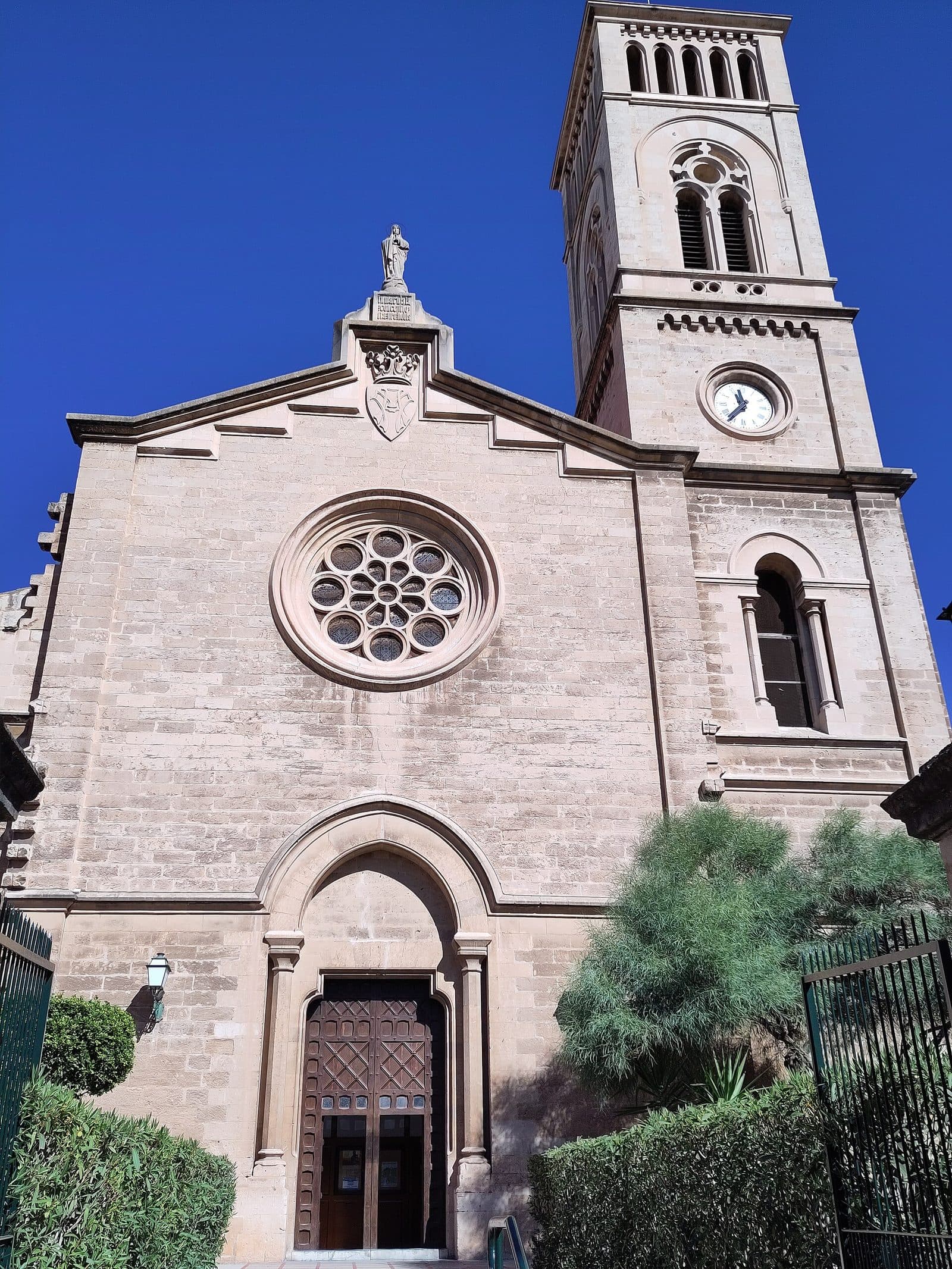
La Immaculada Concepció in Palma
_3.jpg)
La Immaculada Concepció is one of those churches in Palma whose significance cannot be understood solely from its façade or a list of individual art-historical treasures. Its Catalan name alone leads deep into Mallorca’s religious history: it refers to the Immaculate Conception of Mary, a subject that occupied theologians, religious orders, and artists on the island for centuries.
A visit is particularly worthwhile for travelers seeking Palma’s less obvious layers away from the major monuments. Anyone interested in Marian iconography will also find a fitting starting point here: the Immaculata has been present for centuries in Mallorca’s churches, on portals, in paintings, and in altarpieces.
La Immaculada Concepció therefore calls for a different perspective than the cathedral or a major museum collection. It is less about quickly checking off famous works than about considering how a theological idea became a dedication, a visual motif, and ultimately a sacred place.
The church can also encourage visitors to pay closer attention to the language of religious buildings. A dedication is not a neutral label added merely to distinguish one place from another. It determines how a church is understood, which traditions are associated with it, and which images may acquire particular significance within the sacred space. Even before entering, the name provides a framework for interpreting the visit.
This approach is especially useful in Palma, where religious history is visible not only in monumental architecture but also in smaller churches and local devotional traditions. Looking beyond the best-known attractions makes it easier to understand how theological ideas became part of everyday urban life. La Immaculada Concepció offers an opportunity to explore precisely this connection between doctrine, imagery, and place.
History and Significance
The Immaculate Conception
The church’s name is frequently misunderstood. The Immaculate Conception does not refer to the virginal conception of Jesus, but to Mary herself. According to Catholic doctrine, Mary was preserved from original sin from the first moment of her existence. Her exceptional purity was explained by her unique role in salvation history as the mother of Christ.
The concept developed over a long period. Early Christian and medieval Marian devotion prepared the ground, but the precise theological interpretation remained controversial. These disputes help explain why the subject was defended so emphatically in sermons, writings, and works of art. The dogma was formally defined in 1854, but the devotion and its visual language are much older.
This distinction is important for understanding La Immaculada Concepció. The dedication is not merely an appealing church name. It refers to a religious belief that developed into a particularly powerful religious and artistic theme in Spain.
For visitors without a background in theology, the essential point is the connection between Mary’s purity and her role in Christian salvation history. Once this is understood, familiar Marian symbols and images can be viewed with greater clarity. The dedication becomes a key to the church rather than an abstract doctrinal phrase.
The long development of the belief also demonstrates why religious art cannot always be interpreted by looking only at the date of a particular object or building. An image may draw on ideas, debates, and devotional practices that are much older than the work itself. In this sense, La Immaculada Concepció belongs to a tradition whose historical depth extends far beyond the immediate surroundings of the church.
The Mallorcan Tradition
In Mallorca, the defense of the Immaculate Conception was significant long before the dogma was formally defined. The intellectual legacy of Palma-born Ramon Llull played a special role. He was close to the Franciscans, who were among the doctrine’s most determined advocates. They were opposed, among others, by Dominican-influenced positions that assessed the issue differently.
This dispute was not confined to theological texts. It left visible traces in Palma’s sacred art. Depictions of the Immaculata appeared on church façades and in sculptures, paintings, and altarpieces. Examples can be found around the cathedral and at and inside the churches of Monti-sion, Sant Francesc, and Sant Gaietà. La Immaculada Concepció belongs within this broader context of a city where the subject was publicly represented across generations.
This also explains why a visit conveys more than the history of a single building. The church bears a name that forms part of an extensive history of images and ideas in Palma. Anyone visiting other historic churches in the city before or afterward will recognize the motif and become more aware of its different interpretations.
The local context makes comparison particularly rewarding. The same theological subject can be expressed through a church dedication, a figure on a façade, an image within an altarpiece, or a devotional object intended for prayer. These forms do not all communicate in the same way. Architecture establishes a lasting public presence, while paintings and sculptures can concentrate attention on gestures, symbols, and visual attributes.
Travelers do not need specialist knowledge to notice these differences. It is enough to remember the central meaning of the dedication and to observe how each sacred space presents Mary. Repeated encounters with the theme across Palma gradually reveal how closely religious belief, artistic practice, and the identity of the city were connected.
Dedication
A dedication gives a place of worship its religious identity. In the case of La Immaculada Concepció, the focus is on Mary and her conception preserved from original sin.
That identity shapes the way the church can be approached. Instead of treating the name as an incidental piece of information, visitors can use it as the starting point for observation. Marian images, prayer areas, and other devotional elements may then be understood as parts of a coherent religious setting rather than as isolated decorations.
Visiting the Church
Arriving and Entering
As no reliable visiting hours have been recorded, current access should be checked before traveling there.
Visitors should also remember that a functioning place of worship does not operate in the same way as a museum. Access may depend on religious use, local arrangements, or circumstances that are not reflected in general travel information. Checking shortly before the planned visit reduces the risk of arriving when the church is unavailable.
If entry is possible, the transition from the surrounding neighborhood into the church is part of the experience. Allowing a moment to become accustomed to the interior atmosphere makes it easier to notice the organization of the space and the devotional character of individual areas. Quiet observation is more appropriate than moving through the church as quickly as possible.
Time for the Church
Setting a fixed visit duration would make little sense. Anyone who simply wants an impression of the church can keep the visit brief. Those interested in the meaning of its dedication will need more time. The pace matters more than the length of the visit.
La Immaculada Concepció is therefore well suited to a thoughtful stop during a day in Palma. It is not a sprawling museum complex requiring a tightly scheduled sightseeing plan. At the same time, the visit should not be reduced to taking a quick photo.
A useful way to structure the visit is to begin with the overall space before focusing on details. The relationship between the entrance, the principal devotional focus, and the quieter side areas can reveal how the interior is intended to be experienced. Looking slowly also helps distinguish elements connected with private prayer from those designed to shape the church as a whole.
Respectful behavior is essential even when no service is taking place. Voices should be kept low, worshippers should not be disturbed, and photography should only be considered where it is clearly permitted. The sacred purpose of the building remains more important than the visitor’s wish to document every detail.
Getting There and Parking
From the Airport to Palma
From Palma Airport, the drive initially follows the Ma-19 toward Palma. The road distance to Palma is 11 kilometers, and the journey takes around 20 minutes. These figures expressly apply only as far as Palma, not to the church door. Additional driving time through the city must be allowed for the final section to the listed address in Son Serra Perera.
The Ma-19 is the main route from the airport into the island’s capital. Depending on the connection chosen within Palma, the onward route passes through urban traffic. As the precise access route and traffic conditions may vary, current navigation to the address should be used for the final section. A tight schedule is especially impractical if actual access only becomes clear upon arrival.
The distinction between reaching Palma and reaching the church is important when planning the day. Urban traffic, the search for the correct street, and the need to find a suitable place to stop can all extend the journey. Travelers arriving directly from the airport should therefore avoid linking the visit to a narrowly timed appointment.
By Bus
Plaça del Progrés, with several recorded stops in the dataset, serves as a public transport reference point. It functions as an interchange and stopping area; the most suitable connection depends on the starting point and current timetable. As routes may change, checking immediately before traveling is more reliable than relying on a permanently fixed route recommendation.
For travelers already exploring Palma on foot and by bus, the church visit can easily fit into a day in the city. However, the church’s name alone should not be entered into a map app: several churches, works of art, and places in Mallorca and beyond have names connected with the Inmaculada Concepción. Specifying Palma and using the listed address prevents confusion.
It is sensible to compare the location of the chosen stop with the complete destination before boarding. A stop with a familiar place name is not necessarily the closest or most practical option for every route. Current journey-planning information is especially useful when connections or walking sections are involved.
By Car and Parking
When arriving by rental car, it is advisable to plan parking separately from the church visit itself. In Palma, access routes, traffic flow, and parking availability depend greatly on the particular neighborhood. The address should therefore initially be used as the destination; a permitted parking space can then be selected according to current signage.
A dedicated visitor parking lot belonging to the church should not be assumed. Anyone combining the visit with other destinations in Palma will usually have a more relaxed experience by parking once and completing the remaining journeys on foot or by public transport. This avoids having to search for another parking space between several stops.
Drivers should leave enough flexibility to respond to local restrictions and available spaces. The shortest apparent route is not always the most practical one, particularly when unfamiliar streets or changing traffic conditions are involved. Following current signs and avoiding hurried parking decisions makes the arrival considerably easier.
Bus lines to La Immaculada Concepció at a glance
| Line | Route | Departures/day | First | Last |
|---|---|---|---|---|
| 104 | Magaluf - Palma | 427 | 00:06 | 23:56 |
| 103 | Santa Ponça - Palma | 228 | 00:16 | 23:53 |
| 102 | Peguera - Palma | 199 | 06:17 | 23:56 |
| 101 | Port d'Andratx - Palma | 50 | 06:42 | 23:08 |
| 106 | El Toro - Palma | 46 | 06:37 | 23:31 |
| 105 | Sol de Mallorca - Palma | 29 | 06:12 | 22:16 |
| 108 | Son Caliu - Palma | 21 | 06:27 | 22:52 |
From the official GTFS feeds (TIB/SFM), no real-time data. The figures cover all stops in the town; weekend and holiday services differ — check with the operator before travelling.
Getting there by bus
Andrea Doria 2 (40072) · 0.2 km as the crow flies
- 101Port d'Andratx - Palma · Daily
- 102Peguera - Palma · Daily
- 103Santa Ponça - Palma · Daily
- 104Magaluf - Palma · Daily
- 106El Toro - Palma · Daily
Plaça Progrés 2 (40029) · 0.2 km as the crow flies
- 101Port d'Andratx - Palma · Daily
- 102Peguera - Palma · Daily
- 103Santa Ponça - Palma · Daily
- 104Magaluf - Palma · Daily
- 105Sol de Mallorca - Palma · Daily
- 106El Toro - Palma · Daily
Plaça Progrés 1 (40030) · 0.2 km as the crow flies
- 101Port d'Andratx - Palma · Daily
- 102Peguera - Palma · Daily
- 103Santa Ponça - Palma · Daily
- 104Magaluf - Palma · Daily
- 105Sol de Mallorca - Palma · Daily
- 106El Toro - Palma · Daily
Marítim - Monsenyor Palmer 2 (40025) · 0.2 km as the crow flies
- 108Son Caliu - Palma · Daily
Timetable data: official GTFS feeds (TIB/EMT), no real-time — check with the operator before travelling.
Nearby
Palma Beyond the Major Monuments
La Immaculada Concepció reveals a side of Palma that is easily overlooked alongside the cathedral, palace, and waterfront promenade. The island’s capital consists not only of its historic center but also of residential neighborhoods and churches outside the usual sightseeing routes. The visit therefore provides a contrast to the heavily visited main attractions.
Son Serra Perera is described as a quiet, predominantly residential area of Palma. Anyone coming here solely for the church should not expect a self-contained tourist district. The appeal lies precisely in the contrast: first a sacred place outside the usual sightseeing routine, followed by Palma’s denser historic urban areas.
This contrast can deepen the impression of the city. Major monuments present Palma through architecture of exceptional scale and public importance, while neighborhood churches show how religious life is embedded in ordinary urban surroundings. Experiencing both makes the city appear less like a collection of isolated attractions and more like a place shaped by different communities and historical layers.
Palma’s Religious Imagery
The visit can be linked particularly well with other churches where the Immaculata tradition has left its mark. These include the cathedral as well as Monti-sion, Sant Francesc, and Sant Gaietà. The aim is not to check off every stop in the shortest possible time. Just two churches with different characters can show how varied the same Marian theme can be in architecture, sculpture, painting, and altarpieces.
Comparison works best when visitors focus on a few recurring questions. How is Mary presented? Which part of the building or artwork receives the greatest emphasis? Does the image function as monumental decoration, a focal point for worship, or an invitation to private devotion? These questions make differences visible without requiring a formal study of art history.
A Themed Day in the City
Anyone devoting the day to Marian devotion would benefit from a brief introduction to the subject beforehand. Knowing that the Immaculate Conception refers to Mary rather than the conception of Jesus changes how names and depictions are understood. La Immaculada Concepció can then serve as either the beginning or the conclusion of the itinerary.
For a broader Palma itinerary, the church visit can be combined with the old town, the cathedral, and a walk through less tourist-oriented neighborhoods. This provides plenty of variety between major monuments and everyday street life. Before finalizing the order, it is only necessary to establish when the church is actually accessible.
A themed itinerary does not need to include every related site. Selecting a small number of places and allowing time to observe them carefully often creates a clearer understanding than a rushed sequence of stops. La Immaculada Concepció can provide the conceptual focus, while the other churches reveal how the theme appears in different artistic and architectural settings.
The place it belongs to
Palma in the place guidePractical Visitor Information
What Not to Expect
The name does not refer to a particular famous painting: several works of art and churches have names connected with the Immaculata. The focus here is the specific church in Palma.
The visit benefits most from a little background knowledge and realistic expectations. Anyone who understands the religious meaning of the dedication and checks current access will gain an illuminating impression of Palma’s Marian tradition.
It is also best not to expect the standardized visitor services associated with a major attraction. Reliable access details, a dedicated visitor route, extensive interpretation, or church-specific parking should not be assumed without current confirmation. Preparing for a simple and respectful church visit keeps expectations aligned with the available information.
The most useful preparation is therefore straightforward: verify access, use the full address, allow flexibility in the schedule, and approach the building as a sacred place. With that framework, the church can become a meaningful part of a wider exploration of Palma rather than merely an uncertain stop on a sightseeing list.