
Molí d'en Garleta – Mallorca Windmill Museum in Palma
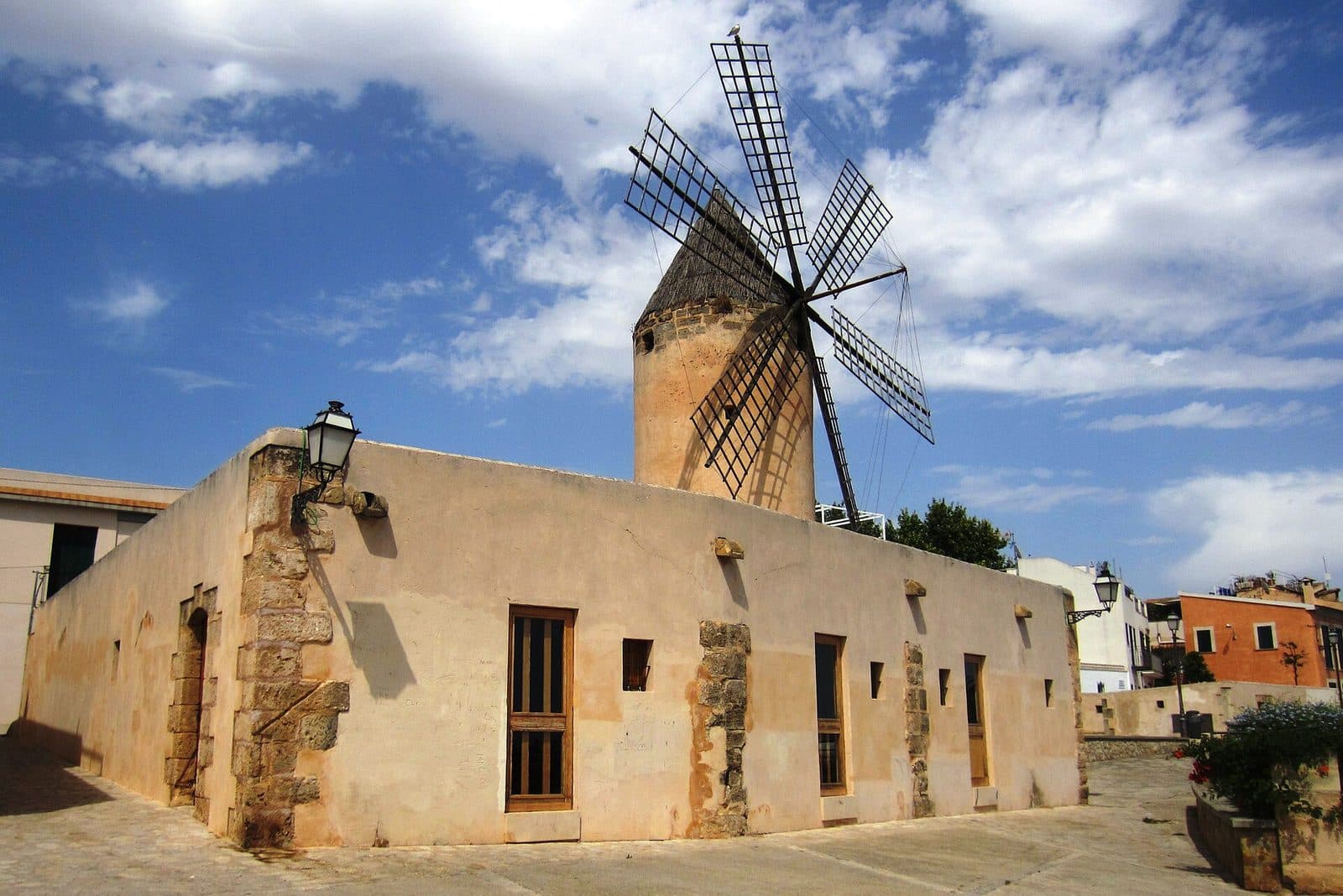

Among the old mills of Es Jonquet, Molí d'en Garleta preserves a piece of Mallorca that is easy to overlook. The restored tower once belonged to the grain mills on the outskirts of Palma. Today it houses the Museu dels Molins, a small museum about wind power, milling technology, and the different types of mills found across the Balearic Islands.
Its appeal lies less in a large collection than in the connection between the building and its subject. Gears, millstones, and models are displayed not in a neutral exhibition hall but inside a former flour mill. This allows the machinery to be understood as a continuous work process: The wind set the sails in motion, the power was transferred through wooden components, and it was ultimately used to grind grain.
For technology enthusiasts, Molí d'en Garleta is a vivid example of industrial archaeology. Families can approach the subject through the child-friendly story of Catalina and her donkey Jaumet. Those wishing to discover Palma beyond the cathedral, Old Town, and shopping streets will also learn about the origins of one of the most characteristic structures in Mallorca's cultural landscape.
History and significance
When the mill was built toward the end of the 19th century, the wind above Es Jonquet was not a decorative backdrop but a usable source of energy. Molí d'en Garleta was constructed as a grain mill and ground grain into flour for the local community. Its purpose was therefore directly connected with daily bread and the processing of agricultural produce.
The grain mill
The building is a tower windmill. In this type of system, the sails captured wind power while the machinery arranged inside transferred the motion to the millstones. Unlike the many Mallorcan wind pumps that drew water from the ground, Molí d'en Garleta was used to grind grain. This distinction is important because the general term “mill” covers structures with very different purposes in Mallorca. The sails, gearing, and stones formed a system in which the wind was harnessed and its power transferred. This precise connection can be understood in today's museum.
Es Jonquet and its mills
The location in Es Jonquet explains why several windmills once stood here. The neighborhood, now densely built up, was known for its mills; their silhouettes defined the transition between the city and the coast. Many disappeared over time, but Molí d'en Garleta survived this transformation and was restored. Its significance therefore extends beyond the individual building. It also helps visitors view the neighboring mill towers not merely as picturesque photo opportunities but as former production sites.
From workplace to museum
Today, the mill houses the Museu dels Molins. The building is protected as a cultural asset and now serves a dual purpose: It is both a historic exhibit in its own right and the setting in which the history of Balearic mills is explained. The restoration therefore preserved not only a distinctive exterior form but also gave the surviving technology a comprehensible context.
The museum covers both how windmills worked and their role in Mallorca's rural economy. It also introduces the various types of mills found across the Balearic Islands and the origins of the Es Jonquet neighborhood. A seemingly small specialist subject thus provides an entry point into agriculture, craftsmanship, energy production, and urban history.
What to see
Even from outside, the difference from an ordinary museum collection is clear: The most important exhibit is the mill itself. The stone tower, restored sails, and compact internal machinery show how closely the architecture and work processes were coordinated. A tour does not lead past interchangeable display cases but through a building whose form arose from its former use.
The mill tower
The massive tower supported the sails and housed the milling machinery. It is a tower windmill and served as a grain mill. The relationship between the sails and the tower is particularly revealing: The sails had to capture the wind while the machinery operated inside the protected interior. Motion was generated outside, then controlled and made useful inside. Its restored appearance also makes Molí d'en Garleta a prominent landmark within the historic group of mills in Es Jonquet.
The wooden gearing
Inside, the large wooden gears are among the most impressive components. Their size was not incidental: They had to transfer the rotational movement generated by the sails. They make it immediately clear that a windmill did not have a simple connection between sail and stone but rather a carefully coordinated mechanical system.
The interlocking teeth make visible a work process that remains hidden when viewed from outside. Once the individual wheels are understood as parts of the power transmission system, the sails also appear in a different light. They were not merely the mill's widely visible hallmark but the beginning of a chain of movements within the building.
The millstones
The millstones stood at the end of this power transmission process. Grain was crushed between them and processed into flour. They therefore embody the true purpose of the entire structure: Everything previously accomplished by the wind, sails, and gears came together at this point.
The close proximity of the individual components is one of the museum's strengths. Rather than presenting the millstones as isolated objects, the exhibition shows their connection to the rest of the machinery. This makes it easier even for visitors without technical knowledge to follow the path from the natural energy source to the completed grinding process.
The mill models
Models of different windmill types broaden the view beyond Molí d'en Garleta. They show that not every mill in the Balearic Islands looked the same or performed the same task. Differences in construction and use are often clearer in scale models than in the original structures scattered across the islands.
The models are especially helpful for comparisons. After visiting the museum, details elsewhere suddenly stand out that might previously have gone unnoticed: the shape of the tower, the type of sails, or the difference between a grain mill and a water-pumping installation. Molí d'en Garleta thus becomes a small school of observation for Mallorca's cultural landscape.
The information panels
Explanatory displays place the components in a wider context. They cover the development of windmills, how they worked, and their significance to the island's historic economy. The focus is not solely on technology but also on why these structures were so common in Mallorca.
Another section is devoted to Es Jonquet. It allows the neighborhood to be understood as a former milling center rather than only as a present-day urban district. Anyone who walks among the surviving towers after the tour will view the surroundings with a more discerning eye.
Catalina and Jaumet
For younger visitors, a dynamic audiovisual story follows Catalina and her donkey Jaumet. Through the two characters, children discover different mills around Mallorca. Rather than simplifying the technical subject by omitting it, the story makes it accessible through a narrative.
The story is designed as an interactive alternative to a conventional explanation and is suitable for families whose children may struggle to focus on lengthy technical talks. Meanwhile, adults can also explore the models and visible mechanical components. Both approaches ultimately lead to the same question: How was wind converted into useful working power?
Visiting the museum
A visit usually begins with a brief welcome, followed by an explanation of the mill or the audiovisual story. Around 30 minutes are allocated for the tour itself. The compact duration suits the character of the site: Molí d'en Garleta is not a sprawling technology museum but a focused place of learning inside a historic building.
The guided tour
The mill is best understood on an explained tour. Although the visible gears and millstones are impressive in themselves, only the explanation connects them into a complete sequence of movement. Questions are explicitly encouraged; the duration may vary depending on the discussion, explanations, and movement through the building.
Visits are made possible in cooperation with the association of Mallorca's mill enthusiasts. Because the museum is small and organized educational programs play an important role, advance inquiries are recommended. Anyone arriving spontaneously outside the building should not assume that the interior will be accessible at that time.
Visiting with children
Families can choose between the technical explanation and the audiovisual approach featuring Catalina and Jaumet. Children particularly benefit from the fact that the machinery does not remain abstract: Large wheels, millstones, and models provide visible reference points for the explanations.
The program is intended for all age groups. Nevertheless, Molí d'en Garleta is more a place for shared discovery than for unrestricted play. Parents can build on the story and then look outside at the mills of Es Jonquet for shapes and components previously shown in the models.
Timing and crowds
About half an hour is usually sufficient for the interior visit. With questions, a look at the mill's exterior, and a subsequent walk through Es Jonquet, it can easily become a longer cultural stop. Those who only want to see the mill can readily include it in a day in Palma.
The character of the museum does not suggest one generally ideal time of day for avoiding crowds. A confirmed appointment is more important than the time, as guided tours and educational programs may determine the schedule. Current opening hours and admission conditions should therefore be checked directly before heading to the mill.
Getting there and parking
Molí d'en Garleta is listed as a museum in Son Serra Perera in Palma. The measured route from Palma Airport to Son Serra Perera is 10 kilometers by road; the drive takes around 18 minutes.
By car
The journey from Palma Airport to Son Serra Perera covers 10 kilometers and takes around 18 minutes.
By bus
Several stops associated with Es Jonquet are nearby, along with stops on Passeig Marítim and near Monsenyor Palmer. From there, the final section is covered on foot. Specific routes and departure times should be checked on the day of the visit, as timetables may change.
Traveling by public transport offers a practical advantage: After the visit, the walk can continue through Santa Catalina or toward the city center without having to return to a parked car. The museum therefore works well as a stop on a city walking tour.
Bus lines to Molí d'en Garleta at a glance
| Line | Route | Departures/day | First | Last |
|---|---|---|---|---|
| 104 | Magaluf - Palma | 302 | 00:06 | 23:56 |
| 103 | Santa Ponça - Palma | 151 | 00:16 | 23:52 |
| 102 | Peguera - Palma | 131 | 06:17 | 23:56 |
| 106 | El Toro - Palma | 43 | 06:37 | 23:31 |
| 101 | Port d'Andratx - Palma | 33 | 06:42 | 23:07 |
| 105 | Sol de Mallorca - Palma | 29 | 06:12 | 22:16 |
| 108 | Son Caliu - Palma | 21 | 06:27 | 22:52 |
| 5 | Es Rafal Nou - Pl. Progrés | 8 | 07:02 | 09:52 |
| 29 | Son Espases - Pl. Progrés | 6 | 07:34 | 08:29 |
| 4 | Ses Illetes - Pl. Columnes | 4 | 09:43 | 11:33 |
| 46 | la Bonanova - Gènova - Sindicat (dreta) | 4 | 07:56 | 08:44 |
| 47 | Gènova - la Bonanova - Sindicat (esquerra) | 4 | 07:41 | 08:29 |
| N4 | Pl. Progrés - Pont d'Inca | 4 | 00:40 | 03:55 |
From the official GTFS feeds (TIB/SFM), no real-time data. The figures cover all stops in the town; weekend and holiday services differ — check with the operator before travelling.
Getting there by bus
33-Es Jonquet · 0.1 km as the crow flies
- 1Portopí - Sindicat · 08:00–08:00 · Daily
- 30Marivent-Palau de Congressos · 08:00–08:00 · Daily
8-es Jonquet · 0.2 km as the crow flies
- 1Portopí - Sindicat · 08:00–08:00 · Daily
- 30Marivent-Palau de Congressos · 08:00–08:00 · Daily
- N1Portopí - Porta des Camp · 08:00–08:00 · Daily
Marítim - Monsenyor Palmer 2 (40025) · 0.2 km as the crow flies
- 108Son Caliu - Palma · Daily
9-passeig Marítim - Monsenyor Palmer · 0.2 km as the crow flies
- 1Portopí - Sindicat · 08:00–08:00 · Daily
- 30Marivent-Palau de Congressos · 08:00–08:00 · Daily
- N1Portopí - Porta des Camp · 08:00–08:00 · Daily
131-Àrea d'intercanvi pl. del Progrés · 0.2 km as the crow flies
- 29Son Espases - Pl. Progrés · 08:00–08:00 · Daily
- 47Gènova - la Bonanova - Sindicat (esquerra) · 08:00–08:00 · Daily
1350-Àrea d'intercanvi pl. del Progrés · 0.2 km as the crow flies
- 29Son Espases - Pl. Progrés · 08:00–08:00 · Daily
57-Àrea d'intercanvi pl. del Progrés · 0.2 km as the crow flies
- 4Ses Illetes - Pl. Columnes · 08:00–08:00 · Daily
- 46la Bonanova - Gènova - Sindicat (dreta) · 08:00–08:00 · Daily
102-Àrea d'intercanvi pl. del Progrés · 0.2 km as the crow flies
- 4Ses Illetes - Pl. Columnes · 08:00–08:00 · Daily
- 5Es Rafal Nou - Pl. Progrés · 08:00–08:00 · Daily
- 40Eixample Transversal · 00:11–22:41 · Daily
- 46la Bonanova - Gènova - Sindicat (dreta) · 08:00–08:00 · Daily
- 47Gènova - la Bonanova - Sindicat (esquerra) · 08:00–08:00 · Daily
- N4Pl. Progrés - Pont d'Inca · 08:00–08:00 · Daily
Plaça Progrés 1 (40030) · 0.3 km as the crow flies
- 101Port d'Andratx - Palma · Daily
- 102Peguera - Palma · Daily
- 103Santa Ponça - Palma · Daily
- 104Magaluf - Palma · Daily
- 105Sol de Mallorca - Palma · Daily
- 106El Toro - Palma · Daily
Plaça Progrés 2 (40029) · 0.3 km as the crow flies
- 101Port d'Andratx - Palma · Daily
- 102Peguera - Palma · Daily
- 103Santa Ponça - Palma · Daily
- 104Magaluf - Palma · Daily
- 105Sol de Mallorca - Palma · Daily
- 106El Toro - Palma · Daily
1342-Regulació pl. del Progrés · 0.3 km as the crow flies
- 5Es Rafal Nou - Pl. Progrés · 08:00–08:00 · Daily
58-Marquès de la Senia - Andrea Doria · 0.3 km as the crow flies
- 4Ses Illetes - Pl. Columnes · 08:00–08:00 · Daily
- 46la Bonanova - Gènova - Sindicat (dreta) · 08:00–08:00 · Daily
Timetable data: official GTFS feeds (TIB/EMT), no real-time — check with the operator before travelling.
Nearby attractions
Outside the mill, Es Jonquet almost explains itself. The surviving towers do not stand beside one another by chance but are traces of a former working neighborhood. After visiting the museum, a short walk through the surrounding streets is enough to notice the difference between restored installations, surviving mill towers, and modern development.
Es Jonquet
Es Jonquet is the immediate historic setting of Molí d'en Garleta. The museum explains the neighborhood's origins and the significance of its mills; outside, this history can be observed in the cityscape. This order is especially worthwhile: First examine the models and explanations, then compare the real silhouettes.
The walk should not be understood as a search for a large open-air museum. This is a residential urban neighborhood where historic mills stand among present-day homes. Yet this proximity between everyday life and industrial history makes the area particularly easy to interpret.
Santa Catalina
Neighboring Santa Catalina is a natural next stop. The lively district offers a clear contrast to the focused museum visit and is easy to explore on foot. Anyone wishing to take a break or combine the cultural stop with a stroll through the city will find a natural transition here.
The mill should not be treated merely as a quick detour. Its history explains why this particular part of Palma contains such a distinctive group of historic mills. A walk through Santa Catalina and Es Jonquet thereby gains an additional dimension beyond dining and city life.
Palma city center and harbor
Palma city center and the area around Passeig Marítim can also be combined with the visit. Rather than immediately continuing to another extensive museum, it is worth first walking through the neighborhood. The short interior visit followed by an urban walk creates a pleasant alternation between explanation and personal observation.
Son Serra Perera, however, should not be confused with Son Serra de Marina on the northeast coast. The similarly named coastal town, its beaches, and the surrounding landscape are not part of the area around Molí d'en Garleta.
The place it belongs to
Son Serra Perera in the place guidePractical visitor information
The mill is a historic working structure, not a spacious modern museum. Comfortable clothing and sports shoes are recommended for the visit, which is completed on foot.
Clothing and footwear
Sturdy, comfortable footwear is especially useful when combining the museum visit with a walk through Es Jonquet. Hiking equipment is not necessary for the interior visit alone. Shoes that provide secure footing are, however, more practical than delicate or very smooth footwear.
Because adverse weather conditions may result in a visit being canceled, a confirmed tour should be checked again on the same day. This is especially important if the mill is the main reason for traveling to Palma.
Mobility
Visitors with limited mobility should inform the team before their appointment. This makes it possible to clarify which parts of the tour are accessible and what assistance may be available. It would not be appropriate to assume complete accessibility in a historic mill tower.
What to expect from the museum
Do not expect a large ethnographic museum with numerous galleries. Molí d'en Garleta focuses on the mill itself, its machinery, models of Balearic mill types, and the history of the site. Visitors willing to engage with this clearly defined subject will gain an understandable insight into an important chapter of Mallorcan working culture in a short time.
A working mill or an extensive milling demonstration should not be assumed either. The focus is on the surviving or restored technology and how it is explained. The most rewarding conclusion is to apply what you have learned outside and look at the mills of Es Jonquet with fresh eyes.
Local insider tips
From the sails to the millstones
Do not photograph only the individual gears: During the explanation, notice how the sails, wooden gearing, and millstones form a connected chain. This path of power is the building's real story.
Museum first, then Es Jonquet
Take the walk among the mill towers only after the interior visit. The models and explanations sharpen your eye for the building design, sails, and the difference between grain mills and water-pumping mills.
Catalina and Jaumet for children
For younger visitors, ask about the audiovisual story featuring Catalina and the donkey Jaumet. It introduces different mills around Mallorca in a more playful way than a purely technical tour and is explicitly designed for families.
Confirm the interior visit in advance
An advance inquiry is advisable if you want to see the machinery and models or join the educational program. The small museum should not be planned as though it were an exhibition hall open at all times.
Navigating to the museum
Use the museum name and Son Serra Perera when planning the route. Molí d'en Garleta is listed there as a museum in Palma.