
Antoni Maura in Palma: Plaça del Mercat Monument
.jpg)
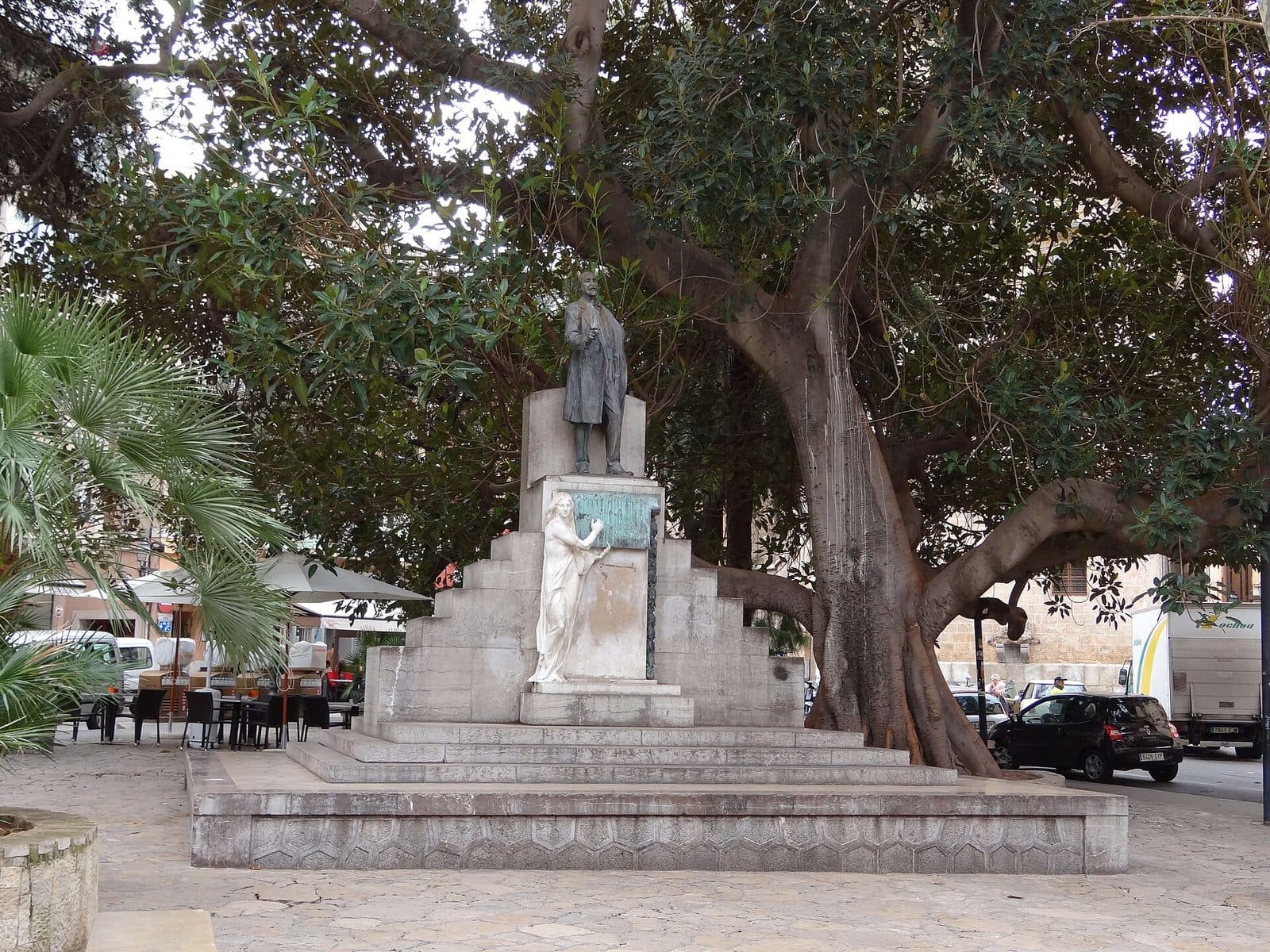
In the heart of Palma’s historic center, the Antoni Maura monument commemorates a Mallorcan whose political career extended far beyond the island. The site on Plaça del Mercat is not an attraction that requires half a day of its own, but a concentrated piece of Spanish modern history: a public tribute, a work by sculptor Mariano Benlliure, and a good reason to look more closely while strolling through the old town.
At first glance, the standing figure of the politician dominates, but the monument tells its story through more than the portrait alone. The pedestal, allegorical figure, and inscription form a deliberately composed statement about public speaking, political conviction, and the aspiration to bring thought and action into harmony. This second layer is precisely what makes Antoni Maura more interesting than many monuments that passersby walk past without a second glance.
The visit is particularly worthwhile for travelers who want to experience Palma as more than a backdrop of cathedrals, palaces, and shopping streets. The monument introduces a more recent historical layer of the city and a figure who served five times as prime minister of Spain. At the same time, it has an unusually tangible recent history: A falling branch brought parts of the monument crashing down before the damaged sculpture was restored and reinstalled.
Antoni Maura is best understood as a stop on a walk through central Palma. Anyone who pauses briefly, considers the two figures separately, and then reads the inscription will discover a carefully staged culture of political remembrance—not monumental for the sake of size, but full of clues about how Maura was meant to be seen.
History and significance
A pronounced Mallorcan accent initially made Antonio Maura y Montaner the target of mockery—and indirectly became a tool in his later career. When the young Mallorcan went to Madrid to study, fellow students made fun of his pronunciation. Maura then worked persistently on his speech and developed into an accomplished orator. The monument in Palma accordingly depicts him in a pose that evokes not a quiet scholar, but a public speaker.
Antonio Maura y Montaner
Maura was born on 2 May 1853 in Palma’s Calatrava district. His father owned a small factory there where raw animal hides were processed into leather, while his mother’s family had a longer tradition of painters and engravers. After his father’s early death, Maura attended the Instituto in the island capital and received his higher education entrance qualification in 1868. He originally wanted to study natural sciences, but in Madrid he chose law for pragmatic reasons.
A decisive encounter at university was his acquaintance with the lawyer Germán Gamazo. He took Maura into his law firm, introduced him to politics, and presented him to his sister Constancia, whom Maura married in 1878. In 1881, Maura was elected to the Cortes. He later held offices including Minister of the Colonies and Minister of the Interior, switched from the Liberals to the Conservatives, and headed the Spanish government a total of five times.
His political career was marked by reform efforts and bitter conflicts. Maura sought to stabilize the constitutional monarchy through political and social renewal. His plans included reforms to local government, and compulsory schooling was introduced during one of his terms in office. Other projects failed or intensified existing tensions. The monument is therefore not merely the portrait of a successful officeholder, but a tribute to a significant and simultaneously controversial figure in Spanish politics.
Creation of the monument
After Maura’s death, an initiative emerged to erect a public monument to him in his native city. The project was financed through a public subscription: Many people contributed funds toward its construction. Mariano Benlliure, one of the best-known Spanish sculptors of his time, was commissioned to create the design. The monument was inaugurated on 13 December 1929 and became a visible part of the cityscape on Plaça del Mercat.
The form of financing is part of the monument’s message. It was not simply a state memorial imposed from above, but a project for which money was raised publicly. At the same time, Benlliure’s composition reveals the intended focus of remembrance: Maura as an orator, his political convictions, and his claim to personal consistency.
Fall and return
In November 2014, the monument suffered an unexpected accident: Falling branches from a tree knocked the sculpture down and caused considerable damage. During the subsequent work, it was repaired, restored, and cleaned. A broken finger also had to be replaced, while damage to the head could not be completely removed.
On 13 November 2015, the restored work was reinstalled on Plaça del Mercat. This episode has added another, surprisingly tangible layer of time to the historic monument. Anyone standing before Antoni Maura today is therefore looking at more than a political tribute from the early 20th century. The work also bears traces of an accident and restoration through which it regained its place in public space.
What to see
The key to the monument lies in the interaction between its figures. Anyone who looks only upward at the figure of Maura will see the portrait-like centerpiece, but miss the actual interpretation below. Only from a little distance does it become clear how the figure of the orator, pedestal, allegory, and inscription were combined into a shared political message.
The orator figure
Antonio Maura appears standing in an explicitly oratorical pose. Benlliure depicts him not in a private or casual position, but as a man of the public word. This suits a career in which parliamentary speeches, persuasive power, and political disputes played central roles. At the same time, the pose recalls the biographical episode in which Maura overcame his mocked island accent through intensive speech training.
When viewing the figure, it is worth looking for more than a physical likeness. The posture conveys a claim to presence: Here, a politician is depicted stepping before an audience and defending his position. In this way, the monument conceptually transforms Plaça del Mercat into a political space in which passersby occupy the place where listeners would have stood during a real speech.
The structure raises Maura well above the level of the square. This elevation is a classic device of representative monuments, but here it is complemented in meaning by the lower figure. The politician does not stand in isolation on a neutral pedestal; the allegory below gives his portrayal a moral interpretation.
Truth
Below Maura is a female figure made of white marble. She embodies Truth and uses her gesture to direct attention toward the monument’s inscription. She thus assumes a mediating role: While Maura appears above her as a public orator, the allegory indicates how his political life is meant to be understood.
Such personifications were a common way of making abstract values visible in representative art. Here, however, Truth is not merely decoration at the foot of the pedestal. Her gesture deliberately guides the eye onward and connects the figure of the politician with the carved sentence. Anyone viewing the monument in reading order therefore follows a clear sequence: first the well-known statesman, then the allegorical interpretation, and finally the written message.
The light marble also stands apart from the other components of the monument. Up close, the modeled figure and her pointing movement become more prominent; from a greater distance, she appears as a calm counterweight to the upright figure above. This interplay between political action and allegorical interpretation is the monument’s most distinctive artistic feature.
The inscription
The Spanish inscription reads: “Antonio Maura igualó con la vida el pensamiento.” In essence, it says that Maura brought his life into harmony with his thoughts. The line comes from a poem by Andrés Fernández de Andrada and condenses the intended memory of the politician into a personal virtue: consistency between conviction and action.
The wording is not a neutral biographical summary. It makes a moral claim and shows that the monument was created as a tribute. This is precisely why it deserves historically attentive consideration, because public monuments do not merely report who a person was. They also show which qualities later generations wished to emphasize. In the case of Antoni Maura, these are oratorical power, political conviction, and personal consistency.
Anyone who understands Spanish can absorb the sentence directly. Yet even without knowledge of the language, the connection remains easy to read: The allegory of Truth points toward words placed below the figure of the orator. Image and text explain one another. This is more carefully composed than an ordinary standing statue with nothing more than a nameplate.
Pedestal and overall view
The stone substructure organizes the different levels and gives the monument its vertical effect. Up close, the individual figures and inscription attract attention; a few steps back, it becomes clear how strongly the monument was designed to be seen as a whole. The standing figure forms the upper conclusion, while the figure of Truth creates the transition to the level of the viewer.
A small change of position is therefore helpful for appreciating the work. From the front, the relationship between the allegory and inscription is easiest to grasp; from the side, Maura’s oratorical pose becomes clearer; and from a greater distance, the hierarchy of the entire composition is revealed. The monument thus unfolds not in a single quick glance, but through several successive views.
Visiting the monument
A visit is best started not directly at the pedestal, but from a few steps away. From there, the entire composition can be taken in before the eye moves toward the details. You can then approach the lower figure, follow her gesture, and read the inscription. Only afterward is it worth viewing Maura’s pose from the side. This simple sequence turns a short stop into a small art-historical discovery.
Time required and nature of the visit
Antoni Maura is not a museum with galleries, exhibition texts, or a prescribed route. Instead, the monument is suited to focused observation during a walk through central Palma. Anyone who only wants a souvenir photo can keep the stop very short. Those who consciously connect the biography, allegory, and inscription should take a little more time and view the site from several directions.
Its appeal lies precisely in this manageable scale. There is no long sequence of objects, but a single composition whose message gradually unfolds. For history enthusiasts, Maura’s path from a Mallorcan schoolboy to the five-time head of the Spanish government provides the most important background, while art lovers are more likely to focus on Benlliure’s staging of the orator and the figure of Truth.
Time of day and activity on the square
Plaça del Mercat is part of Palma’s lively center. How quietly the monument can be viewed therefore depends less on organized visitor activity than on general city traffic and the passersby crossing the square. Anyone wishing to take photographs or read the inscription undisturbed should wait for a moment with less foot traffic rather than plan the visit like a conventional admission time.
No fixed opening hours or admission details are recorded for the attraction. Because arrangements on the square or temporary restrictions may change, it is advisable to check current information before a specifically planned visit. In practice, the monument is best incorporated into an old-town walk in which the entire day’s schedule does not depend on this single stop.
Photography and closer observation
A frontal photograph captures the programmatic connection between Maura, Truth, and the inscription. For the oratorical pose, however, a slightly angled position is more revealing. Close-up photographs of the lower figure help preserve the layer that is often lost in hurried images. The inscription should ideally be included in the frame, because without it the pointing gesture remains incomplete.
The restoration history also provides a reason to look closely. After the fall caused by descending branches, damage was repaired and the sculpture was cleaned; a finger had to be replaced, while damage to the head could not be fully removed. The monument is therefore not only a historic work of art, but also an example of how Palma handles vulnerable cultural heritage in public space.
Getting there and parking
From Palma Airport, the journey initially follows the Ma-19 into the island capital. Palma is 11 road kilometers away, and the drive takes around 20 minutes. These details apply expressly to the route as far as Palma, not directly to the monument’s pedestal. The final section leads into the dense street network of the center, where one-way streets, pedestrian areas, and access restrictions can make direct navigation more difficult.
Driving into the center
Up-to-date route guidance is useful for the final streets in the center, but it should not be followed blindly. Palma has ACIRE zones with restricted access. Around Avenida d’Antoni Maura, drivers are also warned against accidentally turning into a street open only to authorized vehicles. Signs on site therefore take precedence over shortcuts suggested by a navigation app.
A central parking option is located at Av. d’Antoni Maura 8. The paid underground garage is on the edge of the old town, and its spaces are described as rather narrow. Anyone parking there should leave the vehicle in the garage and continue through the center on foot. This avoids searching for a parking space in the narrower streets around the historic squares.
Another option is the Parc de la Mar parking garage. It is particularly popular for destinations around the cathedral, Almudaina, and the old town and can become very busy from midday onward. Here too, drivers should follow the signposted route when approaching, as a wrong turn can lead into a restricted area. The best choice of parking garage therefore depends on the entire planned city walk rather than on the monument alone.
By bus and on foot
Several city-center stops are located around Plaça del Mercat and between the center and the cathedral. From there, the monument becomes a stop on foot within the old town. Because routes and timetables may change, it is advisable to check current connections for the actual day of travel.
Antoni Maura is particularly rewarding to experience on foot. The route through central Palma makes it clear that the city consists of more than medieval and early modern monuments. Among historic façades and lively squares, the monument appears as a reminder of Spanish politics in the late 19th and early 20th centuries. This integration into the present-day urban setting is an essential part of the experience.
Bus lines to Antoni Maura at a glance
| Line | Route | Departures/day | First | Last |
|---|---|---|---|---|
| 35 | Aquàrium - Pl. Reina | Catedral | 8 | 07:10 | 13:50 |
| 3 | Pont d'Inca / Joan Carles I | 6 | 07:37 | 09:46 |
| 25 | s'Arenal - Pl. Reina | Catedral | 6 | 09:35 | 12:41 |
| 20 | Portopí - Son Espases | 4 | 07:17 | 07:31 |
From the official GTFS feeds (TIB/SFM), no real-time data. The figures cover all stops in the town; weekend and holiday services differ — check with the operator before travelling.
Getting there by bus
52-pl. del Mercat · 0.1 km as the crow flies
- 4Ses Illetes - Pl. Columnes · 08:00–08:00 · Daily
- 7Son Gotleu - Son Serra - Sa Vileta / Son Vida · 08:00–08:00 · Daily
- 20Portopí - Son Espases · 06:06–22:40 · Daily
- 35Aquàrium - Pl. Reina | Catedral · 06:21–22:41 · Daily
106-pl. del Mercat · 0.1 km as the crow flies
- 3Pont d'Inca / Joan Carles I · 08:00–08:00 · Daily
- 4Ses Illetes - Pl. Columnes · 08:00–08:00 · Daily
- 7Son Gotleu - Son Serra - Sa Vileta / Son Vida · 08:00–08:00 · Daily
- 20Portopí - Son Espases · 06:06–22:40 · Daily
105-pl. de Joan Carles I - Catedral · 0.1 km as the crow flies
- 3Pont d'Inca / Joan Carles I · 08:00–08:00 · Daily
- 4Ses Illetes - Pl. Columnes · 08:00–08:00 · Daily
- 7Son Gotleu - Son Serra - Sa Vileta / Son Vida · 08:00–08:00 · Daily
- 20Portopí - Son Espases · 06:06–22:40 · Daily
53-pl. de Joan Carles I - Catedral · 0.2 km as the crow flies
- 4Ses Illetes - Pl. Columnes · 08:00–08:00 · Daily
- 7Son Gotleu - Son Serra - Sa Vileta / Son Vida · 08:00–08:00 · Daily
- 20Portopí - Son Espases · 06:06–22:40 · Daily
1048-pl. de Joan Carles I · 0.2 km as the crow flies
- 25s'Arenal - Pl. Reina | Catedral · 06:36–21:01 · Daily
- 35Aquàrium - Pl. Reina | Catedral · 06:21–22:41 · Daily
985-pl. de Joan Carles I · 0.2 km as the crow flies
- CCCircular Centre Ciutat · 08:00–08:00 · Daily
662-pl. de Cort · 0.2 km as the crow flies
- CCCircular Centre Ciutat · 08:00–08:00 · Daily
663-pl. d'en Coll · 0.3 km as the crow flies
- CCCircular Centre Ciutat · 08:00–08:00 · Daily
986-pl. de la Reina - Catedral · 0.3 km as the crow flies
- 35Aquàrium - Pl. Reina | Catedral · 06:21–22:41 · Daily
- CCCircular Centre Ciutat · 08:00–08:00 · Daily
453-pl. de la Reina - Catedral · 0.3 km as the crow flies
- 25s'Arenal - Pl. Reina | Catedral · 06:36–21:01 · Daily
7-pl. de la Reina - Catedral · 0.4 km as the crow flies
- 35Aquàrium - Pl. Reina | Catedral · 06:21–22:41 · Daily
107-la Rambla - Via Roma · 0.4 km as the crow flies
- 25s'Arenal - Pl. Reina | Catedral · 06:36–21:01 · Daily
- 35Aquàrium - Pl. Reina | Catedral · 06:21–22:41 · Daily
Timetable data: official GTFS feeds (TIB/EMT), no real-time — check with the operator before travelling.
Nearby attractions
From Plaça del Mercat, Palma’s historic center can be explored further without a break in theme. The monument stands in an area where political history, civic urban spaces, and the old town’s representative avenues follow closely one after another. Rather than visiting Antoni Maura in isolation, it is therefore worth taking a walking route that connects different periods of Palma’s history.
Plaça del Mercat and Passeig del Born
Plaça del Mercat is more than merely the monument’s location. As a central urban square, it ensures that Benlliure’s work does not stand within an enclosed complex, but remains part of everyday movement through Palma. This open setting also explains why there is no fixed route for viewing it: The monument is approached from changing directions and stands within the flow of the city.
The nearby area around Passeig del Born is a natural continuation of the walk. Here, attention shifts from an individual political figure to Palma’s representative urban form. Walking onward from the monument reveals how squares, avenues, and public art collectively shape the appearance of the center.
Cathedral and Almudaina
Toward the monumental edge of the old town, the La Seu cathedral and the La Almudaina Royal Palace can be included in the same day in the city. Both belong to a much older historical layer than the Maura monument. This contrast in time is particularly illuminating: medieval and monarchical representation here, and the public tribute to a modern statesman there.
Combining the monument with these well-known destinations also prevents the journey from being made solely for a brief photo stop. Antoni Maura works best as a thematic intermediate stop, adding questions about parliamentarianism, reform politics, and public remembrance to the usual Palma walking route.
Calatrava and Maura’s origins
Maura’s biography leads conceptually onward to the Calatrava district, where he was born in 1853. He grew up there in an environment shaped in part by tanners; his father operated a small leather factory. This background differs markedly from his later career in Madrid and makes the politician’s social ascent more tangible.
Anyone exploring Palma with an interest in urban history can therefore read the monument as the starting point of a biographical trail: from his Mallorcan origins through his education and departure for Madrid to his repeated terms as head of government. The monument itself does not recount these stages in detail, but marks the endpoint of public recognition—the surrounding city provides the local beginning of the story.
The place it belongs to
Palma in the place guidePractical information for your visit
The most common mistake is to treat the monument as merely a statue with a name. Anyone who photographs only the standing figure leaves out the figure of Truth and therefore the central visual idea. It makes more sense to consider the complete site first and then read it from bottom to top: inscription, allegory, orator.
What to expect
Antoni Maura is a single monument in public urban space, not a museum or an exhibition about the politician’s entire life. Visitors should therefore not expect a comprehensive chronological account of his career on site. However, a little prior knowledge about his origins in Palma, his five terms as head of government, and his significance as an orator greatly changes the way the monument is perceived.
The intention behind its creation is equally important. The site was created as a tribute and presents a positive interpretation of Maura through its inscription. It is not a substitute for a critical examination of his politics. Visitors interested in history can therefore read the monument as a source: It shows which qualities the initiators wished to preserve publicly after his death.
Visiting with children
For children, the concise visual language offers a good point of entry. Instead of explaining lengthy political contexts, observation can begin with simple questions: Which figure stands above, what is the figure below pointing toward, and why was a politician depicted as an orator? The episode involving the falling branch, broken finger, and later restoration also makes it easy to understand that even massive monuments can be damaged and require care.
Because the site is located on a central city square, normal urban traffic still requires attention. The visit is less a standalone attraction for children than a brief and illustrative stop during a shared walk.
Clothing and conduct
No special equipment is required for the monument. Comfortable footwear for the subsequent walk through central Palma is most important, because the real added value comes from combining it with other stops in the old town. Depending on the weather, the usual precautions for spending time outdoors are also advisable.
The sculptures and pedestal should be viewed from an appropriate distance. Details such as Truth’s pointing hand or the inscription can be recognized without touching them. Anyone who remains mindful of passersby around the monument and briefly changes position for photographs will usually obtain a better overall view than from directly beside the pedestal.
Local insider tips
Read from bottom to top
Do not begin with Maura’s head: Look first at the inscription, then the pointing figure of Truth, and finally the orator. Benlliure’s visual program becomes much clearer in this order.
Choose two perspectives
From the front, the allegory and inscription can be captured together. A few steps to the side, however, Maura’s oratorical pose becomes clearer. Both viewpoints tell different parts of the same monument.
Look for traces of restoration
After the fall caused by descending branches, the sculpture was restored; a broken finger was replaced, while damage to the head remained partly visible. Looking closely connects art with the city’s more recent history.
Connect different eras
Antoni Maura can easily be included between Passeig del Born and the area around the cathedral and Almudaina. This brings the political remembrance of the early 20th century together with Palma’s older representative buildings.
Observe ACIRE signs
When driving into the center, do not take an apparent navigation shortcut without checking it first. Access restrictions apply around Avenida d’Antoni Maura; signposted routes to parking garages are the safer choice.