
Frederic Chopin in Palma: Monument and Memorial
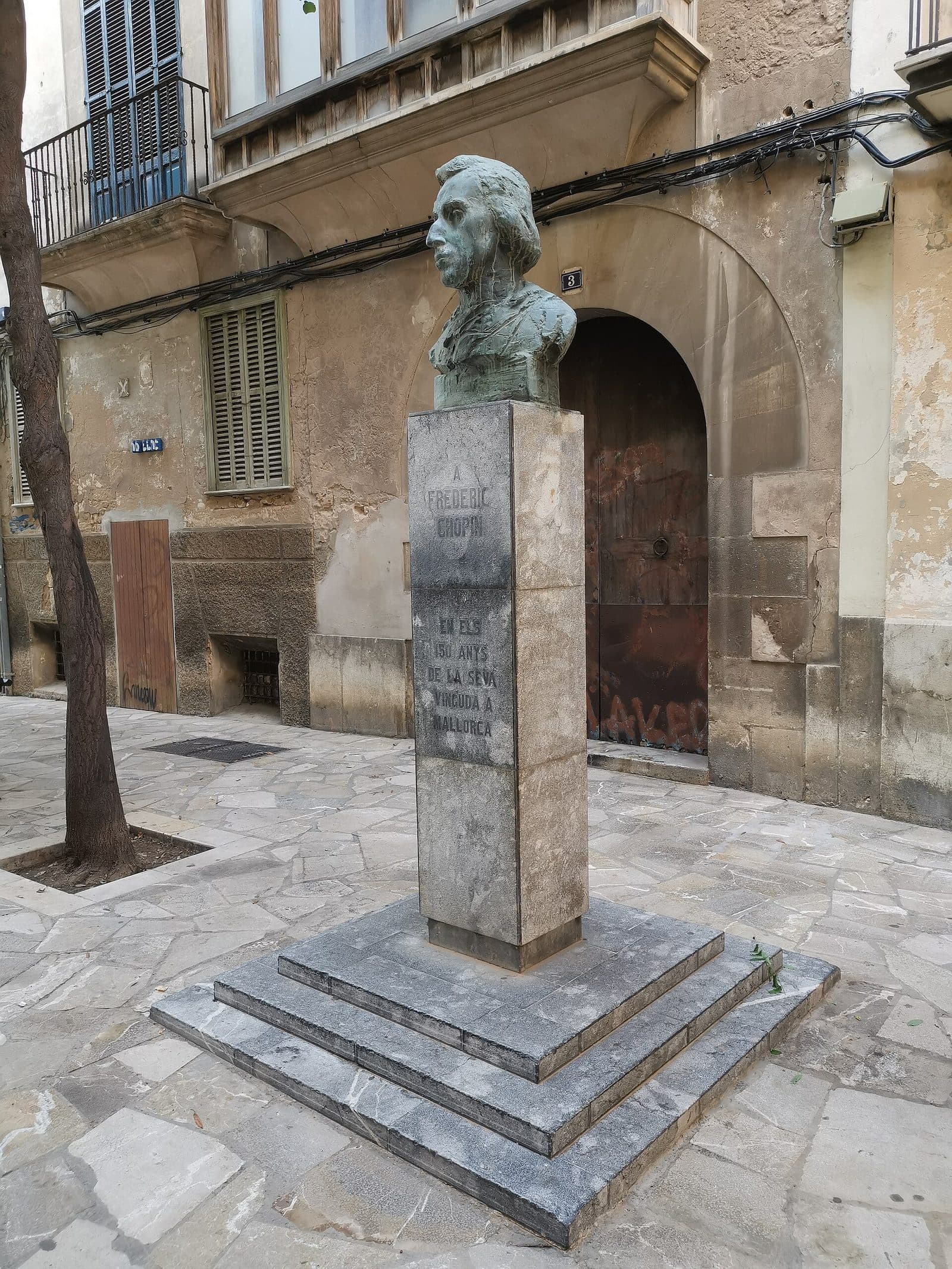

In the heart of Palma's lively center, Frederic Chopin is commemorated not by a concert hall or a large museum, but by a bust in a green pedestrian area outside the church of Sant Nicolau. The site is small and easy to overlook. That is precisely its appeal: among the streets of the old town, you encounter a musician whose brief stay on Mallorca became one of the best-known episodes in European cultural history.
The attraction is especially worthwhile for music lovers, those interested in cultural history, and anyone who enjoys discovering Palma through its inconspicuous details. It is not a destination for a long museum visit but offers a quiet opportunity to consider Chopin's connection with the island where it actually began: in Palma, before the composer continued to Valldemossa with George Sand and her children.
The name can sometimes be misleading. This specifically refers to the memorial in Palma with the Chopin bust outside Sant Nicolau, not the former accommodation and exhibition in the Charterhouse of Valldemossa. The two places tell different chapters of the same stay on the island: Palma represents the arrival, first impressions, and search for suitable accommodation, while Valldemossa represents the later winter in the charterhouse.
Anyone already walking through the center can include the square in an old-town tour without a detour. The encounter works best with some prior knowledge, because only the story behind the bust explains why a Polish composer and a French writer remain part of Mallorca's collective memory today.
History and significance
The arrival in Palma
When Frédéric Chopin and George Sand traveled to Mallorca in the autumn of 1838, the island was not an easily accessible winter destination. Sand, who published under a male name and was one of the best-known female writers of her time, came with her children Maurice and Solange. Chopin joined the journey in the hope that the southern climate might benefit his poor health. At the same time, the distance from Paris offered both artists the prospect of working without interruption.
After traveling through France and staying in Barcelona, the group took a steamship to Palma. Their arrival was less romantic than later accounts of the famous Mallorca winter might suggest: accommodation near the harbor proved too noisy, and finding suitable lodgings was difficult. Nevertheless, Palma impressed the composer. Accounts describe his appreciation of the numerous gardens and courtyards that gave the city an almost springlike appearance even during the cooler season.
This first contact with Mallorca is directly relevant to the monument's significance. The bust does not stand at some random location on the island, but in the city where Chopin's Mallorcan episode began. It draws attention to a part of the story that is often overshadowed by his later stay in Valldemossa.
Between Palma and Establiments
The traveling party initially remained in Palma before moving into accommodation at Son Vent near Establiments. After another brief period in Palma, they moved to the Charterhouse of Valldemossa in December 1838. This sequence shows that the famous winter was not spent in a single place: Palma was the starting point, a place of transition, and the organizational center of the first weeks.
For Chopin, the journey was soon overshadowed by health concerns and practical problems. The mild winter weather they had hoped for did not materialize as expected. Rain, cold, and damp conditions affected him, while a specially ordered piano failed to arrive on time and remained stuck in Palma because of customs procedures. Musical history was created here not in undisturbed Mediterranean comfort, but under adverse conditions.
This contrast in particular has shaped memories of the stay. On one side were Palma's gardens and courtyards and the impression of an unfamiliar southern city; on the other were the difficult search for accommodation, illness, bad weather, and the wait for a suitable instrument. The bust condenses this contradictory story into a quiet symbol within today's urban life.
A brief winter with a lasting legacy
Chopin worked on several compositions on Mallorca and completed the collection of Préludes op. 28 there. George Sand later turned the journey into literature in her book A Winter in Mallorca. As a result, the stay remained alive not only in music history but also in European travel literature. The island became the setting for a story about artistic work, illness, social tensions, and disappointed expectations.
The memorial in Palma is therefore more than a portrait of a famous composer. It also points to George Sand, her children, and a traveling party whose daily life was far less idyllic than the image of a romantic artists' winter suggests. Chopin's music and Sand's account together ensured that these few months remain associated with Mallorca to this day.
The commemoration is even more significant today because Chopin's visible legacy on the island is usually equated with Valldemossa. Palma's monument, by contrast, preserves the memory of his arrival and first stops. It recalls that the story began at the harbor and in the streets of the island's capital, not only later in the mountains of the Serra de Tramuntana.
What to see
The Chopin bust
The bust of Frédéric Chopin is the centerpiece. It gives the site its historical significance and turns the green pedestrian area into a small urban memorial space. There is no elaborate presentation: no reconstructed music room, no series of exhibition galleries, and no concert hall. Attention is focused directly on the composer's portrait and his place in Palma's public space.
This is surprisingly appropriate to Chopin's historical legacy. His connection with the island is based not on a public triumph or a long period of creative work, but on a brief and difficult winter. The monument's understated form leaves room for this ambivalence. Anyone standing before the bust is looking not only at a famous musician, but also at a traveler who arrived with high hopes and left Mallorca under considerably more difficult circumstances.
The experience is most rewarding when Chopin's face is not viewed in isolation. Behind the monument are the noisy accommodation at the harbor, the search for peace, the view into Palma's green courtyards, and the delay of the piano arriving from Paris. None of this is presented as a large exhibition at the square itself, yet it forms the historical context surrounding the bust.
Plaça Frederic Chopin
The square is designed as a green pedestrian area. This makes the visit very different from a conventional attraction with an entrance and a fixed route. You approach on foot, discover the monument among the paths through the center, and stay for as long as your interest lasts. Urban life and remembrance are not separated here.
This setting makes the place tangible. Chopin does not appear behind museum glass, but in the middle of Palma. Passersby cross the area as part of their daily routines, while visitors deliberately seek out the bust. The monument therefore stands within a living city rather than a reconstructed 19th-century setting.
The green character of the pedestrian area also creates a clear contrast with the densely built-up streets of the center. It is less about a spectacular view than about a change in the urban landscape: from the surrounding lanes into a more open area, and from the movement of the old town to a brief pause beside Chopin. Anyone paying attention only to grand façades can still easily overlook the actual destination.
Sant Nicolau
The church of Sant Nicolau is the most important landmark. The Chopin bust stands in the pedestrian area outside the church, so its façade is a more reliable guide than the expectation of a freestanding museum building. The monument and church are separate attractions, but they are perceived together on site because the small memorial emerges directly from its urban surroundings.
This combination also explains why a short visit here offers more than a quick glance at a single artwork. The historical setting anchors the memory of Chopin in central Palma. The composer is presented not as an abstract figure from music history, but as part of a city he experienced himself in 1838 and whose courtyards and gardens impressed him.
If you want to take photographs, do not limit yourself to a close-up of the bust. A slightly wider viewpoint that includes the pedestrian area and Sant Nicolau shows more clearly where the memorial is located. The image then tells not only of Chopin, but also of his present-day place in Palma's cityscape.
What you will deliberately not find here
The Pleyel piano, former living quarters, letters, manuscripts, and documents belong to the Chopin memorial in Valldemossa, not to this attraction in Palma. This distinction is important when planning a visit. Anyone expecting a museum collection based on the name will otherwise find a much smaller site than anticipated.
The strength of Plaça Frederic Chopin lies precisely in its lack of numerous exhibits. It presents a single, clearly defined symbol and uses it to open a view onto the wider story. For music lovers, it can be the beginning of a deeper exploration of Chopin's Mallorca winter; for visitors walking through the city, it is a cultural and historical discovery among better-known sights.
Visiting the monument
A brief stop with historical context
A visit usually begins not at a ticket office or on a signposted route, but during a walk through the center. Sant Nicolau shows the way, and then the bust comes into view. Because the memorial is modest in scale, the length of your stay depends primarily on how deeply you engage with Chopin's story. A brief stop is enough for a photograph and a first impression; anyone placing the site within the composer's entire Mallorca stay will remain correspondingly longer.
It is worth knowing the most important stages before arriving: the journey with George Sand and her children, the difficult search for accommodation in Palma, the stay at Son Vent near Establiments, the return to Palma, and finally the move to Valldemossa. Without this background, the bust remains one portrait among many; with it, the monument becomes the starting point of a specific travel story.
Reliable specific opening hours and a current admission price should be checked before visiting, as this information has not been recorded for the memorial and conditions may change. The square itself is experienced as a pedestrian area, but visitors should not expect a museum tour with a fixed sequence.
Between everyday life and sightseeing
The site is used by passersby and is not an enclosed memorial precinct. This influences the visitor experience more than a conventional recommendation about the time of day. Some people come specifically because of Chopin, while others cross the square on their way through Palma. Quiet and busy moments therefore alternate with the center's normal rhythm.
Anyone wishing to view the bust in peace or photograph it with its surroundings should wait for a moment when the area in front of the monument is clear. No special preparation is needed for the visit, but attentiveness is important: because neither a large entrance nor a museum façade visible from afar announces the destination, it is easy to walk past.
The memorial is particularly suitable as an intermediate stop. It does not require half a day of your vacation and therefore does not compete with an extensive old-town itinerary. At the same time, it feels less arbitrary if it is not merely checked off in passing. Reading a short text about Chopin's first days in Palma or later listening to the Préludes adds another dimension to the visit.
For music lovers and families
Music lovers will find a tangible anchor here for Chopin's island biography. The monument can serve as the starting point for considering how travel conditions, illness, and the delayed arrival of an instrument affected his work. Those familiar with his compositions encounter not an abstract name, but an artist in a stressful personal situation.
With children, the stop works best as a short story rather than an extensive lecture. The piano waiting at the harbor, the overly noisy first accommodation, and the move into a former monastery are vivid themes. Because there is no extensive exhibition to walk through at the monument itself, the visit can be adapted flexibly to attention spans and interests.
Getting there and parking
From the airport to Palma
The route from Palma Airport follows the Ma-19 into the island's capital. The road distance to Palma is 11 kilometers, and the journey takes around 20 minutes. These figures apply specifically to Palma and not to a parking space directly beside the Chopin bust. For the final stretch into the center, you must also account for urban traffic, your choice of parking, and a walk.
Because the monument stands in a pedestrian area outside Sant Nicolau, driving directly to the bust is not a practical goal. Anyone arriving by rental car should plan the visit as part of a walking tour and park outside the immediate pedestrian area. The final streets are covered on foot, with the church serving as a clear landmark.
Especially in the city center, it is more helpful to choose a suitable approach to the center first rather than navigating solely by the name “Frederic Chopin.” The name can also point to Chopin-related sites in Valldemossa. For this attraction, however, the destination must be in Palma near Sant Nicolau.
Taking the bus to the center
Plaça de Joan Carles I serves as a nearby reference point for public transportation. Several stops are located there, including services with the additional designation “Catedral.” From this area, continue on foot through the center to Plaça Frederic Chopin and the church of Sant Nicolau.
The stop should not be confused with the monument itself. It marks the point where the bus journey ends and the city walk begins. The final section leads through central streets and pedestrian areas, which suits the character of the visit: the Chopin bust is not approached as an isolated driving destination, but as a detail within Palma.
Before traveling, check the current connection and the correct side for your stop at Plaça de Joan Carles I. Several stops there have similar names. Once on foot, Sant Nicolau remains the most reliable landmark.
Bus lines to Frederic Chopin at a glance
| Line | Route | Departures/day | First | Last |
|---|---|---|---|---|
| 35 | Aquàrium - Pl. Reina | Catedral | 8 | 07:10 | 13:50 |
| 3 | Pont d'Inca / Joan Carles I | 6 | 07:37 | 09:46 |
| 25 | s'Arenal - Pl. Reina | Catedral | 6 | 09:35 | 12:41 |
| 20 | Portopí - Son Espases | 4 | 07:17 | 07:31 |
From the official GTFS feeds (TIB/SFM), no real-time data. The figures cover all stops in the town; weekend and holiday services differ — check with the operator before travelling.
Getting there by bus
105-pl. de Joan Carles I - Catedral · 0.1 km as the crow flies
- 3Pont d'Inca / Joan Carles I · 08:00–08:00 · Daily
- 4Ses Illetes - Pl. Columnes · 08:00–08:00 · Daily
- 7Son Gotleu - Son Serra - Sa Vileta / Son Vida · 08:00–08:00 · Daily
- 20Portopí - Son Espases · 06:06–22:40 · Daily
1048-pl. de Joan Carles I · 0.1 km as the crow flies
- 25s'Arenal - Pl. Reina | Catedral · 06:36–21:01 · Daily
- 35Aquàrium - Pl. Reina | Catedral · 06:21–22:41 · Daily
985-pl. de Joan Carles I · 0.1 km as the crow flies
- CCCircular Centre Ciutat · 08:00–08:00 · Daily
53-pl. de Joan Carles I - Catedral · 0.2 km as the crow flies
- 4Ses Illetes - Pl. Columnes · 08:00–08:00 · Daily
- 7Son Gotleu - Son Serra - Sa Vileta / Son Vida · 08:00–08:00 · Daily
- 20Portopí - Son Espases · 06:06–22:40 · Daily
986-pl. de la Reina - Catedral · 0.2 km as the crow flies
- 35Aquàrium - Pl. Reina | Catedral · 06:21–22:41 · Daily
- CCCircular Centre Ciutat · 08:00–08:00 · Daily
52-pl. del Mercat · 0.2 km as the crow flies
- 4Ses Illetes - Pl. Columnes · 08:00–08:00 · Daily
- 7Son Gotleu - Son Serra - Sa Vileta / Son Vida · 08:00–08:00 · Daily
- 20Portopí - Son Espases · 06:06–22:40 · Daily
- 35Aquàrium - Pl. Reina | Catedral · 06:21–22:41 · Daily
106-pl. del Mercat · 0.2 km as the crow flies
- 3Pont d'Inca / Joan Carles I · 08:00–08:00 · Daily
- 4Ses Illetes - Pl. Columnes · 08:00–08:00 · Daily
- 7Son Gotleu - Son Serra - Sa Vileta / Son Vida · 08:00–08:00 · Daily
- 20Portopí - Son Espases · 06:06–22:40 · Daily
453-pl. de la Reina - Catedral · 0.2 km as the crow flies
- 25s'Arenal - Pl. Reina | Catedral · 06:36–21:01 · Daily
662-pl. de Cort · 0.2 km as the crow flies
- CCCircular Centre Ciutat · 08:00–08:00 · Daily
7-pl. de la Reina - Catedral · 0.2 km as the crow flies
- 35Aquàrium - Pl. Reina | Catedral · 06:21–22:41 · Daily
663-pl. d'en Coll · 0.3 km as the crow flies
- CCCircular Centre Ciutat · 08:00–08:00 · Daily
54-Jaume III · 0.4 km as the crow flies
- 4Ses Illetes - Pl. Columnes · 08:00–08:00 · Daily
- 7Son Gotleu - Son Serra - Sa Vileta / Son Vida · 08:00–08:00 · Daily
- 20Portopí - Son Espases · 06:06–22:40 · Daily
Timetable data: official GTFS feeds (TIB/EMT), no real-time — check with the operator before travelling.
Nearby sights
Central Palma
The Chopin bust is particularly easy to combine with a walk through central Palma. The route does not lead into a remote museum district, but straight into everyday urban life. Shopping streets, historic lanes, squares, and churches are close together, with the memorial providing a quiet cultural and historical accent among them.
This setting fits Chopin's first impressions of Palma. He regarded the city as more than just a harbor stop and was impressed by its gardens and courtyards. Today's walk can adopt this perspective, at least in spirit: look not only at the major monuments, but also notice green courtyards, transitional spaces, and smaller squares.
For planning purposes, the Chopin site is therefore more of a connecting element than the sole focus of a day. It fits between visits to sights in the historic center without requiring a complicated detour. Anyone coming from Plaça de Joan Carles I can reach it on foot and then continue walking through Palma.
Sant Nicolau and the old-town routes
Sant Nicolau is not only a landmark but also shapes the immediate impression of the square. The church, pedestrian area, and bust come into view one after another and give the stop a historical setting. A detailed portrait of the church itself would distract from the main destination; for this visit, it is enough to see it as a striking counterpart and part of the old-town landscape.
From here, other routes through the center are easy to follow. The Chopin bust makes a suitable intermediate stop between better-known squares and the historic old town. Anyone arriving by bus at Plaça de Joan Carles I can combine the visit on the same walk with the area around the cathedral without confusing Chopin's monument with an attraction there.
The connection to Valldemossa
Anyone wishing to explore Chopin's history on Mallorca in greater depth can regard Palma as the first chapter and plan Valldemossa later as a separate excursion. There, the time in the charterhouse and the artistic work of the winter are commemorated. It is, however, a different site with its own visitor arrangements, not another part of the attraction at Sant Nicolau.
This sequence is historically revealing: first the arrival in Palma and the search for accommodation, then Son Vent near Establiments, another brief stay in Palma, and finally the charterhouse. This gives the bust greater significance. It is not merely an urban reference to a famous museum outside the capital, but a reminder of Palma's own role in the story.
The place it belongs to
Palma in the place guidePractical information for your visit
Choose the correct destination
When searching, the addition “Palma” is crucial. Online results for the name Frederic Chopin often lead to the charterhouse and museum in Valldemossa. For the memorial described here, navigation must lead to Plaça Frederic Chopin or the church of Sant Nicolau in central Palma. Anyone wanting to see rooms, manuscripts, or a historic piano is looking for a different attraction.
Do not expect an extensive tour on site. The bust and its urban setting are the destination. Understanding this prevents disappointment while also helping visitors appreciate the square appropriately: as a monument and a stop on a walk, not as a substitute for a biographical exhibition.
Walking through the pedestrian area
Normal city shoes are sufficient for the visit. Because the square is part of a pedestrian area and is usually combined with other walks through Palma, the overall old-town route matters more than the brief stop at the bust. In warm weather, water and sun protection are useful for walking through the center; the square's green character should not be mistaken for continuous shade along the entire route.
The stop can be included in a city walk with a stroller or small children without having to complete a long museum route. However, binding information about the accessibility of individual approaches has not been recorded. Anyone dependent on step-free routes should check the specific path through the center in advance.
See, read, and listen
The bust tells only part of the story. It is particularly worthwhile to read a short passage about Chopin's arrival in Palma before or after the visit. George Sand's A Winter in Mallorca presents her later view of the journey, while Chopin's Préludes provide the musical connection.
Such context changes how the square is perceived. The figure then represents a winter caught between hope and illness, creative work and everyday difficulties. The delay of the piano in Palma also becomes a tangible detail: a composer whose name is inseparably linked with the piano initially had to make do with an inadequate instrument on the island.
The most important expectation should nevertheless remain modest. This place does not aim to provide a complete Chopin biography. It places a marker in the cityscape and rewards those who connect it with Palma's history. Anyone who does so will discover a surprisingly large chapter of island culture within a small monument.
Local insider tips
Use Sant Nicolau as your landmark
Do not look for a museum building: the bust stands in the green pedestrian area outside the church of Sant Nicolau. The church façade is the clearest landmark for the final stretch through central Palma.
Palma is the first chapter
Before stopping, it is worth reviewing the sequence of Chopin's journey: first Palma, then Son Vent near Establiments, Palma again, and finally Valldemossa. This turns the bust into a tangible setting rather than merely a famous name.
Include the cityscape in your photo
A wider perspective tells more than a close-up portrait. When the bust, pedestrian area, and Sant Nicolau appear together in the picture, Chopin's present-day place in central Palma becomes visible.
Do not confuse it with Valldemossa
The historic piano, former living quarters, and documents belong to the Chopin site in Valldemossa. Palma deliberately offers a small memorial with a bust—ideal as a stop on an old-town walk.
Start at Joan Carles I
Anyone arriving by bus can use the stops at Plaça de Joan Carles I and continue through the center on foot. Several stops have similar names, so check the correct side in advance.