
Botanicactus Near Ses Salines: Mallorca’s Cactus Garden
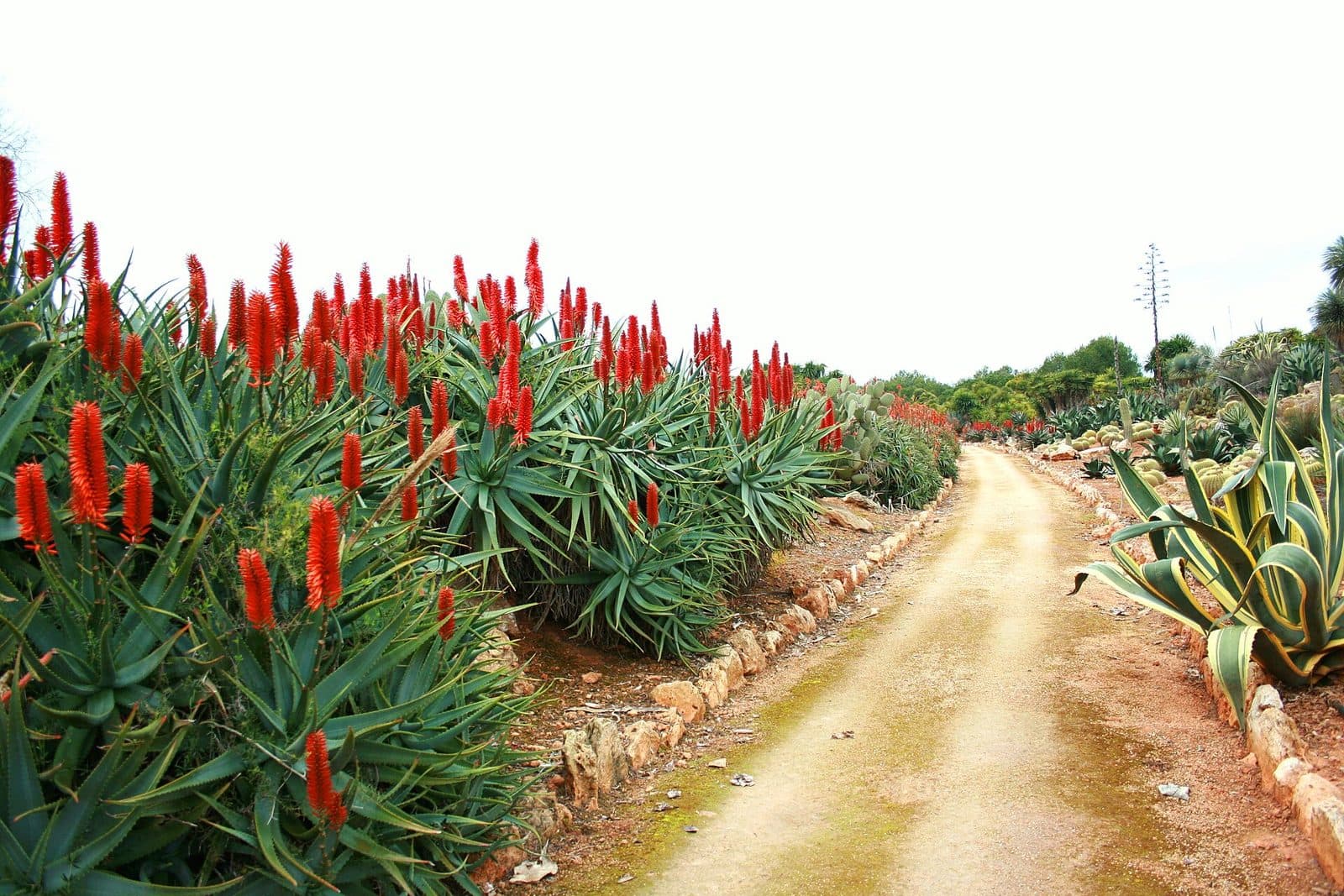

From the very first garden paths, Botanicactus reveals why its name describes only part of the attraction. Towering columnar cacti, compact barrel cacti and sprawling agaves may define its best-known images. Yet between Ses Salines and Santanyí, an entire sequence of distinct plant worlds unfolds—from the Mallorcan garden to the wetland beside an artificial lake.
The botanical garden covers a total of 150.000 square metres and, according to its own figures, contains more than 15.000 specimens from 1.500 species. What matters is not simply its size, but the dramatic changes in scenery: dry, almost desert-like sections give way to Mediterranean trees, palms, bamboo and aquatic plants. Artificial hills, terraces and pools repeatedly transform the view.
For plant enthusiasts, the garden is particularly interesting because of its collection of cacti and other succulents. Families, meanwhile, can enjoy a walk where the plants’ shapes and sizes alone capture attention: some cacti resemble sculptures, while others grow as tall as small trees. Even without botanical knowledge, it is easy to see how differently plants respond to drought, sunlight and water.
Botanicactus is not a small display garden intended for a quick photo stop. Its extensive grounds reward a leisurely walk that takes in not only striking individual plants but also the landscape design. The contrast between prickly desert plants and the lake makes a visit an unusual experience in southern Mallorca.
History and Significance
Only a few months after opening, the dream of a botanical garden nearly became a serious problem. Historic torrential rains flooded parts of the grounds. Standing water around the roots is particularly dangerous for cacti, so the young garden had to be fundamentally adapted to the sometimes extreme sides of the Mediterranean climate. This crisis led to one of Botanicactus’s most important design principles: water is not merely collected but deliberately channelled through the grounds.
The Foundation
Botanicactus brings together three clearly distinct areas: the Mallorcan garden, the cactus garden and the wetland around the lake. Choosing a site near Ses Salines made sense for a collection specialising in arid plants, as southern Mallorca is among the island’s driest regions. Cacti, agaves, aloes and other plants from dry climate zones find abundant sunshine and conditions suited to their natural adaptations here. At the same time, tropical and moisture-loving plants required a carefully planned water supply and protection from the wind.
Redesign After the Torrential Rain
After the flooding shortly following its opening, the garden’s topography was reconsidered. The grounds were given a strategic gradient that allows rainwater to drain quickly into the central lake. The lake thus became a protective reservoir for the more sensitive plantings. During periods of wet weather, its water level is deliberately kept low so it can absorb additional water.
This function explains an observation that could otherwise easily be mistaken for neglect: a lake that is only partly full is not necessarily dried out or poorly maintained. The available storage space protects the desert areas from flooding during a cloudburst. The landscape design therefore also tells the story of Mallorca’s climatic contrasts—long dry periods can be interrupted by extremely heavy rainfall.
A Privately Run Garden
Botanicactus is a private, family-run initiative. According to the management, no public subsidies are used for its care and preservation. Paths, water systems and the plant collection are maintained through the garden’s revenue and the family’s daily work. Jean Marc continues to look after the grounds personally and can occasionally be seen on the paths, particularly in the early morning.
This distinguishes Botanicactus from a university or state botanical garden. The site grew from a personal passion for collecting and remains shaped by that passion today. Its value lies not only in rare individual specimens, but also in the attempt to bring plants from different climate zones together permanently under the conditions of Mallorca’s dry south.
What to See
From a distance, a tall cactus can resemble a column, while a dense group can look like a small forest. Only at close range do the ribs, spines, branches and very different strategies for storing water become visible. Botanicactus is therefore not defined by a single main attraction, but by the transitions between three garden landscapes.
The Cactus Garden
The cactus garden forms the distinctive heart of the grounds. Across broad, open spaces, columnar cacti stand beside barrel-shaped varieties, prickly pears and groups of flowering aloes. They are joined by agaves, yuccas and other succulents whose rosettes and fleshy leaves create very different silhouettes from classic cacti. The plants originate from various dry regions around the world and demonstrate the many ways vegetation can adapt to intense sunlight and water scarcity.
One particularly remarkable specimen is a Carnegiea gigantea from Arizona, said to be more than 300 years old. Such ancient plants change the perspective on the garden: what looks like a spontaneous desert scene is actually the result of extremely slow growth and many years of care. The younger specimens are not simply arranged in rows either. Groups, changes in elevation and curved paths create views in which small, densely spined plants stand out against columns several metres tall.
Much of the appeal lies in the details. Some species protect their surfaces with a fine, almost pale web of spines, while others have only a few but much stronger thorns. Barrel cacti add compact accents between sprawling agaves, while branching forms resemble candelabras or abstract figures. Visitors who focus only on the largest specimens can easily overlook the diversity right beside the path.
The Mallorcan Garden
Covering around 25.000 square metres, the Mallorcan section brings together plants familiar from the island’s cultivated landscape. These include olive, almond, pomegranate, orange and carob trees. Pines, cypresses and eucalyptus trees broaden the range of woody plants.
After the cactus garden, the tree canopies and softer leaf shapes almost feel like a change of climate zone. At the same time, it becomes clear that many Mediterranean species must also cope with dry summers. Small, firm or leathery leaves, deep roots and seasonally timed growth may be less spectacular than spines and water-storing tissues, but they are equally important forms of adaptation.
Objects from traditional Mallorcan agriculture have also been incorporated into this area. Clay vessels, farming tools and donkey carts establish a connection with the rural surroundings of Ses Salines. There is also a Mallorcan windmill with a water basin and an Arabic-influenced waterwheel.
The Wetland and Lake
The artificial lake covers 10.000 square metres and has an average depth of four metres. Its surface alone provides a striking counterpoint to the dry plantings. Bamboo, palms and aquatic plants grow in the adjoining wetland. The greenery becomes denser, the shapes softer, and water replaces open, stony ground as the visual focus.
The lake serves as both a reservoir and flood protection system. It supplies the moisture-loving sections and collects excess water from the grounds during torrential rain. Its size is therefore not merely a design feature, but reflects a practical function that is vital to the survival of the plant collection.
The soil excavated to create the lake also remained part of the garden. It was used to form hills and changes in elevation that protect more sensitive tropical plants from the prevailing northerly winds. A varied topography thus emerged from a technical necessity. Looking across the paths, visitors therefore see not a completely flat collection but a sculpted garden landscape with sheltered hollows, raised sections and changing sightlines.
Paths, Terraces and Water Features
Shaded pergolas and open paths lead through areas receiving very different amounts of sunlight. Between them are terraces, artificial hills, ponds and water features. These elements divide the expansive grounds and prevent the plantings from feeling like a purely systematic collection. Botanicactus is designed more as a landscape to walk through.
It is worth looking back regularly during the walk. Tall cacti that form a single motif at close range become layered with palms and hills when viewed from farther away, creating a completely different scene. At the lake, the strongest contrast is often found not directly on the shore, but where water, bamboo and palms overlap visually with the garden’s dry sections.
Visiting Botanicactus
At first, the largest cacti usually attract the most attention. Visitors who do not rush the walk soon discover that the transitions are just as interesting: Mediterranean trees replace the open desert areas, shadier paths lead towards palms, and eventually the lake opens into view. The visit thrives on these gradual changes.
Time for the Walk
The operator recommends beginning the visit no later than one hour before closing. This hour should be regarded as a minimum. Anyone who reads plant labels, photographs details or spends time by the lake should allow longer. The grounds cover 150.000 square metres, so a complete impression cannot be gained by hurrying to a single viewpoint.
For an initial overview, the three garden areas can be explored one after another. Botanically knowledgeable visitors are likely to spend longest in the cactus garden, while families may move more frequently between striking large plants, water features and the play area. Short breaks are advisable because open parts of the garden are exposed to strong sunlight.
Time of Day and Visitor Numbers
Early morning is particularly well suited to Botanicactus. Temperatures are generally more comfortable than under the intense midday sun, and the lower angle of the light brings out ribs, spines and plant contours more clearly. According to the garden, Jean Marc can also occasionally be seen caring for the grounds at this time.
The extensive site disperses visitors more effectively than a compact display garden. Even so, starting near the beginning of the daily visiting period is recommended for a peaceful walk. Photographers also benefit from the more pronounced shadows cast by tall cacti and agaves in side lighting. In summer, an early visit is especially pleasant because of the open, dry areas.
Opening Hours and Admission
Botanicactus is generally open Monday to Sunday from 9 to 18. From November to January, reduced hours apply from 10.30 to 16.30. In June, July and August, the garden closes at 14 on Saturdays and Sundays. As seasonal arrangements may change, checking the latest information shortly before visiting is recommended.
Admission conditions should also be checked in advance. It is important not to arrive immediately before the end of visiting hours. The walk to the lake and through the different planting areas loses much of its appeal if there is only enough time for a quick detour.
Getting There and Parking
The final roads before Ses Salines cross Mallorca’s flat, dry south. Botanicactus lies on the edge of the town, along the road from Ses Salines to Santanyí. Visitors who have reached the centre of Ses Salines should therefore not head towards the coast, but follow the connection towards Santanyí. The garden is outside the densely built-up area and is designed to be approached via this country road.
From Palma Airport
The route from Palma Airport to Ses Salines covers 47 road kilometres and takes around 41 minutes. It first follows the Ma-19 and then the Ma-6030 and Ma-6014. These details expressly apply only as far as Ses Salines. For the final section, take the road towards Santanyí in the town; Botanicactus is located along this road.
The route is largely straightforward, but extra time should be allowed depending on traffic and the time of day, particularly around the airport and the access roads to the Ma-19. Within Ses Salines, the destination is not the town centre but the exit towards Santanyí.
From Central Palma
From central Palma, the journey to Ses Salines covers 53 road kilometres. It takes around 51 minutes and also follows the Ma-19, Ma-6030 and Ma-6014. Here too, the distance and travel time refer to Ses Salines; the short final section then follows the road towards Santanyí to the garden entrance.
The Ma-19 provides a quick route out of the greater Palma area. Beyond the larger traffic arteries, the surroundings become increasingly rural before reaching Ses Salines. The same route can be used for the return journey, or the visit can be combined with another destination in the southeast.
Parking and Bus
Parking is available directly at the garden entrance. This eliminates a longer walk from the town centre, which is particularly welcome after an extended tour. Nevertheless, the vehicle should not be regarded as a substitute for sun and heat protection: much of the visit itself takes place outdoors on open paths.
Several bus stops in Ses Salines may be suitable when travelling by public transport. As the garden is on the edge of town along the road towards Santanyí, visitors should check before travelling which stop suits their chosen connection and how to cover the final section. Unlike arriving by car, a public transport journey does not automatically end directly at the entrance.
Bus lines to Botanicactus at a glance
| Line | Route | Departures/day | First | Last |
|---|---|---|---|---|
| 517 | Santanyí - Colònia de Sant Jordi - Campos | 76 | 05:55 | 23:08 |
From the official GTFS feeds (TIB/SFM), no real-time data. The figures cover all stops in the town; weekend and holiday services differ — check with the operator before travelling.
Getting there by bus
Ses Creus 2 (59001) · 0.7 km as the crow flies
- 517Santanyí - Colònia de Sant Jordi - Campos · Daily
Ses Creus 1 (59002) · 0.7 km as the crow flies
- 517Santanyí - Colònia de Sant Jordi - Campos · Daily
Maria Antònia Salvà 2 (59012) · 1.4 km as the crow flies
- 517Santanyí - Colònia de Sant Jordi - Campos · Daily
Maria Antònia Salvà 1 (59011) · 1.4 km as the crow flies
- 517Santanyí - Colònia de Sant Jordi - Campos · Daily
Timetable data: official GTFS feeds (TIB/EMT), no real-time — check with the operator before travelling.
Nearby Attractions
The town itself is small enough for a manageable visit and provides a peaceful counterpoint to the extensive garden. After cacti, palms and the lake, a detour into the centre leads back to an established Mallorcan settlement without requiring a long onward journey.
Ses Salines
Combining the garden with Ses Salines is particularly suitable for a break before or after the visit. Botanicactus is not in the centre, but on the edge of town towards Santanyí. The town centre can therefore be visited separately from the garden instead of treating the walk merely as a quick stop while passing through.
The surrounding landscape also complements the garden’s theme. The dry environment explains why such a large collection of cacti and succulents was established here. Travellers who notice the fields, low vegetation and open southern light while continuing their journey will recognise the same climatic conditions deliberately showcased in the cactus garden.
Salt Pans and the South Coast
The salt-pan landscape south of the town is a natural addition if the excursion is intended to focus more strongly on nature and cultivated landscapes. Only a brief comparison is needed: after the artificially created water system at Botanicactus, the surrounding area demonstrates a very different use of water, evaporation and salt.
The south coast can also be included in the same excursion. Botanicactus should ideally come at the beginning of the day, especially during warmer months. A garden walk early in the day followed by time on the coast is more pleasant than the reverse order with a visit in the midday heat.
Santanyí
The road beside the garden continues towards Santanyí, making the town a logical next stop to the southeast. On Wednesdays and Saturdays in particular, Botanicactus can be combined with the market in Santanyí. For a peaceful garden experience, it makes sense to plan the day deliberately: either begin early among the cacti or visit the market first and leave sufficient time before the garden closes.
Such a combination also changes the character of the excursion. Botanicactus offers plants, landscape design and a quiet walk, while Santanyí adds town life and the activity of the market. Both destinations lie along the same regional route without either needing to be treated merely as an add-on to the other.
The place it belongs to
Ses Salines in the place guidePractical Visitor Information
Spines, sunshine and long garden paths shape the practical preparations more than any specialist equipment. Botanicactus is an outdoor attraction with exposed dry areas, shadier groves and a wetland. Heat and sun exposure therefore change noticeably during the walk.
Footwear and Sun Protection
Comfortable, sturdy shoes are advisable for the extensive paths. The garden is not a short, fully covered exhibition, but a sculpted landscape with hills, terraces and long connections between the different areas. Anyone wishing to see all three gardens will spend some time walking.
Many plants in the arid sections stand fully exposed to the sun. A hat, sun protection and sufficient water are therefore sensible precautions, particularly in summer. Shaded pergolas and places beneath trees provide opportunities for breaks, but they do not replace protection during the open stretches. Early morning is not only quieter but also reduces exposure to intense heat.
Visiting with Children
The differences in plant size are particularly easy for children to appreciate. Barrel-shaped cacti, tall columns, agave rosettes and the lake can inspire curiosity without lengthy botanical explanations. A play area in the shade of the trees also provides a break from the walk itself.
Care is nevertheless required near the cacti. These plants are not scenery but living collection specimens, some with powerful spines and sharp-edged leaves. Children should remain on the paths and avoid touching the plants. Short stages between especially striking specimens, the lake and shaded areas usually work better than trying to study every label without interruption.
Photography and Taking a Closer Look
Wide-angle views convey the scale of the garden, but many of the most interesting subjects are small. Spine patterns, leaf surfaces and the geometric rosettes of the agaves can be observed especially well from a safe distance. When the sun is low, their structures appear more sculptural than under the harsh light of midday.
A rewarding viewpoint can be found where the dry plantings meet the wetland. Tall cacti, palms and water can all come together in a single image—precisely the contrast that distinguishes Botanicactus from a purely cactus-focused garden. Elevated paths and artificial hills also provide better overviews than standing directly among the largest plants.
What Botanicactus Is Not
Visitors should expect neither a compact greenhouse tour nor a conventional urban park dominated by shaded lawns. The focus is on large-scale outdoor landscaping and plants that thrive under Mallorca’s sun. Tropical vegetation is concentrated in protected, irrigated areas; it does not form a continuous jungle across the entire site.
The lake’s water level is not a reliable measure of the quality of a visit either. A low level may deliberately leave space for torrential rain. Anyone familiar with this technical function will see the lake not only as a photo opportunity, but as the central element of a system that allows cacti, tropical plants and Mediterranean trees to survive together in one place.