
Ca ses Monges in Ses Salines: Convent, School and Chapel
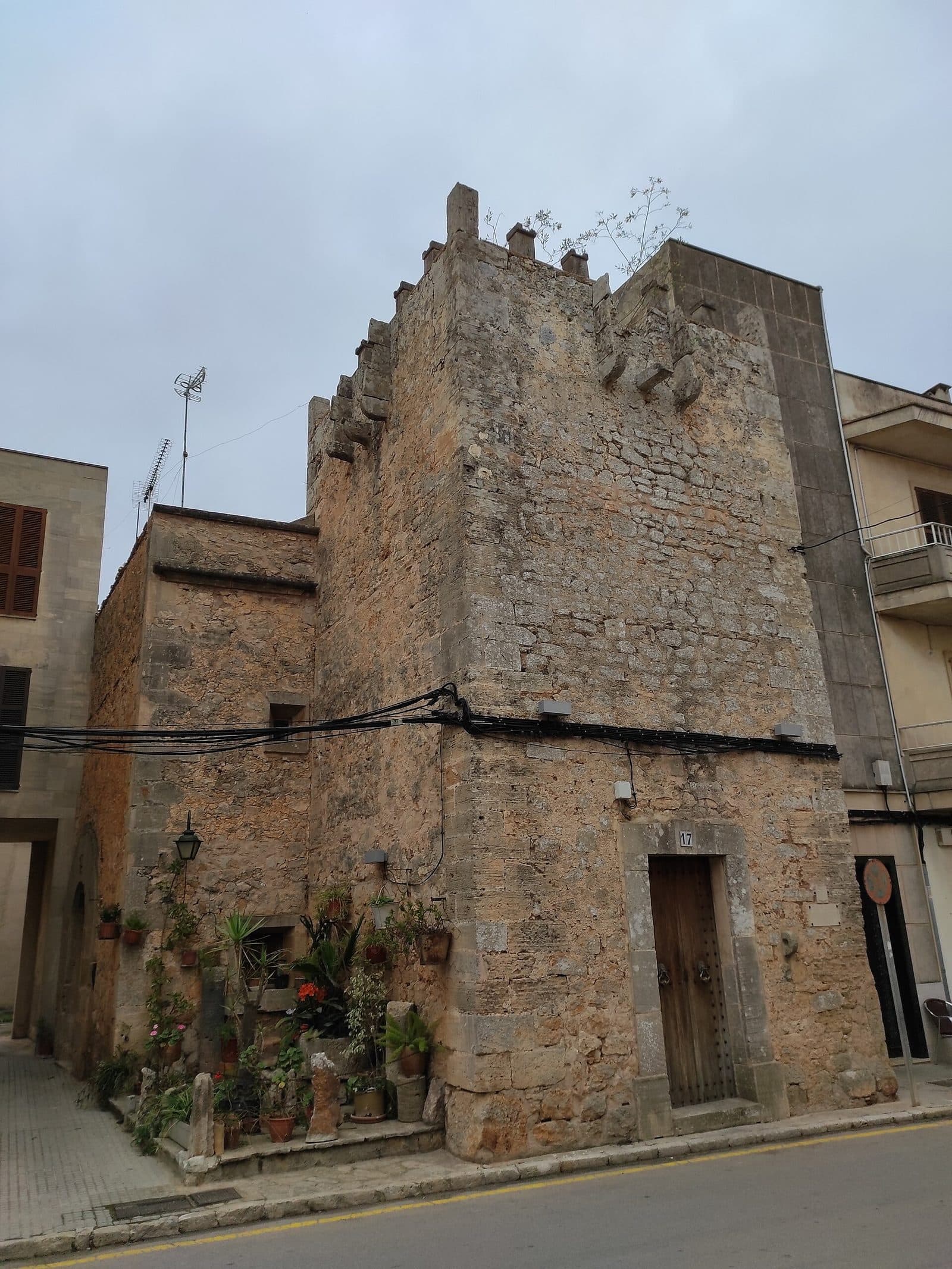

Ca ses Monges tells a quiet chapter in the local history of Ses Salines. The name roughly means “house of the nuns” and refers to a convent building erected for the Sisters of Mercy at the beginning of the 20th century. The house also included a girls' school. This combination of convent, education and religious life alone makes the site more than just another sacred building.
The house's chapel is particularly important. It was dedicated to the Sacred Heart of Jesus in 1913 and designed in the historicist style. Anyone interested in Mallorca's architecture beyond the major cathedrals and pilgrimage churches will encounter a building here that tells of the accommodation provided for the Sisters of Mercy, the girls' school and its religious use.
Ca ses Monges is particularly suitable as a stop on a cultural and historical walk through Ses Salines. The visit is not about monumental dimensions but about looking closely: the house's name, the former girls' school and the Sacred Heart chapel together create a vivid picture of the building's documented uses.
History and significance
The story begins not with a prestigious monument project but with a practical need: the Sisters of Mercy required a house in Ses Salines. Ca ses Monges was therefore built at the beginning of the 20th century as accommodation for the nuns. The Mallorcan name directly preserves this original purpose to this day. It describes the building not through a saint, a benefactor or a special location, but through its female residents.
The Sisters of Mercy
The story of its foundation places Ca ses Monges in a period when religious communities shaped more than spiritual life alone. The house served as both the residence and workplace of the Sisters of Mercy. The building also contained a girls' school.
The building's recorded purpose is crucial to understanding the complex. Ca ses Monges was not a secluded convent outside the village. Instead, the combination of accommodation, religious life and school points to a community whose work reached into the village. Ca ses Monges brought together accommodation for the sisters, a girls' school and a chapel.
The girls' school
The convent contained a girls' school. This part of its history makes Ca ses Monges a testament to local educational history. The building was therefore not only home to the sisters but also a place where girls were taught. Behind its walls, religious life and everyday school activities came together directly.
This detail is more important for understanding the site than a mere description of its style. Where a historic building stands today, there was once a girls' school. Ca ses Monges thus recalls the convent's connection with local educational history.
The chapel's dedication in 1913
The year 1913 provides a clear chronological reference point. That was when the chapel was dedicated to the Sacred Heart of Jesus.
At Ca ses Monges, the Sacred Heart chapel formed part of a house built for the Sisters of Mercy that also accommodated a girls' school. Residence, school and chapel were therefore combined in a single building.
Today, Ca ses Monges can primarily be understood as a cultural and historical monument. The house preserves the memory of the nuns, the former girls' school and a form of community life that helped shape everyday life in Ses Salines at the beginning of the 20th century.
What to see
The most important feature has a precise date and a clear dedication: the chapel dedicated to the Sacred Heart of Jesus in 1913. It is the architecturally and historically prominent part of Ca ses Monges. The rest of the house is understood primarily through its former function as the sisters' residence and a girls' school.
The Chapel of the Sacred Heart of Jesus
The chapel was built in the historicist style. Historicism means that a building deliberately draws on forms from earlier architectural periods instead of following only a new architectural language of its time. When viewing it, it is therefore worth appreciating the chapel not only as a place of worship but also as an expression of religious architecture at the beginning of the 20th century.
Its significance comes from the interplay between architecture and use. The chapel belonged to a house where nuns lived and a girls' school was located. Anyone visiting Ca ses Monges should pay particular attention to this close proximity between chapel, residence and education.
The dedication provides another layer of interpretation. The chapel was dedicated to the Sacred Heart of Jesus. This dedication is therefore not an incidental detail but connects the space with the history of its residents.
The house of the nuns
“Ca ses Monges” is a descriptive Mallorcan name. It draws attention to the building as the home of a community. When visiting, the complex should therefore not be judged solely by the standards of a large church. Its meaning lies in the combination of different areas of life under one roof.
The house provided accommodation for the sisters and contained a girls' school. This original purpose also explains the attraction's comparatively personal character. Ca ses Monges tells not of courtly prestige or military power but of everyday religious life and education.
During a tour, it is helpful to distinguish between the sacred function of the chapel and the practical function of the rest of the house. This makes it possible to understand how the complex simultaneously served as accommodation for the nuns, the site of a chapel and a girls' school.
The former girls' school
The school is one of the most important layers in the history of Ca ses Monges. Although the building is classified as a church or convent, its significance extends beyond religious history. The convent contained a girls' school.
Anyone standing in front of the building can therefore imagine the complex as more than just a convent. Pupils, lessons and educational work were also part of its recorded everyday life. This shift in perspective makes a visit especially interesting: an initially understated historic building becomes a setting for local educational history.
The three aspects—residence, school and chapel—should be considered together. Only then does it become clear why Ca ses Monges is more important to local history than its description as a small religious attraction might initially suggest.
Visiting Ca ses Monges
A visit is best started with the name. “House of the nuns” is not a later tourist label here but a summary of the building's original function. The complex can then be understood in a clear sequence: first the house as accommodation for the Sisters of Mercy, then the former girls' school and finally the chapel from 1913.
Before your visit
Current opening hours and admission conditions should be checked before travelling, as no permanently reliable information has been recorded. This is particularly important if seeing the chapel is intended to be the focus of the excursion. A historic convent or chapel building is not automatically open continuously like a museum.
The type of visit you want also matters. Anyone viewing Ca ses Monges simply as a stop on a walk through the village can already understand its historical function from the building. For an interior visit, however, you should clarify in advance whether access is possible and under what conditions. This helps prevent expectations of an extensive tour from conflicting with the building's current use.
How to understand Ca ses Monges
The visit itself requires less of a fixed sightseeing plan than a clear thread through its history. Although the chapel is the explicitly highlighted architectural element, the history of the school and the sisters is equally integral to the site. Anyone looking only for decorative details can easily overlook the house's significance to local educational history.
The most rewarding question is therefore not simply: What does the chapel look like? Equally important is why it was built here. It belonged to a house where a religious community lived and a girls' school was located. This context explains the distinctive nature of Ca ses Monges far better than viewing the sacred space in isolation.
A fixed visit duration cannot be specified because it depends on the access available. Anyone wishing to engage consciously with the local, educational and religious history should nevertheless stop for more than just a quick photo.
Directions and parking
The road directions initially lead only as far as Ses Salines. This is important because no separate, precisely documented access route to Ca ses Monges is available. After arriving in the village, the final section depends on the building's exact location and local traffic arrangements.
From Palma Airport
The road distance from Palma Airport to Ses Salines is 47 kilometres. The journey takes around 41 minutes and follows the Ma-19, followed by the Ma-6030 and the Ma-6014. These figures apply as far as Ses Salines, not directly to the entrance of Ca ses Monges.
The Ma-19 covers the longer initial section of the journey into southern Mallorca. The route then continues towards Ses Salines via the Ma-6030 and the Ma-6014. Once in the village, it is advisable to set your navigation to Ca ses Monges and observe local signs and any traffic restrictions.
From central Palma
The road distance from central Palma to Ses Salines is 53 kilometres. Allow around 51 minutes for the journey. This route also follows the Ma-19, the Ma-6030 and the Ma-6014. The stated journey time ends in Ses Salines; the final section to the building must be added depending on the chosen approach.
Anyone arriving by hire car should assess the parking situation only after reaching the village. A specific parking space immediately beside Ca ses Monges is not included in the confirmed directions. It is therefore sensible to plan a route that does not assume you can stop directly in front of the building.
By bus
The recorded bus stops in the surrounding area are Ses Creus 1 and Ses Creus 2, as well as Maria Antònia Salvà 1 and Maria Antònia Salvà 2. Which one is most convenient for a particular journey depends on the route, direction of travel and current timetable. The stop names should therefore be checked together with the destination Ca ses Monges when planning your trip.
After leaving the bus, the final section within Ses Salines is covered on foot. Because timetables and routes can change, it is advisable to check current information on the day of your visit. The advantage of arriving by bus is that Ca ses Monges can be incorporated into a walk through the village without having to search for parking.
Bus lines to Ca ses Monges at a glance
| Line | Route | Departures/day | First | Last |
|---|---|---|---|---|
| 517 | Santanyí - Colònia de Sant Jordi - Campos | 76 | 05:55 | 23:08 |
From the official GTFS feeds (TIB/SFM), no real-time data. The figures cover all stops in the town; weekend and holiday services differ — check with the operator before travelling.
Getting there by bus
Ses Creus 2 (59001) · 0.1 km as the crow flies
- 517Santanyí - Colònia de Sant Jordi - Campos · Daily
Ses Creus 1 (59002) · 0.1 km as the crow flies
- 517Santanyí - Colònia de Sant Jordi - Campos · Daily
Maria Antònia Salvà 2 (59012) · 0.6 km as the crow flies
- 517Santanyí - Colònia de Sant Jordi - Campos · Daily
Maria Antònia Salvà 1 (59011) · 0.6 km as the crow flies
- 517Santanyí - Colònia de Sant Jordi - Campos · Daily
Timetable data: official GTFS feeds (TIB/EMT), no real-time — check with the operator before travelling.
Nearby attractions
Ses Salines already carries its most important historical resource in its name. The name refers to salt production on the municipality's coast. Salt has been used in this region throughout many eras and continues to shape the village's identity today. Ca ses Monges reveals a different, more recent layer of the same local history: religious and educational life at the beginning of the 20th century.
Ses Salines
The village is ideal for a walk in which Ca ses Monges is not treated as an isolated destination. The house for the nuns, the girls' school and the chapel all belong to the village's history. The attraction tells of a religious community in Ses Salines, not of a secluded monastic world.
Ca ses Monges can serve as a thematic focus: the building represents the accommodation of the Sisters of Mercy, a girls' school and the chapel dedicated in 1913.
Els Antigors
The Talayotic settlement of Els Antigors provides an addition that reaches far back in time. Remains of a prehistoric settlement survive there. Comparing it with Ca ses Monges reveals the enormous span of settlement and cultural history within the municipality, even though the two sites are not directly connected historically.
This contrast is especially revealing as a combined visit. Els Antigors leads into Mallorca's prehistory, while Ca ses Monges explores the convent and school history of the early 20th century. Together, two manageable stops create a broad journey through very different eras.
Salt pans and Colònia de Sant Jordi
Towards the coast, the municipality's history continues with the salt pans. Salt production gave Ses Salines its name and is fundamental to understanding the region. On an excursion to Colònia de Sant Jordi, this landscape and economic background can be combined with the cultural and historical visit to Ca ses Monges.
The coastal beaches can also form part of such a day. Ca ses Monges should not be viewed as an alternative to an excursion into nature or a beach trip, but as a quiet historical introduction or conclusion. The house adds a less visible story to the familiar image of southern Mallorca: the accommodation of the Sisters of Mercy and the girls' school in Ses Salines.
The place it belongs to
Ses Salines in the place guidePractical visitor information
The key is to assess the character of the site correctly. It is a historic house with a history as a convent, school and chapel.
Check access in advance
Anyone specifically wishing to see the chapel should check current access before visiting. Reliable general opening hours and admission details have not been recorded. Arriving spontaneously with the expectation that an interior visit will always be possible may therefore lead to disappointment.
Ca ses Monges remains interesting as part of a cultural and historical walk through Ses Salines. The building's recorded functions already allow it to be understood clearly. The chapel from 1913, the accommodation of the Sisters of Mercy and the former girls' school together form the core of the visit.
Visiting with children
For children, Ca ses Monges can be presented particularly effectively through the former school. Instead of explaining only architectural terms, the visit can begin with the question of what lessons in a house containing a girls' school might have been like. It is documented that the convent contained a girls' school; more extensive reconstructions of everyday school life should not, however, be presented as fact.
Because neither a children's programme nor an exhibition is documented, the building is better suited as a short historical stop within a more varied excursion. Combining it with a village walk, the coast or the prehistoric remains of Els Antigors creates different points of interest.
Avoid confusion over the name
The name Ca ses Monges appears in similar forms several times on Mallorca. Here it refers exclusively to the convent and church building near Ses Salines. Houses, car parks, cafés or institutions with the same name in other places are not part of this attraction.
When using navigation, you should therefore always check that Ses Salines is selected as the destination. This is particularly important if a search function uses only the name “Ca ses Monges.” Specifying the correct place prevents a route from leading to a namesake in another municipality.
Local insider tips
Keep all three functions in mind
Ca ses Monges is best understood when the building is viewed simultaneously as the home of the Sisters of Mercy, a former girls' school and the site of the Sacred Heart chapel.
Note the dedication
The chapel was dedicated to the Sacred Heart of Jesus in 1913. This dedication fits the role of the Sisters of Mercy and connects the house's architecture with its use.
Combine it with Els Antigors
Ca ses Monges and the Talayotic settlement of Els Antigors represent two widely separated eras in the municipality: prehistoric settlement and religious educational work in the early 20th century.
Include Ses Salines in your search
Several places with similar names exist on Mallorca. When using navigation, always check that Ca ses Monges in Ses Salines has actually been selected.